Katherine McKittrick argues for us to become “implicit to a creative-intellectual project of reimagining what it means to be human and thus rearticulating who/what we are.” Silvia Wynter traces how racial-sexual-economic categories have been made, remade and disrupted, often in relation to geographies, which, she notes, are unfinished. McKittrick suggests that any vision of the future must be acknowledged in terms of knots, threads and unwindings of histories and narratives in relation with one another. In this endeavour, human stories become collective self-inscriptions, necessarily and vitally adaptive to ecological and geopolitical situations.
In this essay, I want to remain with Wynter’s socio-spatial realm, focusing on the panellists at “The Lost-and-Found” symposia in Lisbon (December 2023), Warsaw (March 2024) and Riga (June 2024) where I hosted artist-academics panels. Concerned with social justice, particularly the ways in which histories of marginalisation and exclusion offer scope to challenge tropes such as exceptionalism and exoticism “afforded” to non-Western women artists, I want to return to the threads, strings and ropes that form the knots, moving from their structural properties to derive a language for speaking into practices and thinking outside of such tropes. This is to foreground inclusion and an expanded notion of what it means to be in community, and in this sense consider what it might mean to unwind knots and spin new threads.
Such a material-spatial approach sets out to consider the soil, the body, the theories and histories that define socio-spatial paradigms. It is also to approach the traditions of space-making as unresolved and unfinished and thus utterly alterable. I am concerned here with creating space for a fuller sense of human ontologies. This foregrounds a resistance to fixedness and singular narratives, in favour of plurality, malleability and mutability.
Introduction
In Sylvia Wynter: On Being Human as Praxis, Katherine McKittrick argues for us to become “implicit to a creative-intellectual project of reimagining what it means to be human and thus rearticulating who/what we are.”[1] Wynter traces how racial-sexual-economic categories have been made, remade and disrupted, often in relation to geographies which, she notes, are unfinished. McKittrick pays attention to the repetitive displacement of the planet’s non-white non-male subjects, suggesting that any vision of the future must be acknowledged in terms of knots, threads and unwindings of histories and narratives in relation with one another. In this endeavour, the human stories (his-, her-, its-, their-) become collective self-inscriptions, adaptive to ecological and geopolitical situations.
I want to remain with Wynter’s socio-spatial realm, drawing on McKittrick’s proposal, focusing on the panellists at “The Lost-and-Found” symposia in Lisbon (6–7 December 2023), Warsaw (March 2024) and Riga (June 2024) where I hosted three panels comprising four artist-academics. I want to return to the threads, strings and ropes that form the knots, moving from the structural properties of their formation to derive a language by which to speak into practices and thinking outside of stereotypes. This is to foreground inclusion and an expanded notion of what it means to be in community, and in this sense consider what it might mean to unwind knots and spin new threads.
Following Wynter and McKittrick, such a material-spatial approach sets out to consider the soil, the body, and the theories and histories that define socio-spatial paradigms.[2] It is also to approach the traditions of space-making as unresolved and unfinished and thus utterly alterable. I am concerned here with creating space for and representing a fuller sense of human ontologies. This foregrounds a resistance to fixedness and singular narratives, in favour of plurality, malleability and mutability. Shapeshifting, if you will.
This essay emerges from a series of symposia that took place between December 2023 and June 2024, titled “The Lost-and-Found”, hosted by a team of academics based in Lisbon, Wrocław and Riga. As a travelling concept, the themes and participants changed across the three locations, with some attending all three and others joining the travelling caravan, making for an expanding, nomadic community. The participants were recruited through open calls and invitations, while presentations were intentionally short to support deeper conversations between panellists and conference participants.
For the first panel, “Unmaking—the peripheral space of curiosity” (Lisbon, 7 December 2023) panellists were invited to take the concept of curiosity and adaptability as a means by which to think carefully about how we might inhabit the underside of what it means to be human. Collectively, this became a conversation about unmaking and the curiosity that unmaking demands if it is to become something by which to think and act beyond the violent actions of exclusion and exclusionary thinking. Curiosity is a peripheral practice, and like unmaking is often unseen, hidden, part of the process towards making or forming something. It becomes an ecological practice and thus a means by which to imagine new ontologies, pedagogies and ways of being in community.
In the second panel (Warsaw, 23 March 2024) the concept of unmaking became expanded under the title “Undisciplined Practices—on unmaking as praxis”. Here we were asking questions about what happens when we take up un- or ill-disciplined practices and methodologies. Such an approach could be said to make explicit a creative-intellectual model that allows us to reimagine what it means to be human, a re-articulation of who and what we are and why and how we might be in community. This is speculative and potentially fictive theory-building that privileges the dynamics of flesh, humanness and the materiality of our bodies in the world. Approaching the self in this way allows us to be with its messiness, interruptions, chaos and fragmentation, moving away from dominant narratives of logic and forward-thrusting development in favour of uncomfortable, generative rhythms that move forwards, backwards, sideways and at a tangent—modes that are unruly and badly behaved.
In the final panel (Riga, 7 June 2024), the panellists explored the agency of undisciplined practices, using the title “Beyond the Vulnerability of Being Lost”. The discussion focused on how to express the vulnerability of being lost through material practices and what that means. For those on the move, displaced intentionally or by force, carrying their belongings, there is the constant risk of becoming detached from themselves and their sense of belonging. And yet, vulnerability is a socio-political construct of containment. If one can move towards living an undisciplined life outside of the dominant critical dialogues that create such constraints, there is scope to negotiate a new kind of resilience that is agential and powerful and that brings new notions of being in community. In rethinking vulnerability and resistance to existing and restricting frameworks, following Judith Butler, I want to think of undisciplined practice, where agency is taken up by the vulnerable through acts and actions of being vulnerable, making oneself vulnerable.[3]
This essay travels with the three panels and the symposia seeking to look at the knots, threads and unwindings of histories, narratives and geographies, at how they become an ecosystem built across time and space. Each discussion set the direction for the next and therefore I am deeply grateful to the panellists and symposia participants for helping to shape this essay, for their generosity and openness to think outwards.
Lisbon—Unmaking: Peripheral Spaces of Curiosity
Looking back across the triptych of panels, the first becomes a sort of extended prologue, establishing the conditions for conversation. Where curiosity fuels conversation, it allows it to function as a narrative form that extends, loops, entangles and re-tangles. This is to say that it becomes a form of thinking-in-process at the periphery of the (un)known. Unmaking presupposes that making is an impermanent situation, where actions and forms formed can be readily unpicked, broken, worn through, establishing the labour of production as implicated with its destruction or dismantling. This is a realisation of living that emphasises its precarious relational nature, or in the words of Wynter, “[w]ords made flesh, muscle and bone animated by hope and desire […] and the maps of spring always have to be redrawn again, in undared forms.”[4]
The panel opened up a space for drawing and re-drawing new “maps”. In this, we collectively created a labour-space for the knots, threads and unwindings that allows for losing and becoming lost that does not prioritise finding but seeks to establish the realisation of living as a curious space of becoming and remaining lost.
I was joined in this panel by three artist-writers—Paula Chambers, Madara Kvepa and Dominika Kemila—who are based in the UK, Latvia and Sweden respectively. Where Chambers’s artworks function in a place of refusal between private and public, domestic and wild, conceptual and physical, Kvepa explores the boundaries of “natural sites of significance” within Latvia, creating mediated, slow, ritual-like performances and reaching towards an embodied experience of the ontological value not just of these specific sites, but of nature itself. Kemila drew on the conference participants to create collaborative readings of NKVD archive records collected from the Russian memorial database to produce evidence and validation of genocide, establishing witnessing as a peripheral, relational situation based on trust. My own paper focused upon seaming as a means by which to open up what happens in the space created by repeated actions and the revisiting that repetition necessitates. The concept of edges, boundaries, making and unmaking became sites of unknowing and curiosity about what sits beyond the encounter.
Across all four contributions and the conversations that flowed from them with the assembled community, it became evident that the holding mechanism of the seam could act as a curiosity-driven metaphor or syntax for exploring these sites of impermanence and contingency. Where the seam joins by repetition, it also becomes the site of its own undoing. These two sides of the seam offered scope to think with Chambers, Kvepa and Kemila about how to inhabit the underside of humanness and what it might mean, to become curious about what lies beneath and to ask how this impacts and affects what occurs on the surface. As the seam allowance is formed, the space underneath the seam is where the two raw edges come into intimate proximity, causing edges and loose threads to mingle, creating new spaces for interrelationship.
Making a Seam—Crafting, Revisiting, Re-placing
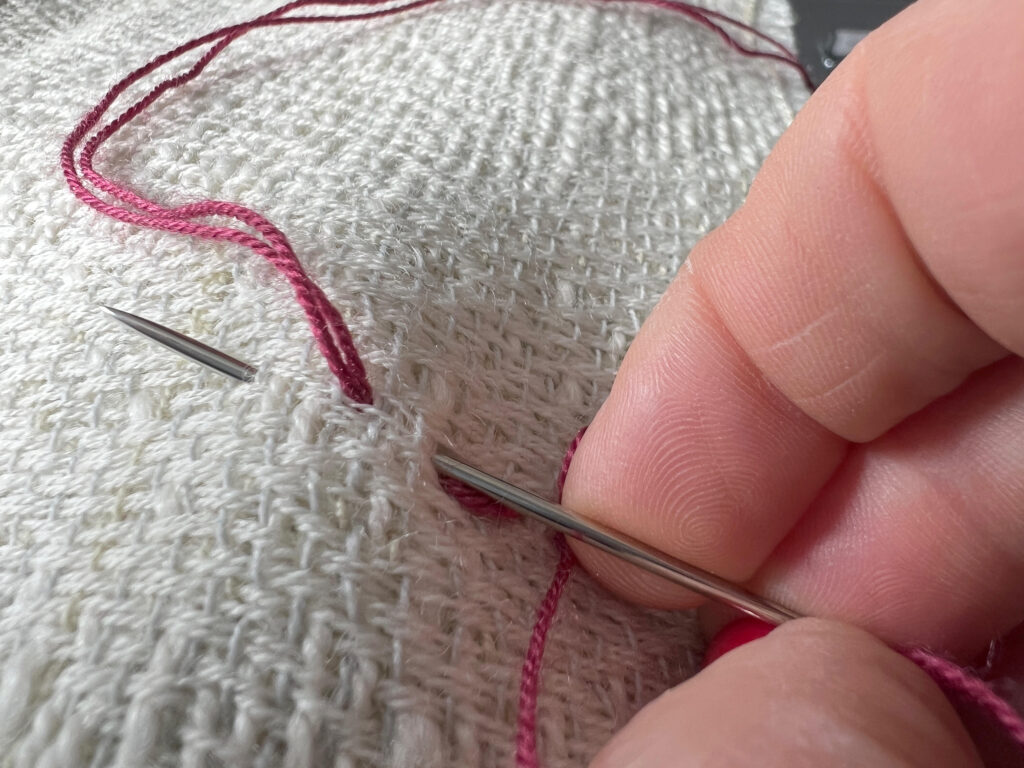
Seams join pieces, holding them in close relation. The stitched seam performs this by the action of needle and thread passing to and fro through layers of fabric: a row of continuous stitches near the edge. At the same time as joining two pieces to create a new whole, a separation is created between the external continuous surface and the internal seam allowance where the edges are brought together. Thus, the elements of a stitched seam are needle, thread, fabric, stitch, seam allowance and formed outcome. Each of the elements brings its own histories and purposes to the performance of the seam, but also interrelations between them. A needle, with its eye empty, asks for a thread; thread cannot pass through the fabric unaided. Needle and thread form an even, semi-permanent join that can withstand daily usage over an extended period of time.
The process of making a seam is one of actions repeated, spaces re-visited. As needle and thread pass through the layers of fabric, the needle’s point pierces the structure and is forced through the hole formed. The thread follows, dragging through and leaving fibres around the edges of that hole. The needle then moves along the line of the seam, repeating this action. The backstitch is most commonly used for seams; it loops back and forth to strengthen, but the extra line of thread seen on one side of the seam functions as a lamination, holding the two pieces of fabric securely and creating a smooth seam.
These two sides of the seam offer scope to think about how to inhabit the underside of humanness and what it might mean: what lies beneath impacts and affects what occur on the surface. When thought of in these terms, we are returned to McKittrick’s call to become implicit to a creative reimagining of what it means to be human. We become cloth, edges, threads, seam and seam allowance, above and below the surface. This is a praxis that is predicated not upon the individual, but on plurality, to being in community with others.
Gregory Bateson refers to societal systems within which the individual must navigate themself, but if considered from the side of the community, as a conversation that can loop to and fro, back and forth, mingle and unmingle, it is like the needle, thread, fabric and fibre do in making and being a stitched seam.[5] Each of these elements contain within them the labour of their production, often violently made, and there certainly is a violence held within the forming of the seam itself as the needle is forced through the fabric and the thread is dragged through the hole formed. This is to say, there is what Doreen Massey describes as,
the power geometry of it all; the power geometry of time-space compression […] the point concerns not merely the issue of who moves and who doesn’t […] it is also about power in relation to the flows and movement: some people are more in charge of it than others; some initiate flows and movement, others don’t.[6]
This is the system of coloniality and patriarchy and gives citizens and non-citizens their allotted place within society. What the seam offers is a reassertion of a conversation-framed narrative. Here spaces and sense of place become centred in what McKittrick refers to as “knotted diasporic tenets of coloniality, dehumanisation and resistance; this is a sense of place wherein the violence of displacement and bondage […] is given a geographic future.”[7] McKittrick specifically refers to a Black sense of place and the production of blackness itself. She urges us to remember that blackness has produced messy and uncomfortable present geographies that form the roots of entangled common histories.[8] This entangled, knotted root system sets aside the notion that those on the underside of humanness come to this situation differently to those on the upper side. They are apportioned this location by the self-same systems.
Massey and McKittrick’s “power geometry” and “spatial geographies” offer scope here for thinking through the seam as performances of the seam-as-conversation, a dialogic model based upon curiosity about, and with, the other. The seam-as-conversation offers a space of resistance to the linear tale of white survival, resistance to appropriation and codification that seeks to “fix” the plight of the other. As Butler notes, if we render people vulnerable, we can be accused of loading them with a need for us to rescue and support them.[9] If we enter into dialogic, conversational relationship with them instead, as in the seam allowance, our collective frayed and fraying edges can co-mingle.
However, before moving on too swiftly to think about what this co-mingling conversation might involve and produce, I want to spend some time considering the seam, particularly its inner and outer workings. What we see in the seam structures is an outside that is smooth and allows differently shaped flat pieces of fabric to articulate in response to the body. A sleeve functions across the shoulder because of the ways in which a convex curved piece of fabric is attached to a concave curved piece, with as a result that the outer surface is a smooth sleeve cap. The inner workings of the seam are rather messier: raw edges trimmed and snipped to reduce bulk, all efforts to ensure the surface is smooth. Thus it is with the structures that render some to the underside of humanness: the actions and performances that make this rendering possible also strive to ensure it is perceived, by those on the upper side at least, as desirable, necessary even. The snipping and trimming of the seam allowance, the stitching of different curved elements together to create a covering form are all spatial, political and colonial activities against particular groups. But for those individuals, those on both sides of the seam, there is a deeply personal aspect as needle and thread pass through: I am free because I deserve to be free, they are not free because they do not deserve to be free.
In the event of the panel presentations and ensuing conversation with the conference participants, the flow of associations and dissonances became that edgy, thready seam allowance and emphasised the way in which an ecosystem relies on them to balance and re-balance itself. Where Chambers’s interventions and ferality moved into vision and drew attention to themselves and the notion of what it means to resist spoken and implicit societal norms through their disruptive placement and forms, Kemila took the panel into a peripherality that entered consciousness through the poetry and rhythms of co-reading lists of names, alleged crimes and dates of exoneration. As the assembled group fell into rhythm with one another, Kemila changed her pace and volume, offering dissonance, preventing an easy aesthetic sound. This disturbing at the edges from both artists, one through playful acts of (re)locating printed fabric pieces within the conference spaces, the other through vocal disruption, restlessly drew attention to the other in those disturbances in the slippage between the two. Kvepa’s work in the landscape, durational and somewhat devotional, picked up this space of slippage, creating a language of slow change and intergenerational narrative through a series of sacred natural sites that she visited and revisited. In this triad, held together loosely by my own mediation upon seaming and making seams, spaces of balance and rebalance appeared as we found points of interplay and then difference. This is the nature of an ecosystem, and it is necessary here that the restlessness, the provisionality offered within and between these papers and the art practices remain as sites for dialogue with one another, for seaming and unseaming, for fraying and stitching.
Warsaw: Undisciplined Practices—On Unmaking as Praxis
To think of seam-as-conversation is to think of the set of actions of joining pieces of fabric together with the structures that emerge from the actions. In this small, intimate space that often sits directly against the body, the edges of the fabric are raw unless finished with an overlocker or so-called French seam (I will return to this shortly). Thus, a space is formed in which frayed and fraying edges mingle and form a knotty space where the two pieces of fabric are, to some extent, indistinguishable from one another.
To think of seam-as-conversation is to focus upon what the seam allowance does both within its construction and its undoing. In the tangling, knotting and looping within the seam allowance is a space for engaging with other(s) at the periphery of the self. When we think about those who live at the margins of social spaces, we are to some extent also discussing those who have been dispossessed or incarcerated in some way, sometimes both. By placing people materially and/or conceptually at the edge, where the fabric is fraying, we are also performing an act of revealing the structures of the community within which they are the underside. Gyatri Spivak talks about this in terms of language, suggesting that where language frays and breaks down and thus becomes inadequate for expression, the structures of its formation are revealed. She goes on to discuss this in terms “spacy emptiness”, where meaning can “hop in”.[10] Building outwards from this idea of the edges breaking down, there is scope to be alert to, and curious about, what is happening when fabric starts to fray. Firstly, the structure of the weaving can be more clearly seen as warp and weft threads start to pull away from one another, but the fabric is also placed in danger of destruction.
When cloth is woven, warp and weft are pushed into proximity with each other, where rows of weft threads are introduced to the warp alternately over and above. This structure is held together by the thrusting of thread upon thread and by the way in which the warp thread is wrapped around the outer edges of the fabric as the shuttle enters and exits the loom. This edge, the selvedge (literally self-edge), creates a stabilising force that gives the fabric its integrity. Which is why, when the cloth is cut for tailoring or sewing, the edges of the pieces are no longer held fast by that selvedge and over time will fray and pull apart unless some intervention is put in place to prevent it.
Spivak, who speaks about language in terms of translation and thus about ways in which bringing two or more languages into close conversation, highlights how the exchange of meaning across these languages can be fraught and frayed. In the act of translation, meaning that sits beyond the mechanics of sentence construction and individual word usage becomes a space for curiosity and often requires a re-imagining of what is being said so that the meaning can be made in both languages and their cultural contexts. This reflection causes Spivak to note that “language is not everything”, but rather is the structural framework for meaning.[11] She recognises language and translation as an interwoven construction, where rhetoricity is found not in the woven piece itself but in the generative act of weaving and in the frayed threads at the cut edges of the fabric. These are generative acts that produce both the fabric and the in-between of language that I want to pursue here within the unmaking of the seam allowance.
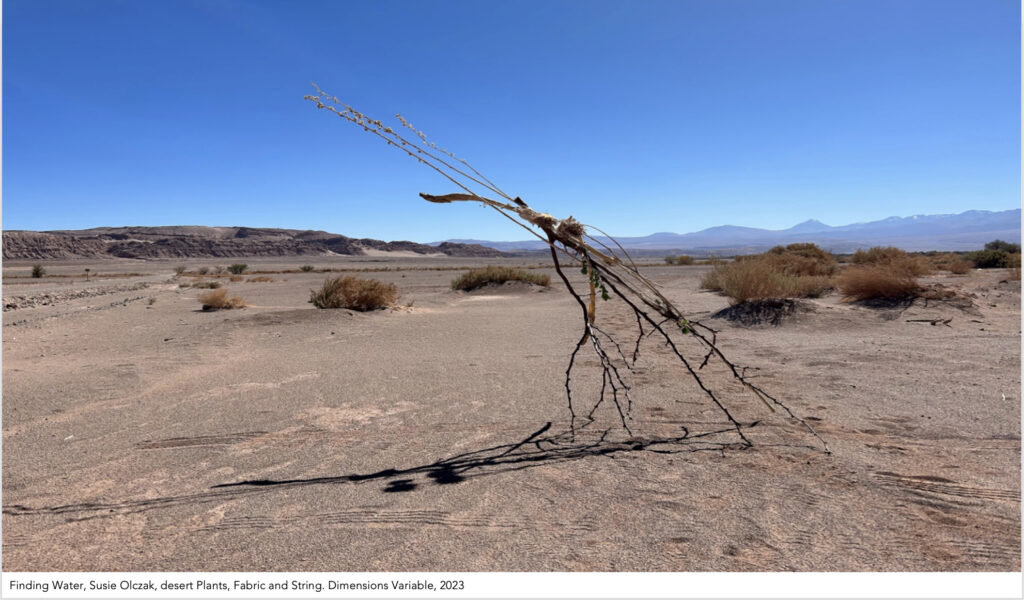
In the panel in Warsaw I was joined by Dellores Laing, Paula Chambers and Susie Olczak. Laing directly unpicks as a research methodology, seeking to understand the mostly hidden labour of constructing military uniforms and thus open up a slippery mode of practice within the seams revealed. Olczak, likewise is interested in processes of making and unmaking as an iterative process that moves between archiving and sheltering by which to give material presence to the Anthropocene within and with communities. Chambers continues the dialogue with found items, thinking about the alterity of ageing through a performance with a virtual assistant, and the notion that ageing is an undoing of youthfulness that can be halted with the right potions.
The panel discussion wove itself materially through Spivak’s notion of erasure within language and translation, highlighting how undoing and unmaking offers an intimate space of co-fraying as a way for thinking about communities that are erased or excluded from cultural structures. They are not simply erased or absented; in many ways these communities and individuals become deeply functional aspects of culture, even in their absence. Therefore, to speak from the unmaking of the seam allowance is to speak together with those on the underside of humanness, recognising their importance in revealing cultural constructs and calling attention to their apparent erasure.
In this way, the panel became a seam-as-conversation, making present those who were absent and made absent, opening out to a space that enabled the voices from within the seam to become active agents. This is to make a call for a way of working across different sites, knowledges and histories in order to undo and challenge colonial logics that thrive upon owning, possessing, having, excluding and extracting. To be in conversation is to engage in active listening and to commit to hearing that which is being articulated, not from the positionality of the self, but from the positionality of the other(s). In this it calls to mind Hannah Arendt’s concept of “enlarged mentality”, a mode of being in conversation with others that involves “training one’s mind to go visiting”.[12] This also involves curiosity at the edges of the self and of the other(s). This is about thinking within the seam allowance, where language and meaning fray and mingle. This is about ensuring that which lies beneath the surface is attended to with care and compassion. This is about thinking with those who are cast into the underside of humanness and engaging in conversation about erasure, absence, presence and the lived experiences of these actions.
McKittrick writes that living as part of this underside is to live within an unmeasurable dehumanising space.[13] It is this system that the seam-in-conversation seeks to address and that uses curiosity as a means by which to unpick it, to understand how it came to be formed and to restructure both its meanings and methods of meaning-making. The seam can be set as a form of commons, a culturally rich resource that is shared across communities actively seeking to remove power structures and hierarchies.
Seaming-as-conversation is not only about drawing together, but also about how those voices and perspectives are held in active tension through the seam. A seam in a garment allows for the different pieces to be articulated across the body, something Laing’s broader research unpicks, literally, revealing how the cloth pieces can have their rigid or stretchy grain positioned accordingly. Likewise, the grain of the dialogue between the three artist-speakers in this panel pulled at each, noting where it stretched and where it held. For Chambers, the play between material and digital came into dialogue across the notion of artifice, at once functioning within Laing’s unstitching and pulling away from notions of manual labouring. Olczak brought into the dialogue the slippage between making and unmaking, using found and made materials within remote community settings, drawing attention to the vulnerability and temporality of the seam while also serving to create its memory in the actions and activity of making artworks in community. Thus, the seam itself and its making became a site of both dissonance and potential resolution. Much like conversation, the importance lies in mutual engagement rather than output, the ecosystem derived through seaming as conversation is not dominated by the joined pieces, but by what occurs in and around the seam and what the seam allows differences to reveal.
Riga—Beyond the Vulnerability of Being Lost: Undisciplined Practice as Agent
The final panel suggests a return to what might be a process of making and remaking of the commons. This involves taking a feminist perspective to commoning that pays attention to everyday practices, social relations and spaces of creativity and social reproduction where people come, share and act together.[14] This notion of making and remaking of the commons and communing is interesting here as it offers scope for thinking not only about the everyday but also for approaching this space with curiosity about what it means to unpick it, how this reveals meaning formed in its creation, and thus what it might mean to remake it.
As I mentioned earlier, the seam is an impermanent feature in constructing items from fabric. While cutting and seaming leave their mark, seaming can be undone, unpicked and individual pieces can be separated. To do this involves untangling the frayed edges within the seam allowance, that space of conversation and co-mingling, and returning them to their original fabric piece. The underside becomes removed, as does the conversation and interaction that the seam invokes. In commoning, this seaming, unpicking and re-seaming has the potential to enable new conversations within the seam allowance and sometimes a re-visiting of previous conversations. It requires a re-opening of the mind; curiosity in the seam and at the edges is a vital element of such commoning.
If we take the commons as processes that re-signify a politics that is performed by ordinary people in everyday interactions and not by expert politicians, it means that it is all the things people do in their neighbourhood, their town, their country or in alliance with others in other countries to change their everyday reality that is imposed by those who have the power, under the principle of direct democracy, co-participation and mutual sharing. This involves thinking about who makes the elements that enable seaming to take place, who undertakes the labour of making a seam, who unpicks and then re-seams. This is vital work in commoning and it is communal work if it is to make the kinds of change for which it has the ambition.
Thinking in material terms initially, this returns us to thinking about the methods and processes required to form a seam that joins two or more pieces of fabric, but this time in terms of the people and their labour that makes this happen. Thread for weaving and for sewing is spun from fibres, a process that involves twisting and twining so that the kinetic energy created holds them tightly together, making them strong and resilient. In the era prior to the European Industrial Revolution, spinning was done manually and dictated the rate at which weaving produced fabric. With the growth of empires and transglobal trade, sails for ships were needed in greater quantities and spinning became a task that simply needed to be sped up. The Spinning Jenny enabled thread to be produced at speed and thus fabric production could be increased. Here I am interested in thinking through the labour-space of the seam in terms of the shared labour of producing fabric, thread and seams for everyday usage, for clothes, sacks, ship sails and domestic cloths. I am not talking about craft practices but rather setting this mode of production as a form of communing, which follows Massimo De Angelis, who states that “commoning is doing in common”.[15] This takes a Marxist approach, in which commoning is social labour and involves modes of production, distribution and governance of the commons and through this establishes a form of non-hierarchical relationships between the members and their activities or labours. Commoning thought as an ecology of labour allows for De Angelis’s process of bringing together “bodies, the affective and social relations” that make up the community.[16]
If we apply this thinking to the labour-space of making and unmaking seams, we enter into a space of activities and actions that bring into being a range of materials from the same starting elements, allowing each to take on their own role within the community of what we might call “sewing”. As the seam is formed between the parts, through the action of some fibres that have been spun and woven, and some fibres that have been spun and threaded into the needle, hierarchies and power structures become undermined in favour of a more subtle, discursive ecology, a balancing and shifting of emphasis across the period of production. In this labour-space it remains important that the structures formed can be unpicked and unravelled, the whole is held together temporarily, the seam allowance mingles and intertwines but can be re-separated and a new join or seam formed in which different conversations can occur. Commoning requires this provisionality, this contingency to hold its valence, but also to refute traditional hierarchical governing structures and thus the exclusionary activities that position some on the underside.
Thinking of seaming as commoning is to establish a rebellious space in which making, sharing and listening—that is, conversation—are rebellious activities entangled with one another. The seam, thought of in this way, has the potential to bring attention to power-based systems by exposing their inequities and limits, while engendering communal belonging and collaborative acts. It is through this shared labour, in which the actions and activities can be re-organised and re-peated, that a space for re-imagining what it might mean to be in community can emerge.
In the panel in Riga I was joined by Sohaila Baluch, Madara Kvēpa, Paula Chambers and Julie Marsh. Baluch’s practice operates at the threshold of discomfort, reluctance and autoethnography, drawing attention to what happens when the narratives of British women of South Asian descent are made visible, how their distinctive liminal lived experience can speak into dominant identity politics and discourses. Kvepa returned with an extension of her meditations with and within natural sites of cultural significance in Latvia, extending her focus to how these sites and their natural materiality impose themselves upon both the landscape and communities who are drawn to them. Marsh also works with site, specifically repurposed secular sites for worship by migrant and minority communities across Europe; she deploys the term “site integrity”, which involves co-constructing documentation and representation that reveals how these groups navigate the challenges to being community they encounter. Finally, Chambers, who journeyed to all three conferences, returned to the notion of ferality as a feminist activist practice, materialising found items as artworks to bring their “thingness” to its extreme.
The dialogic space created by and with these four brought into being a way of thinking about what it might mean to be lost and found that foregrounds vulnerability. This was intensified by their focus on tangible, experiential and corporeal aspects in their practices, while they also signalled transformative thresholds that can facilitate new and significant interactions. As the panel discussion developed, the community formed by the extended nature of “The Lost-and-Found” symposia offered a series of exchanges, a deepening understanding of how shared cultural narratives, collective memory and individual subjectivities can fray and intertwine and thus offer space for new paradigms of home and belonging to emerge. These move beyond the vulnerability of being lost and become vital amid the currents of evolving diaspora and shifting societal norms.
A dialogic space is an ecosystemic approach to thinking about what it might mean to be in community. It is to allow for being lost and finding repeatedly, iteratively and collectively. It is also to bring to the foreground the dissonance within that dialogue. Where Chambers focused on the “thingness” of the found objects through a temporary and perhaps false form of rehabilitation, Marsh took on repurposed sites now used for worship as a way to explore and reignite the architectural and community interplay. Longevity and suspended temporality are vital to both practices, but where Marsh grounds and confirms ways in which the architectural and worship spaces become embedded within the community of practice, Chambers’s feral objects constantly threaten to become absent once again. Similarly, both Baluch and Kvepa focused on durational practices, meaning-making through being with the material and in the action of making for long periods of time. However, where Kvepa’s practice drew attention to the ways in which the sites of practice become increasingly imbued with meaning, Baluch used the durational to speak of the pain of colonisation and the overbearing historical and generational pain endured. The speakers each pulled at the edges of their own and each other’s material practices, making meaning at these fraying edges, troubling the loosened threads. This is an ecosystem that is necessarily vulnerable and, in that vulnerability, charged with meaning and the potential for new meanings to be made within its dialogic framing.
Losing and Finding
Through these three panels, I wanted to explore a re-imagining of community and what it means to be in dialogue across time and space. What I found involves the possibility and labour of unpicking, re-forming, patching and piecing. That is to say, the seam that forms the structure must necessarily be a temporary join, the seam allowance is a space of mingling in the present, a present that might inform the future and speak across the past but is not fixed nor indisputable. What this means in terms of the labour and action of unpicking that seam is important here in terms of the ecology of labour, but also in terms of the nature of the conversation taking place.
When a seam is unpicked, the threads joining the fabric pieces can either be cut at each stitching point or the action of stitching reversed and the whole thread removed from the fabric by pulling it back through the holes created. The latter process is labour-intensive but renders the stitching thread whole and potentially re-usable. Its form will be changed through the act of stitching and unpicking in that its length will have been dragged to and fro, firstly through the newly formed holes as it follows the needle and then in the act of being in the seam as the item is rubbed and pressed, washed and worn and then, thirdly as it is released from the seam and dragged in reverse through the holes. Each part of this lifecycle will cause some frottage of the thread. The threads that tangled and mingled in the seam allowance are now released from one another, but still hold within them some of each other’s fibres, knowledge of that shared and intimate existence.
In terms of the labour-space of unpicking, it must also be noted that the unpicker may not necessarily be the original stitcher and almost certainly not the spinner and weaver. This sets unpicking as a collaborative work that has the potential to disrupt and change the rules within power-based systems through this collective action. The seam acts as a challenge to the grand power structures and the monuments to their leaders with its uncertainty and impermanence. Unpicking it establishes a form of guerrilla projection of what can happen to such structures if they are not formed through communally shared actions and activities. David Graeber, the late anthropologist and activist, spent his life making the case that humanity has always been experimenting with new ways of being. In this he made the point that our collective histories are not straight lines, they cross, re-cross, join and depart from one another.[17] We could conceive of humanity as a series of fabric seams, unpickings, repositionings and new seams being formed through the labour of its communities. Power structures come and go, institutions rise and fall, authorities of all kinds have their moments and then wane. What matters and endures is people doing things together. Graeber frequently noted that “the ultimate, hidden truth of the world is that it is something that we make and could just as easily make differently.”[18] In making a seam, we make a temporary, provisional join between two pieces of fabric, together with a surface, seam allowance and stitched line of thread between them. This allows us to create forms that cover the shoulder, the arm, the torso, the sofa, the chair and to create shaped sails to best catch the wind. The seam’s ecology is one based on the labour of production, human labour deployed in a communal act of social and cultural production. To unpick that seam is to lose and loosen the structure, to open up scope for re-imagining how and why the parts fit together; how and why they might be re-joined. This is a form of losing and finding, which challenges structures of knowledge and knowing in which the known becomes a permanent space, refutes a space in which the communal labour of production is lost to such knowledge and rebels against a system in which the one who holds the final part that brings the knowledge into the light is the one honoured with its creation.
Conclusion: An Ecosystem of Feminisms
On a trip to Paris in 2023, I had the opportunity to see an exhibition of Faith Ringgold’s artworks in the Musée de Picasso, “Black is Beautiful”. What struck me as I revelled in these bold and detailed works was the ways in which she patched and pieced elements, re-ordered narratives and set her viewer to make their own sense of the works, to stitch and re-stitch. In Picasso’s Studio: the French Collection Part 1, #7 (1991), Ringgold presents the viewer with the familiar forms from Picasso’s Desmoiselles D’Avignon (1907), but with her alter ego as fictional artist placed at the centre of the work, pushing Picasso to the edge and partly obscuring the composition. Such a re-stitching of the work is an audacious commentary on Picasso’s orientalising of the women portrayed. Ringgold’s family history sits three generations from slavery removed and she doesn’t look to elide ethnic boundaries, but to electrify and amplify them. Her work announces a vibrant pluralism, a multi-narrative approach, stitching and re-stitching the seams of her and others’ histories. These works speak with neither rancour nor apology, but equally build a conversation with her forebears, her peers and those yet to come, asking how we might reimagine the future through re-purposing the communal labour of the past and present. In her patching and piecing, stitching and re-imagining.
Ringgold stated, “I don’t feel restricted by being female. Any more than I feel restricted by being black or being American—these are the facts of my life. It is powerful to know who you are. The restriction comes in not knowing.”[19] What Ringgold remained throughout her life, and something that is very evident in all of her works but perhaps most in the story quilts, is someone whose curiosity, in stitching and unpicking, placing and re-placing, allowed her to reimagine a future that was in dialogue with the past, but also able to transcend that past. She offers the viewer a conversation in which we can function simultaneously as thread, fabric, stitch and seam allowance, sharing the labour space of the seam, in its impermanence and contingency.
As I reflect across the three panels, the ten contributions and the artworks and art-making that materialised, I am struck by the ways in which the seaming and seam allowance, the stitching and unpicking that took place within and around these conversations created sites of alliance and spaces of dissonance. These panels remind me that in order to create community, we need to repeatedly remake the seam, unpick and reform the structures and ensure that the seam allowance remains a place of mutual flourishing and intimate entanglement. If we don’t attend to this it will become a space where the underside of humanness, the places of exclusion can flourish. If we only present the smooth, unruffled surface, we allow hierarchies and power structures to demonise and establish vulnerability as weakness, in need of saving. The seam and seaming as contingent and provisional forms of community and being in community holds us to account, allows for being lost and found and builds lasting conversations between and within those communities.
Panels and Contributors:
Lisbon, December 2023
Paula Chambers (Leeds Arts University, UK), “Material Nomads: A Feral Artist Intervention”
Madara Kvepa (Art Academy of Latvia, Latvia), “Natural Sites of Significance: The Grand, the Small, the Sacred and the Mundane”
Dominika Łabądź (Academy of Art in Szczecin, Poland), “Dangerous Grounds: Witnessing, Archive and Public Space”
Warsaw, March 2024
Dellores Laing (University of Westminster, UK), “we must embrace a throbbing finger if we want to unpick a seam”
Paula Chambers (Leeds Arts University, UK), “Bad Faith: The Alterity of Ageing”
Susie Olczak (University of Gloucester, UK), “Undoing: A Raft Methodology”
Riga – June 2024
Julie Marsh (University of Westminster, UK|), “(In)visible Practices: Performing Migrant and Minority Places of Worship”
Madara Kvepa (Art Academy of Latvia, Latvia), “Slow Photography and Places of Return”
Paula Chambers (Leeds Arts University, UK), “Radical Ferality: Materialising the Immaterial”
Sohaila Baluch (The Royal College of Art, UK), “Materialising New Hybridities”
Footnotes
- McKittrick, Katherine. “Yours in the Intellectual Struggle: Sylvia Wynter and the Realization of the Living”. In Sylvia Wynter: On Being Human as Praxis. Katherine McKittrick (ed.). Durham, NC: Duke University Press. 2015. p. 2. ↑
- McKittrick, Katherine. Dear Science and Other Stories. Durham, NC: Duke University Press. 2020. p. 121. ↑
- Butler, Judith, Zeynep Gambetti and Leticia Sabsay (eds.). Vulnerability in Resistance. Durham, NC: Duke University Press. 2016. ↑
- Wynter, Sylvia. The Pope Must Have Been Drunk, The King of Castile a Madman: Culture as Actuality, and the Caribbean Rethinking Modernity. Ottawa: McGill-Queen’s University Press. 1995. p. 18. ↑
- Bateson, Gregory. Steps to an Ecology of Mind. Chicago: University of Chicago Press. 2000. ↑
- Doreen Massey, Space, Place and Gender. Cambridge: Polity Press, 1994. p. 65. ↑
- McKittrick, Katherine. “On plantations, prisons, and a black sense of place”. Social & Cultural Geography. vol. 12. no. 8. December 2011. p. 949. ↑
- Ibid., p. 950. ↑
- Butler, Gambetti and Sabsay, Vulnerability in Resistance, p. 7. ↑
- Spivak, Gayatri Chakravorty. Outside in the Teaching Machine. London: Routledge. 1993. p. 398. ↑
- Ibid., p. 399. ↑
- Arendt, Hannah. Lectures on Kant’s Political Philosophy. Chicago: University of Chicago Press. 1982. p. 43. ↑
- McKittrick, Dear Science and Other Stories, p. 186. ↑
- Barbagallo, Camille, Nicholas Beuret and David Harvie (eds.). Commoning with George Caffentzis and Silvia Federici. London: Pluto Press. 2019. ↑
- De Angelis, Massimo. Omnia sunt communia: On the Commons and the Transformation to Postcapitalism. London: Zed Books. 2017. p. 121. ↑
- Ibid., p. 122. ↑
- David Graeber quoted in Krasny, Elke and Lara Perry (eds.). Curating as Feminist Organizing. London: Routledge. 2023. p. 219. ↑
- Ibid. ↑
- Ringgold, Faith. “Coming to the Jones Road”. Feminist Studies. vol. 33. no. 2. 2007. pp. 350–60. ↑