“G(hosting) Institutional Memory through Exhibition Making” processes Crossman and Liu’s curatorial work on Open Admissions: Michael Rakowitz and Early Amherst College Collections (January 28–July 6, 2025), part of a year-long collaboration with Iraqi-American artist Michael Rakowitz at the Mead Art Museum at Amherst College. Founded in 1821 in Massachusetts, Amherst College holds collections that offer a measure of institutional history and change. The College’s art museum, the Mead, serves as the exhibition’s site for its curators to question conventions of making history, learning, the role of museums, and museum display. Co-written by Liu and Crossman, the essay poses the question: How can curators use exhibitions to work through contradictions between institutional structures that reproduce colonial legacies and the current ethical ambitions of individuals who activate museums?
The exhibition explores “negotiation” as a collaborative interplay between “ghosting” the parts of institutional practice that no longer serve their mission and hosting the dialogues and partnerships that encourage transformation. Within this framework, the curators trace the relationships of two pairs of core concepts that guided the exhibition’s development: disorientation and hospitality, habits and disruptions. Their text reflects on the importance of negotiation as part of their curatorial practice—taking a step back and sharing authority at times, while also allowing disorder or uncertainty to live within the system itself and accepting that incompleteness and absurdity are not problems to be solved but conditions to be inhabited, even if disorienting.
Museums are often haunted by ghosts—the institutional structures that continue to reproduce the colonial legacies they were built on. Can the people who work inside museums invite the ghosts in while making space for new collaborators, ideas, and desires? How can curators use exhibitions to work through contradictions between the residue of the past and the current ethical ambitions of individuals who activate museums?
This text processes the making of “Open Admissions: Michael Rakowitz and Early Amherst College Collections” (January 28–July 6, 2025), part of a year-long collaboration with Iraqi-American artist Michael Rakowitz.[1] Museum practitioners, like us, who collaborate with artists to engage collections, have the potential to work both as institutional representatives and agents of change.[2] Negotiation, as a method and mindset, offers a way to move beyond stagnation under habitual institutional deference or radical rejection. We see this “negotiation” as an interplay between “ghosting” the parts of institutional practice that no longer serve our mission and hosting the dialogues and partnerships that encourage transformation.[3]
The exhibition grew out of conversations and organic collaborations that shaped the exhibition, while centering our perspectives as curators—individuals and academic museum workers. Our hope to manifest a transformative hospitality shaped by sensitivity to one another’s perspectives, wellbeing, and blind spots defined our curatorial approach.
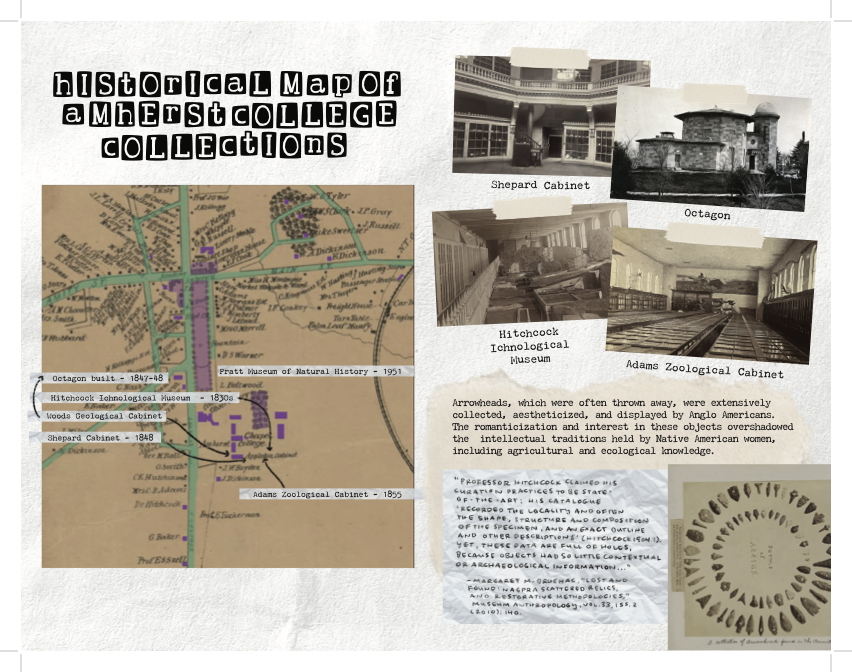
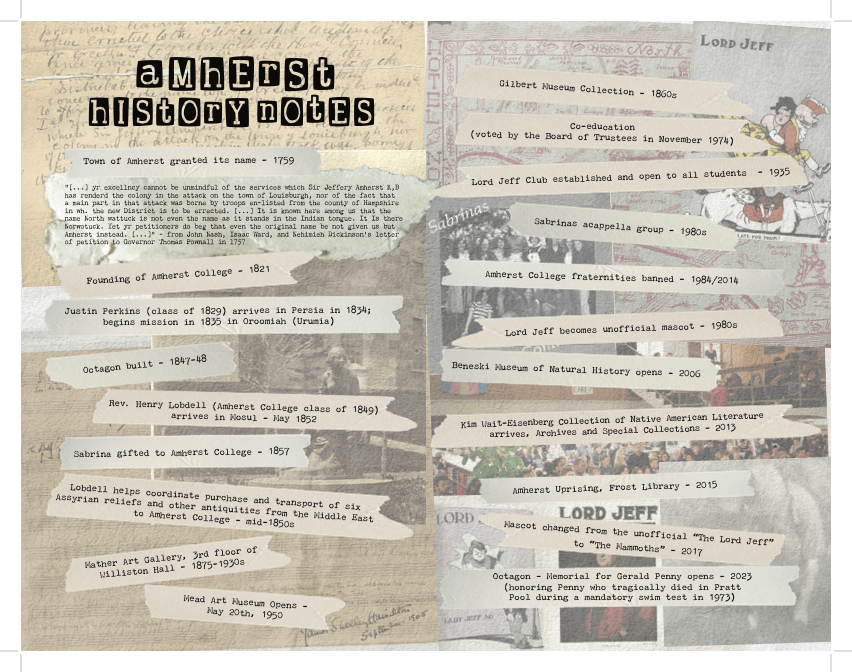
“Open Admissions” drew materials from the collections of Amherst College’s Mead Art Museum, Archives and Special Collections, and the Beneski Museum of Natural History, placing them in dialogue with artworks by Michael Rakowitz.[4] Students, professors, and staff at the College informed our understanding of early collections through Center for Humanistic Inquiry (CHI) seminars, conversations, and resource sharing.[5] The exhibition’s design and content were shaped by a subtle negotiation of the silos and power dynamics that define interactions among the artist, curators, and collaborators. Dr. Ali Mirza, a former CHI fellow, traced the historical networks connecting the acquisition of Assyrian reliefs and dinosaur tracks; Hayley Singleton, Head of Collections and Operations at the Beneski, contextualized the missionary collections of minerals; Mike Kelly, Head of the Archives and Special Collections, reinforced the importance of “receipts” that support the admission of institutional history; students contributed to the interpretation of key works and helped realize spontaneous public events that renewed critical discussion about College traditions; Rakowitz created new work and suggested modes of displaying collection objects.
At the time, we were both Mead staff members: Liu a Curatorial Assistant and Crossman the Director of Curatorial Affairs and Liu’s direct supervisor. The exhibition thus offered opportunities to work against conventional hierarchies and to share authority. Considering our roles as hosts and mediators, this analysis appraises some of the advantages and limits of this position, while also considering how we sought to frame and move beyond institutional critique while working as part of the institution and in partnership with Rakowitz, campus colleagues, and students.
Disorientation and Hospitality
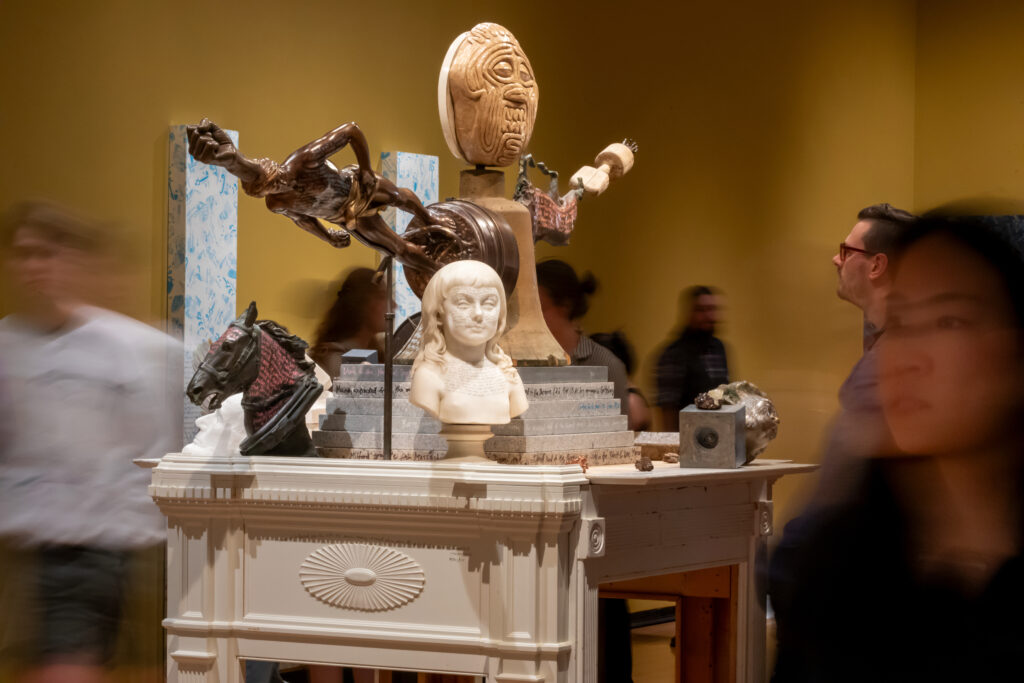
Michael Rakowitz’s sculpture American Golem (2022) was in the sightline of the Mead’s entryway—welcoming and warning visitors who entered “Open Admissions.” Composed of fragments, including sculpture molds, minerals, copies and bits of furniture, American Golem is recontextualized by the artist’s handwritten notes about the lives of selected objects.
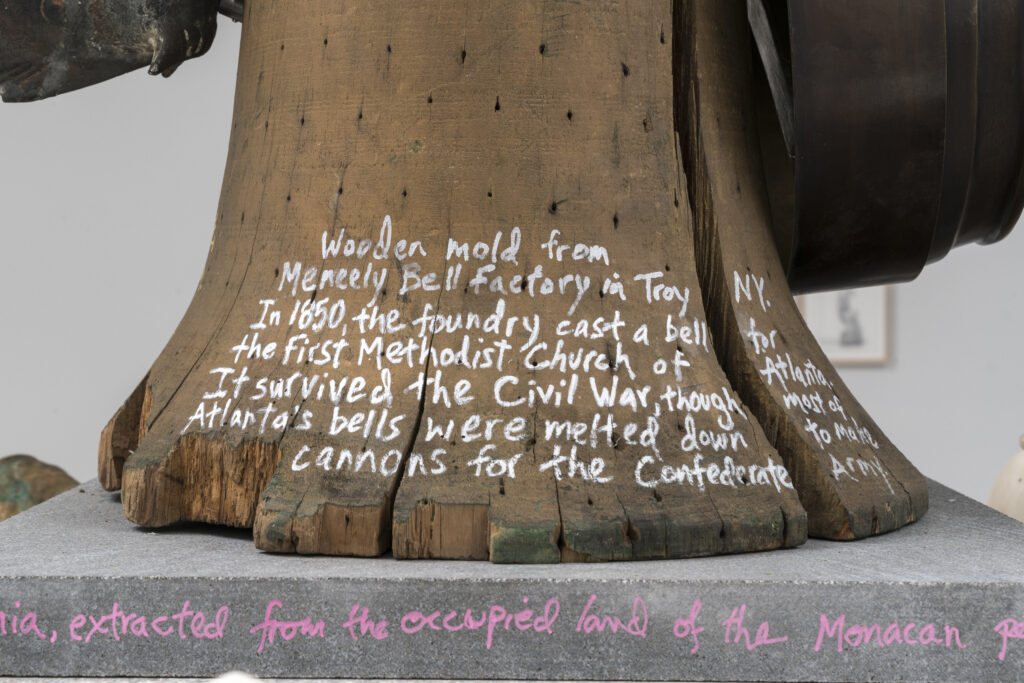
Rakowitz’s American Golem complicated how we understood two central concepts that would define our curatorial methodology: hospitality and disorientation. The work is a model for undoing dominant narratives by admitting difficult truths and suturing these facts together into a single—although not comprehensive—presentation. At the same time, American Golem also expresses care for materials and their ancestors, people, and stories often marginalized by museums.
In interviews, Rakowitz often mentions his visit to the British Museum when he was a child. His encounter with the Assyrian fragments taken from the Middle East planted the seed of doubt on the museum’s claim to these works. Museum professionals have long tried to update their labels and provide new interpretations for how visitors’ encounters with objects are mediated, but nuanced readings of artifacts and of the past often remain elusive. Something is always missing. The museum’s gatekeeping of knowledge is frequently in question.
Curators are challenged to identify which silences, gaps, and fissures can be filled and how to address those that cannot; rather than share only what we know, we sought to expose our uncertainties and to be transparent about the limits of available or definitive information. Sometimes “receipts” are available and at other times provenance information and crucial records that help us to understand an object are incomplete or inaccurate.
What stories can we as curators tell if we are missing crucial information and can’t be sure of what we are looking at? What is a narrative anyways and why should we only present a complete or clear one when history is anything but singular?[6] As curators working in a museum embedded within a college, our answers to these questions during this project often reflected the tension between our aspirations and limits—be they incomplete information, our own doubt, or sense of agency within a doubly layered institutional hierarchy.
In “Open Admissions,” the Mead Art Museum was responsible for “hosting” not only the artworks but also the artist and the vision of hosting that Rakowitz advocates. We came to consider disorientation—through its holding of a plurality of perspectives and objects—as a form of hospitality and a means to reimagine our role as host. Our position draws on historian Achille Mbembe’s unraveling of assumptions about archives and collections. Collections and archives often feel “inevitable,” as Mbembe stated in “The Power of the Archive and its Limits.”[7] Of course, they are not. In making “Open Admissions,” we played with ways to resist recreating the illusion of inevitably and thereby mirroring imperialism and its logic as “inevitable” through art or museum display. We tried to model care through the staging of an exhibition that we hoped would be experienced similar to the process—porous and conversational.
“Open Admissions” was organized around key objects and stories that helped us understand and question the logic of early collecting, as well as the conflicting demands of the objects that remain in the institution’s holdings today. Among these works are the Assyrian reliefs that were purchased and transported to Amherst College in the 1850s; Sabrina—an outdoor sculpture that was gifted to the College in the 1850s and continues to spark student engagement; and items from the dessert service gifted to the Mead in the 1950s and 1990s that bear the Amherst family coat of arms, a marker of status and lineage that provokes discomfort by revealing identity remains shaped by subjecting others to control.
As the checklist expanded in response to our research and conversations with Rakowitz and Amherst College interlocutors, a sense of disorientation arose from the web of materials and sometimes oppositional angles for interpretation that took shape. Yet rather than treat disorientation as a problem to be resolved, we came to understand it as an invitation to challenge ourselves and one that could be extended to visitors through the layout, labels, gallery guide, and programs.
We invited campus collaborators to intervene and worked alongside them throughout this process. One example is our negotiation of the display and interpretation of the Amherst family’s dessert service and the plates that were designed for the College’s dining hall decades ago. As Eleanor Stolzoff (Eastern Band of Cherokee Indians; Amherst College Class of 2027) writes in her label about the dining hall plates that are now held in Archives and Special Collections:
The Three-Piece China Set, commissioned by President Stanley King for the opening of Valentine Dining Hall, depicts Lord Jeffery Amherst atop a horse, sword raised, chasing Indigenous people in a repeating circular design. As the plates suggest, Jeffery Amherst, the town and college’s namesake and Governor General of British North America, endorsed genocidal tactics against the Native people he deemed an “Execrable Race” using smallpox blankets and other means. The china sparked several plate-smashing protests in Valentine (as has been described by Tito Craige, Class of 1970) and was eventually removed from use without public acknowledgment in 1973. No apology was given to the Indigenous community members forced to use dishes portraying the murder of their ancestors. As an Indigenous student today, it can be difficult to reckon with the college’s history of racism against Native Americans through its representations of Jeffery Amherst. While thankfully, we no longer eat from this china or cheer for the “Lord Jeffs,” I believe it’s important to recognize this painful aspect of Amherst’s recent past.[8]
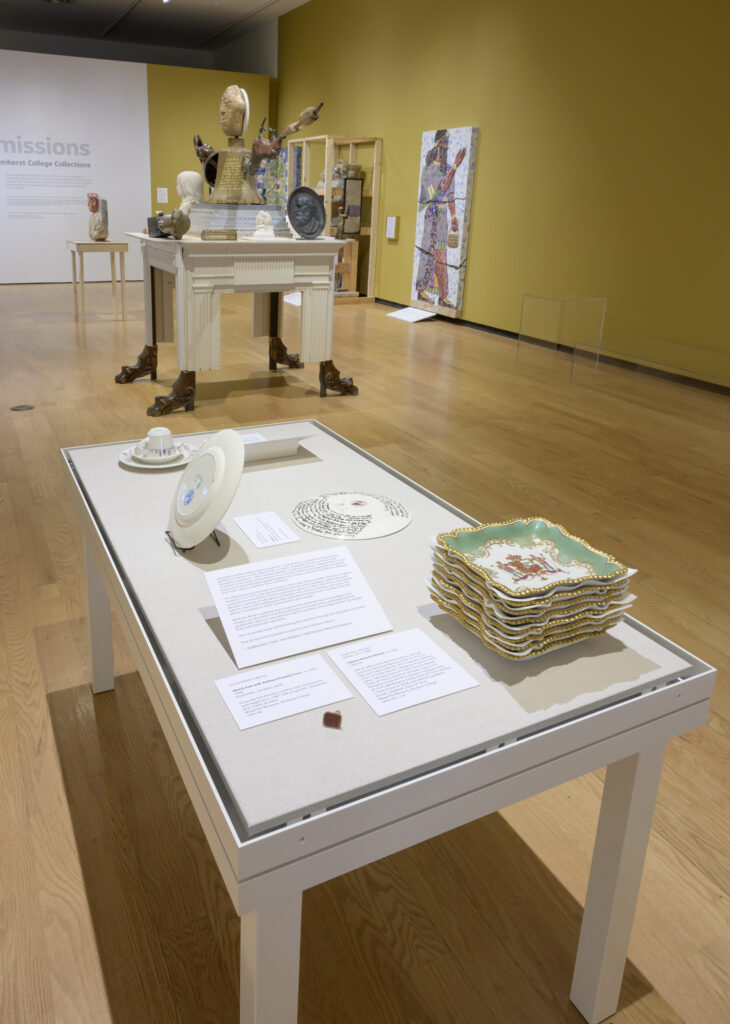
A label by the Mead’s director, Siddhartha Shah, describes the imagery centered on each of the eight Amherst family dessert plates displayed (just a small sampling of those in the Mead’s collection): “Like logos used by modern-day corporations, a coat of arms is a symbol that projects the identity of a person, family, organization, or nation…” The label continues with questions written from an institutional perspective: “How are people today still fashioning their identities through the subjugation of others? How do we envision power in a way that does not harm others?”
Displayed together in the same case, Stolzoff’s and Shah’s words were printed on oversized labels and tilted to increase visibility. The plates were displayed unceremoniously stacked, similar to how they are stored and transported. Their presence under Plexiglass reminds visitors that museum staff are charged with their ongoing care. We decided to display both sets of plates and a related watch fob also bearing the Amherst coat of arms because they, like many objects we displayed in the exhibition, grounded the questions on ethical responsibility that Rakowitz poses to museums. By spending time with these objects and considering how “this frilly dessert service” and the dining hall plates normalize subjugation and racism, have we felt anything?
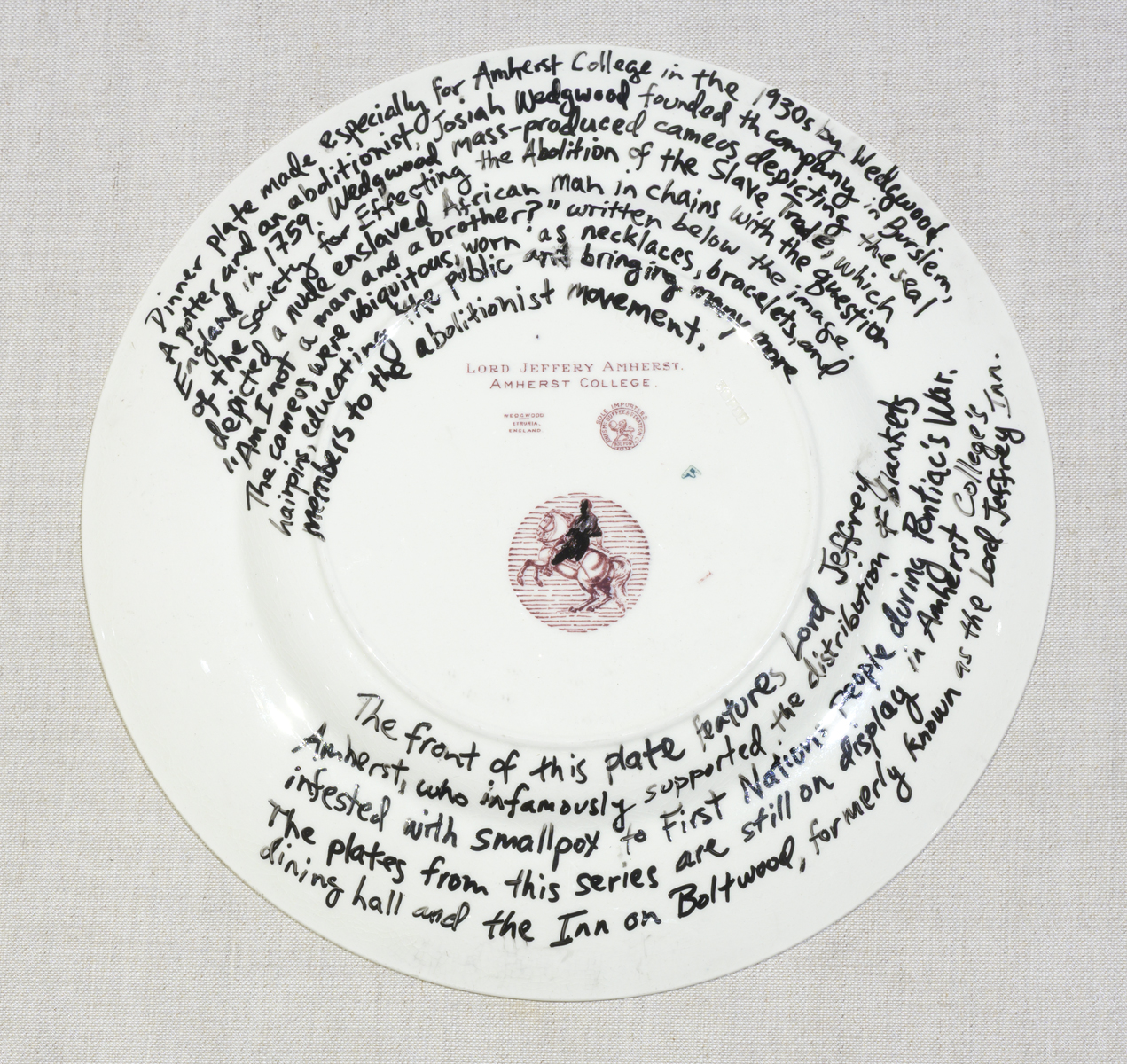
As hosts, we wanted to show our work through labels that reflected our conversations with Mead staff, students, faculty, and with the artist. Rakowitz’s Cameo added to the chorus of responses in the case. Like the labels, it unsettles the Amherst narrative; the nearby American Golem similarly destabilizes national mythmaking through its unmaking and remaking.
The need to hold so many voices together arises from the recognition that the past does not stay past. Echoing Rakowitz’s language, we settled on “haunting” to describe this surfacing of the past, whether intentionally through recreating something, modifying its surrogate, or displaying a historical object whose presence cannot be confined to the words on a label. To exorcise the institutional ghosts that haunt us, we welcomed the reflections of past museum practitioners and professors, as well as the makers of the objects we now care for. We sought to acknowledge past and present perspectives and institute change through what we say about these histories in this exhibition, hopefully extending the work through how we write labels and tell institutional histories going forward.[9]
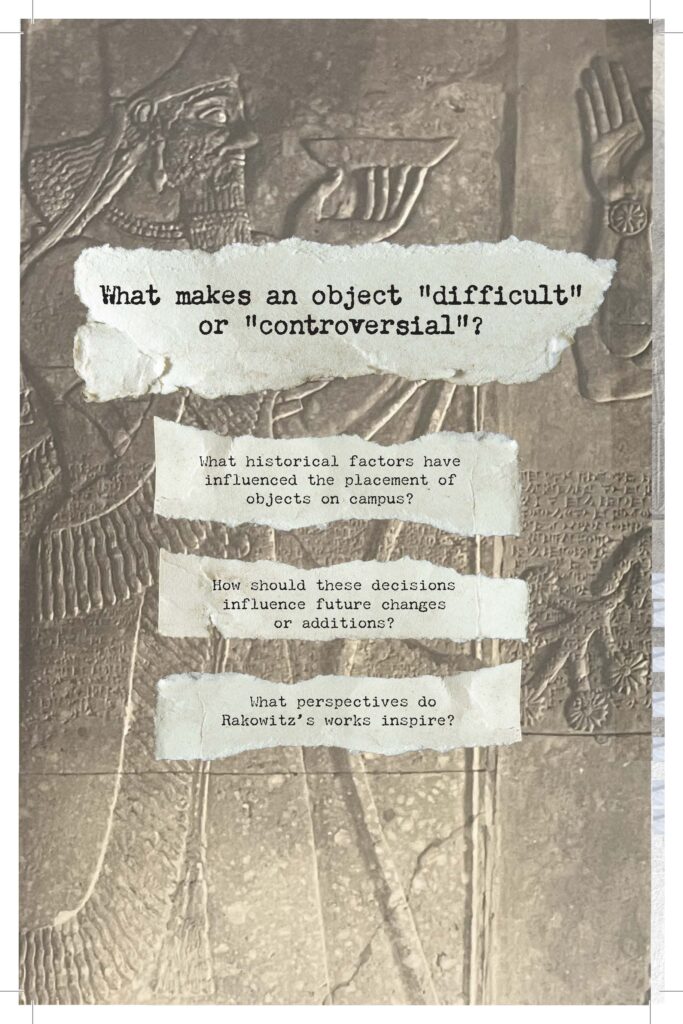
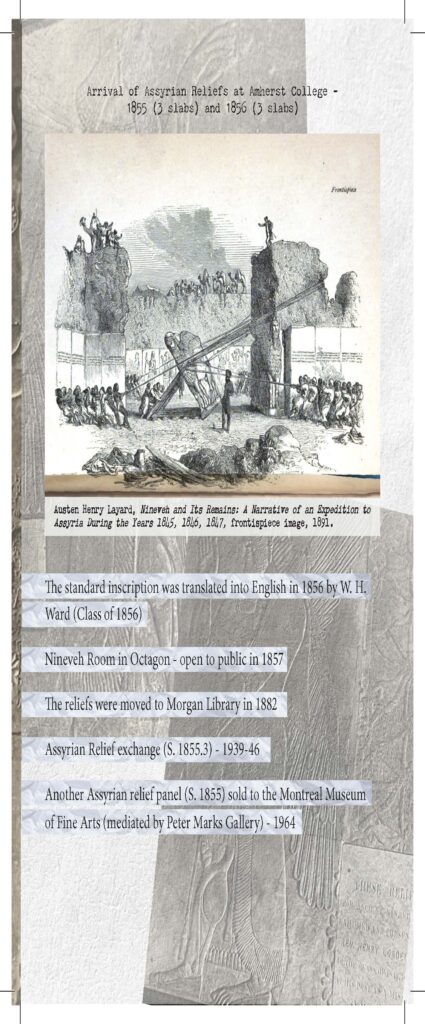
The Assyrian reliefs present their own reckoning. They are found in many US and European museums; conventional museum labels that only describe the subject matter leave out fragmentary histories, partial or problematic provenances, and cultural displacement. Three of the six Assyrian panels that were brought to Amherst College in the 1850s have been on view at the Mead since the museum opened in 1950. Students and other visitors often ask why they are here.
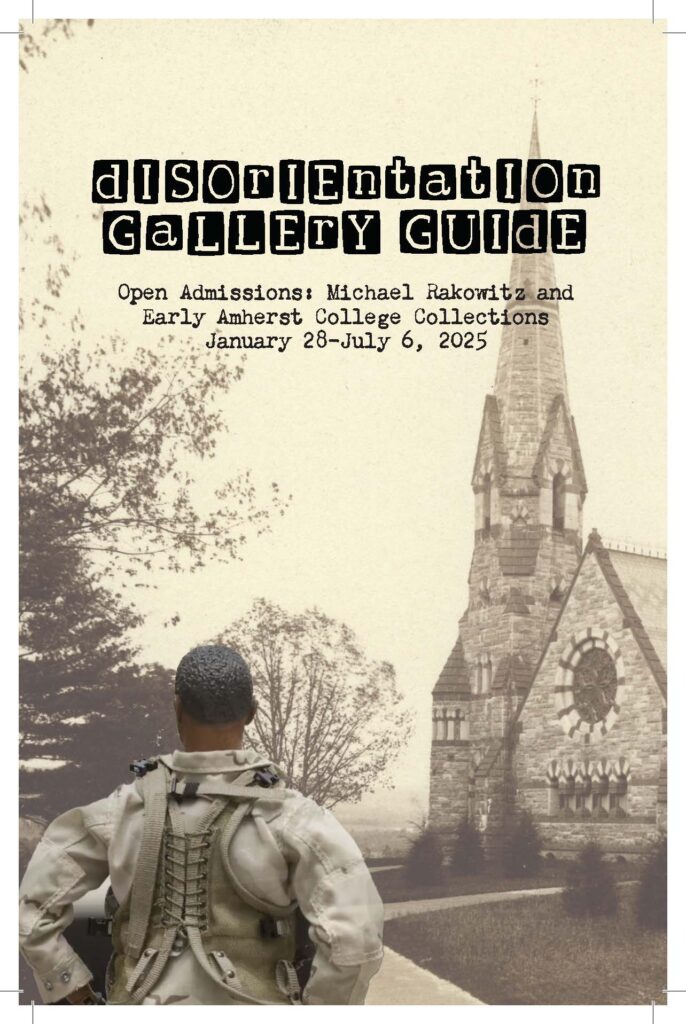
The apt question recalls the one that is asked of the artworks on display in Rakowitz’s video The Ballad of Special Ops Cody (2017): “We shouldn’t be here. We have stories to tell, to our families, our friends, in our own native tongue. We have stories to tell. What’s your story?” These words, narrated by Gin McGill-Prather, a former medic in the Iraq War, are part of this stop-motion animation’s voiceover. The words narrate a scene in which the action figure of a Black man in military uniform confronts a case of sculptures from the Early Dynastic period (2,600–2,500 BCE), in the region that is presently Iraq. The statuettes appear to stoically gaze back at him, at us, with unmoving faces.
In asking the Assyrian reliefs at the Mead about their story, we adopted two types of museum labels: one general museum label that focuses on context and admits what remains unknowable. For example, a Mead-authored label mentions the presence of the middleman Hormouzd Rassam, the Assyrian Iraqi archaeologist who excavated many of these reliefs and facilitated the Amherst trade. The other type of label by Rakowitz documents the provenance of Assyrian reliefs alongside quotes about the looting and destruction of Assyrian artifacts.[10]
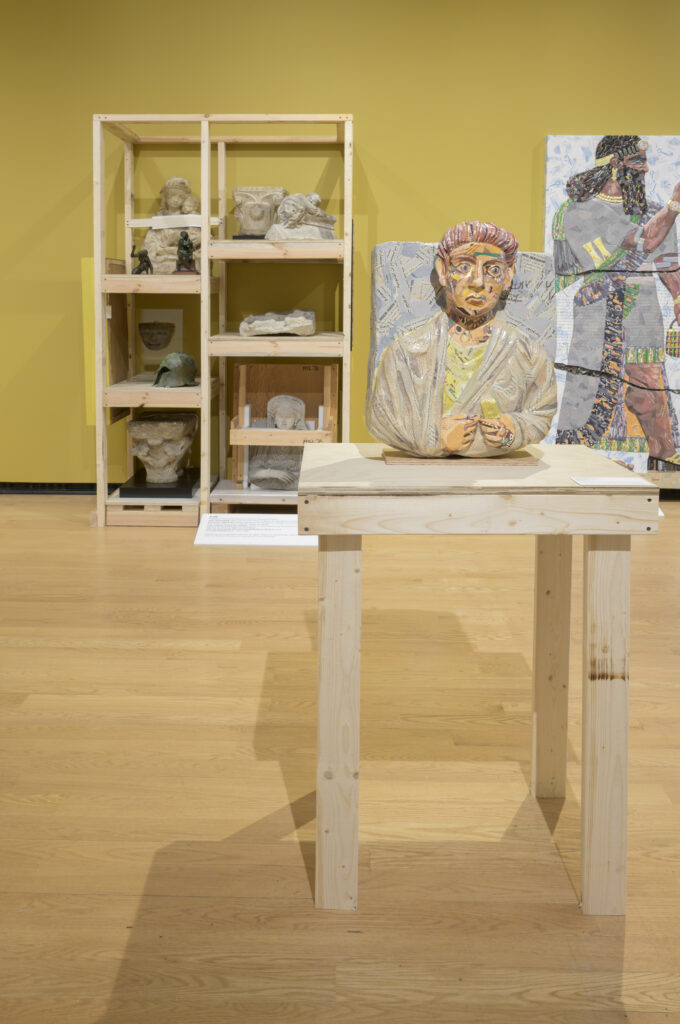
“Open Admissions” included both a selection of small objects and panels from Room H of the Northwest Palace of Nimrud, the ancient Assyrian city of Kalhu, that are part of Rakowitz’s series The invisible enemy should not exist (2007–ongoing).[11] Rakowitz’s sculptures were installed roughly according to the panels’ original placement in the palace, creating unusual gaps and empty spaces that obstruct easy consumption of visual information. The display was complicated by the fact that the Mead’s Assyrian panels are not only from Room H and the exhibition extended across multiple galleries. Additionally, the Mead only borrowed Rakowitz’s sculptures—reappearances of Room H panels—that were not part of other institutional or private collections, thereby showing how Rakowitz’s artworks, like the objects they reference, are themselves subject to the art market and displacement.
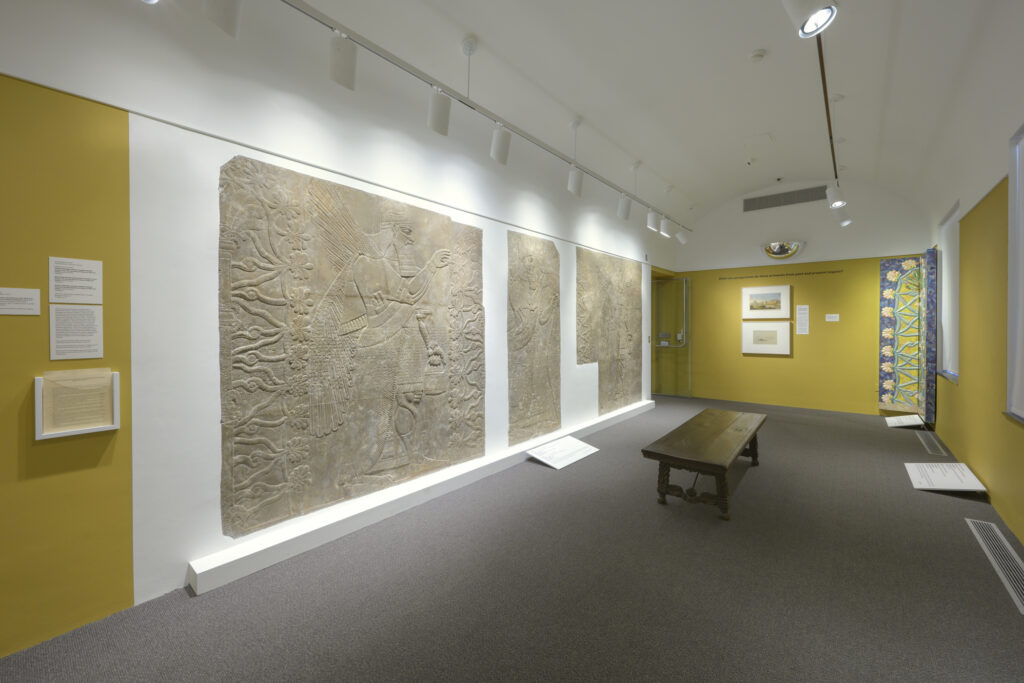
Rakowitz describes The invisible enemy should not exist as composed of “ghosts”—sculptures that materialize other objects of cultural significance from present-day Iraq that were lost, looted, or destroyed. These apparitions are an act of recovery. More than replicas, they are hosts—ephemeral amalgamations of diasporic materials (Arabic-language newspapers and Middle Eastern food packaging) that not only honor the lost objects but also the ancestors and descendants of these works—in which the complex notion of cultural heritage and who has the authority to claim these works is at stake.
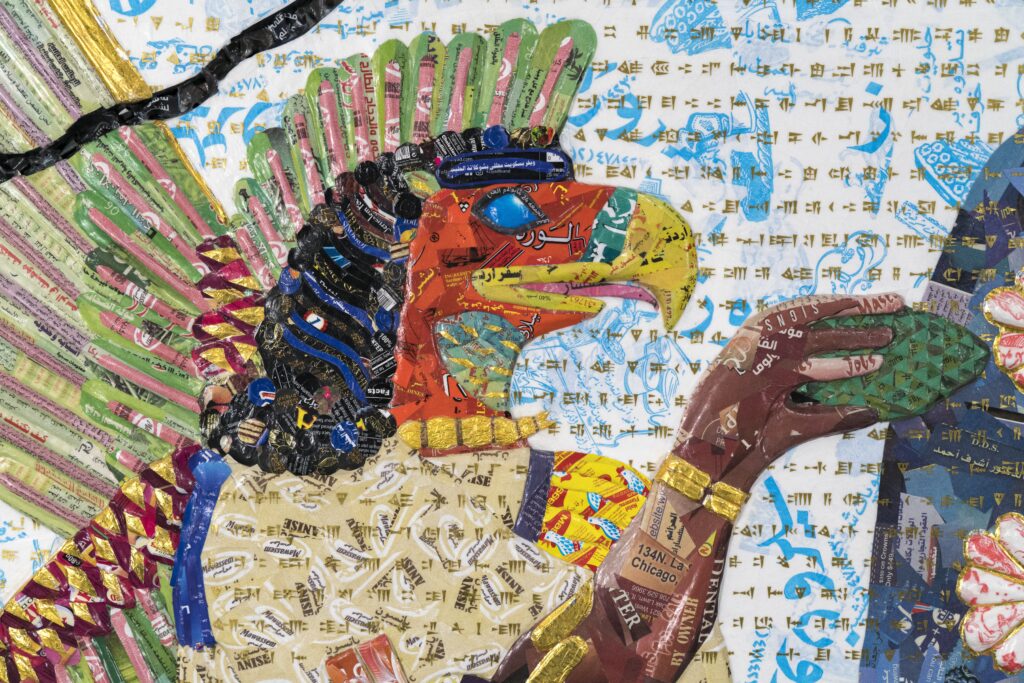
Rakowitz’s consideration of an object’s g/host prompted us to ask: What if we saw ourselves as hosts instead of stewards? If we take a flat ontological perspective, placing ourselves on the same plane as the art, perhaps we could begin to imagine new ways of enacting hospitality through our connections to the objects.[12] “Open Admissions” built on thinking that began in earlier collaborative projects, partnerships, and that reflects scholarship by authors such as Jessie Loyer (Cree-Métis).[13] This idea of animacy, of thinking of objects as linked to a broader web of living communities, places, and historical circumstances “pushes our ethics into the present, avoiding traps of nostalgia or erasure of the past.”[14] It also shifts thinking of our role from one that is fixed to changeable and asks for a critical exploration of the circumstances in which an object or “relative” came to be here and why it remains.[15] How do we differentiate the value or kind of care needed for myriad kinds of objects?
The exhibition settled into an Amherst “Golem” that was reflective of our resistance to a singular counternarrative and insistent on foregrounding our questions. Our collaborator Ali Mirza reminds us:
“The illusion of coherent stories are often too ‘complete.’ If one is sharing their own work then completion and coherence are great, but if one is looking for collaboration then gaps and inconsistencies are not just generative but I tend to think necessary?”
Yet as Claire Bishop argues, celebrating non-linearity can become a form of intellectual privilege, a fetish of difficulty that only certain audiences with cultural capital can appreciate.[16] This approach risks a retreat from politics, where complexity becomes a shield against engagement rather than a tool for deeper understanding. This critique of complexity reveals its own blind spot. While challenging opacity, the demand for conclusive insights may reinforce another problematic power structure that always looks up to individual authoritative voices. When we, as curators, are used to the clarity and wisdom of a single person, scholar, researcher, or artist, we may be engaging in another form of political retreat from messy realities. Borrowing power from authoritative and scholarly opinions is a simple way to skip the labor required for genuine democratic discourse. In Edouard Glissant’s view, opacity refers to the inherent lack of complete transparency and knowability in individuals, cultures, and the world in contrast to an administrator’s desire for legibility and control in the colonial context.[17] In “Open Admissions,” complexity works the same way, presenting an aesthetics of honesty—an admission that relinquishes a certain exclusive authority and makes room for voices of different identities and positions to be weighted equally.
As we wrote and designed the exhibition, we worried that our attempt to employ exhibition-making as a step in institutional transformation would be nullified by packaging colonial critique into digestible institutional messaging that ultimately reinforces rather than challenges the museum’s authority. Taking inspiration from “disorientation guides” designed by college students as alternative zines to their institutions’ standard orientation resources, our gallery guide and the exhibition’s design resisted simple or tidy narratives or counternarratives as a strategy to be more accommodating hosts.[18] Throwing your audience into doubt as an act of care may seem counterintuitive, but we hoped our questions, stories, and selected objects would offer an alternative way of holding us together. Perhaps, we thought, visitors would find comfort in the sincerity of our collective uncertainty and refusal to hide our intersecting sense of awe, hope, melancholy, and frustration. Pairing disorientation and hospitality becomes a curatorial strategy and resonates with our own position in this project as guests—albeit employees—within an institutional structure and hosts of an exhibition-making process.
Habits and Disruptions
Ways of working in museums become habitual through their repetition, adherence to policies, and perceived best practices. These traditions, like art historical accounts of an artwork or college rituals, can seem as fixed and unquestionable as collections. It’s like they have always existed in their current state and should not be changed. Desires for shared traditions, accountability, and transparency were routinely expressed by various collaborators. As we considered how to balance disruption with shared practices or understandings, we came to question our habits, as well as the traditions and daily protocols of the institution that we are a part of.
One of the exhibition’s most direct confrontations with institutional habit concerned a decision made decades before “Open Admissions.” In 1942, the Amherst College board approved the deaccession of an Assyrian relief in exchange for twelve objects. Mediated by the Brummer Gallery in New York, the trade was completed in 1943. Rather than hiding or glorifying the exchange, Rakowitz created an installation that transforms a largely unexamined transaction into a statement showcasing the mechanics of institutional decision-making. By occupying a physical space as large as the dimensions of the sold Assyrian relief, the installation highlights the absence of the relief and opens conversations about the journey of cultural artifacts through art dealers and collectors and the institutional authority that is reframed through an acknowledgment of compromises.
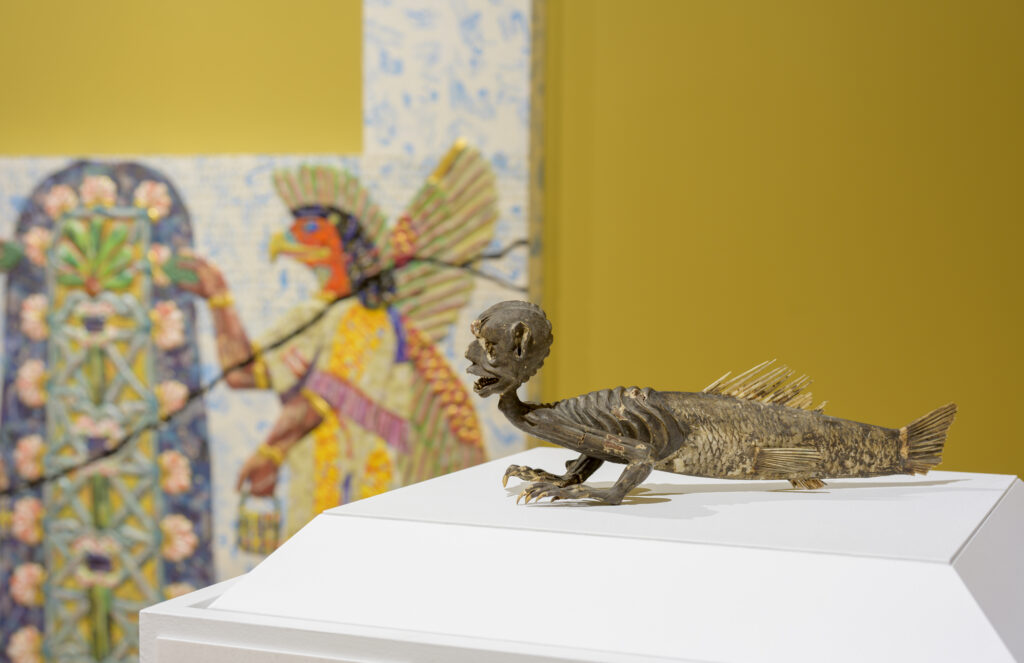
Some other disruptions in the exhibition surface from past collecting habits. Feejee Mermaid (nineteenth century), a sideshow hoax purchased by Edward Hitchcock Jr. in Yokohama, Japan, in 1872 for Amherst’s teaching of natural history, was treated as a legitimate specimen. It became part of the college’s permanent collection. Years later it was found at the Mead (circumstances of its transfer were not recorded) and accessioned as part of the museum’s collection. Amherst’s Feejee Mermaid was not unique in its time. US and European institutions granted scholars like Hitchcock Jr. the authority to determine what counted as a legitimate specimen, and the tradition of a scholar collecting natural history was itself a habit that went largely unquestioned.[19] This inclusion asks: What other hoaxes masquerade as heritage? Or what heritage have we mistaken for hoaxes? In the exhibition, the Disorientation Gallery Guide includes an X-ray of Feejee Mermaid that clearly shows the metal supporting structure inside. This imaging technology built for medical precision made visible the gap between an object’s assumed scientific value and its actual composition.
However, not all institutional habits are relics. No tradition at Amherst is more peculiar and stubbornly alive than Sabrina. Sabrina is a bronze statue of a water nymph that was produced and sold by J.L. Mott Iron Works and gifted to Amherst College in 1857. The bronze statue quickly became the target of student pranks by the then all-male student body (Amherst became coeducational in 1975) and was subjected to theft and vandalism. The abduction and rescue of Sabrina became a game among classes that stopped and started over the years and has recently been reinstituted, although amended. Sabrina—initially part of Amherst College’s collection—has largely remained in the possession of students.
In “Open Admissions,” Sabrina was represented in the gallery through ephemera that are housed in Archives and Special Collections—a piece of the foot and earring that had broken off, presumably during a heist, as well as photographs, replicas, and a catalogue with an illustration of the statue.
“`html
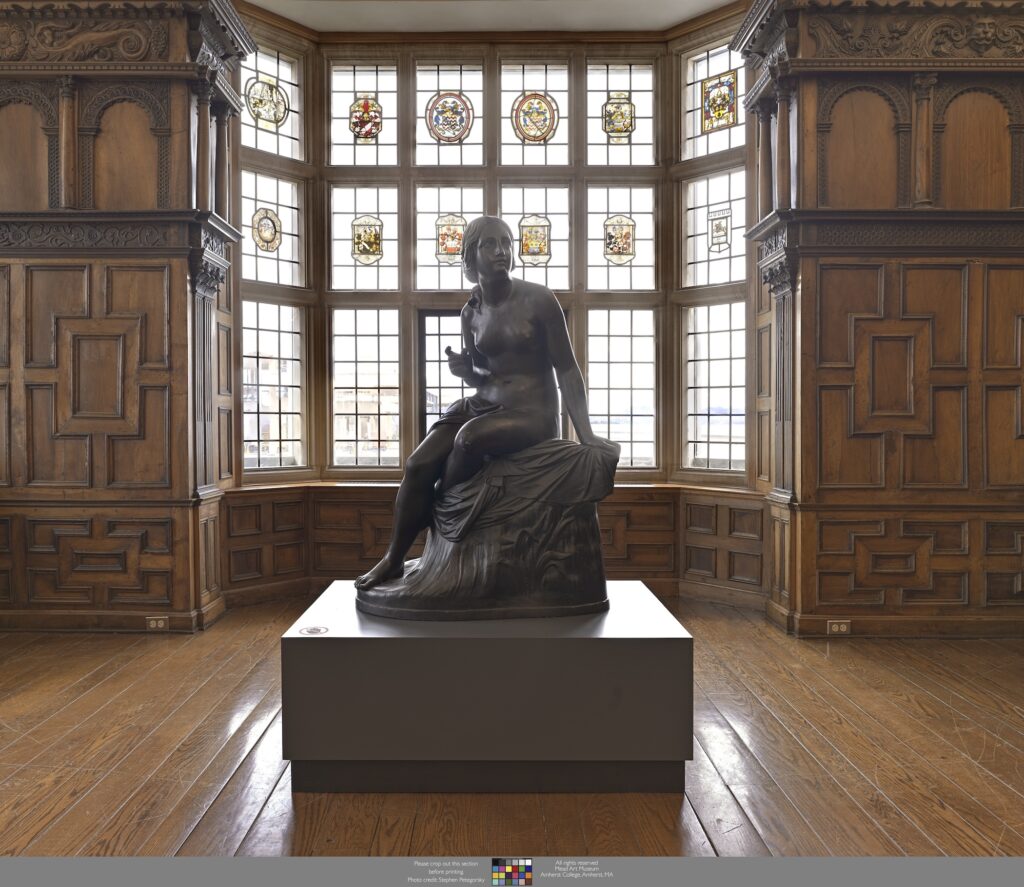
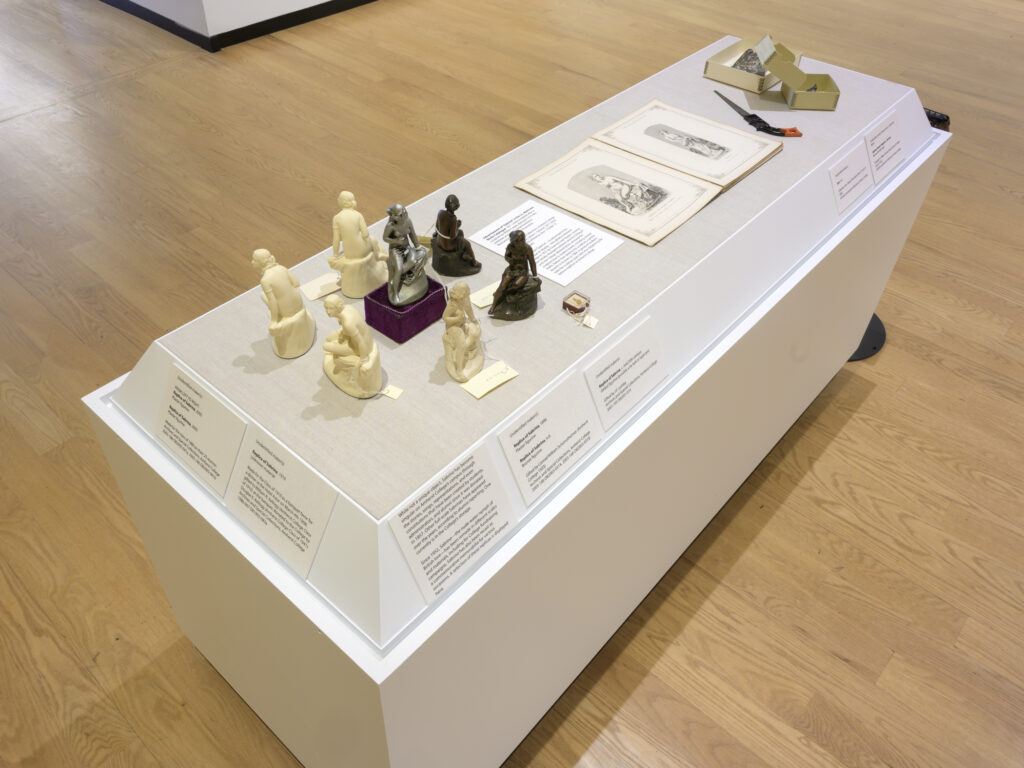
The presence of Sabrina ephemera, the legends associated with the statue, and students’ recent reframing of past traditions led Michael Rakowitz to create Imperial Star (2025)—a sculpture that alludes to memories of Sabrina and current perceptions of this statue’s symbolic value and traditions. Rakowitz’s Imperial Star was a disruption. Its material history and the texts and drawings by the artist across its surface interweave Sabrina stories with those of the readymade sculpture Fountain (1917), joining the objects through their alleged manufacturer and surfacing debates about authorship, authenticity, and gendered traditions. Rakowitz’s handwritten texts about the water nymph, readymade, and campus legend curve along its surface as if draining toward the basin. Holding the goddess and the sink together, Rakowitz uses humor to puncture the seriousness of institutional memory.
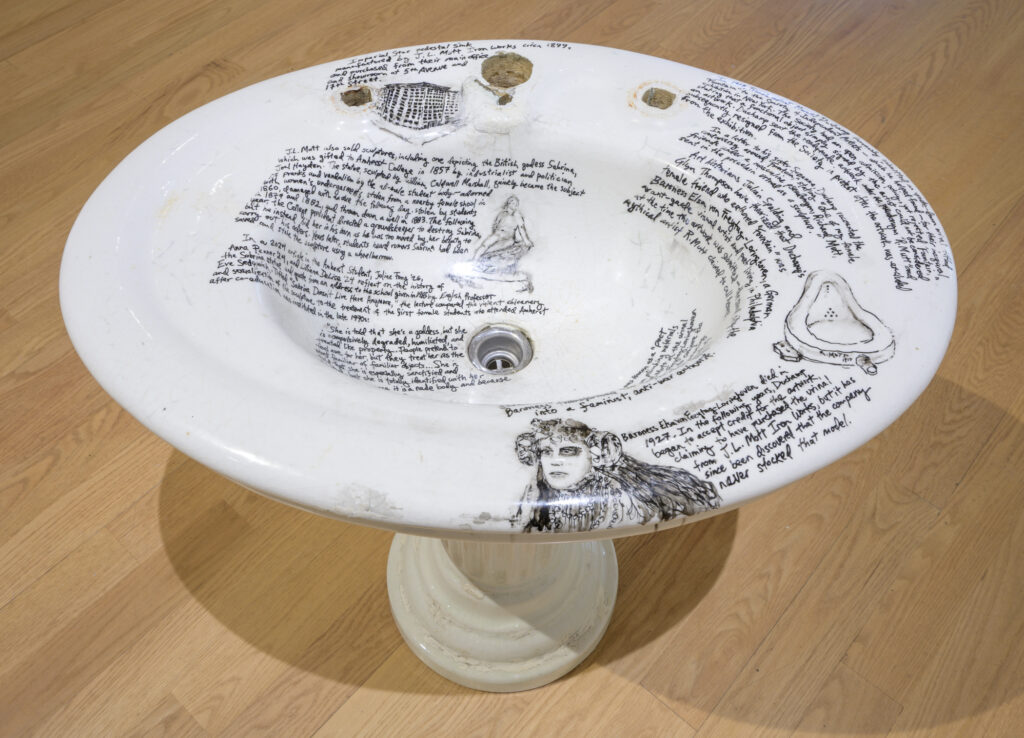
Rakowitz’s wit is often a key part of his troublemaking. His “disruptions” lent an outside voice and perspective that situated campus stories within a broader global and art historical context. This dynamic was perhaps most vivid when students spontaneously located and brought back Sabrina for a temporary visit to the Mead, at which point the institutional boundaries became porous to dialogue. The curatorial work became more about creating conditions for uncertainty to coexist with institutional responsibility, where ghosts can inhabit the same space as scholarship, where honest opacity can stand alongside careful research. The reappearance of Sabrina, however, jolted us from the echoes of history and gave us the chance to see current students test new ways of making or modifying past traditions. The all-women Amherst College singing group the Sabrinas held an impromptu performance with the statue. Visitors wrote letters to Sabrina. Sabrina “appeared” at the Mead and then “disappeared” covertly. Museum staff supported the agency of students and hosted Sabrina as a guest, not as an object in the College’s collection.
Between disorientation and hospitality, habits and disruption, we worked like mediators, creating similar spaces for various parties of an exhibition to sit at the same table, between artists, museum professionals, the public (which in this case centered campus communities), and the museum itself.[20] Through this delicate calibration of mediation and resistance, “Open Admissions” sought to let contradictions remain present and generative—much like Rakowitz’s drawing Monuments in Spolia 1 (2022) overlays a solemn ideological symbol (Lenin’s statue) with a popular culture villain (Darth Vader), creating what scholar Sianne Ngai calls “productive instability.”[21] The combination breaks this singular meaning of a revolutionary or a villain, leaving the viewer unsure whether to laugh or to mourn. Rather than refiguring progress as territorial conquest, the exhibition looks for something softer: an accumulation of care, repair, and the slow work of shared imagination.
Conclusion
An exhibition in an academic museum carries pedagogical expectations, further compounded by museums’ constant claims to offer something “new,” but we should be honest about the limits of what exhibitions can achieve. Social change through exhibitions happens slowly and often imperceptibly. Perhaps this limitation suggests we’ve been asking the wrong questions about usefulness and change.
Have we all been absorbed into a capitalist logic that offers no way beyond parasitic relationships?[22] Is there a more optimistic pragmatism that lies not in dramatic and heroic confrontation but in small and pragmatic interventions by contemporary art? We are so used to seeing exhibitions that set up rigid and antagonistic relationships between different parties—artists, curators, and institutions—but the relationships are not naturally adversarial. A collaborative process could allow different positions in a project to be more flexible. Instead of one voice against a whole system, perhaps a constructive mode would be to gather multiple voices in one exhibition and decentralize individuals while allowing distinct perspectives to sit side by side. In this way, artists, curators, and museums sacrifice their own singular authorship to become a vessel or a “medium” through which displaced knowledge can resurface. The vision of an artwork or an exhibition shifts from disturbing hosts to creating space where fragmented histories and displaced voices can continue to co-exist with a legacy that we are not sure what to do with and a future we cannot predict.
To dwell with fragments and co-exist with the “brains” of others, this approach begins with meticulous care for fractures and fragments. Michael Rakowitz’s The invisible enemy should not exist series, aiming to create over 7,000 reliefs, exemplifies this alternative through rigorous research practice. His team’s careful investigation into the relief slabs from the Northwest Palace of Nimrud extends to every accession number, every crack, every material specificity—a granular archaeology that “cares for fragments of history” through exhaustive attention to detail. The same quality of care appears in his Monuments in Spolia series, which explores how one collection of materials undergoes continuous transformation—melted, reformed, and remolded into evolving sculptures. When fractures are permitted to exist, they generate anxiety, absurdities, and dark situations; and when fractures are fixed in a way that doesn’t hide the original harm and make the repair visible, we can prevent further propagation of wounds.
What emerged from this exhibition is a curatorial strategy based on collaborative negotiation. To negotiate means, at times, taking a step back and sharing authority. But the most challenging thing we face as curators is allowing chaos or uncertainty to live within the system itself: accepting that incompleteness and absurdity are not problems to be solved but conditions to be inhabited, even if they are disorienting. “Open Admissions” asked whether an exhibition could simultaneously host artists, campus partners, objects, and audiences while enduring this partial dissolution of a museum’s interpretive authority. Could we hold space for others without disappearing entirely?
Footnotes
- Our work with Rakowitz began with “Part of an Impossible Task: Michael Rakowitz” (August 24, 2024–January 5, 2025), which brought together his sculptures of Northwest Palace Room H panels from his series The invisible enemy should not exist (2007–ongoing) and works from the 2023 exhibition “The Monument, The Monster, and the Maquette” to explore how power is defined through cultural artifacts. Rakowitz’s work and the Mead’s Assyrian reliefs from the Northwest Palace of Nimrud, built by Ashurnasirpal II in the ninth century BCE, began a dialog about how history is told through objects and the role of institutions in this process. ↑
- “Us” refers to the authors Liu and Crossman, and is used to reinforce that this text, like “Open Admissions,” was written collaboratively. ↑
- Sternfeld, Nora. “Introduction: How do we imagine a museum of the future?” and “Where Does Mediation Stand: An Introduction.” In The Radical Democratic Museum. London: Routledge. 2026. Like Sternfeld, we explore the museum as a site that is both inside and outside of society: “[the museum] is an intermediate space in which a different possible future can be negotiated and imagined against the backdrop of history.” This case study reflects how we sought to negotiate pedagogical and political aims through a collaborative process that allowed for divergence and agreement. ↑
- The Mead Art Museum opened in 1950 under the directorship of Charles H. Morgan, absorbing some of Amherst College’s collections like the Assyrian reliefs that preceded the museum. Images 2–3 track key dates and the movement of collections across campus since the College’s founding in 1821. ↑
- The CHI seminars “Crossing Cabinets: Collecting and Disseminating Across Material Boundaries,” 2023–25, and “Amherst’s Plaster Casts,” 2024–25, enhanced our conversations with faculty and staff about Amherst College collections and early collecting histories. ↑
- Historian Priya Satia is concerned with how history is told, made, enlivened; art, as she notes, offers an alternative to history. So, while Rakowitz’s art, the objects of past eras, can be annotated or include texts with different histories, they also are poetic; they embody multitudes and contradictions that we gesture at without resolution. Satia reminds us that “The very word ‘history’ comes from the Greek istoreo, meaning ‘to inquire.’ More than truth-telling or a search for models, we might reclaim it as an open-ended search for truth, in the manner of poetry.” Satia, Priya. Time’s Monster: How History Makes History. Cambridge, MA: Harvard University Press. 2020. ↑
- Mbembe, Achille. “The Power of the Archive and Its Limits.” In Refiguring the Archive. Dordrecht: Springer. 2002. DOI: 10.1007/978-94-010-0570-8_2. ↑
- Amherst College’s athletic teams were casually called the “Lord Jeffs” and Lord Jeff was the unofficial mascot until 2016.↑
- Some of this work is validating emotions as integral to how political meaning, identity, power, and representation are understood. Doyle, Jennifer. Hold It Against Me: Difficulty and Emotion in Contemporary Art. Durham, NC: Duke University Press. 2013. As Doyle describes in this text, scholars and critics are conditioned to write from an “analytical” standpoint devoid of feeling that can lead to an oversimplification of art that invites political questions and emotions. ↑
- For example, the label for panel S-06 includes the following information: “Location: Cleveland Museum of Art, Cleveland, Ohio; year excavated: 1847, by Austen Henry Layard at the palace of Ashurnasirpal II in Kalhu (Nimrud); previous collection: Mead Art Museum, Amherst College, accession #: S.1855.3; acquired in 1856, Gift of Dr. Henry John Lobdell (Class of 1849); year sold by Amherst College: 1942, in even exchange by Amherst College to Joseph Brummer Gallery for the 12 objects on display; year purchased by the Cleveland Museum of Art: 1943; current inventory #: 1943.246; Fueled by an insatiable appetite for Near Eastern antiquities, sites throughout Iraq are being worked daily by teams of looters in search of “merchandise.”—Selma Al-Radi. ↑
- The palace symbolized power and served as the seat of government for Ashurnasirpal II. Over the centuries, the palace was abandoned, damaged by environmental causes and human conflicts, looted, and ultimately destroyed by ISIS in 2015 ↑
- Graham Harman’s Object-Oriented Ontology advocates for a non-hierarchical perspective in exploring people, works of art, archives, and other kinds of materials together. We draw from Harman’s reflections alongside anti-imperial theoretical perspectives and practices like those of Amy Lonetree (Ho-Chunk) and Walter Mignolo. These writings, among others, inspire and shape our commitment to decentralizing curatorial authority, bringing forward the often-invisible frictions in the curatorial process, and exposing moral and pragmatic considerations together, finding meaning across a web of objects and agencies. ↑
- Loyer, Jessie. “Collections Are Our Relatives: Disrupting the Singular, White Man’s Joy That Shaped Collections.” In The Collector and the Collected: Decolonizing Area Studies Librarianship. Ed. Meagan Browndorf, Erin Pappas, and Anna Arays. Sacramento: Library Juice Press. 2021. “Boundless” was a project that included a two-part exhibition curated by Heid E. Erdrich (Ojibwe) in 2023–24, development of curriculum, a catalog, and changes to the Mead’s practices and collections. ↑
- “The collection is animate, and there is an emotional response to visiting our relatives.” Loyer, “Collections Are Our Relatives,” p. 12. ↑
- Taking inspiration from Amherst College professor Ludmila Ferrari’s 2025 undergraduate course “The Common Arts: Gardening, Telling, Making Refuge” and our work with Rakowitz on an iteration of Enemy Kitchen (2003–ongoing), our thinking about radical hospitality deepened and became pliable as we sought to understand the dynamic needs and imagined desires of the objects, to the richness of their symbolism, material, and cultural histories. Participants from the local academic communities, students, staff, and faculty cooked with Rakowitz and gathered with other area residents of the area to share a meal and stories, creating a space for connection. ↑
- Bishop, Claire. Radical Museology: Or, What’s ‘Contemporary’ in Museums of Contemporary Art? London: Verso, 2012. ↑
- Glissant, Édouard. Poetics of Relation, trans. Betsy Wing (University of Michigan Press, 1997). ↑
- The format of the disorientation guide was suggested by the Mead’s head of education, Emily Potter-Ndiaye, offering anchors while maintaining the exhibition as a site reflective of a process or conversation without resolve. ↑
- Feejee mermaids were widely exhibited in Western museums and sideshows during the nineteenth-century, most famously in P.T. Barnum’s 1842 exhibition, which left contemporary observers uncertain of its authenticity. See Steven C. Levi, “P.T. Barnum and the Feejee Mermaid,” Western Folklore Vol. 36, No. 2 (1977): 149–158. ↑
- O’Neill, Paul. The Culture of Curating and the Curating of Culture(s). Cambridge, MA: MIT Press. 2012. Sternfeld’s The Radical Democratic Museum is a useful reference here, too, as it thinks through pedagogical goals and different forms of mediation that have been tested in museums. “Open Admissions” directly addressed the embedded status of the Mead within Amherst College, exploring learning across multiple collections, disciplines and time, while seeking to level longstanding hierarchies within the institution. ↑
- Ngai, Sianne. Theory of the Gimmick: Aesthetic Judgment and Capitalist Form. City: Belknap Press. 2022. ↑
- Anna Watkins Fisher argues that parasitic resistance emphasizes “exploiting the host’s vulnerabilities,” carrying an inherently confrontational edge that presupposes artists are always dependent on or oppositional to institutions—a fundamentally pessimistic framing that may not account for more collaborative or generative models of institutional engagement. Watkins Fisher, Anna. The Play in the System: The Art of Parasitical Resistance. Durham, NC: Duke University Press. 2020. https://doi.org/10.1215/9781478091660. ↑