The Fallen investigates public monuments as archival infrastructures that materialise and reproduce dominant narratives of masculinity, authority, and national identity. Engaging with the theme of “encounters in the archive,” the project examines how images of decapitated statues constitute a dispersed archive of rupture—documents that reveal the instability of the historical fantasies these monuments were built to sustain. Rather than treating the archive as a static repository, the work approaches it as a site of conflict where meaning is continually reshaped through acts of destruction, displacement, and reconfiguration.
The project begins with archival photographs of damaged monuments, which are then intervened through collage with fragments of exuberant, non‑human‑shaped nature. These vegetal and avian presences introduce a speculative counter‑archive, imagining what emerges when monumental symbols of patriarchal permanence are re-situated within organic forces that resist human control. The collaged images are transferred onto second-hand porcelain plates—objects marked by domesticity, intimacy, and prior use—before being deliberately broken and repaired using kintsugi. This process foregrounds fracture as a method of artistic research: the cracks become visible lines of inquiry that expose the ideological tensions embedded in the archival image.
Through this material and conceptual methodology, The Fallen proposes that artistic knowledge can arise from processes of rupture, rewilding, and repair. The project reconsiders the archive as an evolving structure shaped by conflict, care, and imaginative reconfiguration, offering new ways to understand the politics of representation and the fragility of the narratives that monuments seek to preserve.
The Fallen approaches monuments as archival infrastructures—structures that materialise and reproduce narratives of authority, national identity and historical permanence. Across different geographies and periods, these monuments consistently portray male bodies, reiterating a visual code of hegemonic representation: elevated stances, heroic gestures, militaristic clothing and monumental scale. Through this repetition, the male figure becomes a vehicle for an imposed image of stability and dominance—an official representation crafted to naturalise particular hierarchies. In this project, the encounter with the archive unfolds not in institutional repositories but in the charged spaces where these monuments have been contested, damaged or dismantled.1
The archival images I work with—photographs of decapitated, vandalised or partially destroyed statues—form a dispersed archive of rupture. Among them are classical fragments from Thessaloniki, displaced imperial monuments preserved in Berlin, toppled political effigies from Iraq and colonial figures attacked in public space. These images document moments when the authority of the monument has faltered, when its claim to permanence has been interrupted by collective frustration, political dissent or historical re-evaluation. They are affective documents of conflict: gestures of refusal that expose the fragility of the narratives the monument was erected to uphold. They reveal that the archive is not a stable container of memory but a site of negotiation, where meaning is continually reshaped through acts of destruction, displacement and appropriation.2
Before being transferred onto porcelain plates, these archival images undergo a process of collaging in which fragments of exuberant, non-human-shaped nature—dense foliage, vegetal forms and avian silhouettes—are interwoven with the broken bodies of the statues. This intervention introduces a speculative dimension: it imagines what might emerge when the monumental is released from its ideological weight and allowed to coexist with organic forces that have not been shaped by human intention. The presence of this unruly nature does not function as preservation but as transformation. It proposes a counter-archive in which the monument is no longer a symbol of permanence but a material open to decay, reinvention and ecological entanglement. These vegetal and animal presences act as agents of rewilding, suggesting that the collapse of patriarchal symbols may create space for other forms of life, other narratives, other futures.3
Transferring these collaged images onto porcelain plates introduces a further shift in scale and meaning. Porcelain, with its connotations of fragility, care and commemoration, stands in stark contrast to the monumental and masculine coding of the statues. Plates often function as objects that memorialise events or figures, yet in The Fallen this commemorative logic is unsettled: the plates are deliberately fractured and then repaired using kintsugi. This process creates a visual and conceptual tension: the break interrupts the authority of the image, while the golden seams refuse the possibility of returning to an intact narrative. My decision to work with kintsugi is informed by a historical and aesthetic understanding of the practice, in which visible repair does not aim to restore an earlier state but instead reveals the temporality of damage. Rather than a technique of restoration, kintsugi introduces a material ethics that acknowledges fracture as constitutive of the object and as an opportunity to reconfigure its meaning. Instead of preserving the monument, the repaired plate evokes transformation—suggesting that the fall of these symbols of power opens a space for reinterpreting their histories. Through this material tension, porcelain becomes an area where memory is activated not through celebration, but through the visible traces of rupture and repair.4
The deliberate breaking of the plates is both an act of destruction and a method of enquiry. Fracture becomes a way of thinking through the archive—revealing its seams, its ideological tensions, its points of vulnerability. Breaking the plates interrupts the authority of the image, exposing the instability of the narratives embedded within it. The subsequent repair using kintsugi does not restore the image to wholeness; instead, the golden veins highlight the impossibility of returning to an unbroken narrative. The philosophy behind kintsugi—embracing damage as part of an object’s history rather than concealing it—resonates with the conceptual core of the project. It creates a visual conflict: the broken monument, symbol of fallen power, is repaired through a technique rooted in care, patience and acknowledgement of fragility. This tension activates memory, making visible the violence that shaped these symbols and the historical processes that led to their collapse.
In The Fallen, kintsugi becomes more than a technique; it becomes a conceptual hinge. It proposes a form of repair that does not erase violence but insists on its visibility. The repaired surfaces suggest that histories of authority and domination can be re-read through their fractures, and that the act of repair can make space for critical reflection. The golden seams do not heal the monument—they expose the wound, marking the point where power falters and where new interpretations can emerge.5
The Fallen suggests that encounters with the archive are not only preservational but also violent, affective and transformative. The presence of unruly nature within the fractured monuments generates a speculative space: a vision of what these symbols might become once their authority collapses. Here, masculinity is no longer an immutable monolith but a fragile, contested and continually reconstructed terrain—one that, like the repaired plates, carries its fractures openly.
The work proposes that artistic research can emerge from processes of rupture, displacement and repair. By engaging with archival images through collage, destruction and kintsugi, The Fallen demonstrates how acts of intervention can generate new understandings of history, identity and the politics of representation. This is not an attempt to “correct” the archive but to inhabit its fractures, to explore how symbols of power fall and what remains after their collapse. The project positions the archive not as a fixed repository but as an evolving structure shaped by conflict, care and the imaginative possibilities that arise when dominant narratives fall apart.
Footnotes
1 Gamboni, Dario. The Destruction of Art: Iconoclasm and Vandalism since the French Revolution. London: Reaktion Books. 1997.
2 Schacter, Daniel. The Seven Sins of Memory: How the Mind Forgets and Remembers. Boston, MA: Houghton Mifflin. 2001.
3 Segato, Rita Laura. Crítica de la colonialidad en ocho ensayos. Buenos Aires: Prometeo. 2013.
4 Bartlett, Christy. “A Tearoom View of Mended Ceramics”. In Flickwerk: The Aesthetics of Mended Japanese Ceramics. Ithaca/Munich: Cornel University/Museum für Lackkunst. 2008.
5 Kemske, Bonnie. Kintsugi: The Poetic Mend. London: Herbert Press, 2021.
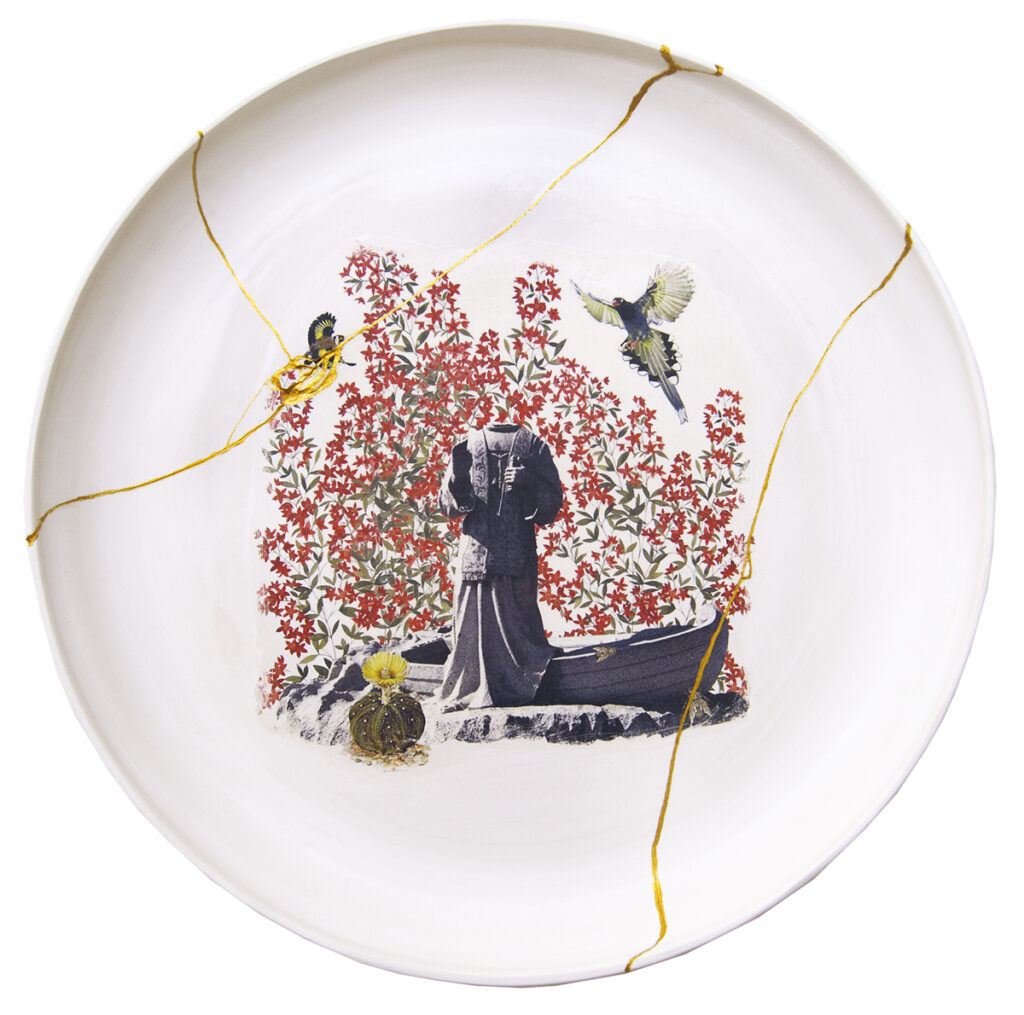
Plate 1
Commemoration of the Fall I
Collage, ceramic transfer, fracture and kintsugi by Cecilia Hurtado, 25 cm ø, 2021.
*Statue of Christopher Columbus, Christopher Columbus Waterfront Park, Boston, Massachusetts, USA. Marble statue, decapitated during vandalism in June 2020. Source: CBS News, “Christopher Columbus statue in Boston beheaded as Confederate monuments torn down,” June 10, 2020.
The Collapse of the Heroic Body
The beheading of the Christopher Columbus statue in Boston exposes the fragility of the heroic narratives once attached to his image. In the ceramic plate, the damaged monument is reimagined among botanical forms and small birds, where nature unsettles the authority of the colonial figure. The kintsugi repair highlights the fracture rather than resolving it, suggesting that the fall of these symbols opens space for other readings of history.
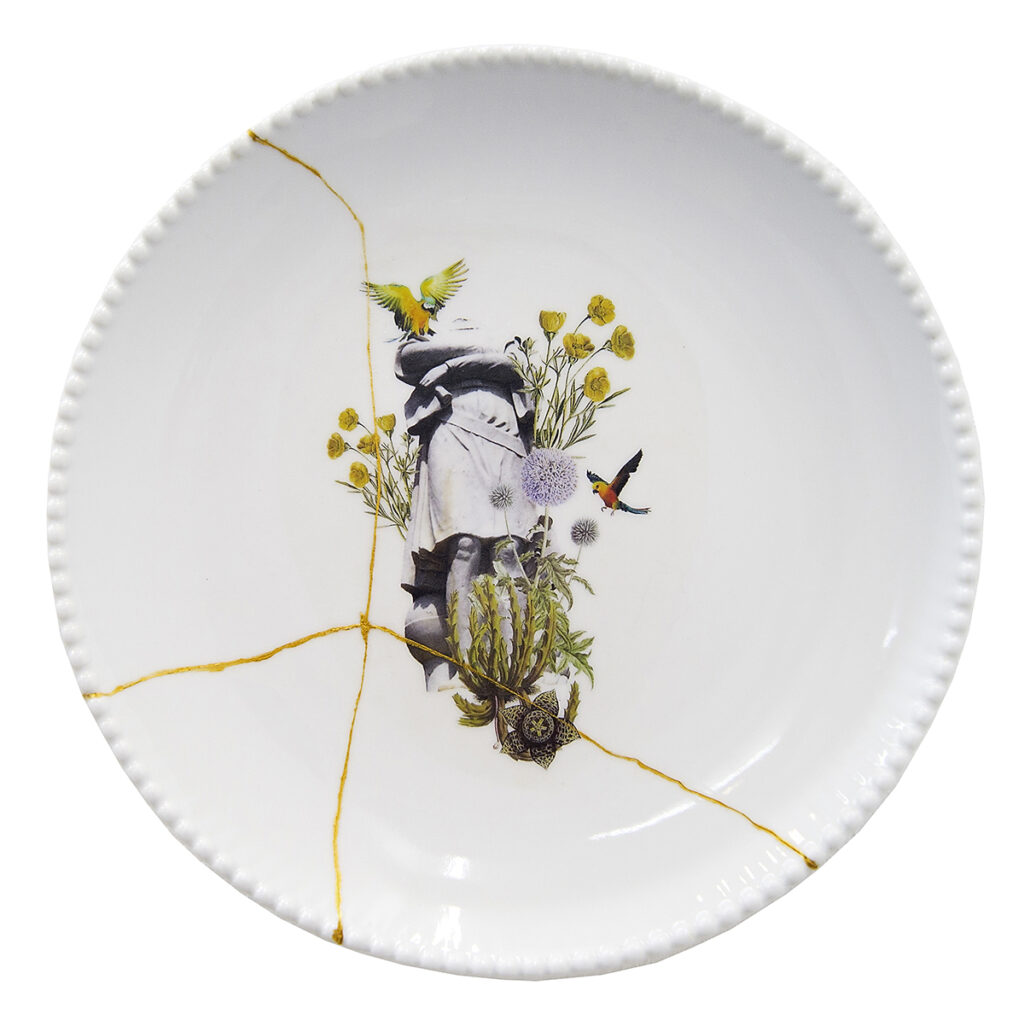
Plate 2
Commemoration of the Fall II
Collage, ceramic transfer, fracture and kintsugi by Cecilia Hurtado, 28 cm ø, 2021.
*Statue of Sir Henry Bartle Frere, Frere Hall, Karachi, Pakistan. Marble statue, decapitated during vandalism (documented 2016). Source: Dawn newspaper, “Frere Hall’s decapitated statue,” June 12, 2016.
Fracture as Disobedience
The decapitated statue of Sir Henry Bartle Frere marks a moment when colonial authority visibly collapses. In the ceramic plate, this damaged figure is reimagined within a field of vegetal and avian forms, where nature occupies the void left by the monument’s fall. The kintsugi repair highlights rather than resolves the rupture, proposing fracture as a way of reading the instability of historical power.
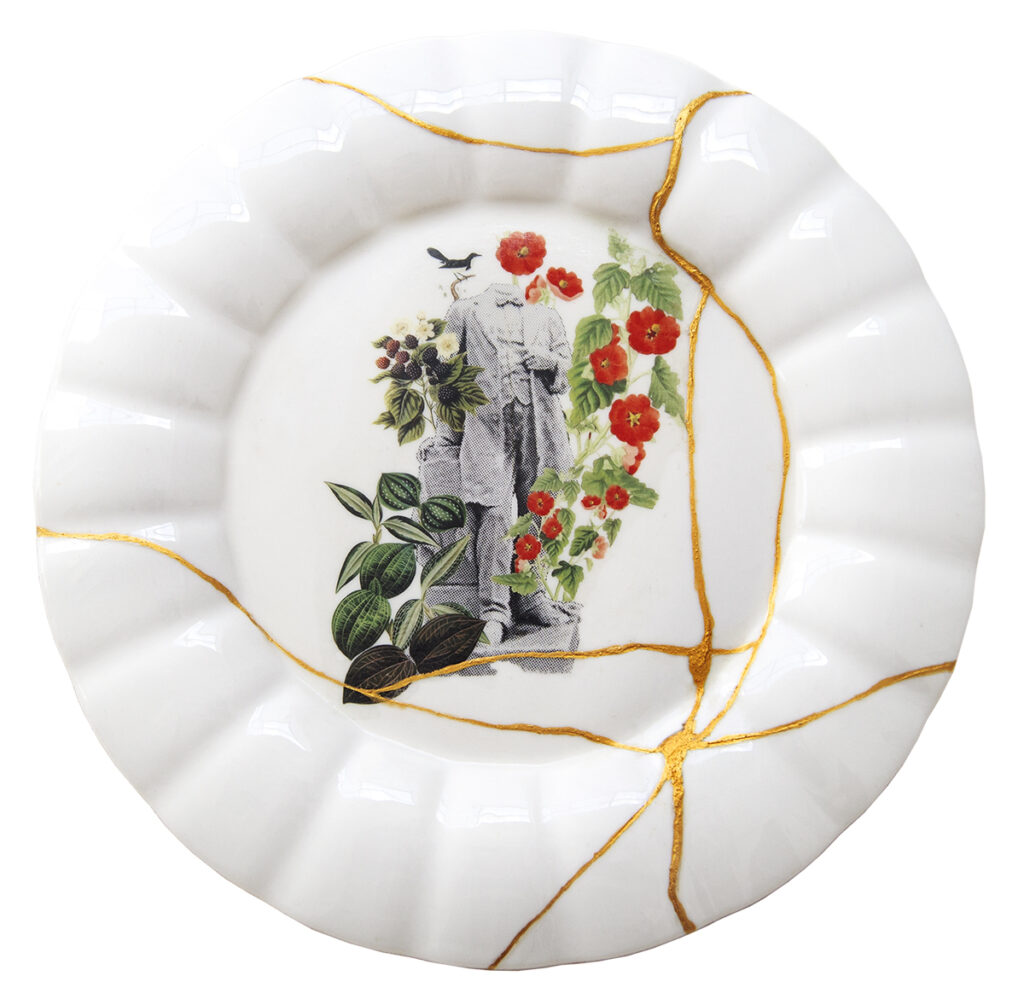
Plate 3
Commemoration of the Fall III
Collage, ceramic transfer, fracture and kintsugi by Cecilia Hurtado, 28 cm ø, 2021.
*Statue of Christopher Columbus, Waterbury Green, Waterbury, Connecticut, USA. Public monument decapitated during vandalism in July 2020; head restored later that year. Source: New York Daily News, “Christopher Columbus statue gets its head back in Waterbury,” December 3, 2020.
Restoration and Its Discontents
The beheading of the Columbus statue in Waterbury, and its subsequent restoration, reveals the tension between preserving contested monuments and acknowledging the histories they embody. In the ceramic plate, the fractured figure is surrounded by botanical forms that unsettle the logic of repair. The kintsugi seams foreground the rupture rather than the restoration, suggesting that the return to wholeness is neither possible nor desirable when the narratives behind these monuments remain unresolved.
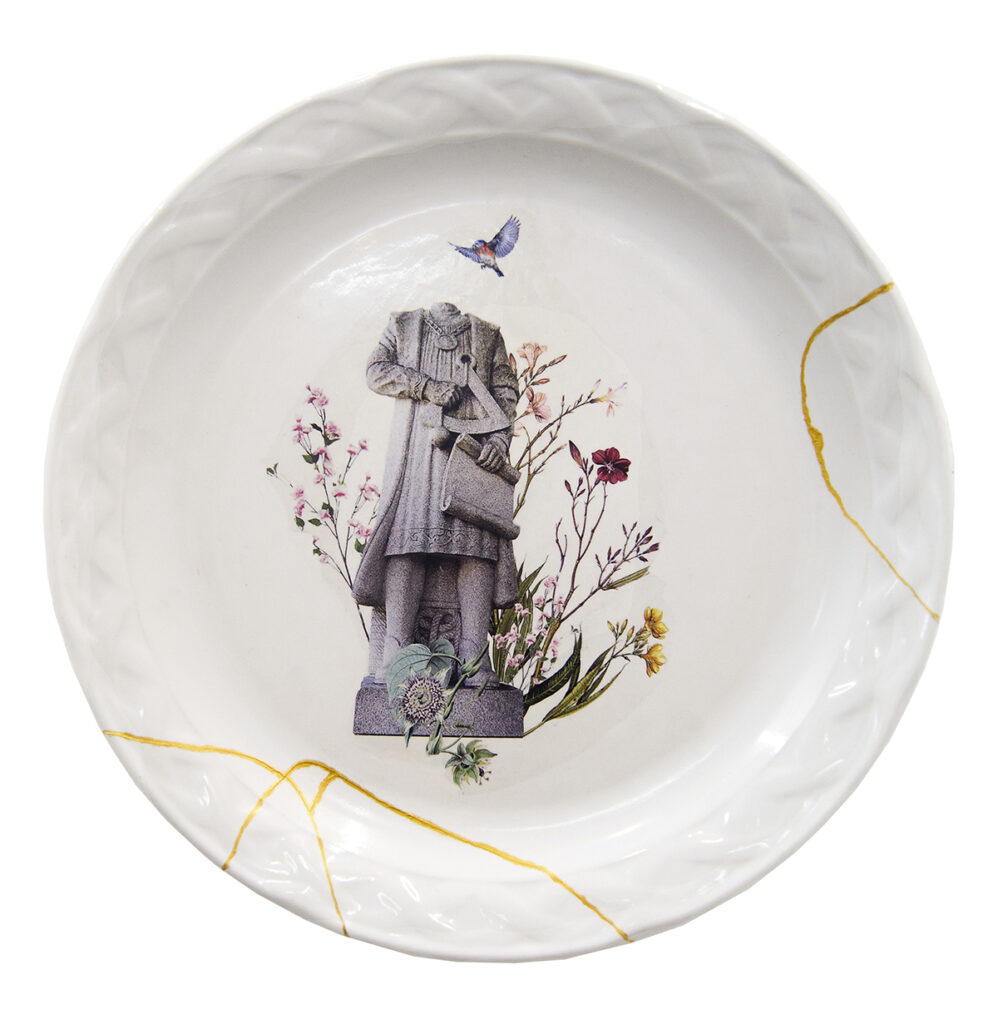
Plate 4
Commemoration of the Fall IV
Collage, ceramic transfer, fracture and kintsugi by Cecilia Hurtado, 22 cm ø, 2021.
*Statue of Yoichi Hatta, Wusanto Reservoir, Tainan, Taiwan. Public monument decapitated during a politically motivated act of vandalism on April 16, 2017. Source: public online documentation of the incident.
The Political Wound
The beheading of the Yoichi Hatta monument in Tainan reveals how public sculptures become sites where competing histories collide. In the ceramic plate, the headless figure is transformed by botanical forms that emerge from the wound, shifting the focus from political retaliation to processes of regeneration. The kintsugi repair underscores the fracture as a space of tension, where memory is contested and reconfigured rather than restored.
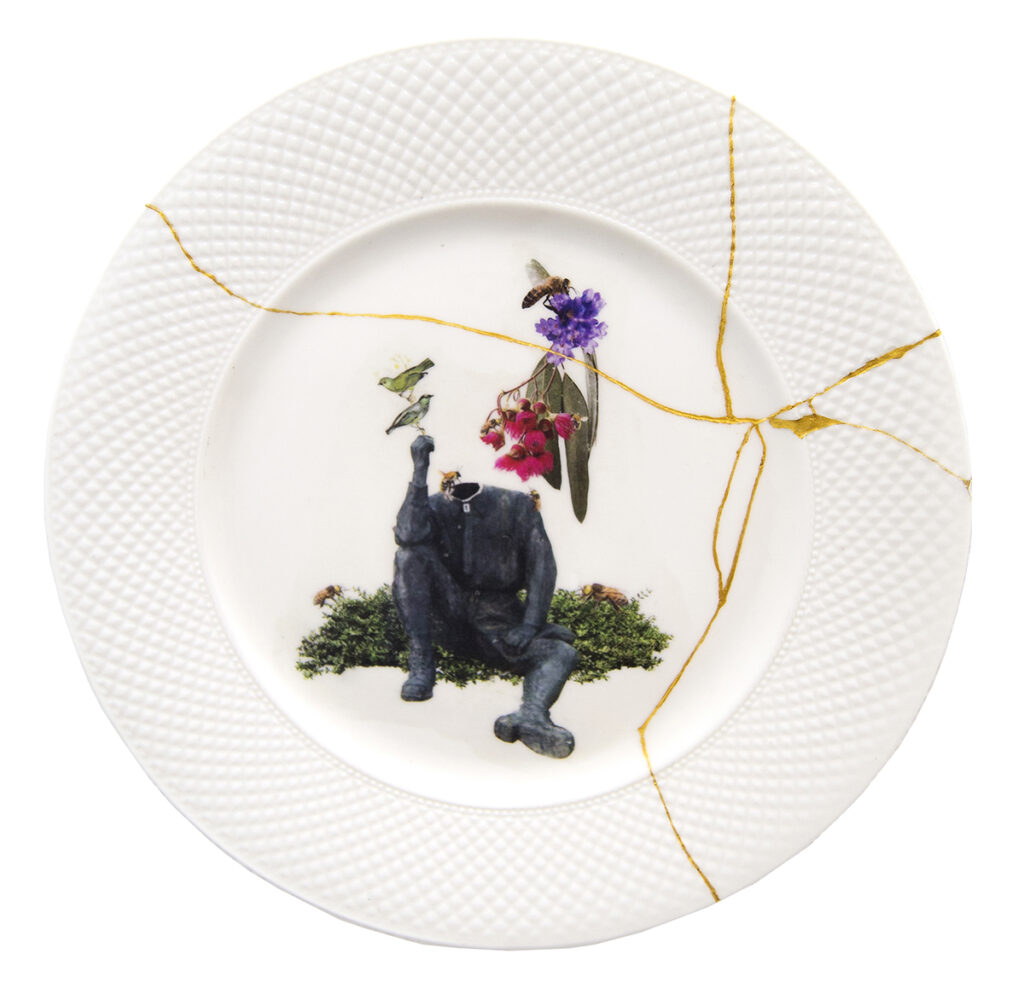
Plate 5
Commemoration of the Fall V
Collage, ceramic transfer, fracture and kintsugi by Cecilia Hurtado, 25 cm ø, 2021.
*Headless Roman-style statue, Palatine Hill (Orti Farnesiani), Rome, Italy. Classical sculpture displayed outdoors among the archaeological remains of the imperial palaces.
Ruins Within Ruins
This headless classical figure, encountered on the Palatine Hill, embodies the layered erosion of Rome’s imperial past. In the ceramic plate, the fragmented body is surrounded by birds and plants that soften the monument’s authority, shifting it from relic to living surface. The kintsugi repair highlights the fracture as part of the landscape itself, where history persists not through completeness but through the traces that remain.
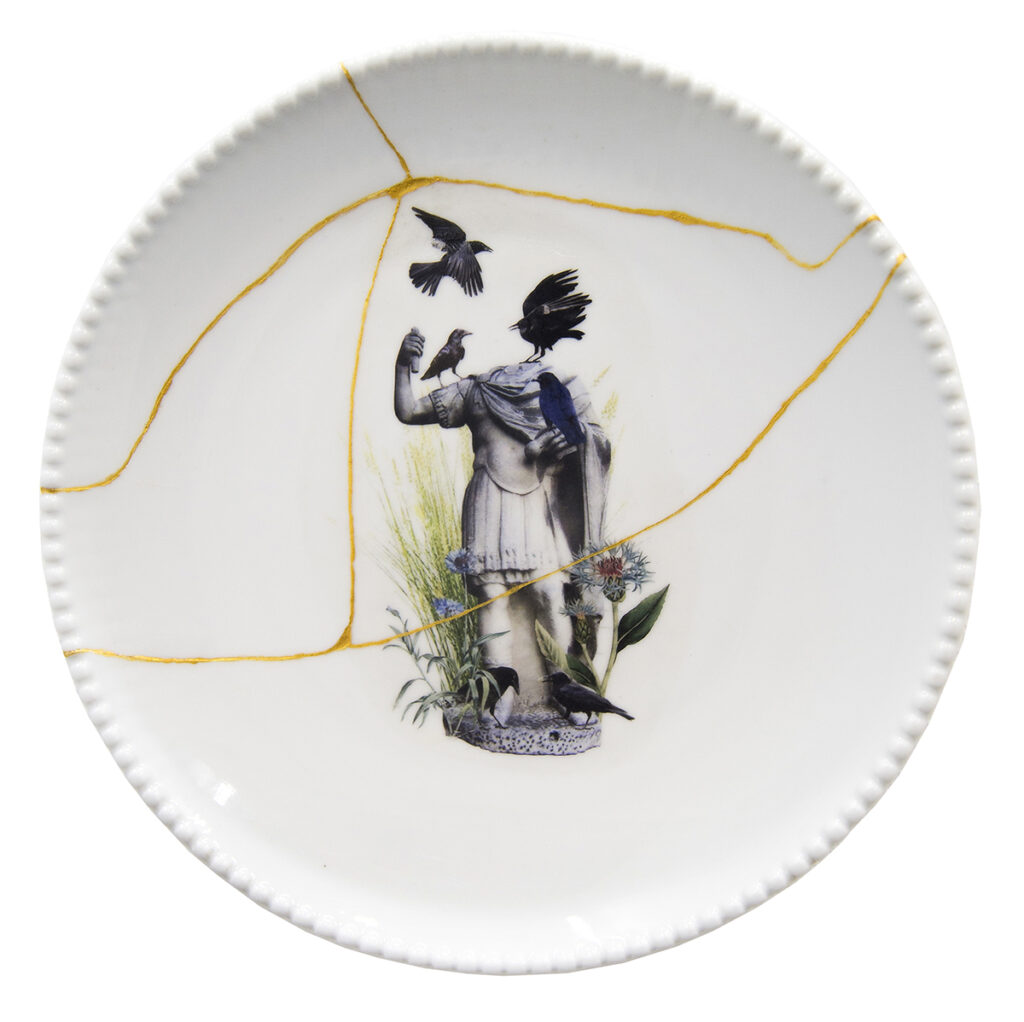
Plate 6
Commemoration of the Fall VI
Photograph by Cecilia Hurtado, 2020. Collage, ceramic transfer, fracture and kintsugi by the artist, 28 cm ø, 2021.
*Fragment of a headless monumental statue, Enthüllt. Berlin und seine Denkmäler, Zitadelle Spandau, Berlin, Germany. Historical sculpture removed from public space and preserved as part of Berlin’s collection of displaced monuments.
Displaced Histories
This fragment from Berlin’s collection of displaced monuments reveals how political shifts leave their marks on the bodies of public sculptures. In the ceramic plate, the headless figure is reimagined among birds and foliage, softening the monument’s former authority. The kintsugi repair highlights the fracture as a site where history is not erased but exposed, inviting new readings of what remains.
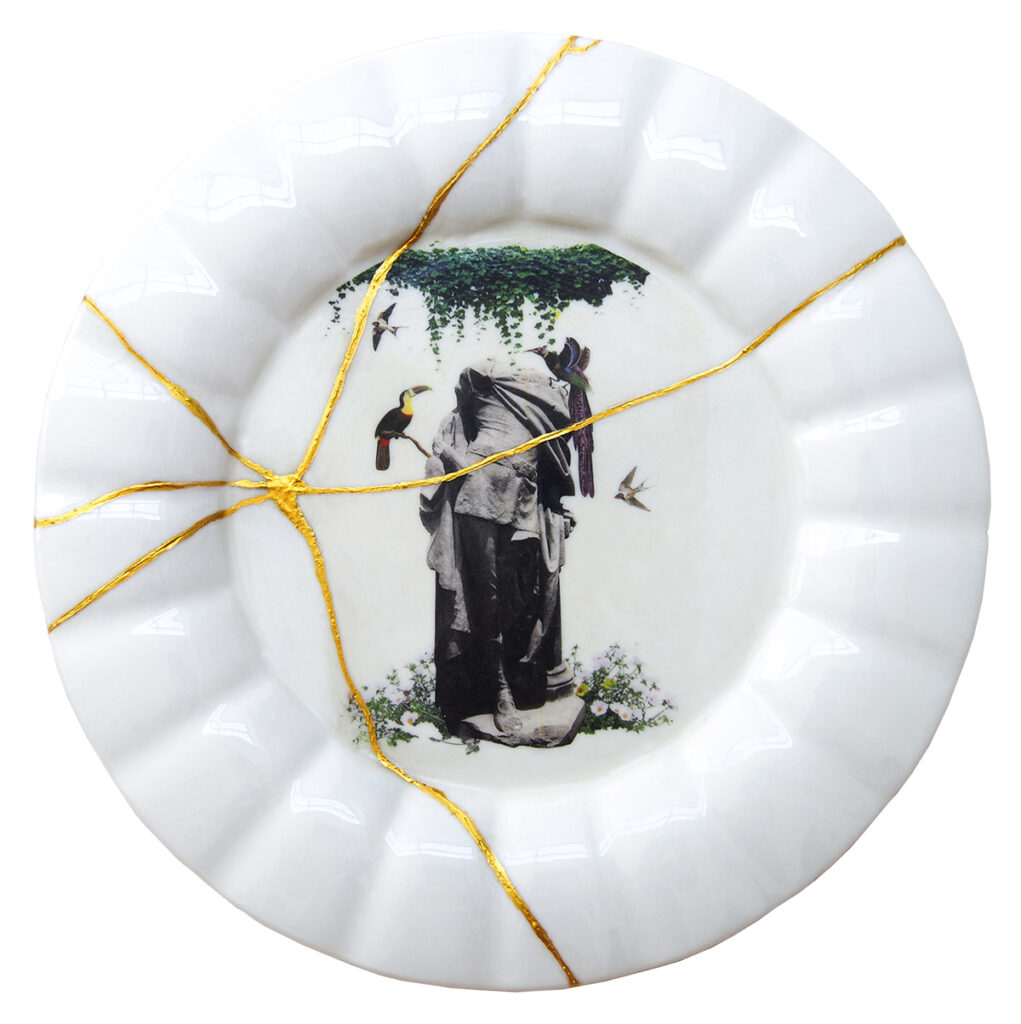
Plate 7
Commemoration of the Fall VII
Collage, ceramic transfer, fracture and kintsugi by Cecilia Hurtado, 28 cm ø, 2021.
*Torso of Asclepius, marble sculpture, 1st century BCE. Classical fragment representing the Greco‑Roman god of medicine, Archaeological Museum of Thessaloniki, Greece.
The Healing Fragment
This fragment of Asclepius, the Greco‑Roman god of medicine, carries the long history of bodies restored, worshipped, and broken again. Encountered in the Archaeological Museum of Thessaloniki, the torso becomes a reminder of how ancient healing cults survive only through what time allows to remain. In the ceramic plate, birds and foliage soften the divine authority of the figure, while the kintsugi repair reframes the fracture as a site of renewal rather than loss.
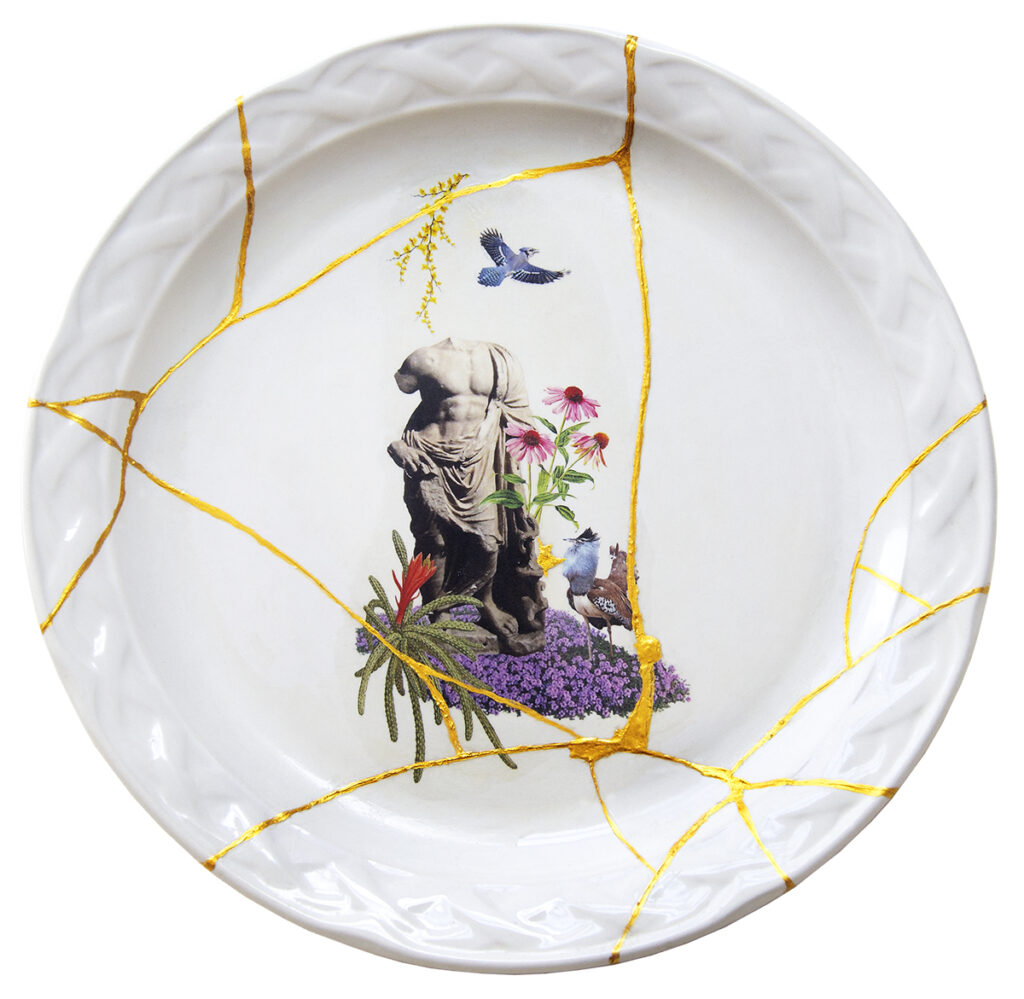
Plate 8
Commemoration of the Fall VIII
Collage, ceramic transfer, fracture and kintsugi by Cecilia Hurtado, 19 cm ø, 2021.
*Headless Roman-style statue, Palatine Hill (Orti Farnesiani), Rome, Italy. Classical sculpture displayed outdoors among the archaeological remains of the imperial palaces. (alternate view of the monument).
The Repeated Body
Seen from another angle, the headless figure on the Palatine Hill reveals how repetition alters perception. The second view does not simply document the same monument; it exposes new fractures, new gestures, new absences. In the ceramic plate, the mirrored posture becomes a quiet echo, where birds and foliage soften the ruin while the kintsugi seams insist on the persistence of the wound.
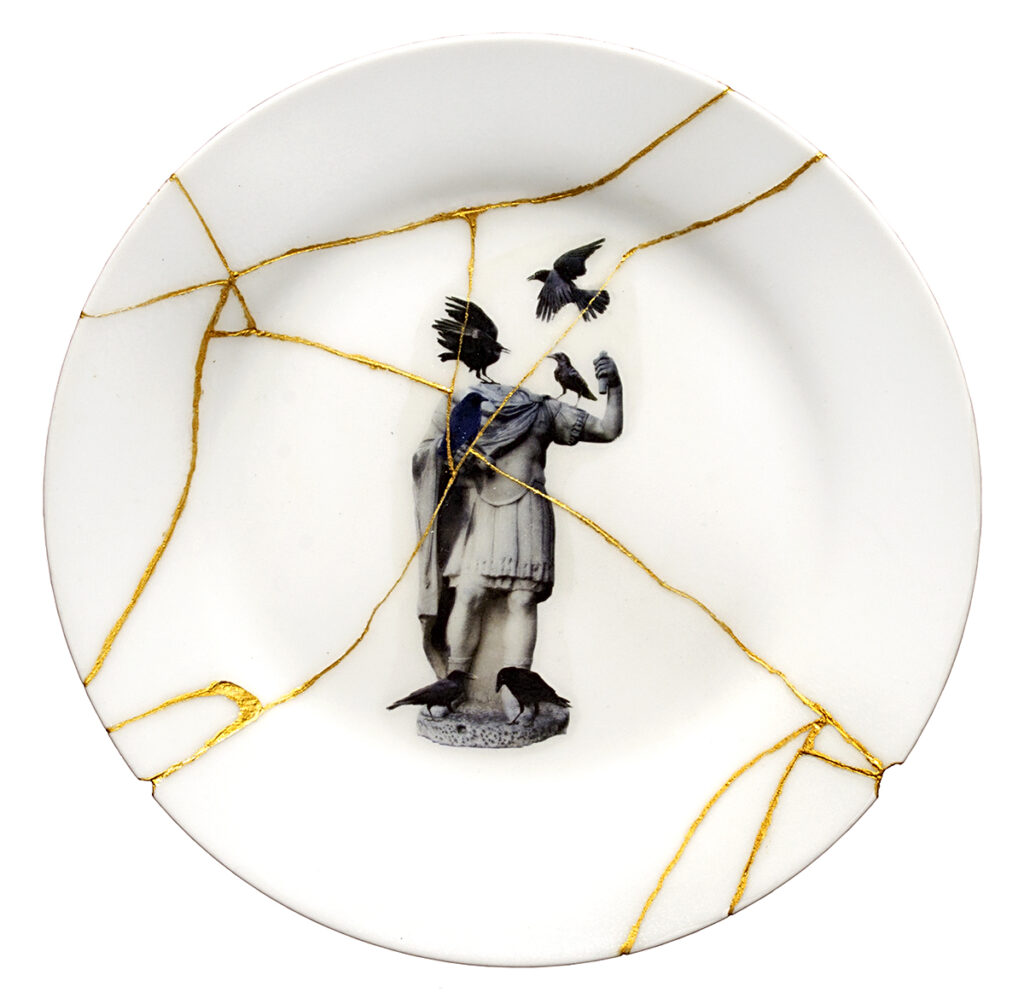
Plate 9
Commemoration of the Fall IX
Collage, ceramic transfer, fracture and kintsugi by Cecilia Hurtado, 35 cm ø, 2021.
*Severely damaged statue of Saddam Hussein, photographed in southern Iraq during the 2003 U.S.-led invasion (Operation Iraqi Freedom). Concrete and metal monument partially destroyed during armed conflict; only the legs and part of the torso remain standing.
The Fall of the Icon
The shattered statue of Saddam Hussein, photographed in southern Iraq during the 2003 invasion, reveals how war dismantles not only regimes but the symbols that once upheld them. The broken monument, reduced to legs and fragments of a torso, stands as a material record of political collapse, a reminder that the images of power are often the first casualties when authority falls. In the ceramic plate, birds and foliage soften the violence of the scene, while the kintsugi seams underscore how destruction becomes part of the monument’s afterlife, marking the point where history ruptures and begins again.
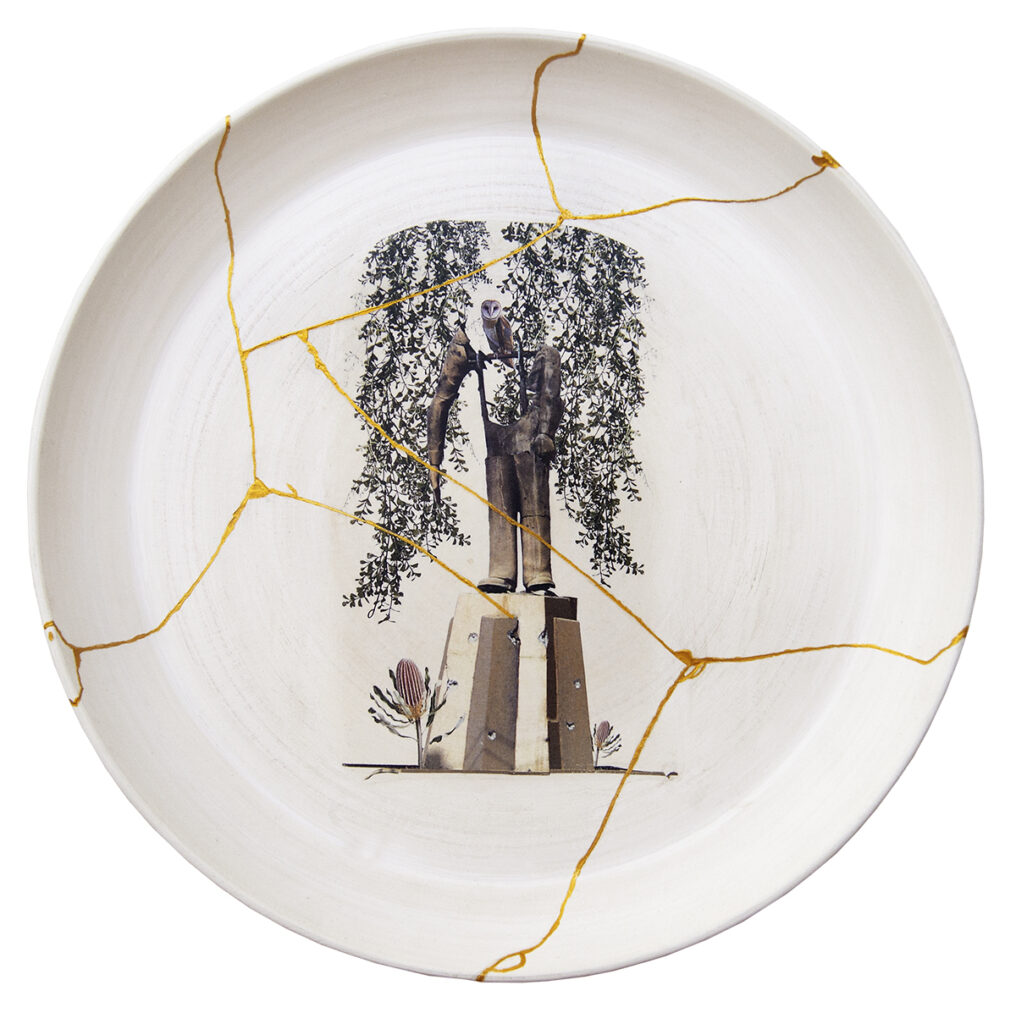
Plate 10
Commemoration of the Fall X
Collage, ceramic transfer, fracture and kintsugi by Cecilia Hurtado, 35 cm ø, 2021.
*Monument to Fray Junípero Serra, Lower Presidio Historic Park, Monterey, California, USA. Granite monument erected in 1891 by Jane L. Stanford to commemorate Serra’s landing in Monterey on June 3, 1770. The statue was decapitated in October 2015 during an act of protest linked to debates over Serra’s colonial legacy.
The Sacred Violence
The decapitated figure of Fray Junípero Serra stands as a reminder of how religious expansion in the Americas operated as a tool of colonial domination. Behind the image of the missionary lies a history in which evangelization was inseparable from the displacement, coercion, and cultural suppression of Indigenous peoples. The beheading of the monument echoes the unresolved wounds left by a system that framed conquest as spiritual salvation. In the ceramic plate, birds and flowers soften the monument’s authority, while the kintsugi seams mark the fracture where faith, power, and violence converge.