This article examines the collage series Traumatic Updates of Debret (2020–24) by Gê Viana, focusing on the artist’s interventions in lithographs from Jean-Baptiste Debret’s Voyage Pittoresque et Historique au Brésil (1834–39). I investigate how practices of cutting, pasting, and reassembling disrupt racial iconographies and their continued role in shaping racialized visual archives in Brazil.
Drawing on Stuart Hall’s notion of the “archives of racial difference” and Ariella Azoulay’s call to “unlearn” imperial visual practices, I argue that Viana’s collages expose procedures through which race was produced in nineteenth-century representations of Brazil, while transforming the archive into a space of contestation and political imagination. The article further proposes collage not only as an artistic practice but also as an epistemological approach to colonial archives, emphasizing its material and corporeal dimensions and its capacity to reimagine Black memory and presence.
In The Masters and the Slaves (Casa-Grande e Senzala, 1946), a classical work on Brazil’s sociocultural formation, Gilberto Freyre states that to be able to understand the country’s social history, no sources are more reliable than the travel books written by foreigners.[1] The author cites northern travelers who described and portrayed both daily life and the geomorphological, zoological, and botanical features of the Portuguese colony from the sixteenth to the nineteenth centuries. Freyre’s statement emphasizes the historical importance of these records in the country’s social memory, while also pointing to underlying issues concerning the legitimization of the colonial archive, as consolidated through what Mary Louise Pratt terms “imperial eyes.”[2]
This vast interdisciplinary mosaic of books, documents, paintings, photographs, and songs, known as the Brasiliana Collection, seeks to record both what was seen and how Brazil was perceived at different historical moments. The fact that much of this archive, especially its pictorial works from the colonial period, was produced by foreigners is crucial to reinterpreting these representations, raising questions of how the land and its people were portrayed and which images still persist. In depicting enslaved people and colonial subjects, certain iconographies have contributed to “repertoires of representation” that, as Stuart Hall has argued, function to construct and stabilize racial difference through the production of the racialized “Other.”[3]
Within this context, Afro-Indigenous Brazilian artist Gê Viana employs cuts and displacements to intervene in some of Brazil’s iconographies.[4] On the bicentennial of Brazil’s Independence in 2022, Viana’s works featured in exhibitions that revisited historical processes from 1822 to the present and critically engaged the Brasiliana Collection and its contemporary rearticulations. Among them was Atualizações Traumáticas de Debret or Traumatic Updates of Debret (2020–24), a digital collage series reworking Jean-Baptiste Debret’s 1834–39 Voyage Pittoresque et Historique au Brésil, whose lithographs remain central to Brazilian visual culture.
In this article, I investigate how two works from Traumatic Updates of Debret interact with and confront the racialized constructions articulated by Debret’s visual and textual work, which contributed to the formation of the “archives of racial difference” across the colonial period and consolidated an enduring iconography of “Brazil.”[5] Focusing on the practice of cutting, pasting, and reassembling, I examine how Viana’s collages destabilize these archives, exposing the visual practices of empire and their ongoing effects, as Ariella Azoulay suggests.[6] My analysis also considers the tensions between Debret’s images and Viana’s interventions and formats chosen for displaying the collage series.
Viana’s artistic practice constitutes a methodological and epistemological approach: collage functions as a mode of handling, reading, and confronting the iconographies of colonial Brazil across both aesthetic and political dimensions. In doing so, it also brings into view procedures of fragmentation and displacement that already underlie these iconographies. This is the case with Debret’s watercolors, which were composed through the calculated arrangement of figures and background scenes across multiple planes within a single composition.[7]
I argue that Viana’s practice fosters a critical—and embodied—way of thinking about the construction of race from the colonial period to the present. This embodiment is twofold: on the one hand, it emerges from collage itself as a material, bodily practice; on the other, it does so from engagement with the visual archive, as its archival status shapes how it is preserved, circulated, and interpreted, leaving material traces on subjects, and thereby producing historical meaning.[8] Here, I propose that Traumatic Updates of Debret not only exposes the violence embedded in Brazil’s visual history but also redirects attention to the materiality and corporality of the archive itself. No longer fixed or untouchable, the archive emerges as a site of contestation and agency, shaped by the very material and visual conditions that structure the “archives of racial difference.”[9]
A “Brazilian” Dinner
Among the most circulated images of nineteenth-century Brazil are the lithographs of French painter Jean-Baptiste Debret, published in Voyage Pittoresque et Historique au Brésil (1834–39), a three-volume record of visual and textual impressions from his time (1816–31) with the French Artistic Mission. Financed by King João VI to establish an academy of arts in Rio de Janeiro and introduce French Neoclassical training, the work spans Portuguese court events and scenes of daily life, combining images and commentary on landscapes, clothing, tools, religious practices, festivals, and social types. As Lilia Schwarcz observes, Debret’s project constitutes a kind of “ethnography of slavery” while reflecting tensions between the European “civilizing” gaze and the attempt to portray the colony as “picturesque.”[10] According to her, these tensions emerge through a simultaneous tendency to aestheticize scenes of enslavement, celebrate the monarchy and the elites who sponsored the artist, and subtly expose the violence of captivity.
In the introduction to the second volume of Voyage Pittoresque, Debret states his aim of tracing “la marche progressive de la civilisation au Brésil” (the progressive course of civilization in Brazil). The work begins “by reproducing the instinctive tendencies of the savage Indigenous person and seeking, step by step, their progress in imitating the industry of the Brazilian settler, himself heir to the traditions of his mother country.”[11] Echoing the structure of European naturalists’ travel accounts, Volume I opens with descriptions of Brazilian fauna and flora, including Indigenous populations and their tools, clothing, and everyday practices. In doing so, it brings ethnographic observation in close proximity with the classificatory logic of natural history and narrates cultural and racial difference through notions of progress, inheritance, and civilizational hierarchy.
Following its progressive logic, the first volume of the book describes botanical species and Indigenous populations, while the second focuses on what Debret calls “the customs and habits of civilized Brazilians.” At this stage, the Brazilian population is described in its racial divisions, the different provinces of the country, and the city of Rio de Janeiro in particular—the seat of the Portuguese court since 1808 and place of the artist’s own arrival. This descriptive approach, marked by an explicit racial positioning common to Debret and among other travelers, contributed to the formation of what Hall describes as a repertoire of images of difference: the regime of representation through which “difference” is produced and made legible at a given historical moment.[12]
In the section Le Dîner au Brésil (Dinner in Brazil), the lithograph Le Dîner / Un Dîner Brésilien (The Dinner / A Brazilian Dinner) presents more than dining habits; it also depicts the social positions present in the scene. The image shows a white couple seated at a dining table set with meats and fruits, surrounded by Black servants. Among them, one fans the lady, who, while seated, offers food to a naked Black child on the floor beside another who is distracted by eating. Behind the table, two male servants stand with crossed arms, observing the meal. The couple exchange no glances and share no interaction. No gaze meets another in the image. According to Debret’s description:
In Rio de Janeiro and in all other cities of Brazil, it is customary, during the tête-à-tête of a marital dinner, for the husband to silently tend to his affairs, while the wife amuses herself with her little negroes, who replace the almost extinct family of little pug dogs in Europe. These little rascals, spoiled until the age of five or six, are then handed over to the full tyranny of the other servants, who tame them with whip strokes and thus train them to share with the servants the hardships and unpleasantness of service.[13]
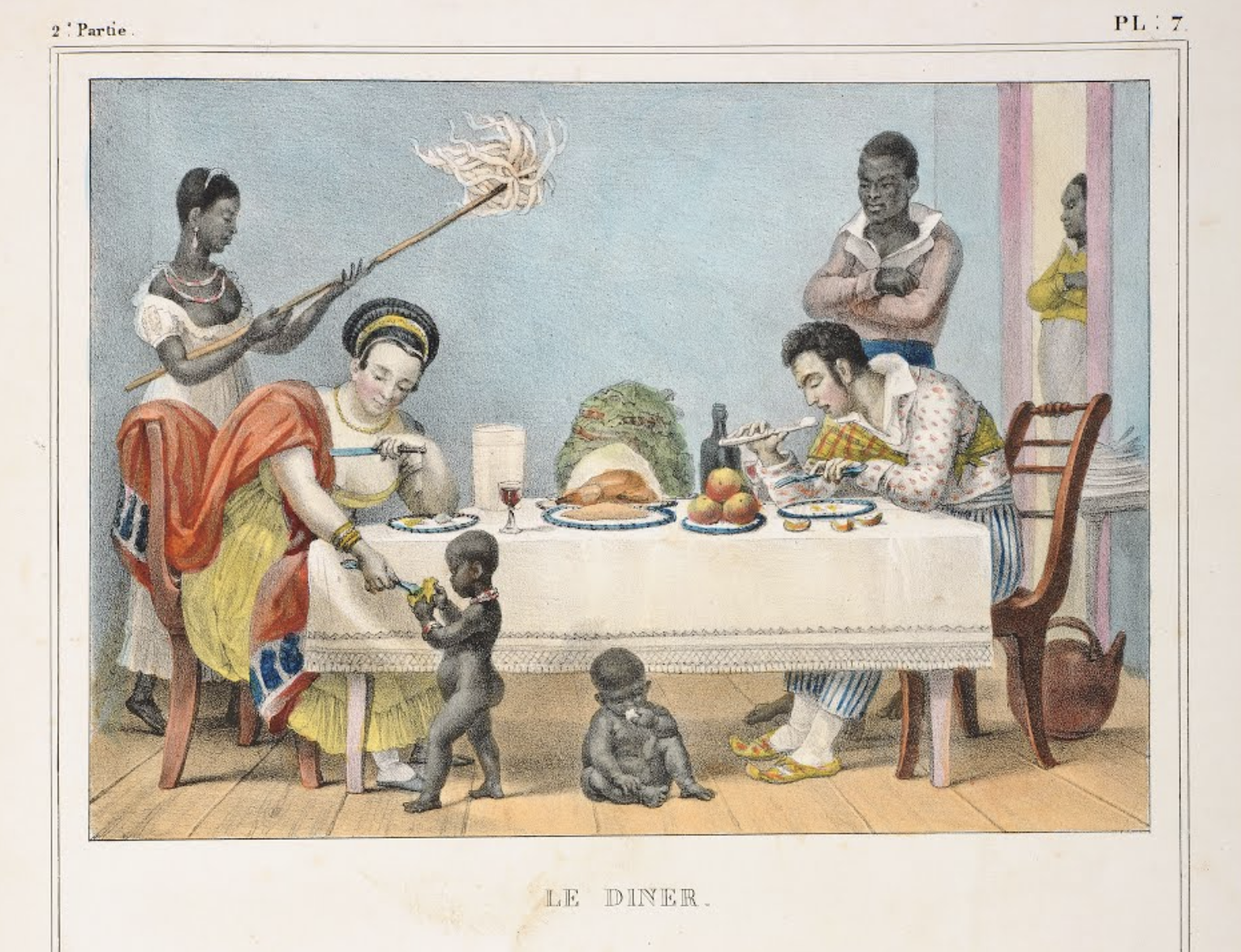
In Debret’s account, Black children appear to be “well treated” until the moment that they are handed over to other servants, the “true” enforcers, who whip them before white onlookers. Violence, or rather the “hardships” of service, is thus displaced onto these servants, while whites are portrayed as reluctant witnesses. The narrative naturalizes punishment as the enslaved children’s “inevitable fate,” absolving the masters of responsibility. Within this perspective, Debret stresses that the children fall under the servants’ “tyranny,” framing violence as their exclusive duty. By dissociating slaveholders from the immediate enactment of violence, this moral divide simultaneously directs an implicit critique toward the colonial ruling class. Debret’s lithograph presents an elite that does not look at itself and appears incapable of recognizing its own implication in the system it upholds. Such a representation points to the ways in which criticisms of the colonial order were surfacing in Europe during this period.
Beyond social relations, Debret also offers a detailed inventory of the dinner table, describing its components in a strongly evaluative manner that seems to both catalog and qualify the meal as “typically” Brazilian. The passage moves through soups, meats, side dishes, fruits, and beverages, emphasizing abundance, mixture, and sensory intensity, from richly prepared broths and heavily spiced dishes to elaborate arrangements of fruits and desserts. The author not only lists food items but assigns value to them, oscillating between appreciation and estrangement in the depiction of local flavors and preparations.
This descriptive strategy constructs the meal as a kind of visual and sensory taxonomy, in which local produce is both enumerated and aestheticized. The list of fruits, for instance, recalls Debret’s lithograph Fruits du Brésil (Fruits of Brazil) (1839), which similarly operates as a visual inventory.[15] At the same time, the emphasis given to Madeira and Porto wines in the description, alongside imported delicacies from Holland and England, introduces a clear hierarchy of taste in which European products subtly function as markers of refinement and “civilization” within the Brazilian context.
The description of foods and fruits, as well as of Indigenous and Black bodies, ornaments, and customs, is part of a broader system of classification and ordering of nature, which intertwines cataloging practices, colonial values, and projects of visual and scientific domination. The impact of the Swedish naturalist Carl Linnaeus’s methodology should also be considered, as he developed a system for organizing the elements of nature (Systema Naturae, 1735) based on classifications grounded in plants’ reproductive structures.[16]
Linnaean taxonomy circulated widely across European scientific and colonial networks, shaping the production of travel accounts from the eighteenth century onward. It has also underpinned the exploitation of nature as a resource, enabling its passage from naming to commodification.[17] In the Brazilian context, this classificatory logic later informed nineteenth-century museum practices, where natural history exhibitions sought to visually “translate” nature according to Linnaean principles of order.[18] Such practices were closely tied to emerging nation-building projects, as natural history collections became dispositifs for articulating ideas of the “national being.”[19] They have also shaped modes of observing, ordering, and describing both nature and human groups, thus contributing to the production of racial hierarchies.
The same classificatory logic extends to Debret’s travel accounts and portrayals of Brazil. Like other European travel narratives in Latin America, Voyage Pittoresque belongs to a broader corpus of texts and images tied to what Pratt describes as the “search for commercially exploitable resources, markets, and lands to colonize.”[20] Within this framework, Debret’s visual descriptions, shaped by both their content and the objectives of his mission in Brazil, participate in the consolidation of a European project of representation that not only constructs the image of the colony but also stabilizes racial and social hierarchies.[21]
Although published alongside his travel narrative, the lithographs circulate independently of textual commentary or captions, a condition that intensifies their apparent self-evidence that requires no accompanying explanation. As Hall argues in relation to eighteenth- and nineteenth-century visual culture, representations of slavery often render relations of domination self-evident, producing what appears as a “natural order” in which, for instance, “white men should sit and slaves should stand.”[22] It is precisely this allegedly “natural” character of Debret’s iconography—its role in fixing racial hierarchies through the depiction of Black bodies—that Traumatic Updates of Debret interrogates.
Reassembling Debret
In the digital collage series Traumatic Updates of Debret (2020–24), Gê Viana performs a set of interventions on lithographs from Voyage Pittoresque, overlaying them with images from diverse sources. Focusing on altering the ways in which Black bodies are represented in these iconographies, the collages rework how these figures are positioned within scenes associated with everyday life in early nineteenth-century Rio de Janeiro.[23] In a way, the operation of Viana’s work is a return to Debret’s lithographs, echoing the question articulated by Hall, “how was this archive formed and what were its typical figures and practices?”[24]
Traumatic Updates of Debret carries a deliberately provocative ambiguity in its title. “Traumatic” may refer both to the trauma of revisiting images of colonial violence and to the impact on contemporary viewers, confronted with disruptions to expectations that position non-white subjects as subordinate. The series questions the notion of a “faithful” depiction of nineteenth-century Brazil, reinforced by readings of Debret’s lithographs as a “faithful historian of João VI’s Brazil and the First Reign.”[25]
In Viana’s reinterpretation of The Dinner, the white couple and various objects on the table are removed. Sentem para Jantar (Sit Down to Dinner) (2021) re-enacts Debret’s lithograph by removing, shifting, and adding elements to the dinner scene.[26] In place of the seated man and woman, the formerly enslaved man, previously depicted with crossed arms, now sits on the right side of the table. The enslaved woman, who was fanning the lady, now occupies the left end and passes a bowl to the others, while the child who was once on the floor eating scraps is now seated on her lap. The child who previously received food from the lady is now dressed and playing a video game. The presence of this device introduces a flash of the present into the scene, bringing heterogeneous temporalities into coexistence within the same visual field. It also points to the right to leisure, denied to the children represented in Debret’s composition.
Another instance of temporal and geopolitical convergence is the figure of Omar Ibn Said, a Muslim scholar captured in Senegal and enslaved in the United States in 1807. Positioned at the center of the image, Said is known for having written an autobiography in Arabic during his enslavement. Said’s inclusion exceeds a strictly national frame, pointing to a broader Atlantic world of slavery across the Americas and situating Brazil within interconnected diasporic formations, knowledge production, and visual regimes. In this sense, his presence shifts the scene from a representation of colonial domesticity portrayed as strictly national toward a transatlantic field of memory. Said’s presence functions as a flashpoint through which enslaved intellectual production emerges within the European gaze, potentially interrupting and reconfiguring dominant visual and epistemic orders.
Other additions further expand the scene’s temporal and symbolic horizons. Through the open window, a woman appears to be walking freely across the landscape, introducing a sense of movement and autonomy absent from Debret’s enclosed domestic space. In addition, the framed photograph on the wall suggests the possibility of preserving familial and ancestral ties that slavery systematically fragmented. The room is filled with objects still commonly found in low-income Brazilian households. A display cabinet contains a lamellaphone (or kalimba), a musical instrument rooted in diverse sub-Saharan African traditions and taken to Latin America through the forced displacement of enslaved Africans. Nearby, a statue of Saint George (São Jorge) accompanied by a candle evokes the saint’s significance within Afro-Brazilian religious traditions and its syncretic associations with the orishas (orixás) Ogum and Oxóssi. Other elements include a bottle of guaraná, a popular Brazilian soft drink made from an Amazonian fruit, as well as a wooden chapel, a dog, and a plastic pineapple placed on the table. Taken together, these additions reinforce the temporal, cultural, and racial stratification embedded in the colonial process. Rather than merely juxtaposing past and present, Viana’s composition stages the coexistence of distinct regimes of memory and visibility. It allows interrupted genealogies, diasporic histories, and alternative forms of sociality to emerge within and against Debret’s scene.
Sit Down to Dinner also dismantles the established image of the “Brazilian dinner” in its catalog-like nature, yet in doing so it intensifies the violence inscribed within it, as if staging the remains of a future that never came to pass. The title likewise transforms the work’s mode of address, becoming simultaneously imperative and invitational. In Sit Down to Dinner, the command seems to extend beyond the scene itself, interpellating the viewer as a potential participant.
This work reframes these visual archives beyond their status as “illustrations” of accompanying texts, emphasizing instead their active epistemic role. As Schwarcz suggests, such images should be understood as influential records that, while produced within specific historical and cultural contexts, also contribute to shaping and producing the very realities they depict.[27] Thus, in repositioning Black figures at the table, Viana restructures the scene, creating space for Black subjects who, in historical travel writing, were often rendered indistinct and undifferentiated, lacking individual names or distinguishing features.[28]
At the same time, although Sit Down to Dinner reconfigures Debret’s lithograph, it also highlights the gap between the place of belonging envisioned within the image and the persistent social non-place still experienced in Brazilian society. Far from only functioning as a gesture of “symbolic reparation,” the collage draws attention to the historical underrepresentation of Black lives and conviviality practices as dignified modes of visibility within Brazilian visual culture.
Other collages in the series also perform a critical displacement of canonical images from the colonial iconography, as in the reinterpretation of Petit Moulin à Sucre Portatif (Small Sugar Mill). In Debret’s lithograph, enslaved Black men operate a sugarcane mill, a crop central to Brazil’s colonial economy. The accompanying description emphasizes the direct dependence on enslaved labor and the integration of Black bodies with machinery in the production process—“the mechanism of this small model requires an additional Black man, positioned behind, to pass the cane already flattened between the other cylinder.”[29]
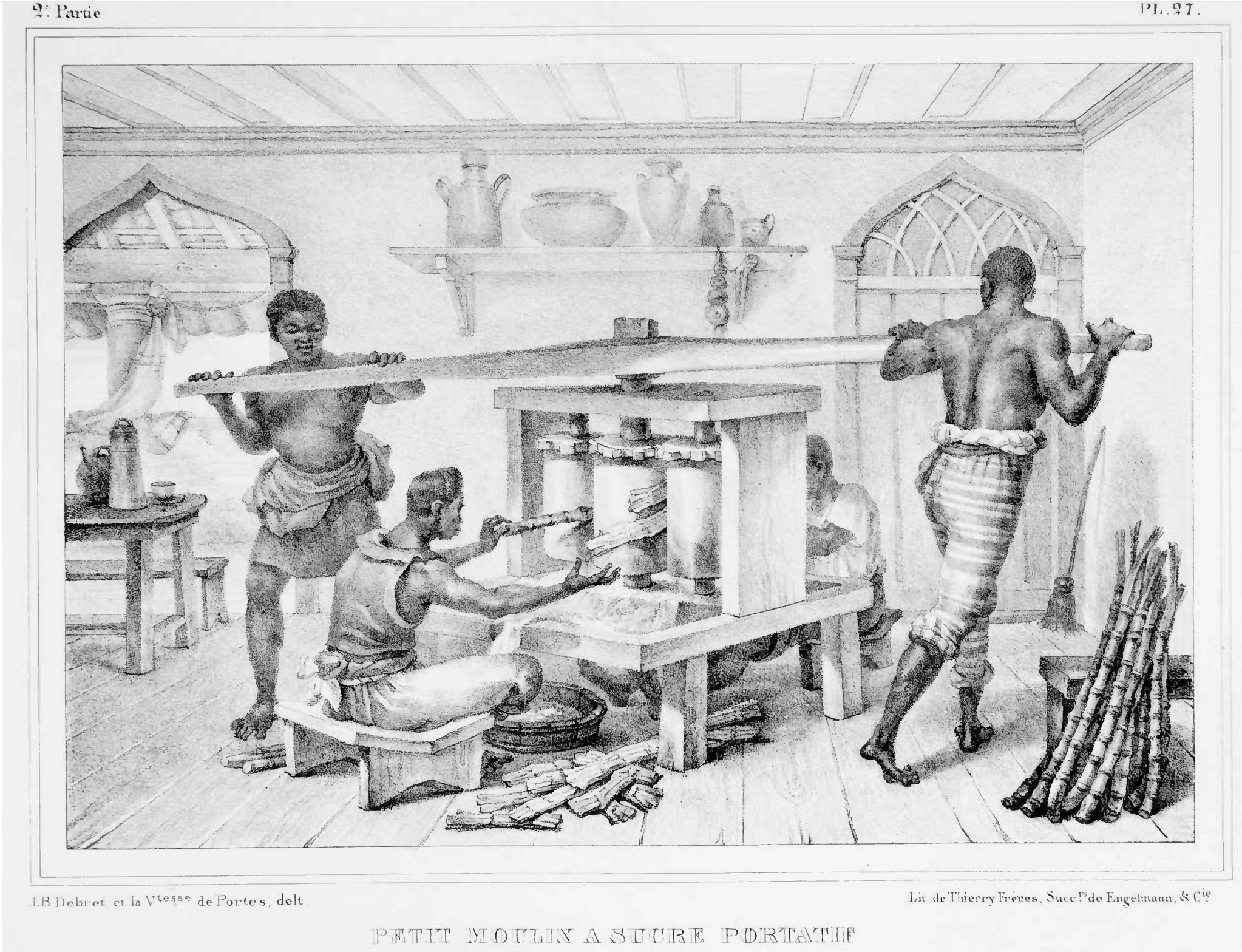
In Viana’s updated version, Cultivo de Cogumelos (Mushroom Cultivation) (2020), the colonial setting is radically transformed.[33] Bodies previously linked to the mill’s machinery are relocated to a different scene: the Black men depicted are involved in cultivating giant mushrooms. One holds branches of flowers; another, a bird in his hands—elements suggesting forms of engagement with the natural world not mediated by forced labor, but by relationships of care, sharing, and creation. The giant mushrooms themselves occupy the space of the sugarcane processed by the mill, displacing the logic of extraction that organized Debret’s image.
This substitution gains an additional layer of significance in light of Anna Tsing’s reflections on mushrooms as “anti-plantations.”[34] Whereas the plantation is organized around monoculture, extraction, and the interchangeability of human and nonhuman life, mushrooms emerge from relations of interdependence and multispecies collaboration, as Tsing argues. Unlike sugarcane, whose cultivation historically depended on the violent simplification of landscapes and labor, fungi develop through symbiotic processes of mutual nourishment. From this perspective, the oversized mushrooms occupying the center of Viana’s composition do not simply replace one element with another. They gesture toward a world structured by ecological and social relations no longer governed by plantation logic. Instead of functioning as commodities, they evoke other forms of knowledge and use, including recreational and psychoactive uses that exceed the utilitarian imperatives of plantation labor. Their enlarged scale and slightly fantastical appearance reinforce the speculative dimension of the image, suggesting that alternative forms of life and coexistence can be imagined from within the very archive that once naturalized slavery.
The pieces of selenite crystals on the ground replace the sugarcane ones in Debret’s scene and extend this process of visual transformation. Similar in shape and color to sugarcane, the crystal appears almost as a transmutation of the commodity that once organized the plantation economy. If sugarcane condensed the violence and exhaustion underlying colonial wealth, selenite crystals reorient these associations toward imaginaries of restoration and healing commonly associated with the stone in contemporary spiritual discourses. Through this displacement, an object linked to extraction is transformed into one associated with care, suggesting the possibility of reimagining material and symbolic relations inherited from slavery.
Alongside flowers and birds, the mushrooms and selenite crystals contribute to a fabulated and almost utopian atmosphere in which nonhuman elements become associated with delicacy, imagination, and alternative modes of inhabiting the world. Doors and windows that in Debret’s lithograph framed the domestic interior are now open to a beach landscape, which, intertwined with the act of cultivation, marks an optical expansion beyond the enclosed environment.
In engaging with colonial archives, Viana’s series takes up Hall’s question of whether repertoires of representation surrounding “difference” and “otherness” have remained intact or have been transformed in contemporary contexts. Cutting into Debret’s iconographies without deference, the collages intervene in the optical and representational regimes through which racial difference was historically constructed. They reposition figures once fixed as visual objects, displacing them from passivity, even as the perspective and framing imposed by Debret remain unchanged or only minimally altered.
In this sense, Traumatic Updates of Debret brings into view optical practices that historically attempted to naturalize race and gender in the “New World.” This gesture resonates with Ariella Azoulay’s theoretical proposition to “imagine that the origins of photography go back to 1492,” reframing photography not as a nineteenth-century invention but as an optical apparatus already active at the Spanish arrival.[35] For Azoulay, the inventions of both the New World and photography are intertwined, as visual technologies were central to naturalizing events, political rituals, bodies, social roles, and hierarchies of race and gender.
Following Azoulay’s proposition, the collage series treats the visual archives not merely as records of the violence of enslavement but also as devices that actively contributed to the construction of racial classifications, markers of subalternity, and representations that still operate today. Traumatic Updates enacts a critical displacement aligned with Azoulay’s call to “unlearn” these canonical archives and their optical naturalization of racial violence and stereotypes.
In this epistemic maneuver of reworking the lithographs, the collage prompts a return to Debret’s images, compelling the viewer to revisit them through its own visual operations. This return is not passive: it requires the viewer to mentally reassemble the procedures at stake—cutting, selection, displacement, and re-composition. The interpretive process thus mirrors the logic of the collage itself, as the viewer must continually place and replace figures and elements across both images. The act of looking becomes a form of re-enactment of the procedures through which the colonial archive was constructed. In this sense, the collage does not illustrate a method; it stages it. What emerges is a recursive relation between artwork and interpretation: the viewer’s engagement reproduces, at the level of reading, the same operations that govern its visual construction. They highlight, through pictorial materiality, how race is produced through the arrangement of visual building blocks. In other words, the critical encounter with Debret’s archive becomes structurally homologous to the logic of collage itself, rendering visible the mechanisms through which racialized visual regimes were assembled in the first place.
Traumatic Updates demonstrates how the visual strategies of the Empire challenge the notion that the practices involved in large-scale imperial violence can be detached from that violence itself or positioned as external forms capable of accounting for it from the outside, as similarly critiqued by Azoulay.[36] In other words, this perspective constitutes a critique of the assumption that such practices are neutral or external to this context to the point of appearing capable of explaining it without participating in it. Within this perspective, the collages demonstrate how the violence of the gaze and representation manifests both materially and figuratively—and how it can be contested through acts of reappropriation and alternative modes of representation. Traumatic Updates not only challenges the apparent neutrality of these representations but also reinscribes other possibilities of interpretation within them. The artwork proposes that these bodies be represented differently from the status of captives, subverting the racial visibility regimes that structured colonial iconography.
Collage as an Approach to the (Racial) Archive
In Bello como la Flor de Cactus (As Beautiful as a Cactus Flower), Ana Porrúa reflects on the status of the image as montage, analyzing surrealist and Dadaist collages. The essay itself is structured as a critical and visual collage. Porrúa argues that montage has the capacity to intensify the qualities of the fragments it brings together, operating as a form of mediation that nonetheless produces discontinuity, since it does not aim to close the fissures it opens.[37] This reflection illuminates Traumatic Updates of Debret, which works by fragmenting and reconstructing representations that helped sustain racial stereotypes in Brazil. Through this process of working with fragments, the collage series re-inscribes these images—piece by piece—within a critical reading of the visual (and historical) mechanisms that shaped iconographies of race.
The fissures opened by the collage also enable movement between different contexts and meanings. The cutting, a gesture that is both symbolic and material, allows the various components to preserve their distinctiveness or to be reassembled into a new configuration.[38] In producing rifts in the original composition, Traumatic Updates makes the artifice of representation visible, drawing particular attention to how those corporealities were constructed and from which perspective. While the original images already operated through cutting and displacement, stabilizing hierarchies and distances between observer and observed and fixing difference onto specific bodily features, Viana’s reconstructed scenes rework this same visual logic from within.
The reframing of Black figures from these visual archives into new compositions not only grants them a different form of “life” but also questions the very status of the archive. As Mbembe argues, the archive is defined by its capacity to function as an “instituting imaginary”—an entity that witnesses, records, and attests to the existence of something or someone.[39] However, this function only becomes possible through death: for Mbembe, the archive is a trace of what no longer exists, a testimony to disappearance. In this regard, attributing “archival status” to a document involves subjecting it to processes of selecting, cataloging, sacralizing, and storing. These procedures aim not only to preserve the past but, as the author notes, also to ensure that the dead do not disturb the order of the present.[40] In this sense, the archive is also “a death sentence, a tomb, a display of the violated body, […], an asterisk in the grand narrative of history,” as Saidiya Hartman proposes.[41] Viana’s assemblages reanimate figures condemned to violent regimes of representation, breaking with logics of mnemonic containment and allowing traces of the past to return as an active and politically unsettling presence in the present.
Another aspect discussed by Mbembe that resonates with Viana’s artistic practice—understood here as an epistemological proposition for reading and reworking racial archives in Brazil—concerns the material dimension implicated in “archival status.” Mbembe argues that this status entails an inscription of the archive within the realm of the senses, insofar as documents become objects that can be touched, seen, and read, thus engaging a tactile, visual, and cognitive experience of knowledge production.[42] At the same time, the author stresses that the archive does not culminate in its material presence; rather, its ultimate significance lies beyond it, in the narratives and histories it enables.
In this perspective, Viana’s approach to Debret’s lithographs operates on a dual level: on the one hand, an attentive engagement with the materiality, corporeality, and physicality of the images—both their surface, their “skin,” and the body handling them; on the other hand, an imaginative gesture that tests the limits of that materiality. In other words, one hand touches the materiality of these visual archives, breaking the “sacredness” of this archive-body, while the other shows how, through this iconographic materiality, racialized bodies are fixed and constructed in language. In a “critical fabulation” of images, borrowing from Hartman’s method, this intervention proposes alternative readings of the bodies represented, repositioning them in the present and rejecting the passive destiny imposed by the archival status.[43]
Drawing on Didi Huberman, Porrúa reflects on collage as capable of producing a “thought of images,” a form of craft of thinking that brings other temporalities into appearance within the present time.[44] Through selection, cutting, and combination, it becomes a form of thinking grounded in making, as Porrúa argues, from which we have become increasingly distanced. By reassembling iconographies, Traumatic Updates of Debret operates as a form of critique, since the archives are treated not merely as sources but as living material to be touched, cut, and rearranged. Thus, Viana’s interventions function as both making and thinking with and through images.
Collage as a way of thinking with the archives not only re-signifies images but also proposes a method of reading involving both the reader’s body and the body of the images. The interventions allow the handling and reenactment of the Brasiliana Collection and the visual imaginary of the “Brazilian people,” but through how they are often displayed they also encourage a process of “unlearning,” in Azoulay’s terms, in how these images are engaged with. Using wheat-pasting, Traumatic Updates of Debret was installed as part of multiple exhibitions: on walls in Maranhão, Viana’s birth state, and São Paulo. Some collages were applied over woven polypropylene or raffia bags, previously used for food or construction materials, further contrasting with the traditional supports of historical archives.
This material and spatial shift, from illustrated pages to city walls, denotes a critical distance from Debret’s lithographs and the institutional channels through which they circulated. Whereas nineteenth-century European travel books sought to establish and disseminate a specific image of Brazil to foreign audiences, Viana’s display strategies refuse such fixation, reappearing as insurgent interventions in public space. By using a display method that references the language of street propaganda, rooted in popular culture, Viana brings the collages into freely accessible urban spaces. Contrasting with the encyclopedic representation produced by Debret and other European travelers—structured by typification and distance for a foreign audience—the work enables viewers to encounter and re-signify the images, fostering a reinterpretation in dialogue with the passer-by’s body.
Like the sketches that preceded Debret’s lithographs, which required careful observation of colonial streets through walking, listening, and active visual engagement, collage involves bodily contact with images. While it is an optical operation, the procedures carried out by Viana foreground an embodied way of making as an interaction with the visual archives left by travelers—images by other travelers, including Johann Moritz Rugendas and Joaquim Guilhobel, are reworked in other series of collages. Viana’s practice emphasizes the presence of the body in its entirety in relation to these archives: the eyes that critically read the images, the hands that cut and reposition them, and the body that leafs through collections such as Voyage Pittoresque and moves through the streets to paste these altered images on city walls. This enacts a corporeal confrontation with the archives—both with the bodies fixed within them and with the materiality of the images—and a reading that unfolds with and through the body.
By breaking with the rigidity of colonial archives and reinscribing them in public space, the collages establish a collective and situated form of reading, bringing multiple bodies into an exercise of seeing, interpreting, and reimagining Afro-diasporic visualities. Traumatic Updates of Debret positions artistic procedures as a critical lens for engaging with Brazilian iconographies, exposing the processes through which they constructed the “Other.” At the same time, through the imagination of alternative bodies and racial representations, Viana’s work engages with the archive both materially and corporeally, disrupting the linearity of historical records and, as Hartman suggests, seeking to free these lives from the violent descriptions through which they were first made known. The archive ceases to function as a repository of traces documenting constructions of “racial difference” and becomes a field of contestation and imagination, from which other corporealities, histories, and presences can emerge.
Footnotes
- Freyre, Gilberto. The Masters and the Slaves: A Study in the Development of Brazilian Civilization. Trans. Samuel Putnam. New York: Alfred A. Knopf. 1946 [1933]. p. xlii. ↑
- Pratt, Mary Louise. Imperial Eyes: Travel Writing and Transculturation. London: Routledge. 1992. ↑
- Hall, Stuart (ed.). Representation: Cultural Representations and Signifying Practices. London: Sage. 2013 [1997]. p. 239. ↑
- Gê Viana (b. 1986), of Anapuru Muypurá ancestry, was born in Maranhão, northeastern Brazil. Viana holds a degree in Visual Arts from the Federal University of Maranhão (UFMA) and was awarded the PIPA Prize in 2020. The artist has exhibited extensively in Brazil and internationally, including at the 36th São Paulo Biennial (2025); the 38th Panorama of Brazilian Art (MAM São Paulo, 2024); the Bienal das Amazônias (2023), in Belém; “Brazilian Histories” at the São Paulo Museum of Art (MASP, 2022); “Acts of Revolt: Other Imaginaries of Independence” at the Museum of Modern Art of Rio de Janeiro (MAM Rio, 2022); the PhotoIreland Festival (2020), in Dublin; and the Borås Art Biennial (2024), in Sweden. ↑
- Hall, Representation. ↑
- Azoulay, Ariella Aïsha. “Unlearning the Origins of Photography.” Fotomuseum Winterthur. September 6, 2018. Available at https://www.fotomuseum.ch/en/2018/09/06/unlearning-the-origins-of-photography/ (accessed 20206-07-11). ↑
- Naves, Rodrigo. A Forma Difícil: Ensaios sobre Arte Brasileira. São Paulo: Companhia das Letras. 2011. p. 43. ↑
- Mbembe, Achille. “The Power of the Archive and its Limits.” In Refiguring the Archive. Dordrecht: Springer. 2002. pp. 19–27. DOI: 10.1007/978-94-010-0570-8_2. ↑
- Hall, Representation. ↑
- Schwarcz, Lilia Moritz. “Os Símbolos da Branquitude Sob Análise.” piauí. August 18, 2024. Available at piaui.folha.uol.com.br/os-simbolos-da-branquitude-sob-analise/ (accessed 2026-07-11). Unless stated otherwise, all translations from Portuguese, French and Spanish are by the author. ↑
- “Je me suis proposé de suivre dans cet ouvrage le plan que me traçait la logique, c’est-à-dire, la marche progressive de la civilisation au Brésil. Dès lors j’ai dû commencer par reproduire les tendances instinctives de l’indigène sauvage, et rechercher pas à pas ses progrès dans l’imitation de l’industrie du colon brésilien, héritier lui-même des traditions de sa mère-patrie.” Debret, Jean Baptiste. Voyage Pittoresque et Historique au Brésil ou Séjour d’un artiste français au Brésil depuis 1816 jusqu’en 1831 inclusivement.”. vol. 1 Paris: Firmin Didot. 1834. p. i. Emphasis as in the original. ↑
- Hall, Representation. p. 232. ↑
- Debret, Voyage Pittoresque et Historique au Brésil, vol. 1, pp. 39, . ↑
- Debret, Jean-Baptiste. Le dîner. Les délassements d’une après dîner. 1835. Lithograph held by the Imperial Museum (Ibram/Minc), Brazil, and is accessible via https://artsandculture.google.com/asset/le-diner-les-d%C3%A8lassements-d%E2%80%99une-apr%C3%A9s/LAGZpuGB6k51Jw?hl=PT-BR (accessed 2026-06-16). ↑
- Debret, Jean-Baptiste. Frutas do Brasil. 1839, lithograph, 36.5 × 55.5 cm, held by the National Historical Museum, Rio de Janeiro. Facsimile reproduction of the original edition by Firmin Didot Frères, Paris, photograph by Bárbara Primo. Available at https://artsandculture.google.com/asset/frutas-do-brasil-jean-baptiste-debret/bwE4vqz1z9HeaQ?hl=pt-BR (accessed 2026-05-12). ↑
- Linnaeus, Carl. Systema Naturae per Regna Tria Naturae, Secundum Classes, Ordines, Genera, Species, Cum Characteribus, Differentiis, Synonymis, Locis. Lugduni Batavorum: Theodorum Haak. 1735. ↑
- Rodríguez Freire, Raúl. Musa Paradisiaca. La Musa en el Museo. De la Bananización del Mundo. Formas Menores de la Plantación. Filatelia, Botánica y Colonización. Santiago de Chile: Ediciones Mimesis. 2025. p. 109. ↑
- Andermann, Jens. The Optic of the State: Visuality and Power in Argentina and Brazil. Pittsburgh: University of Pittsburgh Press. 2007. p. 28. ↑
- Linnaeus, Systema Naturae. ↑
- Pratt, Imperial Eyes, p. 30. ↑
- Ibid., p. 59. ↑
- Hall, Representation, p. 245. ↑
- Dos Anjos, Moacir. “Independência do Brasil, Debret e violência colonial.” Revista ZUM. May 26, 2022. Available at https://revistazum.com.br/colunistas/independencia-do-brasil-debret-e-violencia-colonial/ (accessed 2026-07-11). ↑
- Hall, Representation, p. 239. ↑
- “historiador fiel do Brasil joanino e do primeiro reinado.” Bandeira, Julio and Lago, Pedro Corrêa do. Debret e o Brasil: Obra Completa (1816–1831). Rio de Janeiro: Capivara, 2007. p. 56. Emphasis added. ↑
- The work is accessible at the Modern Art Museum of Rio de Janeiro (MAM-RJ) website. Viana, Gê. Gê Viana. Museu de Arte Moderna do Rio de Janeiro. August 23, 2021. Available at https://mam.rio/ge-viana/ (accessed 2026-09-01). ↑
- Schwarcz, “Os Símbolos da Branquitude Sob Análise.” ↑
- Pratt, Imperial Eyes, p. 51. ↑
- “La simplicité du mécanisme de ce petit modèle nécessite un nègre de plus, placé par der-rière pour repasser la canne déja aplatie entre l’autre cylinder.” Debret, Voyage Pittoresque, vol. 1., p. 88. ↑
- Debret, Jean-Baptiste. Petit Moulin à Sucre Portatif (1835). Lithograph. In Voyage pittoresque et historique au Brésil, vol. 2. Biblioteca Brasiliana Guita e José Mindlin, Universidade de São Paulo (BBM/USP). Available at https://digital.bbm.usp.br/handle/bbm/3802 (accessed 2026-06-17). ↑
- Schwarcz, “Os Símbolos da Branquitude Sob Análise.” ↑
- Allewaert notes that the amputated bodies of enslaved Black people were both legally sanctioned in the sugar economy and represented in oral and written cultures, appearing in lithographs and narratives. Such dismemberments could result from punishment for theft or quilombola organization (marronage), decapitation for resisting enslavement, or accidents with machinery, where workers often carried small axes to cut off limbs caught in machinery. Allewaert, Monique. Ariel’s Ecology: Plantations, Personhood, and Colonialism in the American Tropics. Minneapolis: University of Minnesota Press. 2013. p. 79. ↑
- The work is accessible at the Pipa Prize web page. Viana, Gê. Gê Viana. Pipa Prize, 2026. https://www.pipaprize.com/wp-content/uploads/2019/04/homens-cultivam-plantas-atualizac%CC%A7a%CC%83o-traumaticas-de-Debret.png (accessed 2026-06-07). ↑
- Lowenhaupt Tsing, Anna. The Mushroom at the End of the World: On the Possibility of Life in Capitalist Ruins. Princeton: Princeton University Press. 2015. p. 38. ↑
- Azoulay, “Unlearning the Origins of Photography.” ↑
- Ibid. ↑
- Porrúa, Ana. Bello como la Flor de Cactus: Ensayo sobre la Imagen. Bulk Editores. 2020. p. 22. ↑
- Ibid., p. 21. ↑
- Mbembe, “The Power of the Archive and its Limits,” p. 9. ↑
- Ibid., p. 22. ↑
- Hartman, Saidiya. “Venus in Two Acts.” Small Axe: A Caribbean Journal of Criticism. vol. 12. no. 2. June 2008. p. 2. https://doi.org/10.1215/-12-2-1. ↑
- Mbembe, “The Power of the Archive and its Limits,” pp. 20–21. ↑
- Hartman, “Venus in Two Acts,” p. 11. ↑
- Porrúa, Bello como la Flor de Cactus, p. 89. ↑
