As I hear, Beloved, by the writer Toni Morrison is swept up in the large swaths of books, being banned in US school districts and libraries, I wish to return to the late author’s Nobel address lecture in 1993 where she brings forth the bird-in-the hand – as an image to speculate with or about. ‘Speculation on what (other than its frail body) that bird-in-the hand might signify has always been attractive to me’, Morrison states.
The performance lecture, Enargeia: ‘I hold it to my ear. I hold it in my hand’ enters the act of speculation and fabulation with birds and other animals – living and dead – presenting material from the exhibition, Enargeia and the recent installation, The Other Night, The Wolf’s Night, with further performative asides.
The ‘live’ of language becomes a site where the question posed lifts speaker, listener and witness to enter various environments and assemblages – text, object, sculpture and sound. Here inner speech or the ‘objects of thought’ are recovered and transfigured in the present moment.
Together with the participants in the performance, we take the question relayed by the children in Morrison’s lecture – ‘Old Woman, I hold in my hand a bird. Tell me whether it is living or dead.’[2]
A two-day workshop in Gothenburg invited contributors to present their practice and reflect on their use of fabulation as method. On the occasion of the opening, Edith Marie Pasquier was invited to share the development of her exhibition “Enargeia” and the multiple connections it draws to fabulation—from the objects included in the exhibition to the experience of working with the apparatus of the camera and the materiality of film. Here, Pasquier reflects on the impetus for some of the elements in the exhibition and potential effect of fabulation. This text is derived from her performance and traces a deeply embodied experience that invites us to consider how the senses can be evoked through vivid descriptions to produce deep emotional responses. The energeia that Pasquier evokes took on various forms in her exhibition and were undeniably palpable in her performance.
The Invocation
There is the figure of a bird, its living body so delicate and fragile
between fingers, in the palm of the hand. It moves in ways that
the eye, even if it wanted to, could not take in their entirety. The
bird, its naming, all dissolve during this time of looking and
the attention to its breath, its soundings, intimately ties you to
watching; the breath of the bird and the movement of the body
enter a scale of such refined tunings that it affects the body of the
person who is holding it. A pause, the bird is lying between your
fingers and you are blowing gently onto it, you can see its skin
behind the feathers; there is a resemblance to the skin of your
own hand. The skin of your own hand and the belly of the bird
reach a sensation of touch, and all this while the sound of the
living, breathing bird is the score that measures time, measures the
vibrations in the room. The bird—a chaffinch, a young bird, a year
old—is resting for a while, its breath, hurried, nervous, alarmed,
is steadier now; the gazing can loosen its intensity, and a measure
of distance enter. The bird is calm; you—who are holding the bird
—are calm, so others break into this time and space, shift the hut,
the room, the corner, the amount of light, smudged faintly there.
It is dawn, not too windy or they would not migrate, they would
wait. Other sounds fill this picture, they fill in this moment of time,
halted in a lucidity, a thought lost. When, it is hard to say, how it
is this—nothing is that clear, except the warmth of the body, of the
bird’s body, bending time, creating time through its heat, swathed
in closeness of the physical body, a living body, and this contact with
my body, and then a distance, a coolness, a withdrawal, a pulling
back. The skin, the breath of another; there is a communion of sorts
of two living beings.
“Enargeia” is a proposition for a fabulation of feeling, thought and articulation, in which resonances and resistances expand how we receive and respond to images of the living and the dead. Where is the forgotten or forbidden language that emerges to acknowledge death and life and accept a timeless state? Who listens to the sentient beings, the animals, the birds, the living plant?
“Enargeia”’s fabulation began as a gift over ten years past—from the sculptor Tryggve Lundberg—of a small bronze bird, so close in resemblance to life that the bristling energy of the living bird remained. A prediction maybe, encased in a long summer’s day with the cirrus clouds assuming a shape resembling that of a vast extended wing.
I was pregnant, at the time, and nothing could prepare for the silent litany of loss that followed.
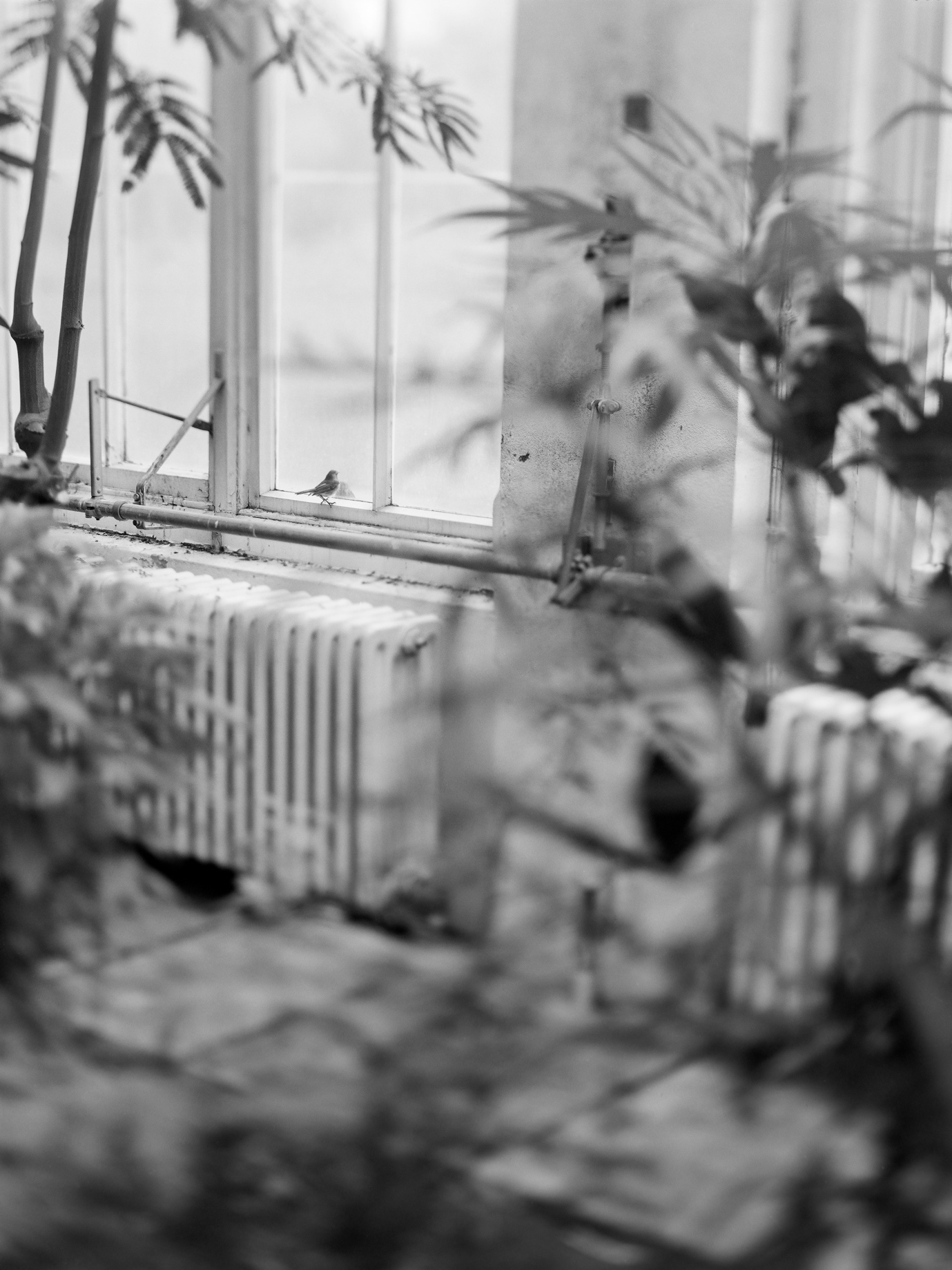
My works build a fabulation, a hint of magical realism, a feeling that absorbs the voices or lives that have disappeared and how they continue to affect the living—sparks, flashes, spinnings of wings and life. Made over a decade, mostly in Umeå, but sometimes beyond—further North and further South in Sweden, as well as in London and the hills of Los Angeles—a speculation of encounters, an effort to grasp the complexity of our eyes still blinking at the end of a film or recalling a photograph that never loses its after-image. To understand the presence and be guided by these resonant patterns and the empty spaces left behind, holding onto a present tense or an immediacy and urgency into the landscape of the now.
In the exhibition “Enargeia”, works in different media embody a living lament for memories that remain at the entrance of the underworld amidst the urgent consolation of renewal in honouring life.[3] The wild animals and birds are intimately connected to the person lost. Images are made using the chemical processes of the analogue—the handprint, the screen print, the film strip, the birds cremated in the lost wax technique, the singing of bird song by human voices. Here the analogue holds its trail as a physical imprint, a hand, a body, a communion of living beings, a vast image world embedded in the material. These figures tied to the real and the imagined allow no easy resolution. All this exists without privileging any kind of telling: artists, poets, musicians, scientists and healers become guides in the land of the living and the dead.

A dream appears and the body feels peaceful, as though the timeless spirits have not forgotten the work to do. A dream with two or three children asks whether the bird in the hand of an old woman (what is old to a child?) was alive or dead. What did the old woman respond to? Upon waking, I knew the reference—I was awoken to Toni Morrison and a reverie of a memory of reading Beloved as a young adult, and the strange scene of the children. Upon reading that morning’s daily news, I learned Beloved was to be banned from public libraries in numerous states in the US. I thought of Morrison’s rigorous mind, my African American lineage and being in Sweden and by association Morrison’s public address on accepting the Nobel prize for Literature, during which she speaks of an old woman who are asked by some children, “Old Woman, I hold in my hand a bird. Tell me whether it is living or dead.” The Old Woman answers, “I don’t know whether the bird you are holding is alive or dead, but what I do know is that it is in your hands. And it is in your power.”[4]
Winter was receding, the birds were arriving in the North from their migrations South, there was a story to tell, to fabulate, an old woman with a bird in her hand. The living bird of language. And another old woman, from another story, who in the face of political oppression walked all winter until spring, only to reveal her identity many years later before her death, when independence was restored to Lithuania in Spring 1990. This happened long ago—does time matter to the dead?—as the images became sharp, in focus, and the arms and body swing at the audience with two bird wings, cast together in golden bronze and wrapped in hemp string. A weapon, a peace tool, a musical instrument—to call upon the living and the dead, bringing forth the ancients and the bright unbearable reality of humanity.
This and our entire bodily existence implicated in the hearing, the feeling, the sensing, the seeing, the tasting. Yes, my performance is a proposition—it liberates us, there are no closures.
The Ground
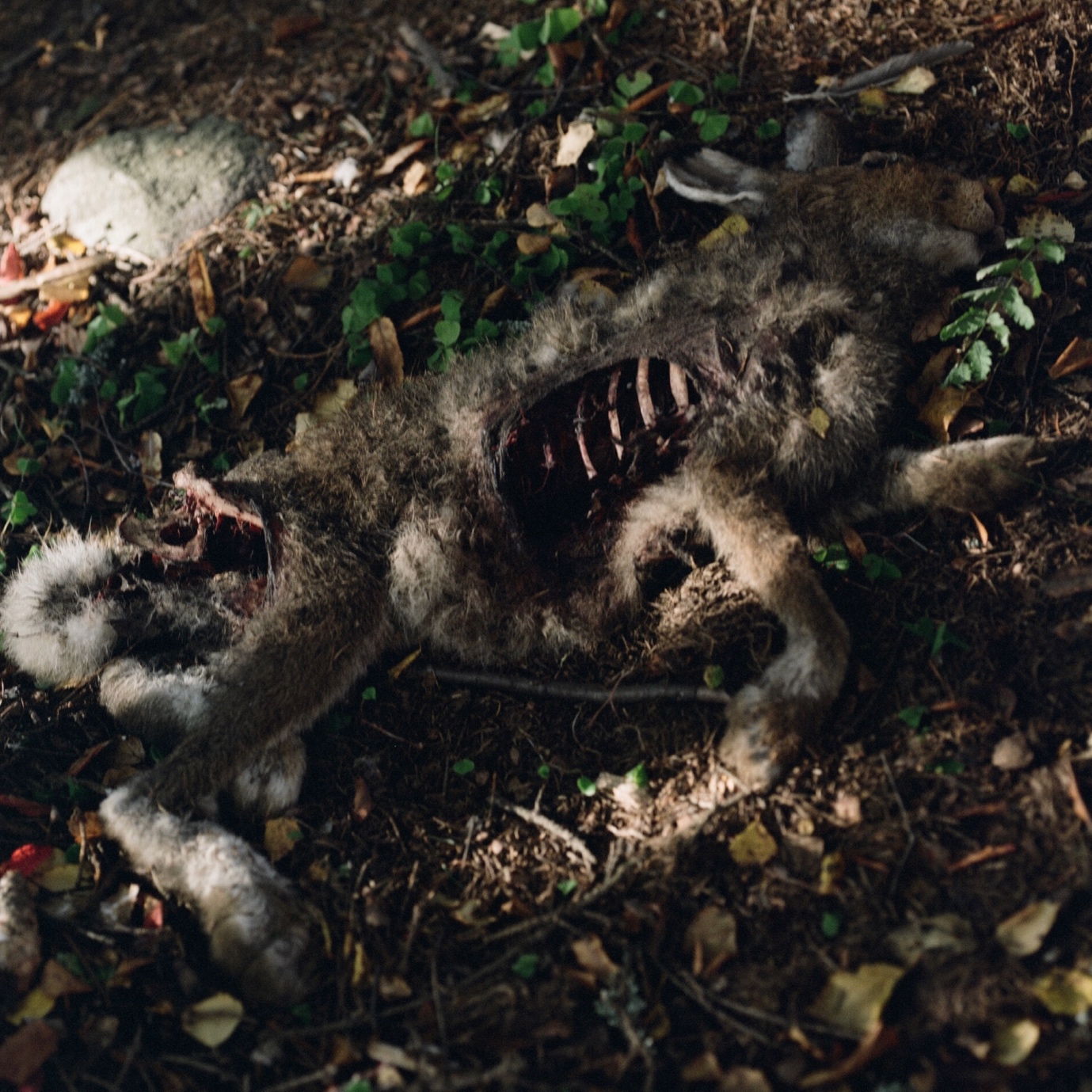
Equating the ground with digging is a habit I picked up from the late Irish poet Seamus Heaney in his poem Digging (1964).
Between my finger and thumb
The squat pen rests; snug as a gun.
Under my window, a clean rasping sound
When the spade sinks into gravelly ground:
My father, digging. I look down.
How to define the ground, or grounding in filmic terms, as we look down the viewfinder? It suggests a certain slowness or arrest, an unpacking of the 24 analogue frames into still moments played in succession. This dissection of the moving image and the very process of construction is how I explore conceptual material. In an early work, I used an optical printer to make a looped film, Down by the Salley Gardens, for which I optically printed hundreds of still frames from Super 8 onto 16mm film to create and edit a narrative within the optical printer. The final print was looped in a gallery space, a former court room at Toynbee studios, in London’s East End, supported by nowhere lab. Looking back, I understand this work differently now; although on the surface it appeared as a poetic love song to a place that connected the South of Ireland with the North through a round juncture—the Balleygawley roundabout—now I see it as a lament for those who had died in Northern Ireland during the bloody violent years. The slowed down, repeated shots are grounded in time to form a union, a love letter to a road. There is a banality to it, but it also creates the poetic arc of the film.
This very physical relation to a grounding of images through the optical printer and the body is jolted into existence in the films of Yervant Gianikian and Angela Ricci Lucchi. The work Dal Polo all’Equatore (From the Pole to the Equator, 1986) is, as the writer Robert Lumley remarks, “made to be remembered long after they have been seen and are made for the viewer to remember through them. The screen then fills with the image of a tunnel and a railway track and then journey begins.”[5]
A grammar of feeling, implicated within every frame, resisting what is historically embodied politically and ideologically. Ways of looking, and more specifically ways of looking through the camera lens, are never neutral or innocent. By re-working Luca Comerio’s footage, the hunting scene in the Arctic circle (film footage from the Italian North Pole expedition led by the Duke of Abruzzi (1899–1901) which has become a sequence that holds a visceral place in my body as an artist and filmmaker and grounds many of the conceptual decisions in filming That Other Night, the Wolf’s Night (2024–25), which I showed as the end note of the performance. It is no coincidence that Gianikian and Lucchi’s first human figure holds a rifle and that we see a polar bear reeling from the impact of their close-range bullet. This cruelty continues relentlessly: a hunter on board a ship repeatedly lines up his telescopic sights to aim at the polar bear swimming with its young, the bear diving in vain to escape.
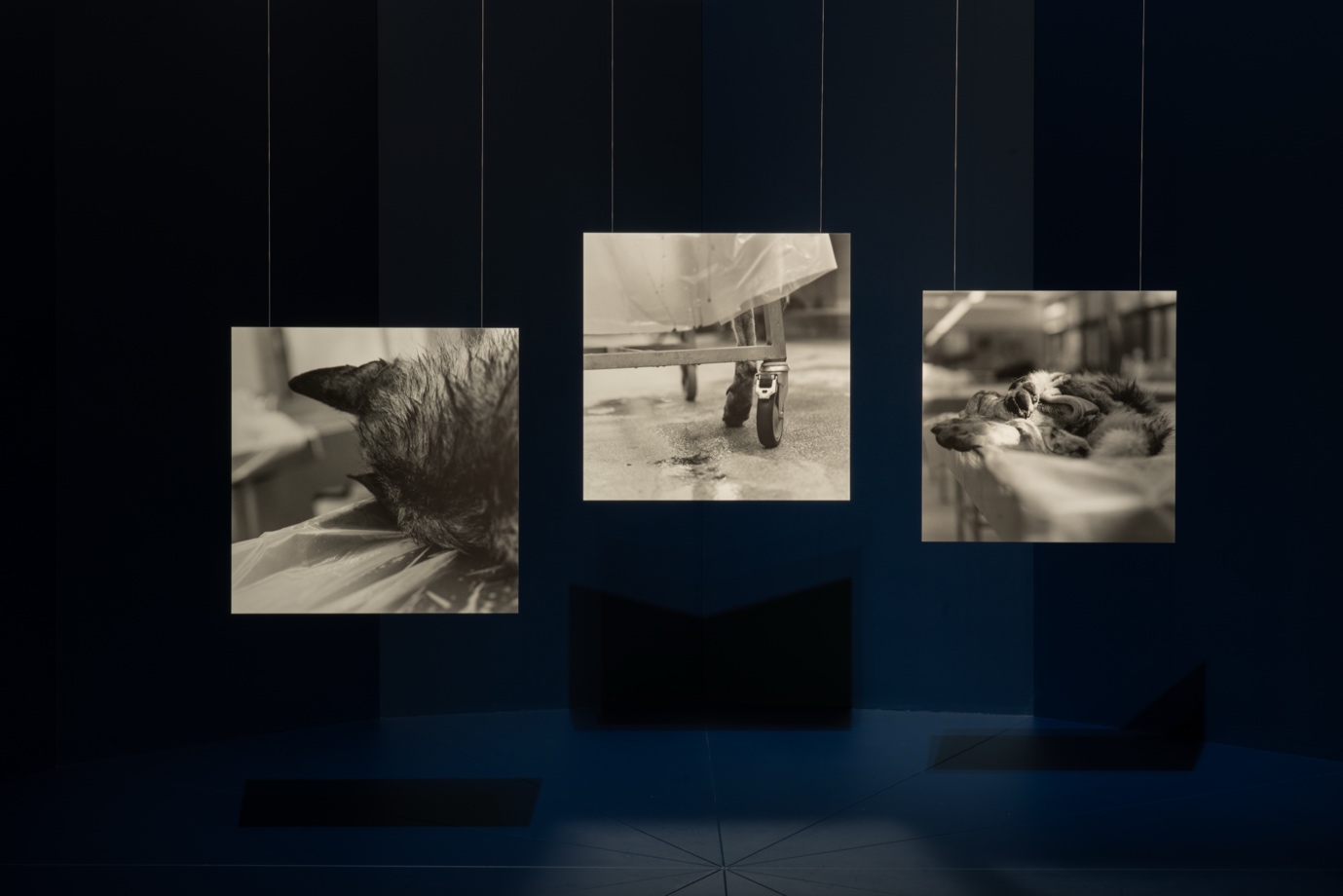
The circularity of death and cruelty—recalling history and returning to history—a sequence of looks that implicates camera, filmmaker and viewer. Reeling against such detachment and sovereign power, I worked on That Other Night, the Wolf’s Night to ground the filmic language to capture the wolf’s perception—projecting the moment of encounter with an animal, a living sentient being, as a moment of transfiguration between scientist, listener/viewer and the wolf. The work is structurally insistent in this unpacking of the hierarchy of vision, which I owe to Gianikian and Lucchi. I’ve never had such an extreme reaction to a hunting scene, to the whole film in fact, as to theirs, which is claustrophobic in its relentless repetition—airiness has little room in this work. I am very grateful for it. To flip the apparatus, to shoot the whole film at the wolf’s height and mimic the wolf’s dichromatic vision, scored in this document and slowed down, is to honour the wolf.
Wings
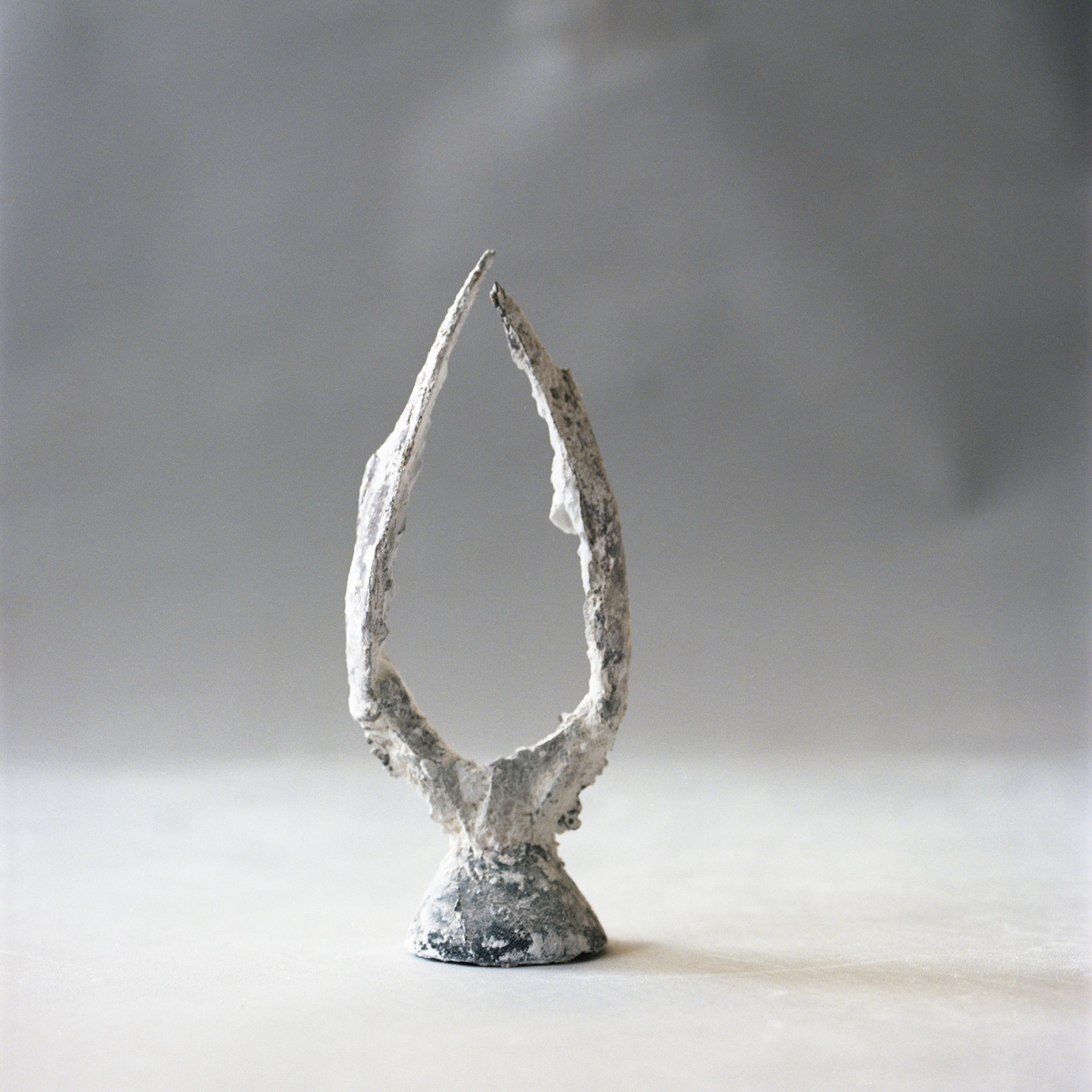
Wings fanned in the snow, a finch lies, its breast and belly pointing
to the insomniac’s sky. The dusk or dawn of winter. Half of this
ice-filled universe is filled with frozen stalks of hardy, sharp grasses,
an alien topographical structure, swathes of frozen lines sweeping
into a circular, scooping gesture.
A milk-light metamorphosis, a small, elegant finch shaped into a
broken moth-like creature suspended in a frozen lair. Rarely do
you find a dead bird in such a dramatic posture, scoured by winds:
the wings are generally closed, face to the ground. Death, the result
of a tumble, of hunger or of sickness.
The sour of the dusk night allows a ritual, a gestural repositioning,
to evoke a pause, a moment in the photographic mind, a humble
reimagining of the bird in flight and in health. A liturgy for a living,
vibrant songbird.
Dawn or dusk—does it matter to the dead?
The wings that bind my work together tend to be grounded or rooted in images. My performance was punctuated by the holding and rhythmic flapping of these winged bronze casts, but also by the sound of bird song that occupied my voicings.
I recall the opening chapter of Rachel Carson’s work, Silent Spring (1962).[6] As a biologist she begins with a fiction, a fable for tomorrow, and it is to this fabulation that the tone of the work is tuned. The birds are essential to Carson’s narrative, as their very silence signifies a grim spectre—of what has already passed. In the performance, flying the wings becomes synonymous with life, with humanity’s overreach, with migrations and borders, with the gravitational forces of the earth. Here the grounding transforms into airiness, the wings create not purely a visual apparatus but a listening one too.
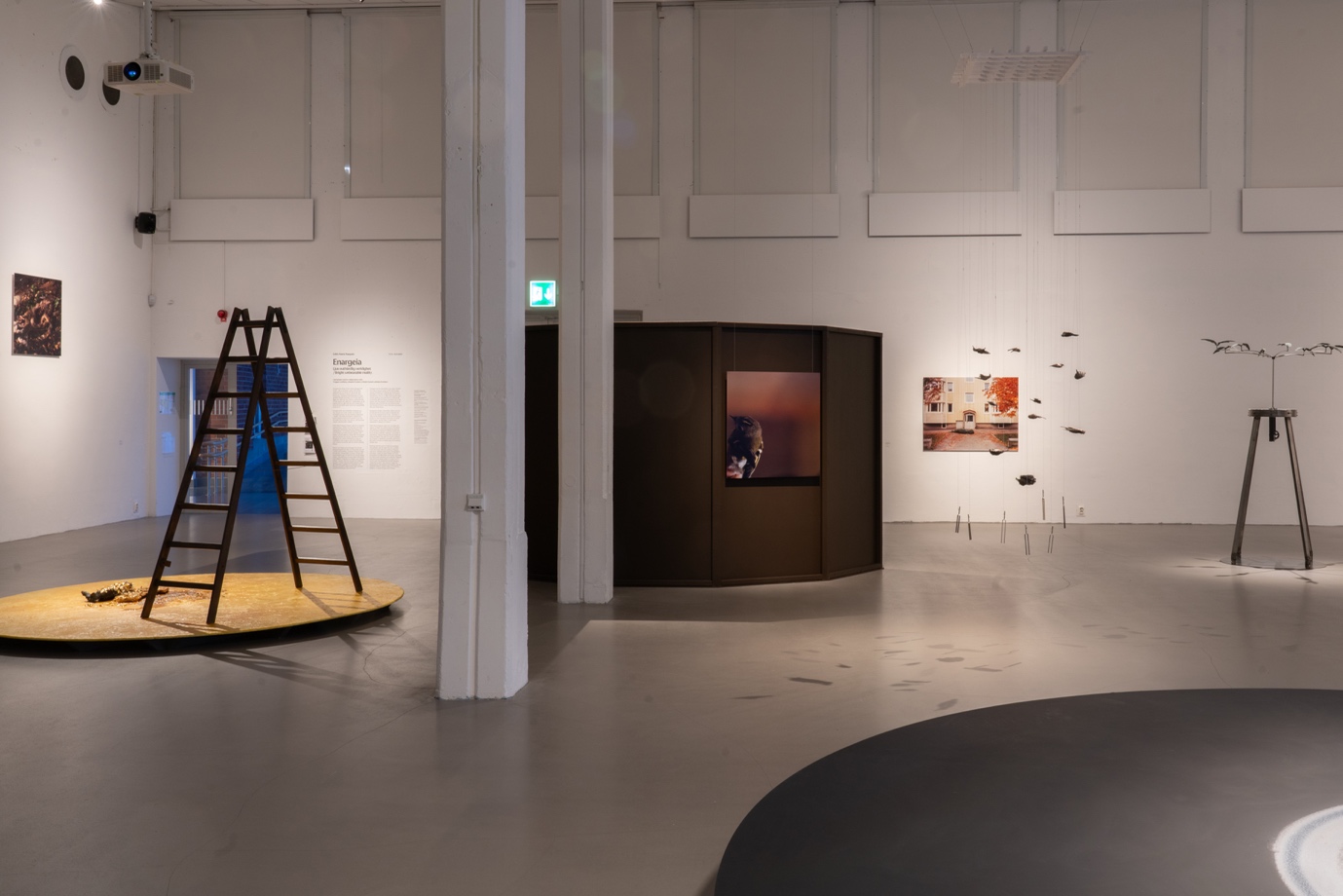
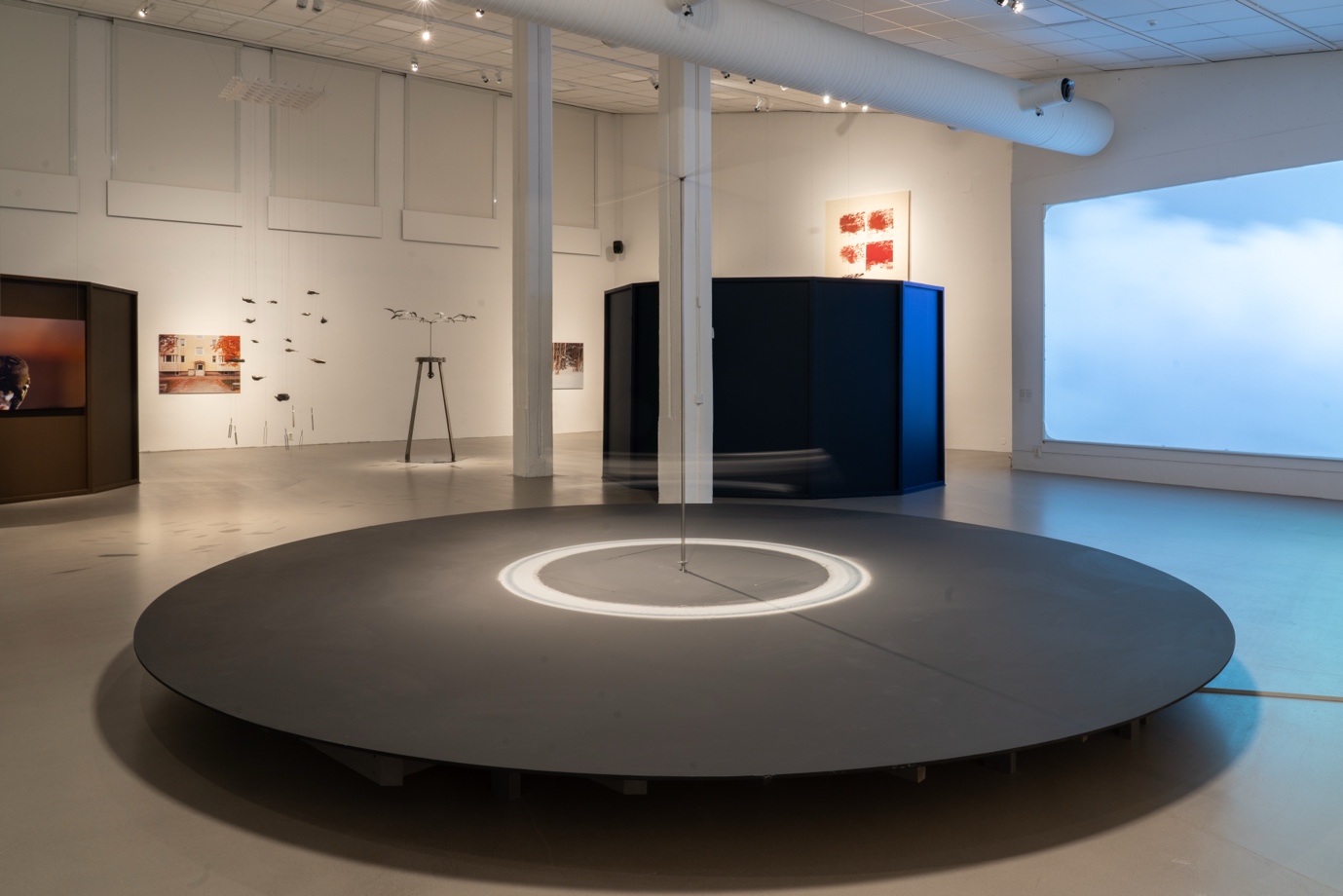
Birds’ and children’s voices opened the exhibition, at the entrance to the museum, in the open air, so it all began outside, this sounding of the archive, lost fallen birds, dead children. Song for the Slain Birds and Children (2023–25) was conceived as a lament for the babies and children brutally lost to global conflicts and genocide and the fate of the birds. The intention is for the work to continue to sound. The birds native to the museum’s surroundings also involved themselves in fighting for this territory, as the work disrupted the ecology of the site, and suggested a scene that must be grasped and lamented. In the North, the snow-filled landscape is silent in winter, and the birds’ song and children’s voices signify hope for a coming spring.
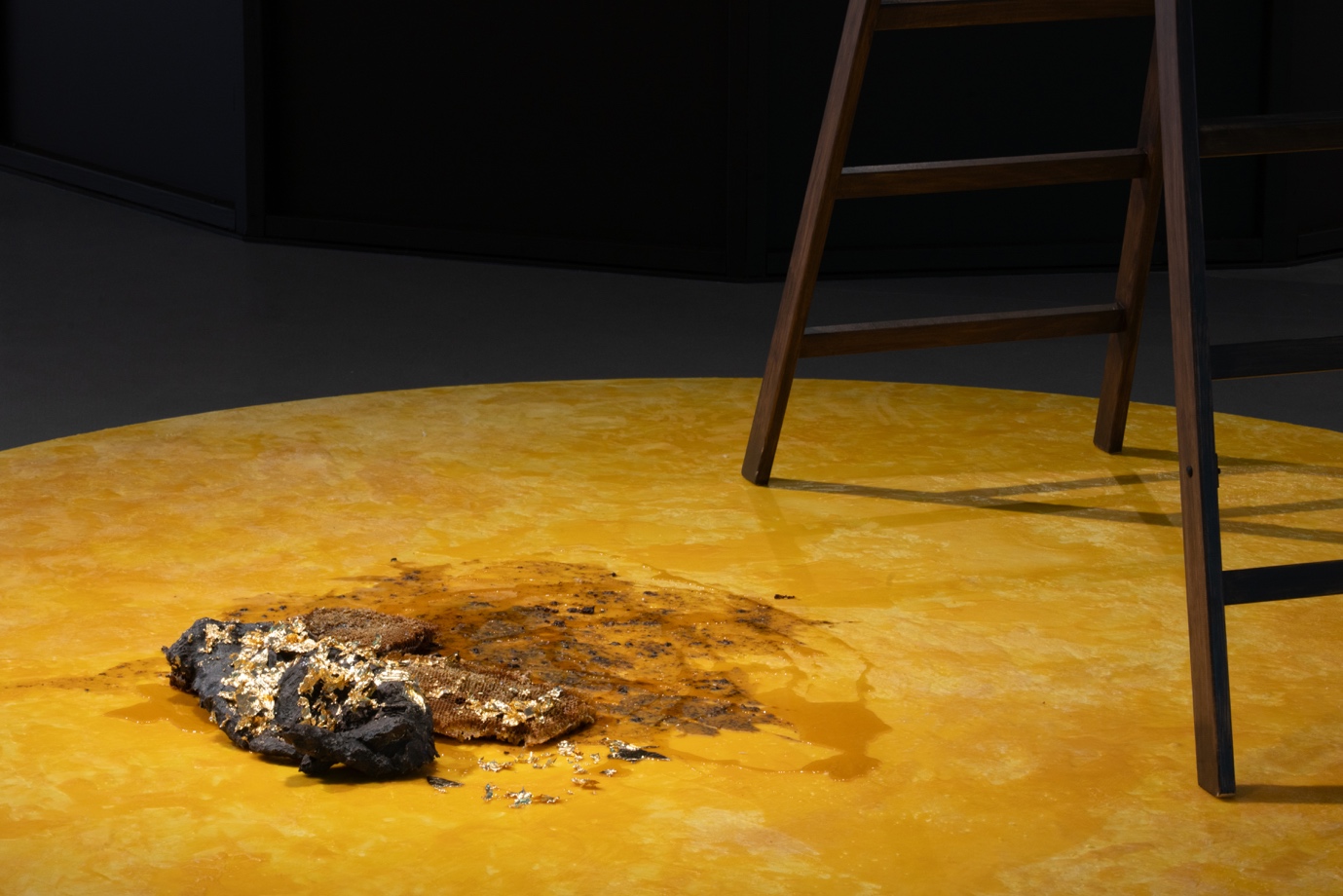
“If every moment contains the possibility of being alive and being dead then could an acute awareness of every moment also create an acute consciousness of living and dying?” wrote the artist Amar Kanwar in his beautiful project The Sovereign Forest (2015).[7] There is a sensibility of the poetic as evidence in “Enargeia”—its fabulation an expressive manifestation, drawing upon the language of the poetic image, the image as document, the image as historical, as fiction, narratives or reconstructions on film, in sculpture, embedded in photographs, printed onto felt, laid in beeswax, covered in honey and goldleaf and activated through performance. Fabulating as an archive that is ongoing and responsive to the physical, political and spiritual landscape.
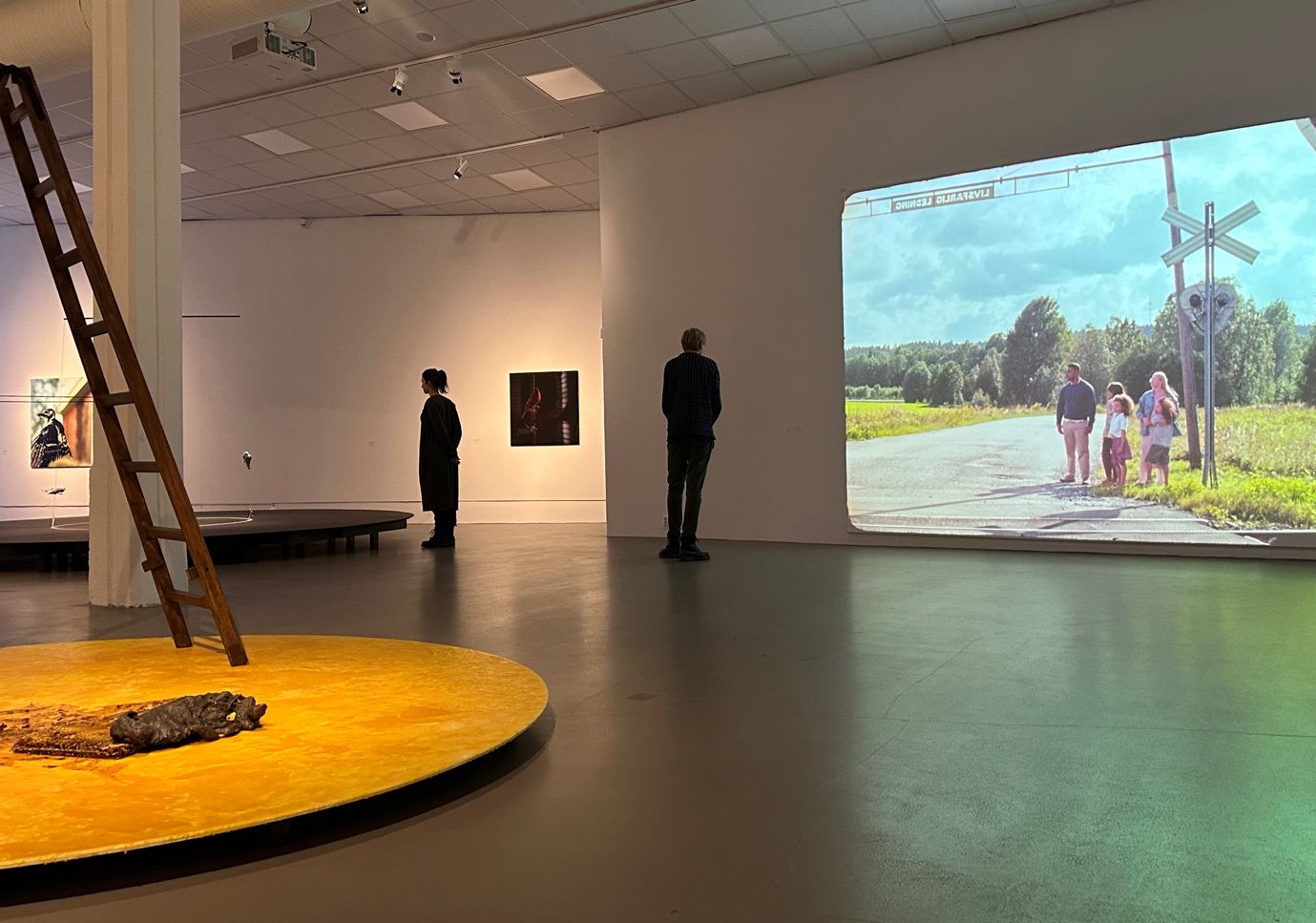
My performance brings forth this possibility of being alive and dead—a projected moving image to create an echo, a mirror, after the cacophony of birds’ and children’s voices—the image of a young family waiting, quietly greeting the passage of time. The Funeral Train 1968 (2025) induces a simultaneous viewing of multiple times, a still but restless barrier of vulnerability, the visual tone holding the colours of a past not yet grasped. Shot on 16mm and tuned to Kodachrome, they await a train that passes, and still they wait, a flock of birds pass through the frame, and still they wait, the train passes and so it goes on.
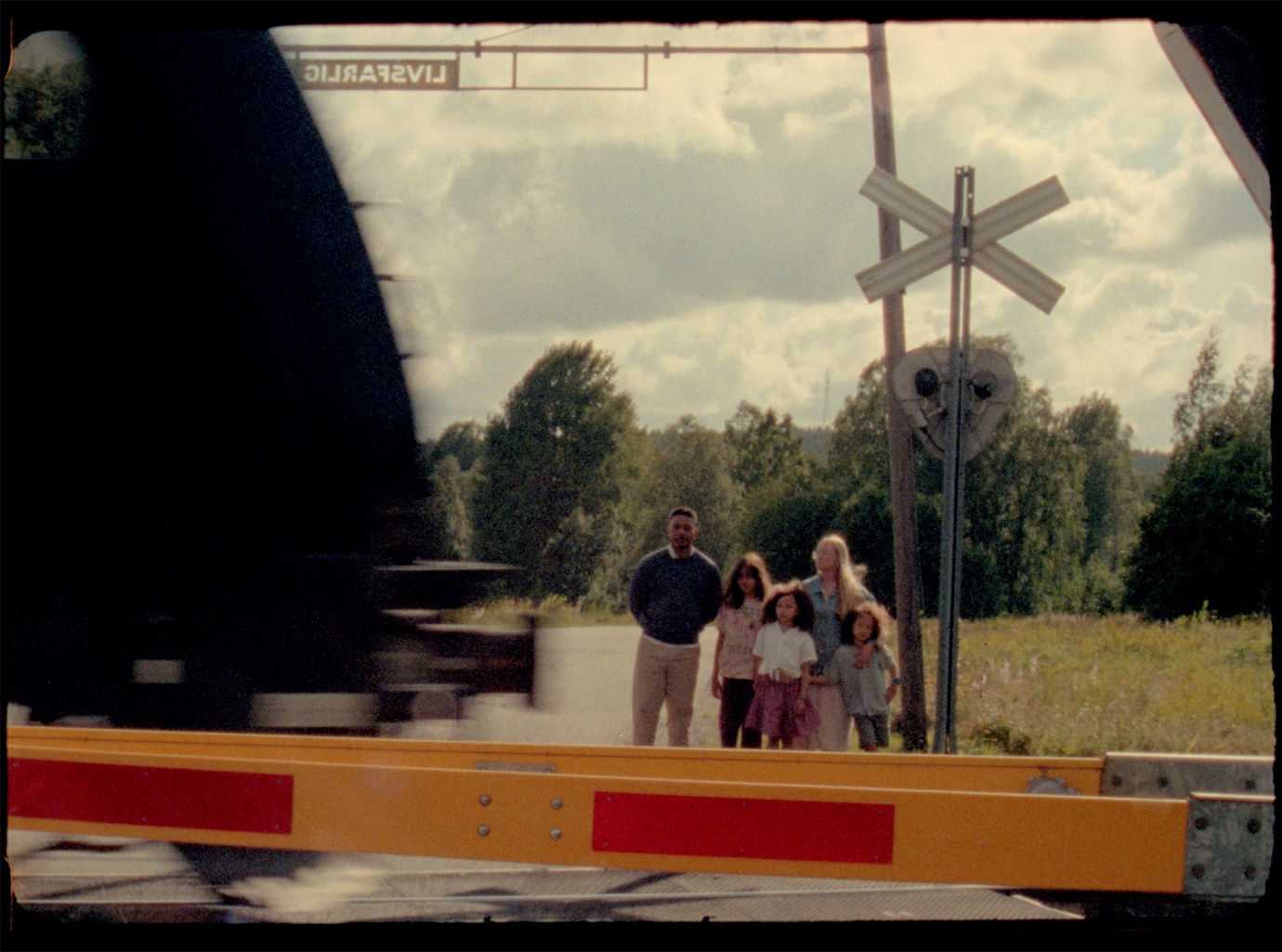
On the now and then, on division—political, social, psychic—on union, on grief, on the living, their residue is from an encounter with the collection of photographs by Paul Fusco of Robert F Kennedy’s Funeral Train, of Martin Luther King’s funeral, and more recently the shared anguish of collective grief, which continues unabated since the beginning of 2018 with the Covid pandemic and the wars. What are we searching for among the dead and the living?
The ancient critics praised Homer’s Iliad for its “energeia”, its sounding, which can be translated as something like “bright unbearable reality”. It is the word used when gods come to earth, not in disguise but as themselves[8]. Are the gods really the gods, or do they metamorphose into an idea of protecting what is to be forgotten or stay as distant imaginings? How can “Enargeia” translate to the visual experience? Is that the visual spectacle that becomes an oral cemetery, a communal “you” in seeing and speaking to the dead person, animal or bird? They have spoken. Are we to be left to live with the gods?
During such strange happenings, a mind creates its instants and its shadows. Turning to work of the poet Denise Riley, who wrote an arresting text after the sudden death of her beloved son in 2012, Time Lived Without Its Flow. A tiny first edition stayed in my pocket during that time and is now quite worn, and sets the tone, the grammar for the encounter with images. Denise’s observation that there are “no tenses anymore”, of the collapse of language to express the state of grief—opened up what an expressive image could be, as time grew fluid and malleable.
What are the flows of energy that are to be perceived—elements with the potential to resonate with others—of love and memory, fragility, brutality and uncertainty? A person walking among the works could weave various patterns, different tales. The critical fabulation of “Enargeia” looks to life, to carrying the aura of those who have passed from the living, into the now, interconnecting various registers. The work has grown slowly, appreciating non-verbal connections, listening, learning an honesty through practice. Living Bird: Stig, Konrad, Bryan, Brian, Pelle, Jill, John, Daniel, Tom, Ivy, Tony, Paul (2025) invites the viewer to sound the birds and nest with tuning forks tuned to core frequencies and merge their bodies with the sound frequencies held in the birds. The energy has changed, grown and reconceived. The machines of the scientist and inventor of cinema Étienne-Jules Marey (1830–1904), whose work with birds and cinematography spin the birds into the real world, led to the Zoetrope with Wings (2019-2024) and Drawing Machine (2024). A 1000 Year Riddle (2024), a 16mm film loop, is struck by the simple observation of air as the arch mediation of our presence in the world—the mind reflects how deeply we are tied to air—no other element is as light and as free. If air is unbreathable, life cannot ensue, with fiction and non-fiction blurring into a monochromatic apparition.
Interruptions are needed, for in all the silence and statis, a raucousness of voices, of migrating birds, hold a shrill tone, a surprising sonic landscape in the exhibition space that screams life. Feeding, gulping simultaneously, skipping high overhead, hunting down the food of the trees, until the trees are bare. The urgent demand of thrush hunger —looking up, among the rocking branches, hurling out, a rattling call of defiance that might be heard above all the other birds passing. Living, calling, shouting birds, refusing the silent frame of a picture. The birds’ chorus of life forms an intermittent backdrop.
A fabulation of feeling.
Footnotes
- Pg 202 Walter Benjamin, A Short History of Photography (In German only) Trachtenberg, Alan, Classic Essays on Photography,Amy Weinstein Meyers, USA, Leete’s Island Books, 1980 Also cited and translated by Eduardo Cadava Words of Light, Theses on the Photography of History, New Jersey, Princeton, Princeton University Press,1997 ↑
- Toni Morrison, Nobel Lecture, 12/12/1993: https://www.nobelprize.org/nobel_prizes/laureates/…/morrison-lecture.html ↑
- “Enargeia” took place at the Västerbottens museum in Umeå, Sweden, between 17 November 2024 and 13 April 2025. ↑
- Morrison, Toni. Nobel Lecture. 12 December 1993. Available at https://www.nobelprize.org/nobel_prizes/laureates/…/morrison-lecture.html (accessed 20206-06-15). ↑
- Lumley, Robert. Entering the Frame: Cinema and History in the Films of Yervant Glanikian and Gela Ricci Lucchi, Bern: Peter Lang AG. 2011 ↑
- Carson, Rachel. Silent Spring. London: Penguin Classics. 2022 [1962]. ↑
- Kanwar, Amar. The Sovereign Forest. Ed. Zyman Daniela. Berlin: Sternberg Press. 2015. ↑
- Oswald, Alice. Memorial. London: Faber, 2011. ↑