This essay addresses the question of what can be done or said in the face of overwhelm caused by the climate crisis. When facing traumatic events connected to environmental harm on an ungraspable scale, it can be difficult to know how to begin to respond, and for so many of us such overwhelm can result in turning away, paralysis and numbness. Here fabulation—which engages with interspecies relation, ecological precarity and the limits of language—is explored as both a conceptual and material practice within contemporary fine art. Drawing on the work of Donna Haraway, the text situates fabulation not as a fictional departure from reality, but as a situated, collective practice of “worlding” that composes relations between human and more-than-human bodies. Through my drawing series Traumatic Objects, fabulation is approached as an embodied, process-based mode of thinking and doing, in which repetition, mimicry and material attention generate forms of knowledge that de-centre linguistic articulation.
Central to the essay is an encounter with the gorilla Koko, whose use of American Sign Language becomes a point of entry into questions of translation, authorship and interspecies communication. My iterative drawing practice—developed through the bodily rehearsal of Koko’s gestures—becomes an area in which fabulation operates as a durational and tactile process. Here, lines are not illustrative but generative, accumulating into surfaces that register shifts in attention, affect and temporal experience. The work proposes drawing as a form of thinking-through-making, where meaning emerges relationally rather than representationally.
The essay places this practice in dialogue with J. A. Baker’s The Peregrine, examining how linguistic excess and metaphor function as attempts to follow non-human life across irreducible difference. Roger Caillois’ concept of “legendary psychasthenia” further complicates this dynamic, reframing mimicry as an attraction to space itself where subjectivity risks dissolution into environment. These frameworks are extended through reflections on domestic grief and memory, in which language operates as a connective thread across species and temporalities.
Engaging Meister Eckhart’s theology of “attraction”, the essay argues that fabulation enables forms of relation that resist possession, identity and epistemological closure. The text concludes by situating fine art practice as a site of what Josephine Berry calls “planetary feeling”, where embodied attention, material process and speculative storytelling intersect. Fabulation, in this context, becomes a critical and generative method for sustaining relationality within a fractured ecological present—one that does not resolve crisis but remains with its complexities through ongoing acts of making.
Donna Haraway’s writing, thinking and activism repeatedly address the vast amorphous mass of the non-human world and its increasing precarity. As more species are threatened with disappearance through habitat loss and extinction, her work is not anchored in the past, but accelerates into the future. Haraway turns to the animal world, still perceived as lacking “language” [1], to fabulate collective strategies of earthly survival. In Staying with the Trouble: Making Kin in the Chthulucene (2016), her speculative fabulation develops qualities of attention, practices of worlding and methods of enquiry rooted in collective storying.[2] Co-creating and imagining a radically different future that includes and involves exchanges with more-than-human lives, is approached not as a reversal of climatic harm, but as a practice of living with the world as it is. Fabulation in her hands becomes a molten, pluralistic, malleable substance; a material that remains responsive, improvisational and open to imaginative possibilities of interspecies connectivity.
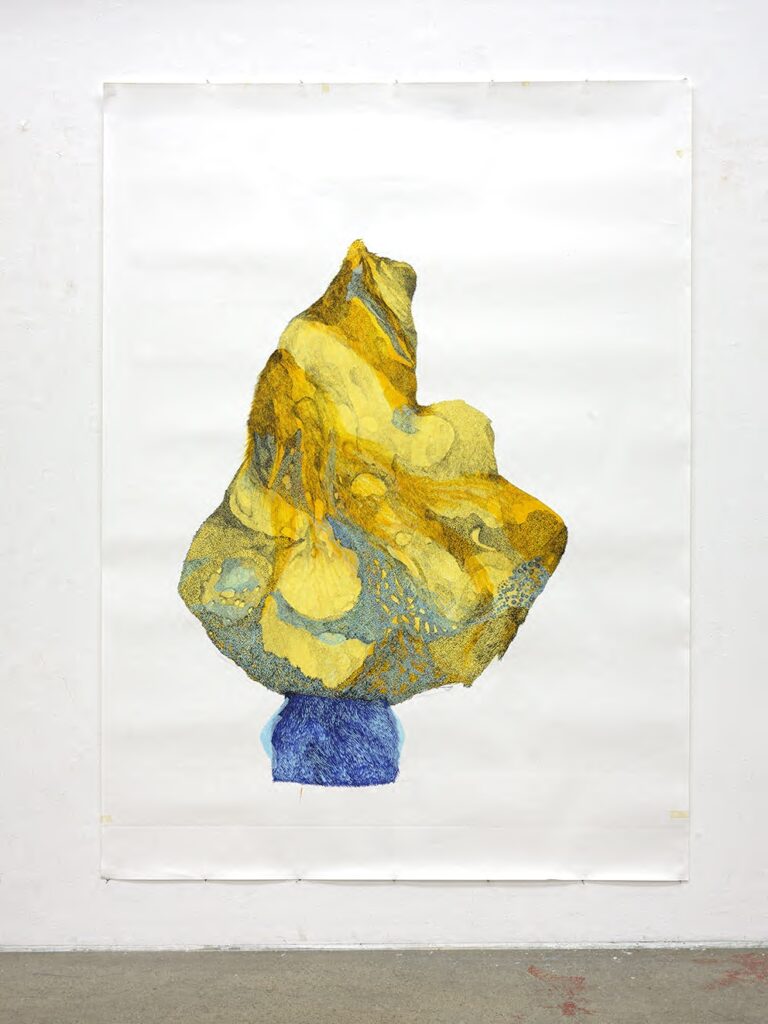
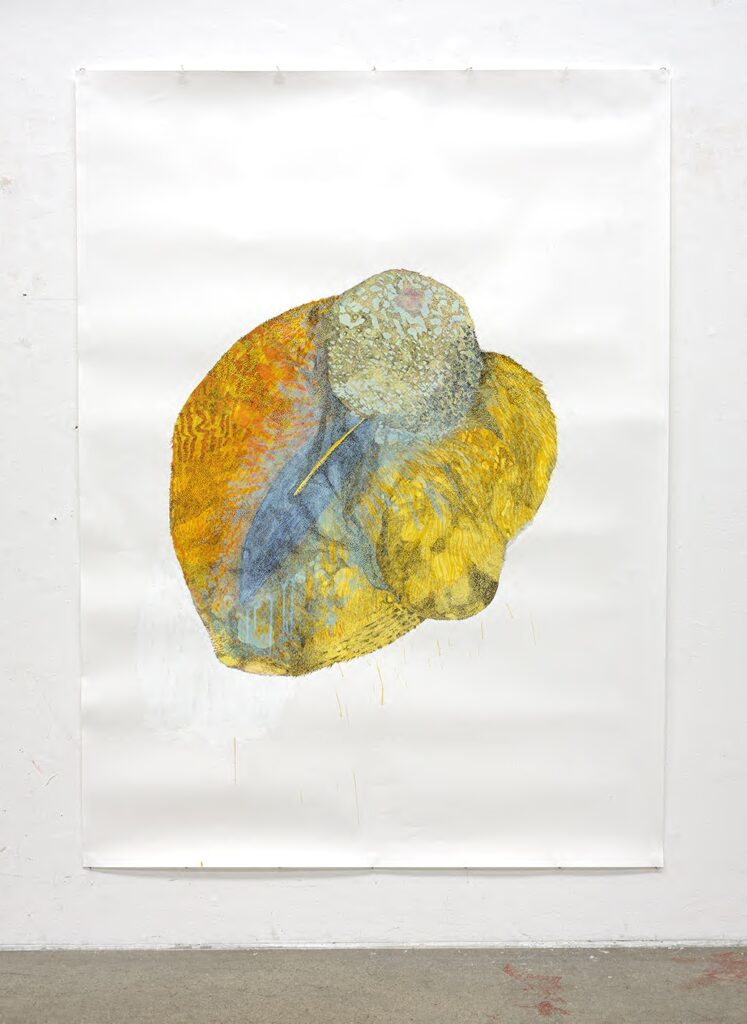
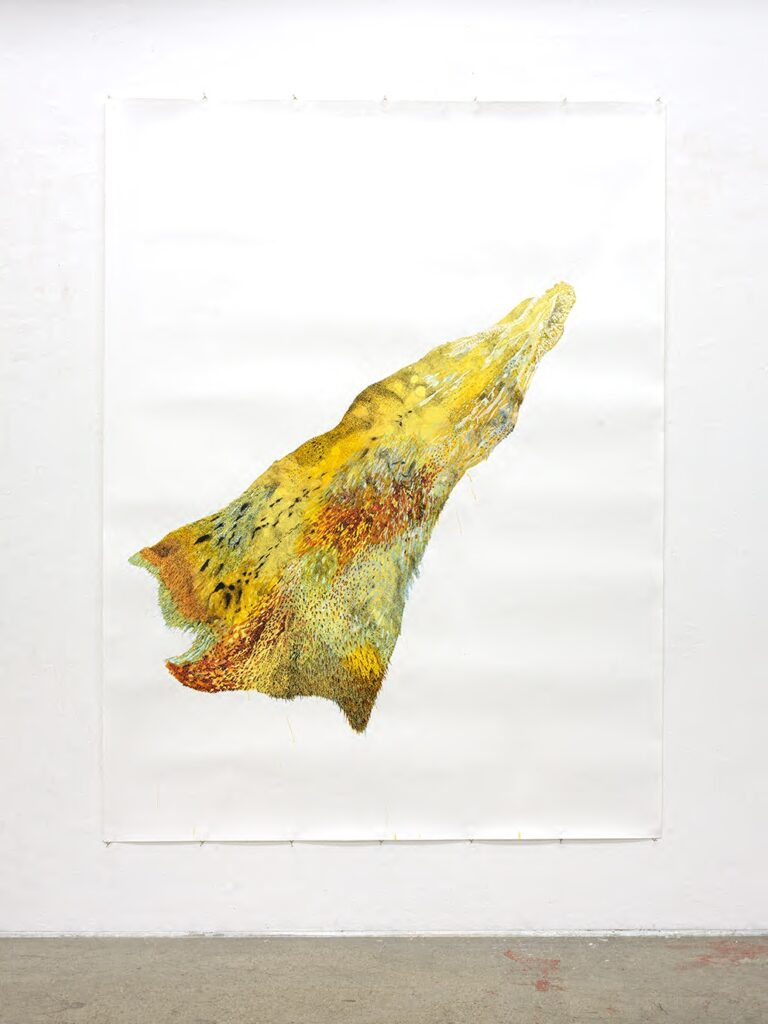
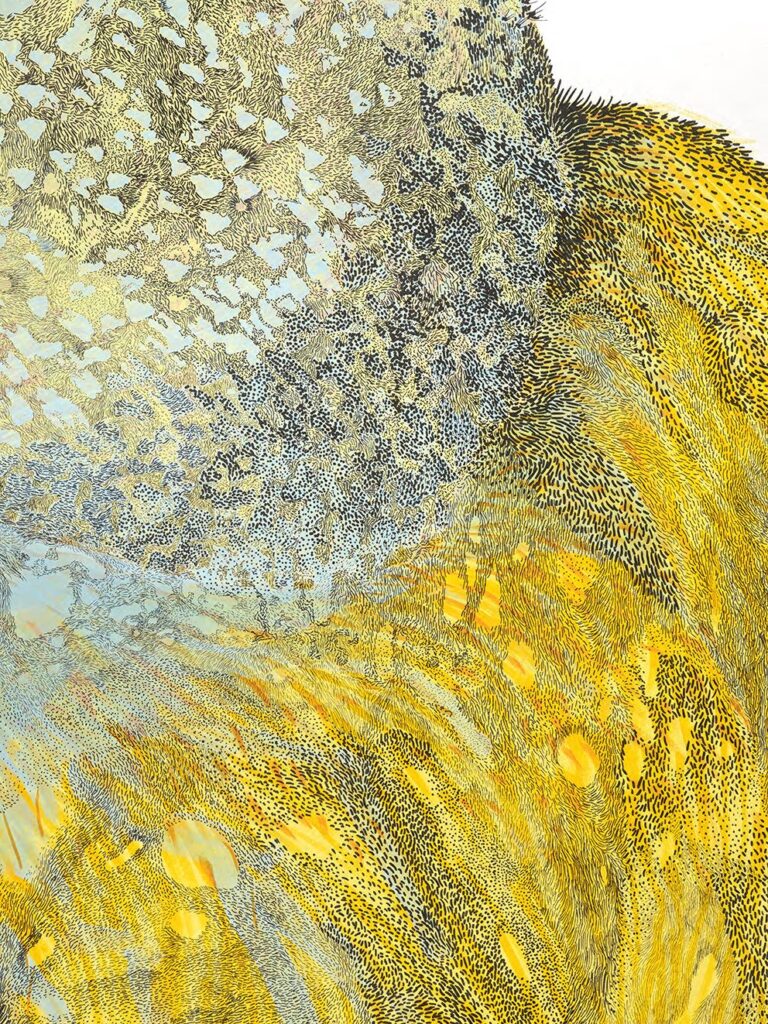
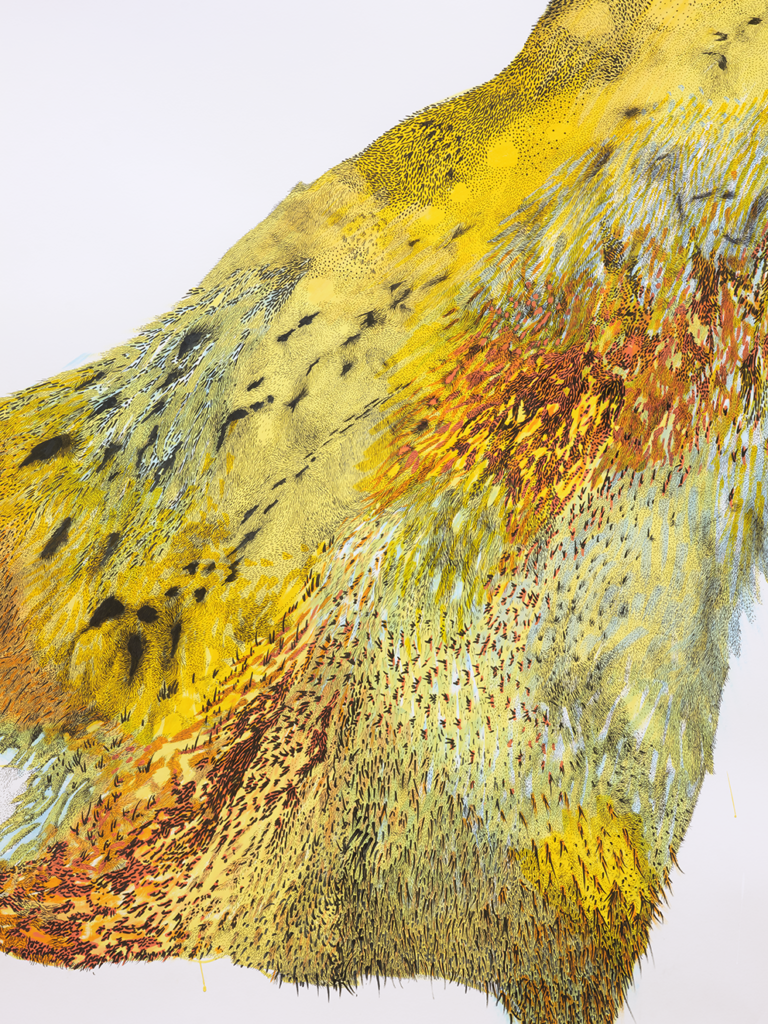
With influence from Haraway, my series of drawings Traumatic Objects approaches interspecies connection through the lens of a challenging encounter with another primate. The work commits to an enduring interaction between my own body and that of a captive gorilla named Koko. With Haraway’s The Companion Species Manifesto; Dogs, People, and Significant Otherness (2003) it shares the desire to rethink common binaries to restructure relations between humans and non-humans. In that text, Haraway examines the semiotic potential of a centuries-long partnership between dogs and people, arguing that sustained proximity creates each other and the world together.[3] Haraway’s proposal of “staying with the trouble”, of not turning away, resisting paralysis and any lack of feeling are key to the materialisation of the Traumatic Objects drawings.
Traumatic Objects is based on a speech the gorilla Koko performed via video link to the COP21 climate change conference in Paris in 2015.[4] She had been taught American Sign Language (ASL) from infancy, and in this speech signs phrases such as, “see nature”, “fix nature” and “I am animal, flowers” in a moving testament addressed to a gathering that included world-leading environmentalists. At the start of the address, Koko’s “voice” is described on screen as “the voice of nature”. Signing “man stupid”, she asks humans to stop their environmental harm and respect the natural world. The Traumatic Objects drawings are made entirely in response to this challenging footage, which is just over a minute long.
Before beginning the series, I learned Koko’s signed speech through watching and rehearsing the way she performed the signs in the video, including her personally adapted way of forming words and phrases. This repetition became an everyday ritual in the studio. Gradually, my body instinctively retained “see nature”, “fix nature” and movements of the hands, arms and upper body began to echo the silent transmissions of the ape. Copying Koko’s signs had been a response that wasn’t aimed at closing the gap between our bodies, or “becoming” gorilla. Instead, it was an attempt to form an intimacy through doing as she did, combined with a desire to learn something from her despite the acknowledged limitations of doing so from a captive, trained animal.
It feels significant that I never met Koko body to body. She died aged 46 in the year I had planned to visit the Gorilla Foundation’s preserve in Woodside, California, where she was kept. My encounter with her occurs through tightly selected and edited video clips on YouTube. In the COP21 video, she is initially pictured outdoors in a forest, yet the camera quickly zooms in on her head and upper body against a neutral grey screen that isolates her from any ecological context. She appears as though she were a newsreader in a conventional studio setting, her image carefully mediated. At times she pauses before signing, hesitating in ways that suggest interiority or strain, as if stammering within a context that cannot fully contain her. The pull to anthropomorphise her is intentional within the NGO framing that produced the video. Yet this framing is unstable: she is a great ape, made to approximate human language, while remaining structurally unable to consent to its performance.
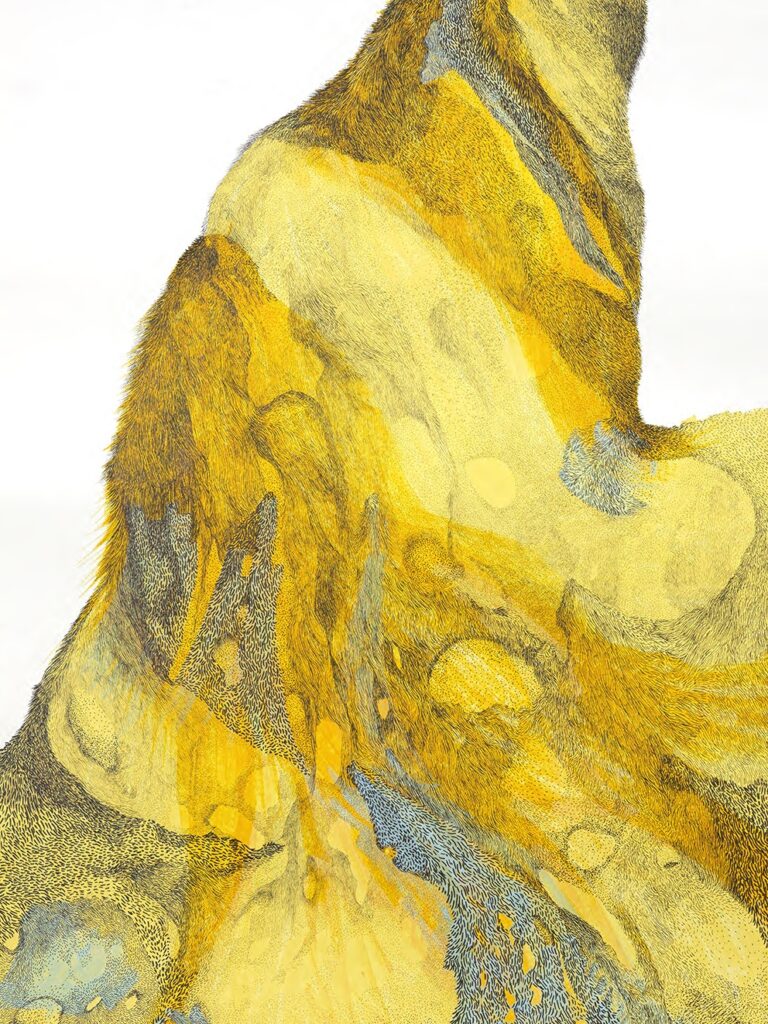
In the studio, I do have a choice. I opt to follow Koko further by constructing an approximation of her bulk on a large sheet of paper using a paint pen. This is not a conceptual decision but a sensed one, a response to the conflicting emotions of watching Koko perform. A yellow, orange and blue form is laid down in an instant, slightly larger than my own body. What begins as repetition of Koko’s signs continues with fineliner pen strokes over the painted areas of the paper. One line follows another, accumulating into a second skin, led by and yet resisting the underpainted form beneath. With every drawing taking around a year to complete it is possible to see areas within each that show varying line weights made by a tight or loose hand, reflecting varying moods and intensities, levels of distraction and attention over time. The surface shifts unpredictably—from fur to scale, from bruise to rock face—registering instability rather than representation.
For Haraway, approaches to living differently and collectively in a fragile world are developed through fabulatory propositions that compose spatial constellations and diagrams of interdependency between fleshy bodies and bodies of knowledge. Such modes of relational intimacy can also be traced, in a different register, to the medieval mysticism of Meister Eckhart. Eckhart’s thought has been reactivated in contemporary continental philosophy as part of a broader attempt to think life beyond fixed identity and metaphysical determination. In this reception, his notion of Gelassenheit (detachment) and the soul’s “emptiness” before God is no longer read solely as theology, but as a way of articulating existence beyond possession, subjectivity and law. Across his sermons, Eckhart develops a subtle account of attraction, resemblance and movement. The impulse towards what is desired—an orientating pull towards an object of attention—becomes a means of understanding closeness as something participated in rather than possessed. Movement from inertia into an “attracted” state renders the subject simultaneously active and receptive: both transmitter and receiver within a shared field of relation. To be attracted or to be attractive is to enter a reciprocal dynamic in which neither term exists independently of the other. This relational condition is inseparable from a corresponding shift in visibility, in which the subject is not only seeing but also seen, constituted within a shared field of appearance and attention.
Eckhart transcribes this symbiosis between the attractive and the attractor, or the follower and the followed, into a metaphor for a physiological process. We are to imagine a hollow pipe with one end placed in water. Suction draws water through the pipe, up the stem, into the mouth. Water entering the emptiness of the pipe follows itself: water follows water through the void of the vessel. The following of lines in Traumatic Objects similarly involves what seems like an automatism: a self-propelling process with each mark drawn in response to the one before it, as if carried forwards by its own momentum. Here, attraction produces intimacy without mastery. Knowledge is not overview or possession but felt proximity—an attention that unfolds at a minute, local scale. Such mimetic attention offers a counter to the overwhelm of issues at planetary or cosmological scale through a situated, embodied pull and flow.
The Traumatic Objects series emerges from an experience in relation to which language appears to fail and the body becomes the primary site of knowing. With gorillas genetically close to humans, and with Koko drawn yet closer into human territory through her captivity and training, it was possible for her to be frequently recorded, imaged and closely observed. At the opposite end of this spectrum are of course non-humans associated more strongly with wildness, animals difficult to reach, to find, to access or observe. In this respect, the nature writer J. A. Baker, pursued a more extreme interspecies challenge in his pursuit of peregrine falcons in a percussive, violent interaction between animal and human bodies. Baker was extremely short-sighted and suffered from long-term debilitating inflammatory arthritis. He pursued falcons for around a decade of his life, aided by prostheses in the form of binoculars and a bicycle, near his Essex home. His book The Peregrine (1967) compresses this ten-year period of field observations into one cold intense winter.[5] He subsequently destroyed his field notebooks so that his observational descriptions of falcons’ locations couldn’t be traced and compared. Through doing so he gained a freedom in relaying their specialised hunting techniques. In Robert Macfarlane’s review of the influence of this book, titled “Violent Spring: The Nature Book That Predicted the Future” (2017) he describes how Baker approached his subject matter through writing. He observed that, “Grammatically, [Baker’s] prose is dense in metaphors, similes, verbs and adverbs; accentually, it is thick with stressed syllables.”[6]
Baker uses language vividly and visually. His is a natural world unburnished, ragged, sensorily extreme, synesthetic, often cruel. He records the peregrine’s unrelenting kill after kill, sedimenting a build-up of knowledge, that began in careful, watchful note taking, and ultimately became felt, embodied, instinctive.
Plummeting through the sky to gather their prey at 270 mph, the peregrine is the fastest creature on earth. Baker includes many passages describing a desired collusion with this predator’s aptitude and physique, one with capabilities so radically different from his own. For example, after the peregrine has killed its prey, he writes of himself, “The owl calls. I stand above the kill. Red ice reflects the stars.”[7] And of the peregrine after a kill, “hot blood dripping from the hook of the beak and rage dying slowly to a small hard core within.”[8]
In “Violent Spring” Macfarlane first presumes that Baker’s book is dedicated to the author’s aspiration to become a falcon through mimicking and following the animal he hunts. Then he concedes that the book may instead explore Baker’s failure to become a raptor. Morphological limits, anchorage in his challenged body, prove too powerful for him to jump species, which he so evidently desires. Macfarlane cites the filmmaker Werner Herzog as one of The Peregrine’s most fervent devotees, setting it as one of only three books for his Rogue Film School seminars. Herzog likens Baker’s dark, harsh, unflinching nature writing to his own approach to filmmaking. That too requires a form of ecstasy or “ekstasis” a stepping outside of your own body or skin, a sudden structural shock that enables moving beyond human bodily confines, if only temporarily.[9]
Baker’s “ecstatic” writing style and repeated positioning of his own body in place of the falcon’s over a kill, both clearly invoke an attraction to a morphology and to spatial dimensions that he cannot fully occupy or follow. Baker learns the sites that the birds visit most and returns to them frequently. However, when they are high in the sky, dots in the blue, his body shrinks also to a punctuation full stop. Even the dominance of “metaphors, similes, verbs and adverbs” in his writing, as Macfarlane observes, divert to his land-bound surrounds, to what he can see and know from below the trees when the peregrines are absent. These figures of speech pile up, thickening into a bodily intensity even when the peregrines are elsewhere. In his observations, Baker appears to build the qualities of the birds into oak leaves and fence posts, extending them into the environment when the birds cannot be found. In doing so, he seems to acknowledge where words will not take him: a concession to the complications and challenges in following, and what cannot be reached.
At this point, Roger Caillois’ account of mimicry offers a further inflection of this problem of attraction and spatial relation. In “Mimicry and Legendary Psychasthenia” (1935), Caillois describes a pathological form of identification in which the organism does not imitate another body so much as dissolve into the surrounding environment.[10] Mimicry here is not adaptive camouflage but a “depersonalisation by assimilation to space” in which the boundaries of the self become unstable and porous.[11] The subject is no longer oriented as a discrete figure against a ground, but is instead drawn outwards, absorbed into the very field it inhabits. Caillois’ formulation reframes mimicry as a kind of spatial vertigo—an attraction not simply towards another body, but towards the loss of distinction between body and world. Read alongside Baker, this suggests that the desire to follow the peregrine is also an attraction to the aerial space the bird inhabits: a space that cannot be occupied by the writer, only imagined or dissolved into. In this sense, mimicry becomes less a movement towards resemblance than a drift towards disintegration within a shared field.
It is precisely this problem of following—of morphologies and environments that can’t be occupied by humans—that shifts the question from Baker’s failed ekstasis, the leap beyond the human that Herzog identifies in his reading of Baker, in the direction of a more situated and material account of relation. A scenario in our home prompts this reorientation, suggesting how language itself might be followed as if it were a thread or string, enabling a form of straying across species that does not depend on a jump per se, but does foreground relational qualities of environment and space. Rather than resolving the obstacles Baker encounters in accompanying a living form that occupies a different spatial register, this scenario considers storying as malleable matter: a material that can be folded, carried and re-formed, offering unexpected extensions into interspecies worlds.
This scenario involves our cat who died recently. She was entirely black, with round green eyes that always seemed overly open. Whenever we spoke to one another, she would sit between or weave herself in some invisible line to me and my partner, drifting out onto the small landing outside our flat, into the bathroom to sit in the puddle beneath the shower, creating a triangle with us. She was a cat magnetised to sound, her head swivelling to whoever was speaking as if watching a tennis match. With her gone, we have lost a coordinate, a shadowy dimension in space. Her mossy purring in patches of sun, her contrary affections strung us together as if the air in the rooms of our home had weightless properties and we could float around along any axis. In her absence there are fewer frequencies, less of a pull of language beyond our own. Our cat’s name was Mary, significant in her yearly check-ups at the vets when my partner’s surname would be added to become their mother’s name. The cat as my partner’s mother, the grief of mother then cat passing, although decades apart, start to mingle.
I never knew human Mary, my partner’s mother, but understand that she had a habit of singing familiar song lyrics a few seconds before the radio did. She’d also often remember a single line from a song and sing it whenever a particular word or situation came up, as if triggered automatically to perform. Her favourites were hits from the shows and she’d blast out lines from “Annie Get Your Gun”. My partner’s family would cringe whenever this happened. Each of them knew to prepare in advance and was still wrong-footed by the effects of enduring it. No preparation could shore up its power. Human Mary, stuck on repeat, would block out anything but her own voice, sashaying around the kitchen, a restaurant or pub, feeding on her family’s embarrassment, the spectacle she was causing, the way the song carried her along, momentarily shutting out the world. In her bubble of song, Human Mary was unstoppable and unreachable just as her muse Annie was.
Cat Mary learned the song “Ave Maria” that we used to randomly sing to her when she was a kitten. Following the first two notes, she’d rush up and feel the need to stick her face literally in our mouths, either fascinated by where the sound was coming from or in a will to stop it from carrying on. Obligingly, when she did this, the one with a cat in their mouth would stop singing upon which she’d move on to the other to do the exact same. She seemed satisfied only when she’d silenced us both. This applied only to this particular song, otherwise she loved our vinyl sessions, imitating our dance moves as best as she could.
“I so miss Mary”, my partner often says. As they call their mother Mary, and not Mum, I’m unsure cat or human, which channel of grief we are travelling down. Feeling unable to ask, what follows can be an intricate weaving together of cat and mother. A true “blurring”, as Haraway invokes in Staying with the Trouble, of boundaries between animal and human; an interdependent spell of making. For the purposes of grief and void, both Marys, with their distinct sonic connections, occupy a shared space. Through visits to that space and to these specific songs, I feel I get to know Human Mary better. Fabulatory learning and telling take me there through loosening my grasp on how Mary tales combine. It feels like a form of worlding and unworlding combined. This storying of the two Marys becomes an act of composing and decomposing each other in and out of living and life. For Haraway such processes are happening “in every scale and register of time and stuff in sympoietic tangling.[12] A sounding Mary body has been forming and unforming, held in movement, in a state of attraction, in liveness. Following the Marys has enabled a binding of species dead and living into something that continues to give and contain knowledge.
In Planetary Realism: Art Against Apocalypse (2025), Josephine Berry asks how artists navigate the unstable relation between meaning and the body.[13] In Chapter 1, “The Agency of Planetary Feeling”, she draws on Isabelle Stengers and Donna Haraway to approach the world as a trickster figure “that won’t let itself be watched.” [14] Vision, in this account, is never neutral or disembodied; all acts of seeing are situated, entangled and mediated within the very worlds they attempt to apprehend. As such, the fantasy of a detached, all-seeing perspective—one that observes from nowhere—is unable to generate meaningful or reflexive knowledge.
Berry extends this argument by emphasising that visual technologies themselves are embodied and therefore implicated in the relations they produce. The world does not passively await representation or extraction but responds to engagement. When harmed or touched the world is more than capable of touching back. This reciprocity forms the basis of what she terms “planetary feeling”, a mode of attention in which ecological, aesthetic and political registers converge. Within this framework, artistic practice does not simply depict crisis but participates in the ongoing negotiation of relations between bodies, environments and systems of meaning.
Berry devotes attention to specific artistic practices, including Traumatic Objects, situating them within this expanded field of responsiveness. Here, “feeling” emerges not as subjective expression but as a necessary modality of engagement—one that registers the pressures of ecological precarity while resisting abstraction. Art becomes a site in which disrupted or “spoiled” worlds are not resolved, repaired or redeemed, but allowed to persist and act. In this sense, the work does not offer solutions to planetary crises but sustains a space in which their conditions can continue to be sensed, negotiated and reconfigured.
Across Haraway’s speculative fabulation, Meister Eckhart’s mystical attraction, Caillois’ assimilation in space and the interspecies grammars of Koko, Baker and the domestic field of grief, a series of shared problems emerge. Initially there is the challenge of how to defuse overwhelm and respond at all when faced with traumatic climatic events that can cause numbness and paralysis. Integral to this is considering the possibilities of travelling companions if your species is not considered a control or a limit. Space and scale factor in too; for Caillois, space has agency and animacy and can be followed or be “attractive” or an “attractor”. Scale can withhold or offset proximity and channel intimacies towards unexpected dimensionalities. Then there is the question of how to think relation without possession and proximity without Caillois’ collapse. In each case, language and form are stretched towards practices of following—of signs, bodies, lines and absences—that resist resolution into mastery. They remain partial, contingent and open, shaped by what exceeds them.
Within this field, fabulation operates not as fiction opposed to reality, but as a method of staying with complexity. It is a practice of composing relations that cannot be stabilised, of generating provisional structures—stories, images, gestures—that hold together without fixing meaning. In Donna Haraway’s sense, fabulation is always collective and worlding: it produces constellations of relation that are lived rather than observed from a distance. In Traumatic Objects, this takes the form of repeated gestures, accumulated lines and embodied attention that follow without fully knowing where they lead. Absorption and concentration become core states with obsession and disintegration hinged to them.
The practice of following—whether of Koko’s signs, Baker’s birds, Eckhart’s flowing water or the residual presence of Mary—becomes one of fabulatory movement itself. It does not arrive at equivalence or understanding, but sustains a relation across difference, trauma and strain. Here, fabulation is not an escape from the limits of language or embodiment, but a way of working within them: bending, extending and reconfiguring them in response to what cannot be contained.
As a fine art practice, drawing becomes a site where fabulation is materially enacted. Together, the slow accumulation of line, the durational labour of attention and the instability of form produce a space in which knowledge is not extracted but generated through relation. These marks do not describe interspecies encounters; they participate in them. They hold open a field in which attraction, resistance, proximity and failure coexist without resolution.
Against the overwhelming scale of the current ecological crisis, fabulation offers not solution but persistence. It allows for forms of thinking and making that remain responsive to entanglement without seeking to master it. In Planetary Realism, Berry recalls Anne Boyer’s thoughts on crisis and feeling in Questions for Poets (2008).[15] For Boyer, new feelings arrive with new circumstances of crisis, but to what extent we can feel new feelings and whether and how we can shape or share them is also in question. Traumatic Objects wrestles with feeling and failure, feelings and questions of form and legibility, feelings and how to feel them. Fabulation becomes both method and ethic: a way of continuing to compose relations within a world that is already fractured, already interdependent and still, insistently, in the process of being made.
Footnotes
- Noam Chomsky argues that language is biologically unique to humans, marked by innate syntactic structures and infinite creativity. Critics suggest a continuum between human and animal communication, citing studies of dolphins, primates, and elephants that show learning and abstract understanding. Arik Kershenbaum defines true language as communication capable of conveying unlimited concepts—arguing that while animals lack this capacity, their communication systems are often more sophisticated than assumed. See Kershenbaum, Arik. The Zoologist’s Guide to the Galaxy: What Animals on Earth Reveal About Aliens—and Ourselves. London: Viking, 2020. ↑
- Haraway, Donna J. Staying with the Trouble: Making Kin in the Chthulucene. Durham, NC: Duke University Press. 2016. ↑
- Haraway, Donna J. The Companion Species Manifesto: Dogs, People, and Significant Otherness. Chicago: Prickly Paradigm Press. 2003. ↑
- For a COP21 video of Koko signing, see https://www.youtube.com/watch?v=FVuNTiqHys0 (accessed 2026-05-15). ↑
- Baker, John Alec. The Peregrine. London: Collins. 1967. ↑
- Macfarlane, Robert. “Violent spring: the nature book that predicted the future”. The Guardian. 15 April 2017. Available at https://www.theguardian.com/books/2017/apr/15/the-peregrine-by-ja-baker-nature-writing (accessed 2026-05-17). ↑
- Baker, The Peregrine, p. 112. ↑
- Ibid., p. 124. ↑
- Macfarlane, “Violent Spring”. ↑
- Caillois, Roger. “Mimicry and Legendary Psychasthenia” [1935]. In Le mythe et l’homme, Paris: Gallimard, 1938. pp. 470-473 ↑
- Caillois, Roger. “Mimicry and Legendary Psychasthenia”. Trans. John Shepley. October. No. 3. Winter 1984. pp. 16–32. https://doi.org/10.2307/778354. ↑
- Haraway, Staying with the Trouble, p. 97. The full quote from which I cite is as follows: “Critters—human and not—become‑with each other, compose and decompose each other, in every scale and register of time and stuff in sympoietic tangling, in ecological evolutionary developmental earthly worlding and unworlding.” ↑
- Berry, Josephine. Planetary Realism: Art Against Apocalypse. London: Sternberg Press. 2025. ↑
- Ibid., p. 55. ↑
- Boyer, Anne. “Questions for Poets”. In A Handbook of Disappointed Fate. New York: Ugly Duckling Presse. 2008. ↑