Don’t, don’t—don’t ever look at her. You can marry her, you can talk to her, you can sleep with her, but don’t—don’t ever look at Mélusine. Not on that day of the week when her secret tail appears. Of course, you will anyway—and she will then leave you and your stone castle. With her body, half-snake and half-human, she is thereby exiled. Obstructed in her stride, forced into hiding. Forever after. But where does “life” end and where did “wife” begin? Why did you think you needed to know what she was up to, simply to protect your honour? Did you really need to know what goes on behind that heavy door? What if you had known how that might appear to us, now? And what would Mélusine do, today, to prevent trauma and tragedy, to grow scales over scars?
Our chapter considers how Mélusine’s story can be retold with her hyphenated body in mind, to celebrate the twists and turns of her tale as a source of advice that connects a fabulating reader-writer to Mélusine’s lineage of multi-creatured mythical power.
Mélusine’s Myth
The story of supernatural half-fairy Mélusine is part of the medieval canon of pan-European legends—set in the area around Poitiers in northern France. It tells the story of a snake-woman, or woman-snake, translated into many languages, widely travelled and successfully adapted to local connotations. It portrays a noble woman of human-fairy descent, who is cursed by her fairy mother to become a snake-hybrid every Saturday. The curse punishes Mélusine for taking revenge on her human father after he broke a similar viewing ban imposed by her mother: not to see her during childbirth. The mother therefore left her husband to bring up their daughters on the lost island of Avalon. On hearing the full story on her fifteenth birthday, Mélusine convinces her two sisters to take revenge on their father. For this she is banished and forced into the form of a serpent—from the navel down—every Saturday, until she marries a man who respects her privacy on Saturdays.
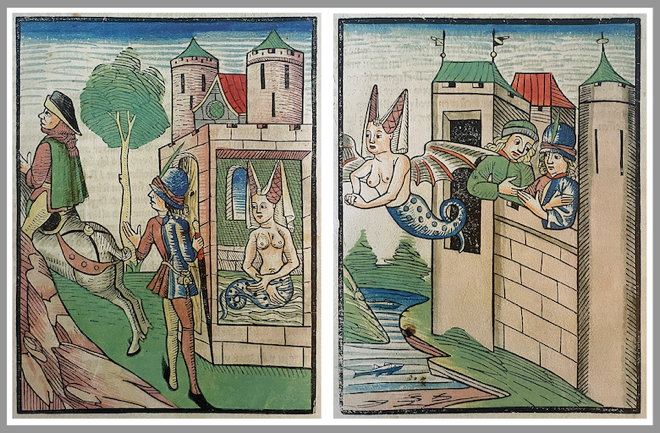
In need of redemption, she marries the human knight Raymondin, promising to make him wealthy and famous on the condition that he must not look for her on Saturdays. For ten years he keeps his promise, and she gives him great power, land and ten sons, who go on to become successful knights, but are born with monstrous deformities. After she has provided him influence, wealth and offspring, Mélusine’s tragic end comes when Raymondin, spurred on by his brother by rumours of adultery, spies on her. Breaking his vow, he cuts a hole into the door with his sword and peeks into the room where she spends her Saturdays—the bathroom. And what he discovers in his jealousy is that all she does is take a bath, albeit in another form—as a snake, from the belly down.
Even though she knows he knows, nothing happens immediately. But after one of their sons kills his brother, Raymondin reveals Mélusine’s secret to his court, blaming her for the murder and questioning her abilities as a mother and her status as a human being. Following this act of distrust and disclosure, Mélusine is forced to fully transform into a winged serpent-dragon and leave the human world for good. Crying and grieving over her fate, she has to say farewell to her heartbroken husband and her children and fly away from the tower of the Castle of Lusignan in front of everyone’s eyes. Legend has it that her last human footstep remains on the windowsill as an imprint in stone: the end of her hopes to find salvation, impressed as the indentation of a perpetual echo. Only returning at night to nurse her infants, she is condemned by the obligation of the curse to appear in her monstrous form to lament for three days every time one of her descendants dies or when the fortress changes hands.
Following the literary tradition of a mortal man marrying a supernatural woman, the genealogy of the story about Mélusine’s hybrid fairy-human-animal body combines monstrous elements with Christian virtues. Her shapeshifting character is depicted through an interplay of text and images that reshapes and transforms on its journey across languages and cultures as it transitioned from handwritten illuminated manuscript to print.
The material of the story was shaped and reshaped: initially transmitted orally, it was then written down by two French authors—Jean d’Arras’s prose version (compiled 1382–94) and Coudrette’s verse version (around 1401). It gained particular importance with the illuminated German prose transposition by Swiss writer Thüring von Ringoltingen (completed in 1456), responsible for shaping the visual imaginaries, future adaptations and migratory reach of the legend. But unlike other “offended supernatural wife” stories, Mélusine does neither lure anyone to certain doom nor does she rebel against Christian rule(r)s. Rather, she is depicted as a heroine undeserving of her fate, which adds a tragic dimension.
Two key moments in the narrative reflect on the visibility of her ambiguously hybrid nature: in the Saturday bathing scene, during which her secret tail is discovered, she is described and depicted as a human hybrid with a snake tail. In the flight from the castle tower, the text refers to her as having the form of a full-bodied snake, but Bernhard Richel’s iconography depicts her as a winged, bare-chested half-serpent, which image became the influential prototype for subsequent visualisations, transforming the story from local legend to best-selling romance.
To Dash Through and Fly Away—a Feminist Angle
Working with this material, we wanted to find ways to poetically re-read the illuminated manuscripts in the contemporary context of feminism, intertextuality and interspecies encounters. After introducing the thematic aspects of the Mélusine romance that we have been particularly interested in, we present the writing and reading scores we developed as means of activating the legendary encounters from the text through spoken, written and performed gestures.
In this way, we view the myth of Mélusine through our own contemporary eyes and questions instead of poking around in the text with the excellent swords of (medieval) literature. We read the words and the images to see how they resonate and in which way the old legend is still meaningful today. In our shared artistic practice, which moves between creative writing, photography and performance, we want to encounter Mélusine’s myth as a space to rest, to unfold and perhaps even float. Focusing on being actively engaged readers and interrogative writers, we developed a series of experimental scores as possible approaches for interacting with the text to create spaces for both unlearning and rewriting in order to reveal different nuances through different (written) means and with different (material) tools.
A legend is a narrative dealing with a happening or an event. A legenda in Latin is something to be read—derived from leger, ‘to read, to gather, to pluck’. Select. A legend selects certain circumstances, spins a fictional story around them and then gathers readers around it. The German word Stoff, literally ‘fabric’, denotes the material of a story. The readers, in turn, pluck things from the narrative, thus gathering an understanding. But how can we deal with an old text, in our case a medieval one that is almost 1,000 years old? When we lack the contemporary knowledge and frame of reference? When we are late—centuries too late—to the gathering, the plucking and the circumstances?
Building on Robert Scholes’s concept of fabulation, Marleen Barr developed an understanding of feminist fabulation, which she describes as “feminist fiction that offers us a world clearly and radically discontinuous from the patriarchal one we know, yet returns to confront that known patriarchal world in some feminist cognitive way.”[2] As Donna Haraway points out, speculative fiction, feminist fabulation and speculative fabulation merge in her own writing practice: “passing patterns back and forth, giving and receiving […] Again and again, SF has given me the ideas, the stories, and the shapes with which I think ideas, shapes, and stories in feminist theory and science studies.”[3] The fabulatory approach is a means of questioning rather than knowing, a means of complaisant doubt. In this respect, it is interlinked with the notion of the anarchive, as it can be used as a method to challenge assumed historical certainties, archives and their “consciousness fundamentally tied to power.”[4]
To us, fabulating means working with blanks and constellations, working from the fringes where much has already been lost. Welcoming this loss. Welcoming what cannot be known, while not staying silent. The sword and its piercing of holes are crucial elements of the Mélusine legend— and haven’t we heard it, haven’t we heard all about it many times before?[5] Surely, there must be another story within the legend; another story that can be extracted, to become a seed for another opening onto the material and how it comes to engage us—as re-readers and re-writers, as contemporary containers for re-fabulating, revealing and catalysing. Surely, there is something to be found in the legend that connects to the present, but how? When slithering becomes dashing, a method evolves. Dashing, as in moving quickly, then—flying. Leaving behind the paper and its laws of gravity, reaching a boundless space, thanks to the act of taking flight. In Hélène Cixcous’s words:
If woman has always functioned “within” the discourse of man […] it is time for her to dislocate this “within”, to explode it, turn it around and seize it; to make it hers, containing it, taking it in her own mouth, biting that tongue with her very own teeth to invent for herself a language to get inside of. […] For us the point is not to take possession in order to internalize or manipulate, but rather to dash through and “fly”. Flying is woman’s gesture—flying in language and making it fly.[6]
To read and fly—to speak and fly; leaving the castle and its cold, century-old walls. Showing one’s body, speaking one’s mind. Flying away into a borderless hue of blue. Voler in French doesn’t only mean ‘to fly’, but also’ to steal’. Taking the text from its past in order to read—to gather—to pluck. Stealing away from the rule while finding delight in incompleteness and connectedness. Read—gather—pluck. To steal once meant to secretly take something and carry it off. If others get to tell the story, maybe the only thing we can do is to steal it from them: taking what speaks to us, secretly carrying it off.
Men scripted Mélusine’s story, plucked it from the ever-changing ecosystem of telling and retelling. Still, how Mélusine evolved as a character, how she was formed by moments that told her story, has been lost to us. All that remains is a version of Mélusine, written down by men. Men writing about other men: the main part of the myth is about husband Raymondin, his journey from one of the lowest point of his life—when he has accidentally killed his uncle who generously supported him—to his rise as a wealthy king thanks to Mélusine’s fairy wisdom and the good deeds and heroic victories of their ten sons who expanded the kingdom. However, if we apply narrative models such as the hero’s journey to her myth, Mélusine remains mostly still. She is not the heroic central character of this story, rather, she is the helper, at best the mentor, maybe the elixir in a story about men living in a world of swords. She wasn’t granted that kind of narrative development that would have enabled her to stay in the story, remain a woman, become whole and die peacefully.[7]
If to steal once meant to secretly take something and carry it away, then perhaps we might have arrived at a point where we would have been able to step out of the concealing darkness with its conspiratorial hushing. Then it is also a point in time that requires us to speak up and remind ourselves how important it is to take up positions that challenge prevailing narratives. Time, still, to spread the wings, fly in language and making it fly.
In our work with the myth of Mélusine, we focus on motifs of constriction and intrusion—the hole, the snake’s body, its hybridity—carrying them to a place where they can become starting points for new approaches that are informed by those cuts and seams and silences. To celebrate them as strategies for inventing ways of writing and reading traces that allow us to get in and sneak out again.
Hyphenated Bodies and Compound-Nouns
In order to read this medieval text today, we need a translation into modern English, German or French. But Mélusine’s body has always existed in translated adaptations and transposition—transposed to what was modern at the time of writing and reading, in its different habitual contexts, dress codes and interpretations. Kevin Brownlee observes that “Mélusine is a genealogical hybrid, born of a fairy mother and a human father. And Jean d’Arras’s text represents this hybridity as a tension.”[8] The narrative is driven by Mélusine’s ambiguous poly-corporality and the tragic reasons for her different transformations: her fairy-human ancestry, her cursed Saturday body as woman-snake, her Christian body as wife, state founder and mother, and her leaving body as a winged dragon-snake.
Even after her love-transformation into a woman, Mélusine remains a serpent-woman, or woman-serpent, if only on one day of the week. The order of words is important here, because the first part of a compound-noun is only ever the specification of the second part of the compound-noun: a snake-woman being a woman with snaky attributes; a woman-snake referring to a womanly snake.
A compound noun means something more specific than its two separate words. The front-word acts like a prefix to the end-word of the compound: second-ness in reading defining first-ness in meaning. Accordingly, the front part of a compound-noun is governed by its back part, which is also the case in the tragic end of the story of Mélusine story, who is forever defined by her tail, and not by her achievements, her goodness or her bravery. And after having been seen in her compound state, her tail lingers on in the minds of those who have seen it and will eventually judge and ‘write’ her.
Lydia Zeldenrust suggests that “Mélusine’s hybrid body questions the boundaries between human and animal, thereby providing a challenge to the normative distinctions commonly found in medieval chivalric literature”, arguing that the constructed nature of the monstrous body “reveals the anxieties and desires of those who created it.”[9] Part fairy, part human, part animal. The process of looking in-between the shapeshifting elements of a quasi-collaged body made up of woman and animal parts is akin to a process of imaginary montage, which animates her image in the process of being-looked-at as an event in time.
So, what needs to be seen second in order to mean first? What emerges productively from the shadows, before jumping assertively to the fore—rather than becoming all-too hybridised? Where does the female start, and the snake begin?
A creature is a thing created—a creation. And just like a composite character is collaged by a writer or artist, the figuration of Mélusine’s character is created by blending traits and characteristics of multiple mythologies, languages and origins into a complex personality.
But how do we picture her bodily transitions from scale to skin? Where are the seams and the scars of these metamorphoses? Do her scales get smaller as they turn into skin, do they appear on the same height, around the middle of her body, just where we imagine her hips, or lower or higher? How do we imagine skin and scales merging around her waistline; how wings grow from her shoulders as her legs fuse together? And what about her teeth, her tongue, her spine, her pelvic floor, her digestive organs? And in imagining her, we rewrite her bodily transitions, enact her transformative scars. Each score anew.
Some Reading and Writing Scores
Mélusine Score 1: “Twisted Point”
…but in his anguish he turned and twisted the point of his sword until he had made a hole through which he could see.
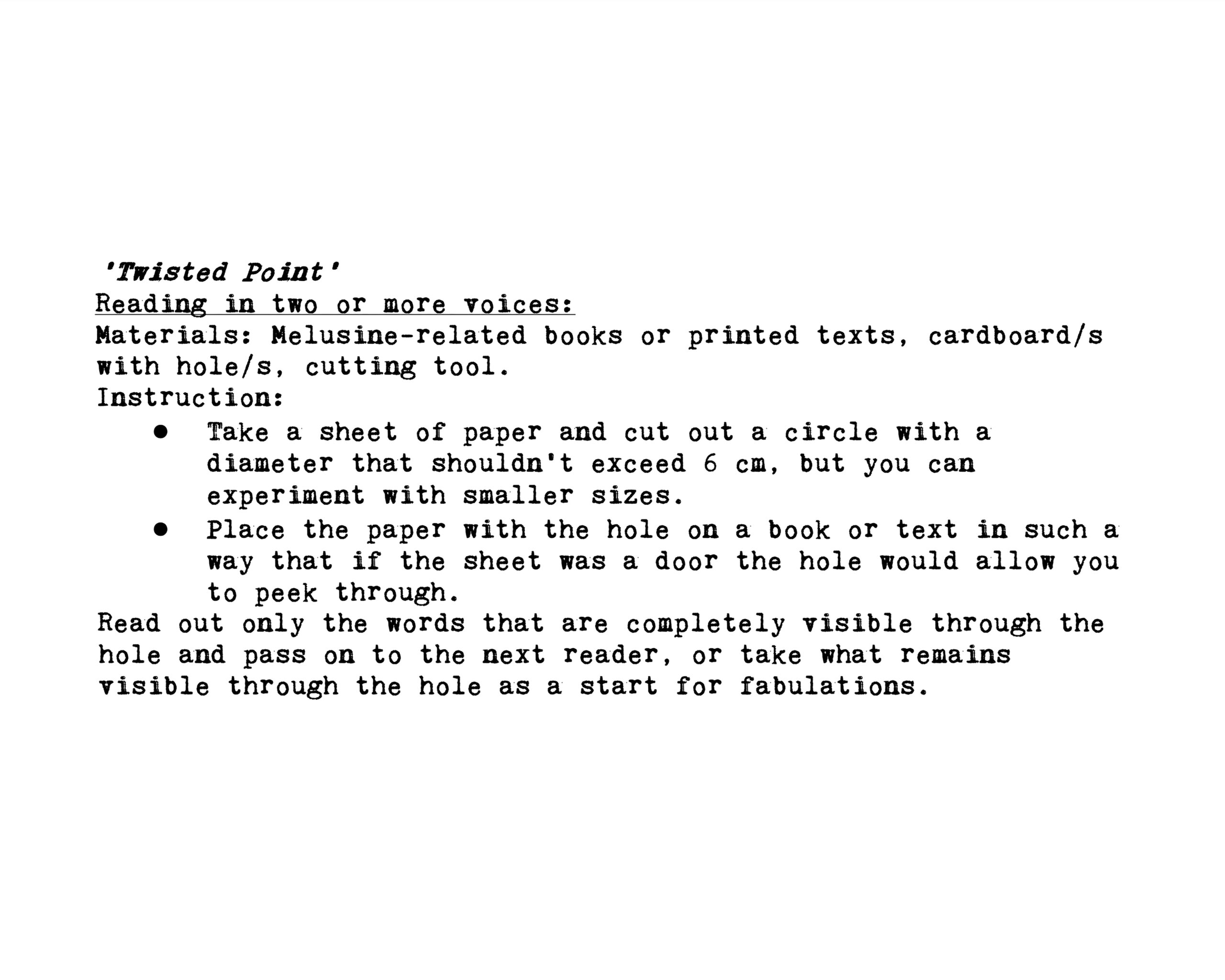
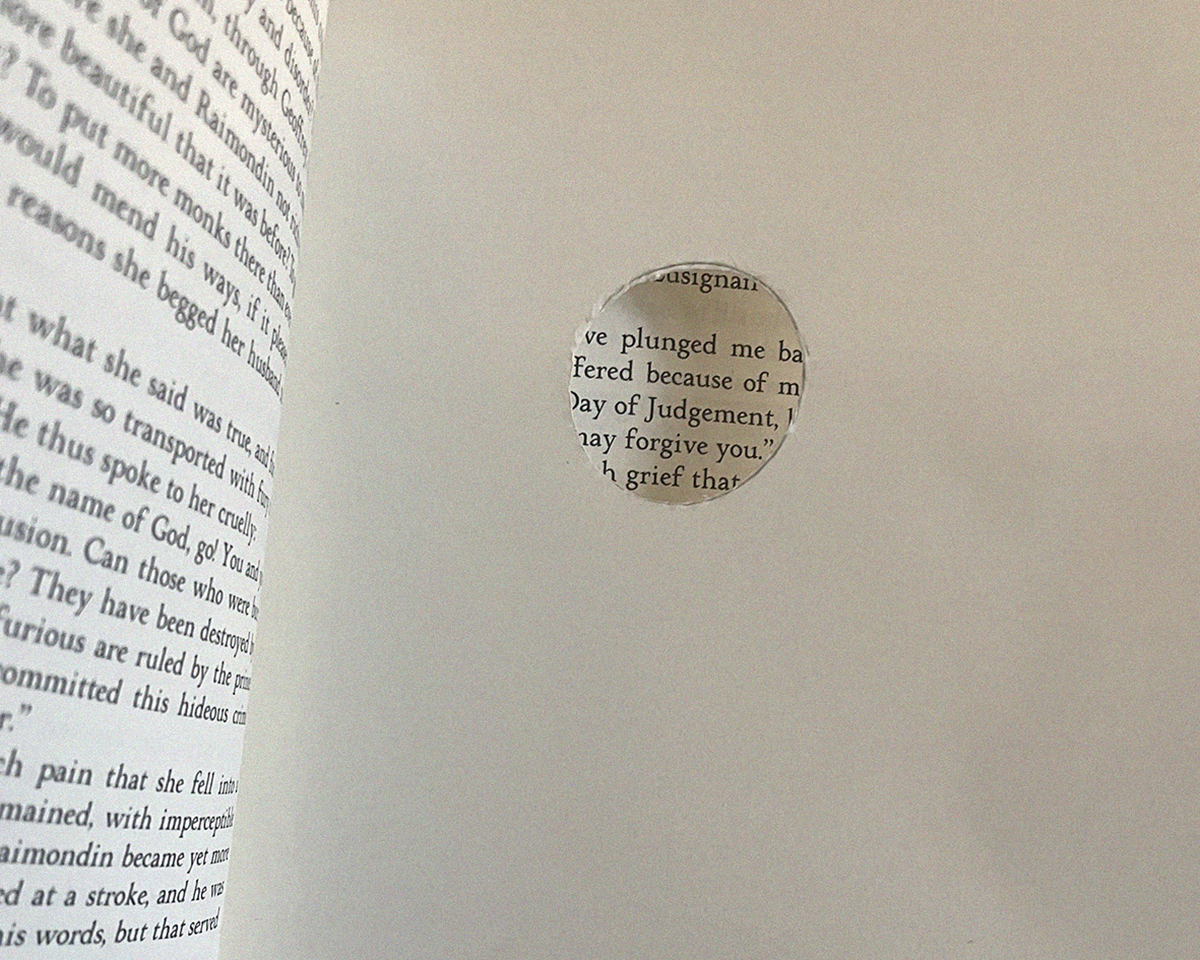
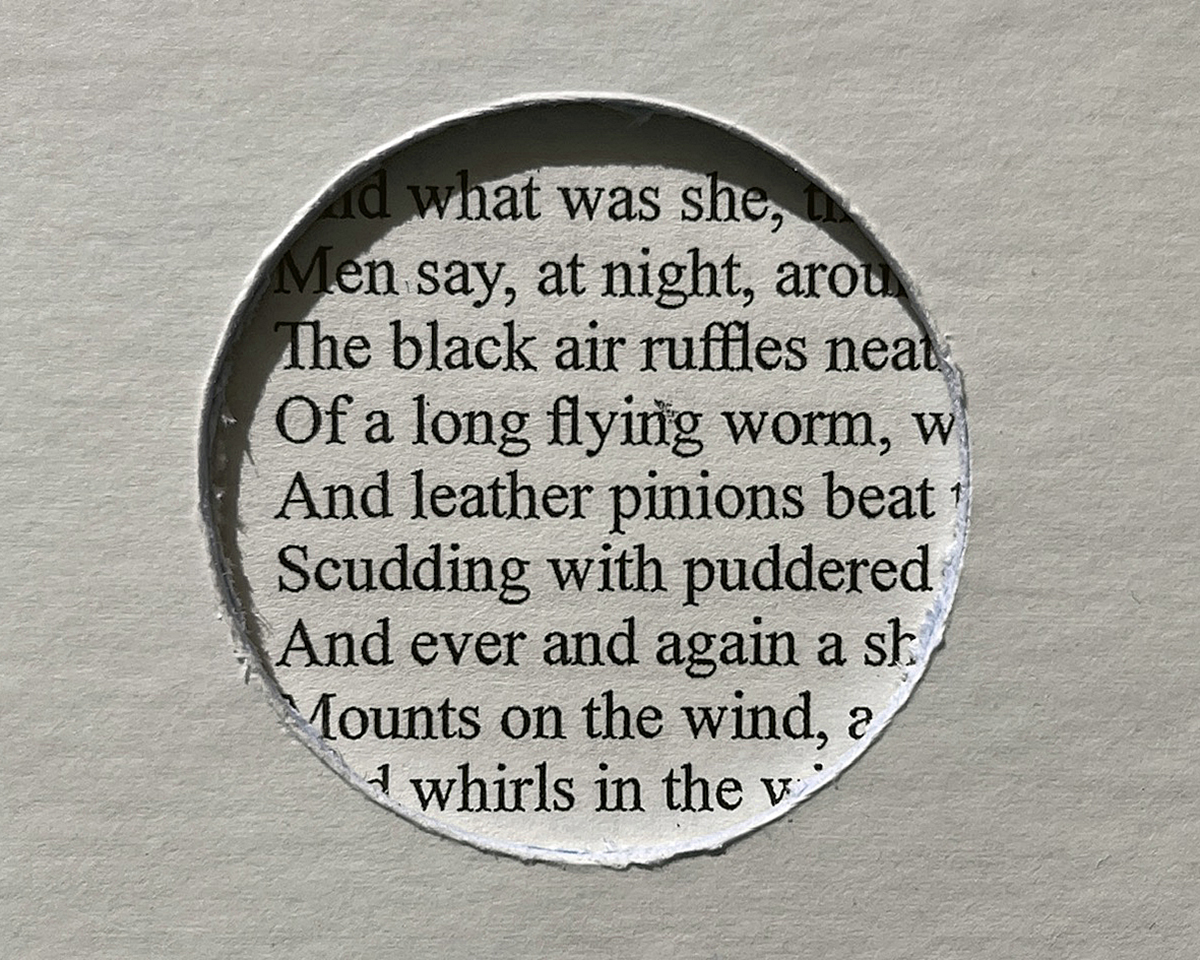
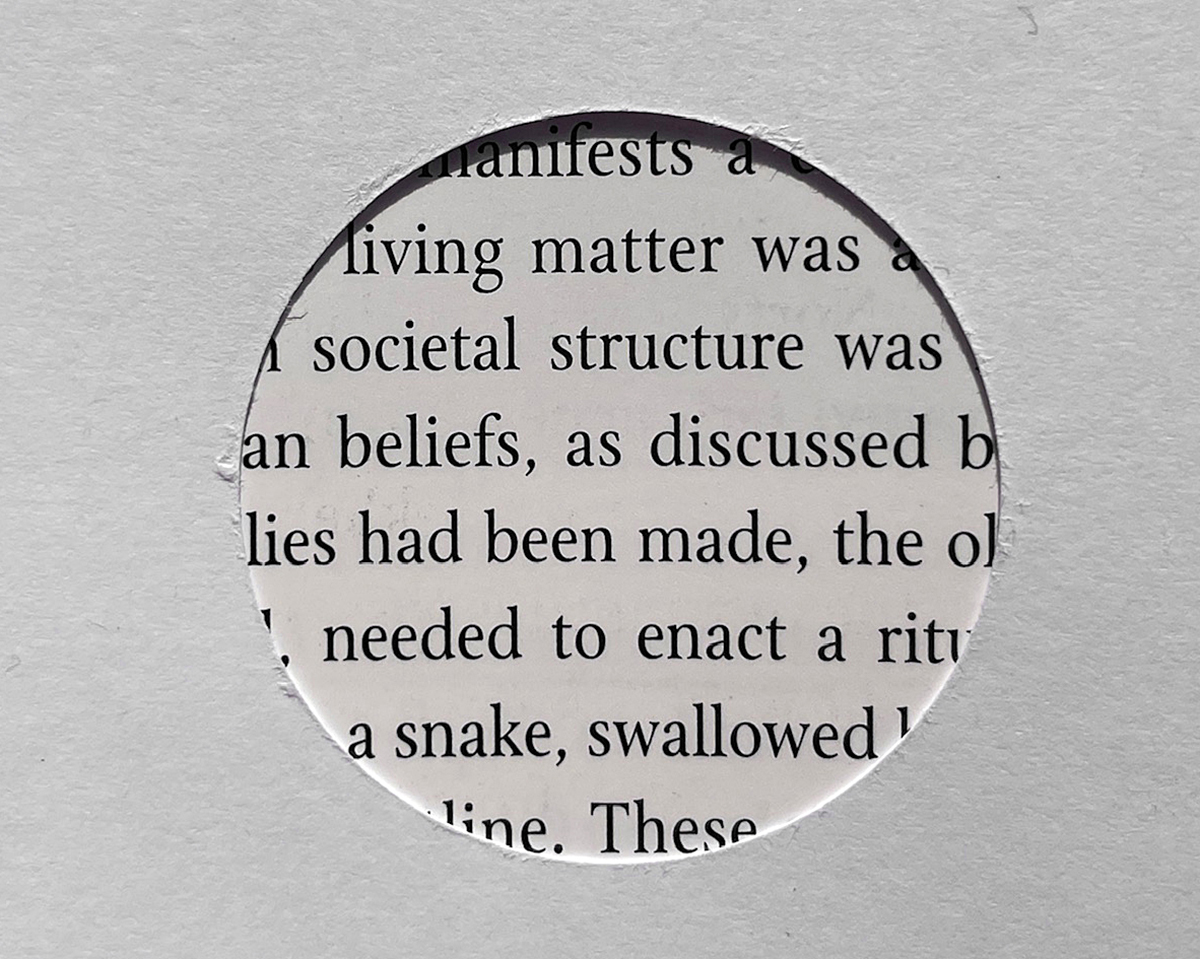
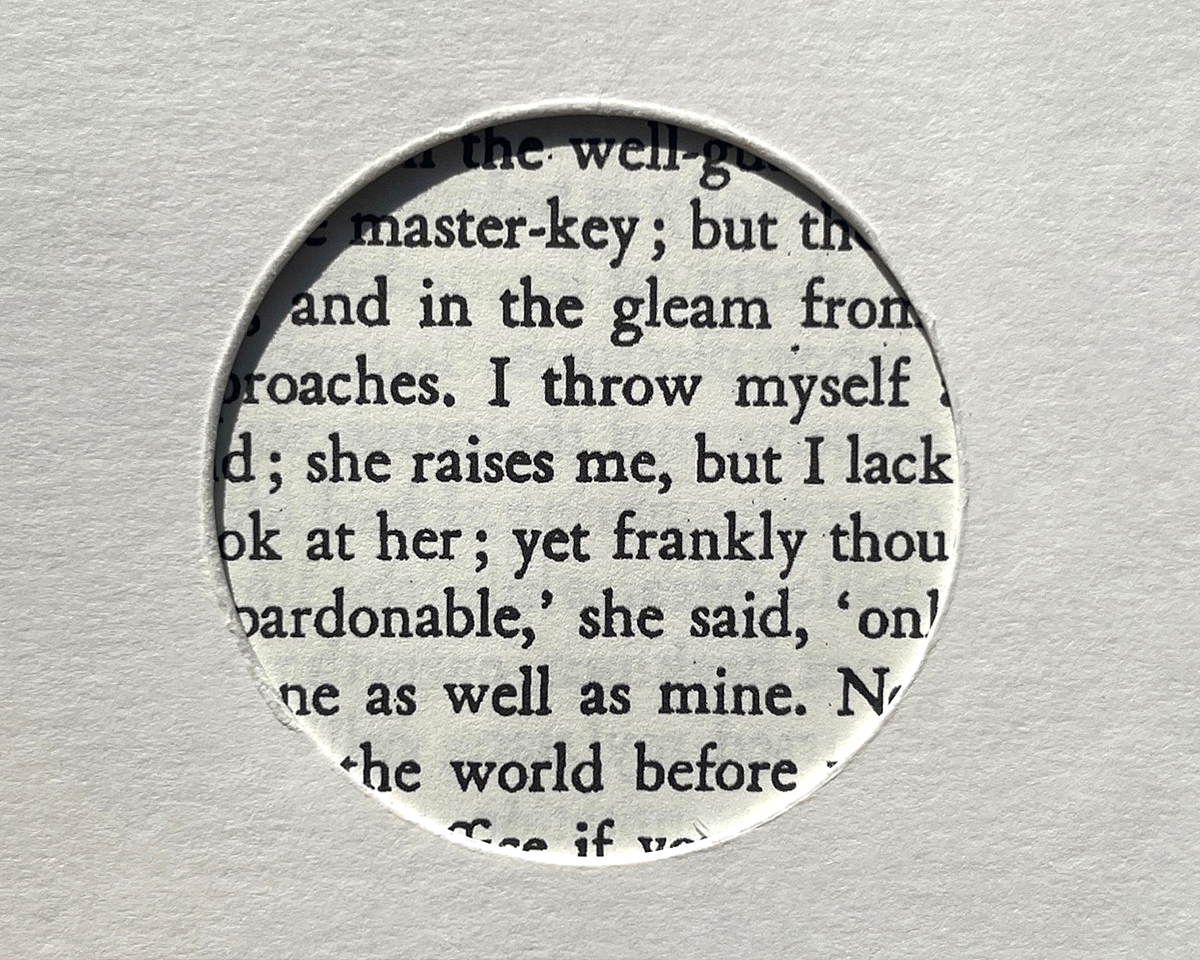
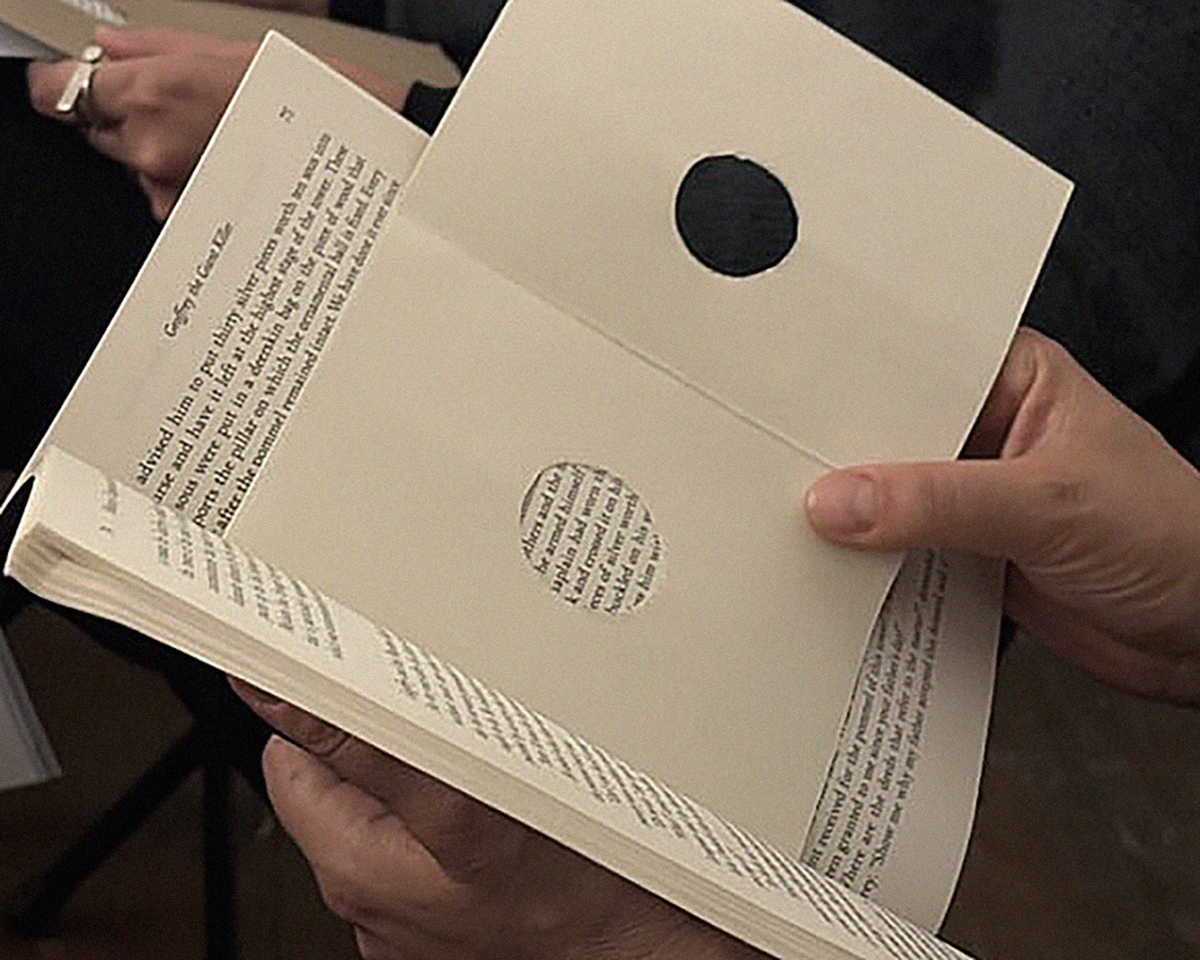
The hole here simulates the rupture Raymondin’s penetrating sword left in the door that had hidden Mélusine’s secret. But it also stresses what is revealed behind and through the hole that makes this score a magical instrument for textual findings as the words appear in the cutout. In the context of a participatory performance, members of the audience can also place punctured sheets somewhere on a text and read aloud what is legible through the cutout. Either one after another or as an overlapping group improvisation. Like this, the first encounter with a text is multi-voiced, poetic, enigmatic and decentred. In this way, a text slowly develops and materialises through and between framed excerpts.
Mélusine Score 2: “4/4 Scales”
…her tail trailing behind her, unbelievably long and of blue and silver scales.
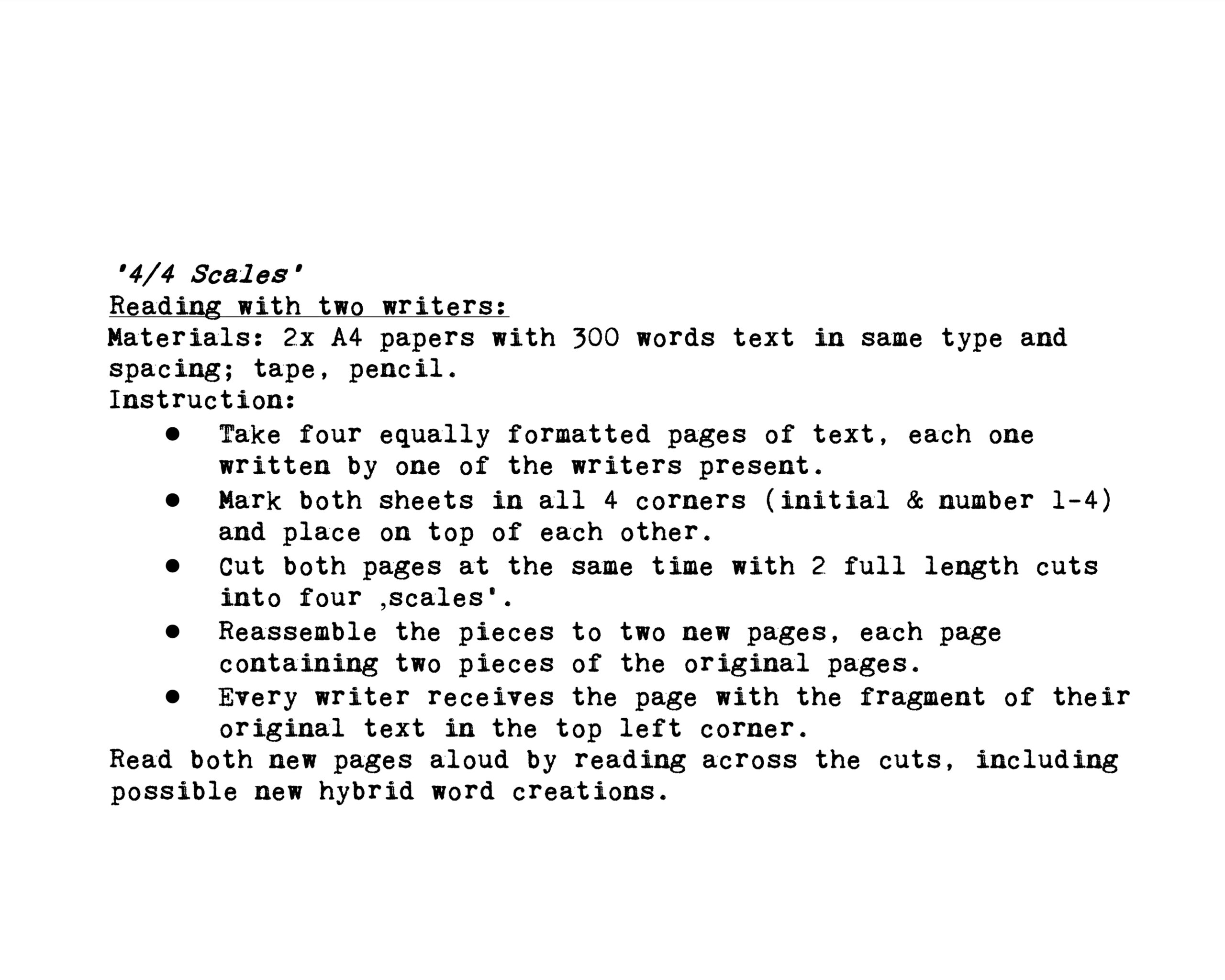
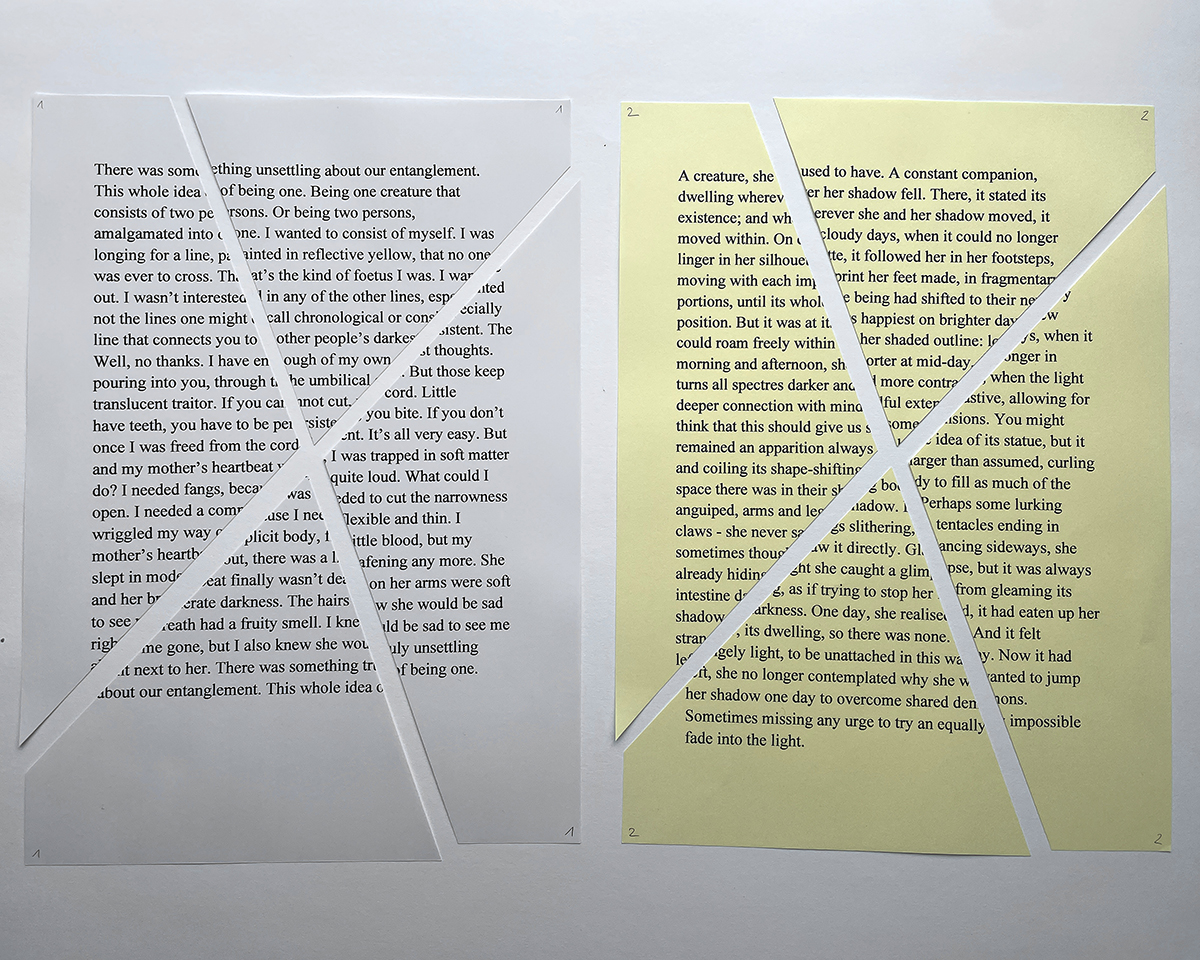
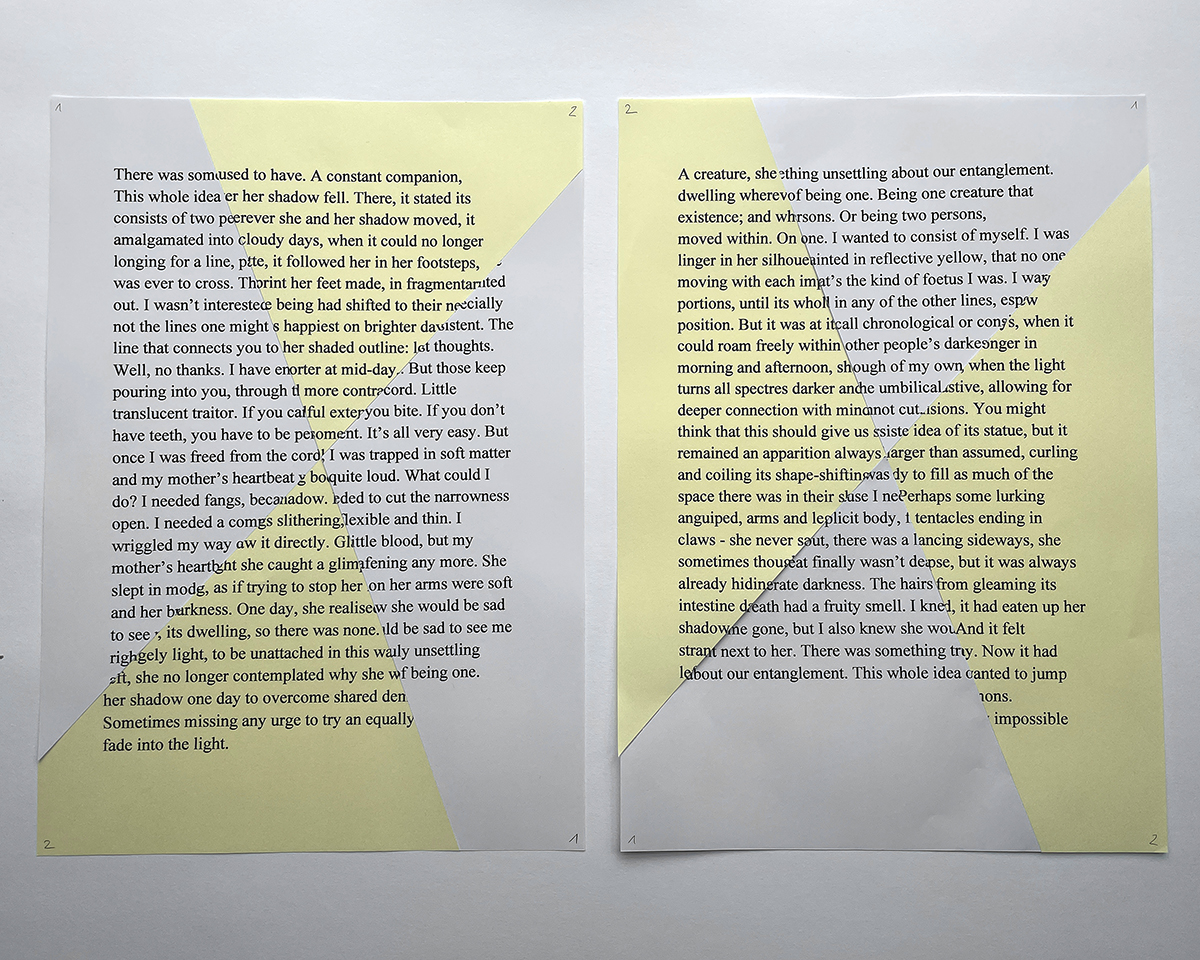
In this score, the newly combined text-scales celebrate the multi-bodied otherness that represents Mélusine’s punishment in the myth. The instructions let two texts truly connect as one skin—interacting, entangling and colliding when read across the cuts. It draws on cut-up techniques used by the Dada movement and later by William Burroughs, who, for example, cut book pages into four rectangles before deciding how to join them anew. In contrast, our score combines writing about a shared theme before combining the different parts more conceptually. It highlights the seams and scars where body parts, words and scales meet, underlining friction and differences.
Mélusine Score 3: “Snaking Back and Forth”
…my friend, now our love has changed to hate, your tenderness to cruelty. Our pleasures and our joys have turned to tears and crying, our good fortune to misfortune and calamity.
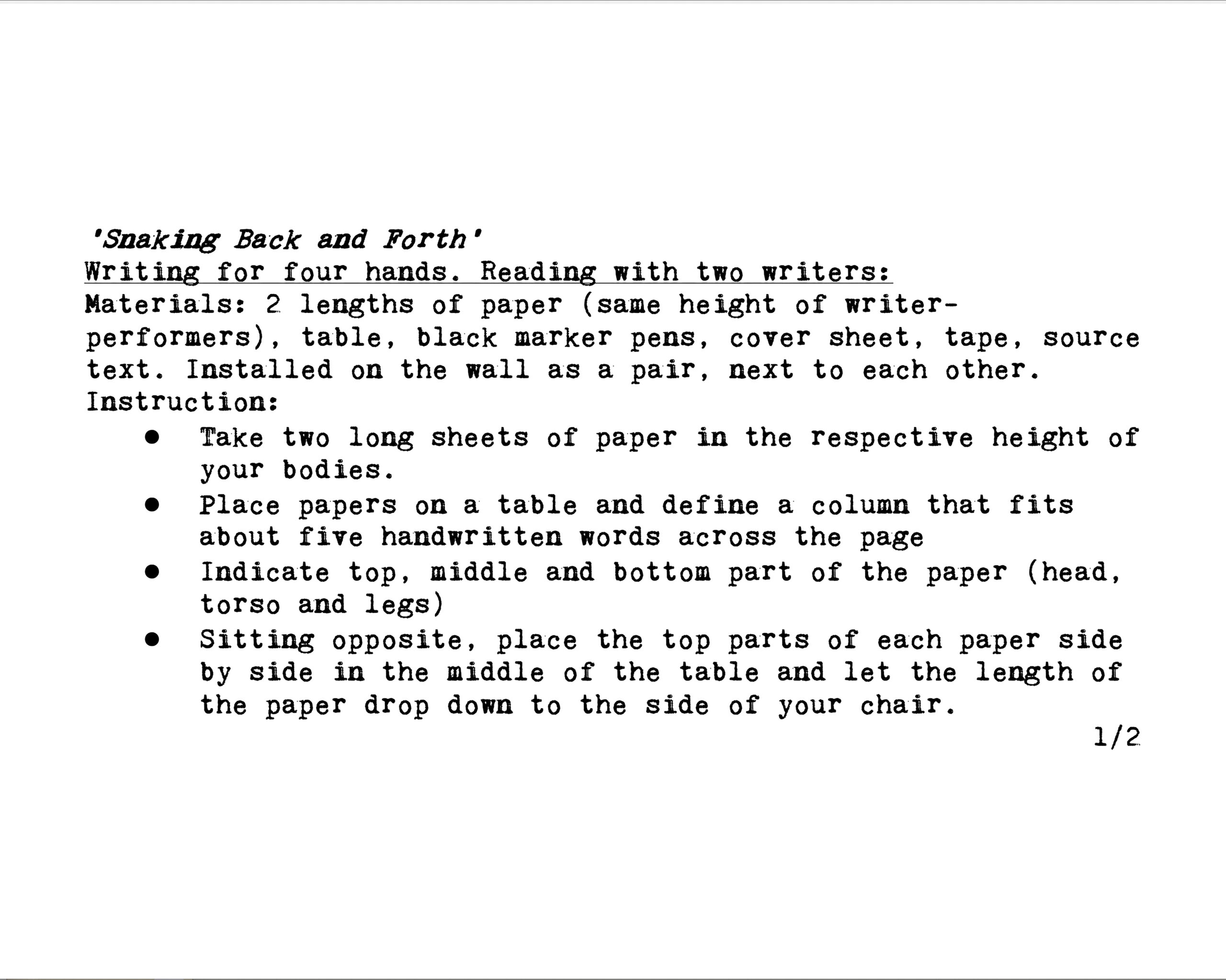
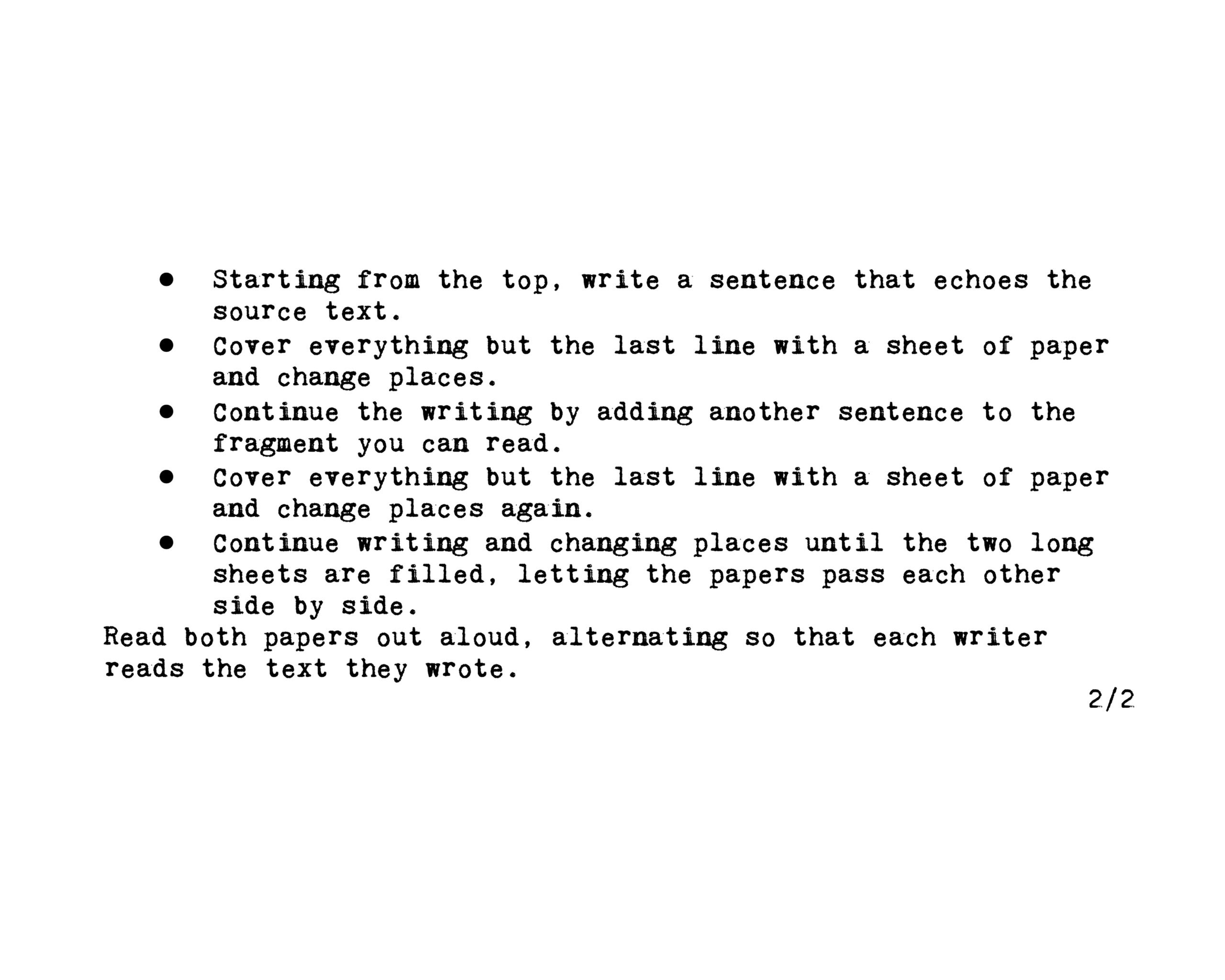
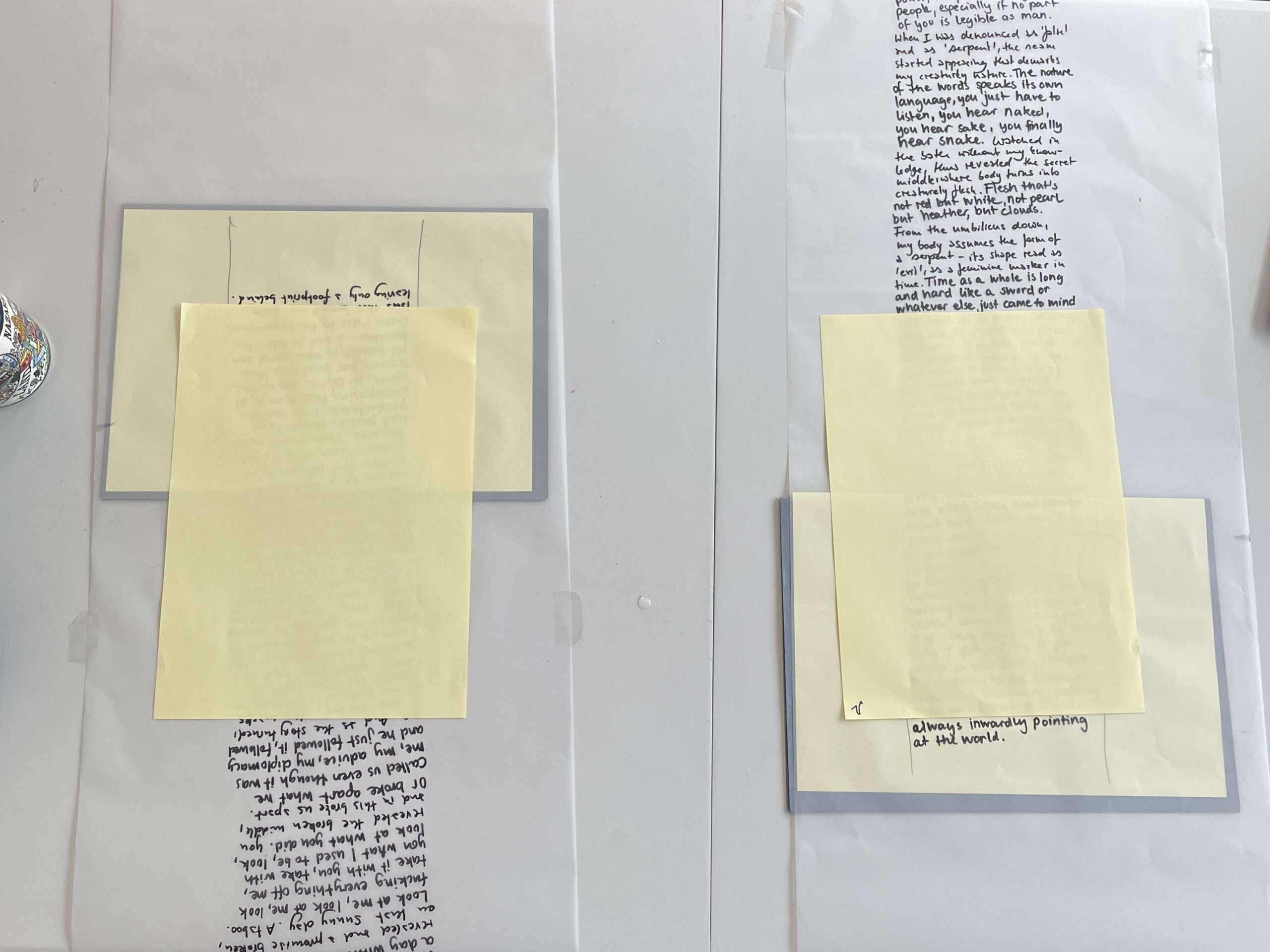
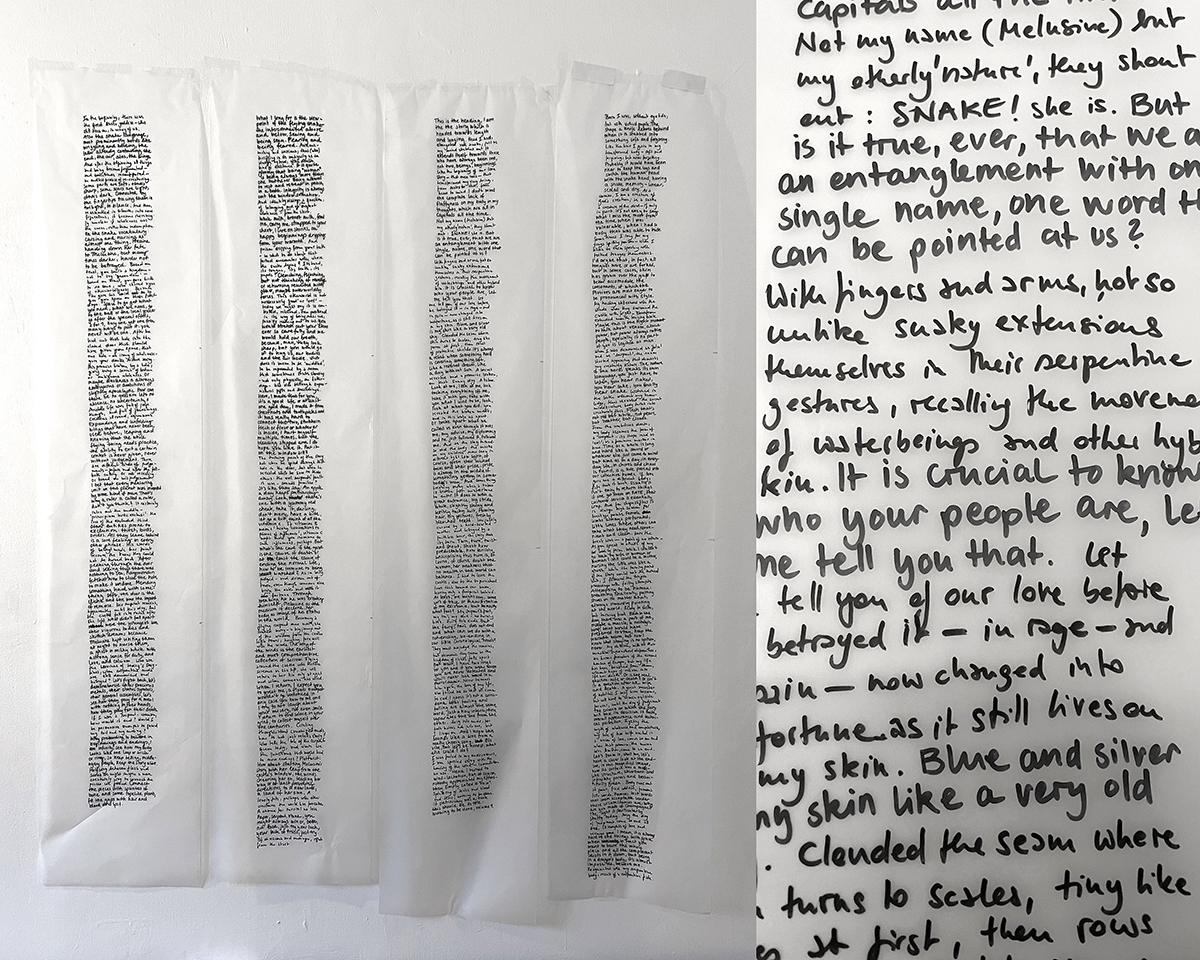
“Snaking Back and Forth” alludes to the Surrealists’ drawing game of the cadavre exquis, during which several people add to the same drawing and conceal most of it by folding the paper before it is passed on to the next contributor. Similarly, here two writers’ voices interlace by reacting to the few words that remain visible from the former writer. While the direction of both texts is being negotiated simultaneously, ideas that had not been considered at the beginning of the process emerge. Trying to grasp and to go at the same time brought a lot of playfulness, while the length of the paper created a challenging framework as the game lasted for almost two hours. The writing shifted from the head into the hand, the reflection of the myth no longer coincided with being in the moment, finding words to put down on the paper. This moment of detachment from the myth and turning towards each other adds another layer to the score that is intensified in the later reading: an immediate connection of two writers’ voices in the here and now, led by each other’s words.
Mélusine Score 4: “Howling”
…making such cries, together with a humming and a roaring as if a thunderstorm or tempest were about to come upon them.
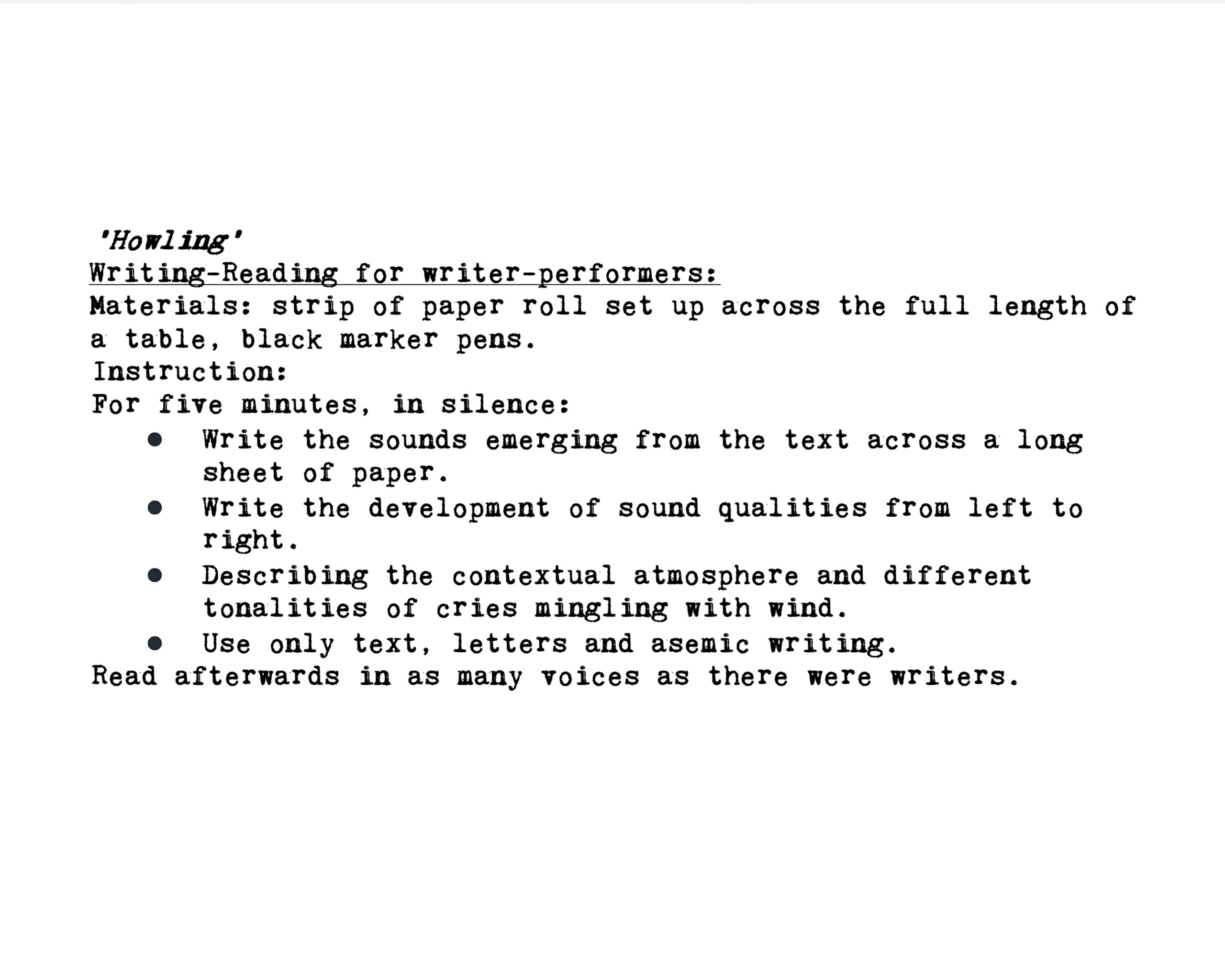
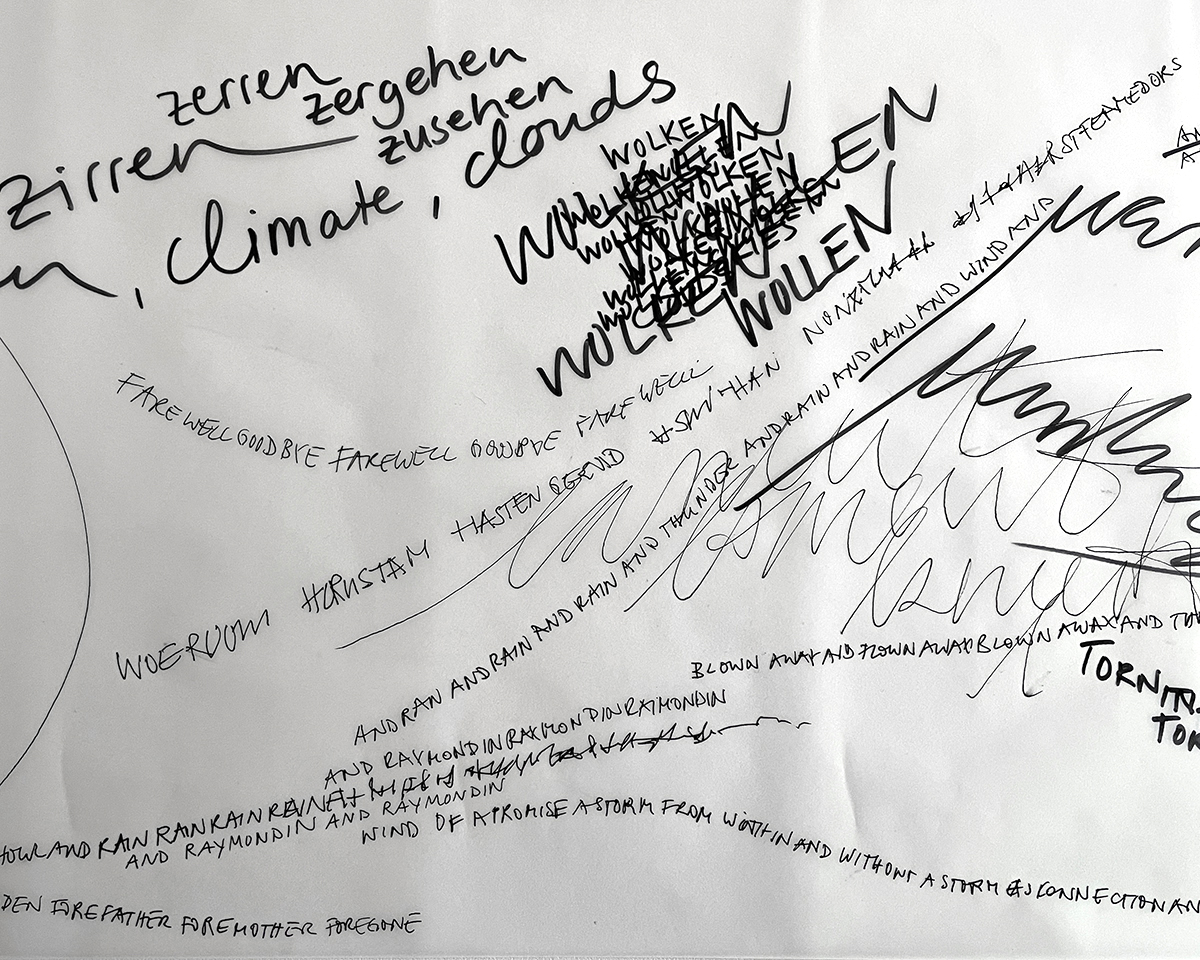
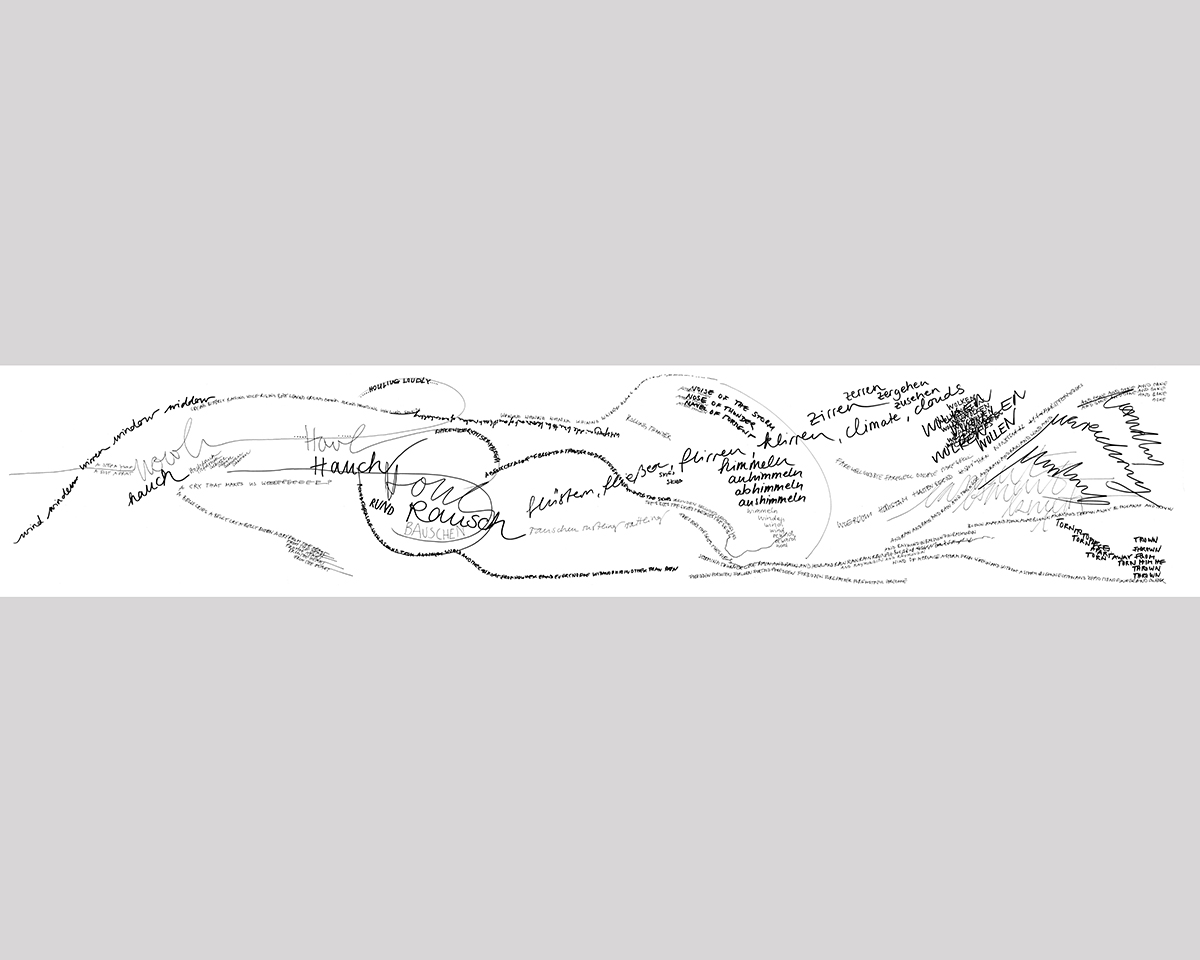
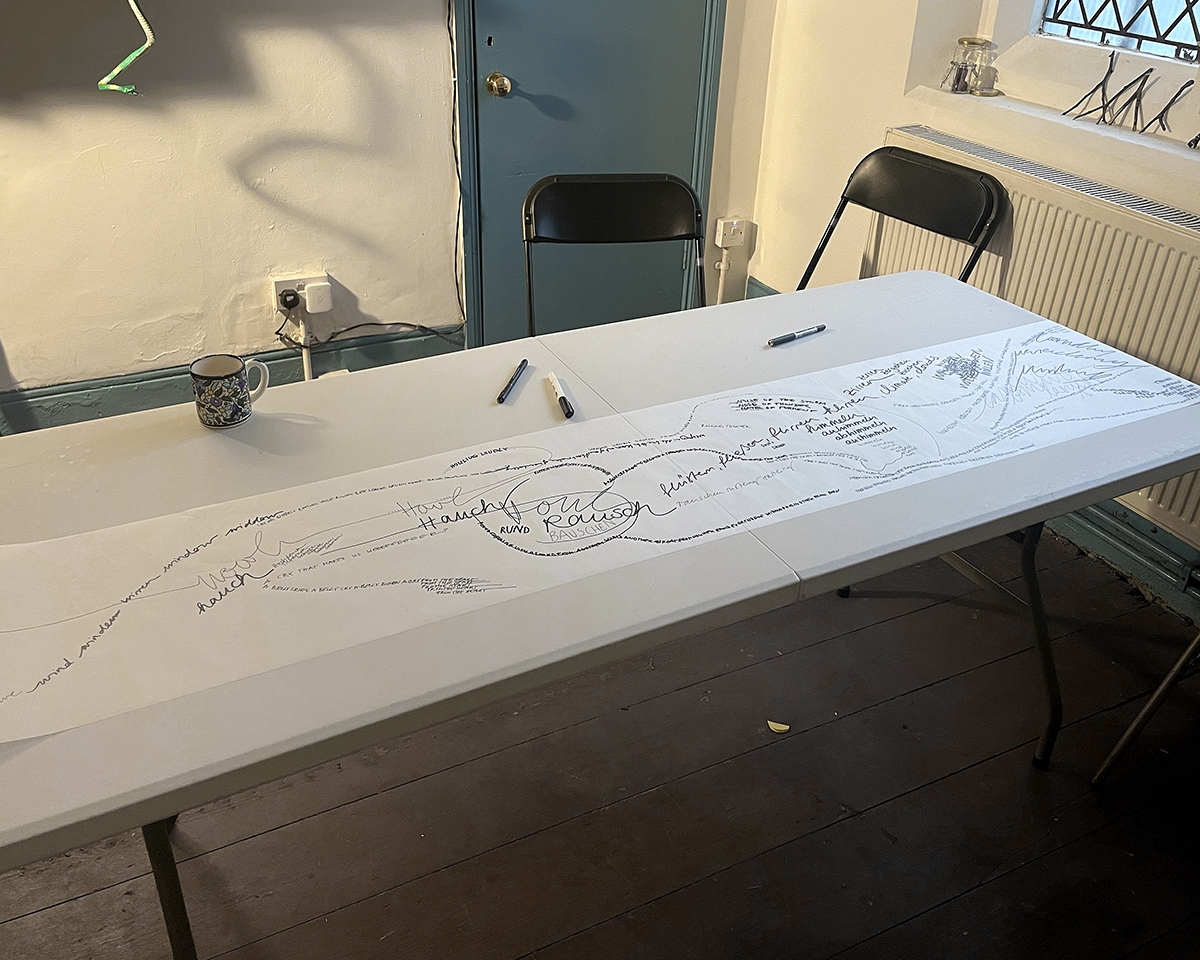
This score encourages the expression of both inner and outer worlds, making the sounds embedded in the text not only visible but also audible. It conveys Mélusine’s spectacular final moment in the myth, in which she reveals herself—for the first and only time not in the service of Raymondin, her house or the narrative.[10] Echoing methods used by Konkrete Poesie, here the combination of legible and asemic elements reflect the meaning rather than spelling it out. The writing becomes an abstract gesture that invites interpretation rather than a means of transmitting information. “Howling” invites writing and later reading from a volume—in terms of loudness, but also in terms of listening to the dynamics of a (narrative) space. “Howling” is a countermeasure, an exercise in taking up space and filling this space with a voice. A voice that fills and writes and reveals itself.
Footnotes
- Von Ringoltingen, Thüring. Die schöne Melusina; Ein Feenroman des 15. Jahrhunderts in der deutschen Übertragung des Thüring von Ringoltingen (1456); Die Bilder im Erstdruck Basel 1473/74. Ed. Heidrun Stein-Kecks. Darmstadt: Wissenschaftliche Buchgesellschaft Universitäts- und Landesbibliothek Darmstadt. 2012. p. 177 (fol. 49r) and p. 133 (fol. 62v). ↑
- Barr, Marleen S. Feminist Fabulation: Space/Postmodern Fiction. Iowa: University of Iowa Press. 1992. p. 10. ↑
- Haraway, Donna. “SF: Science fiction, speculative fabulation, string figures, so far”. Ada: A Journal of Gender, New Media, and Technology. vol. 3. no. 1. 2013. pp. 1–184. DOI:10.7264/N3KH0K81. ↑
- Zielinski, Siegfried and Winthrop-Young, Geoffrey. “AnArcheology for AnArchives: Why Do We Need—Especially for the Arts—A Complementary Concept to the Archive?”. Journal of Contemporary Archaeology. vol. 2. no. 1. 2015. p. 116. ↑
- “So long as culture was explained as originating from and elaborating upon the use of long, hard objects for sticking, bashing, and killing, I never thought that I had, or wanted, any particular share in it.” LeGuin, Ursula. The Carrier Bag Theory of Fiction. London: Ignota. 2019. p. 28. ↑
- Cixous, Hélène. “The Laugh of the Medusa”. Signs: Journal of Women in Culture and Society. vol. 1. no. 4. 1976. p. 887. https://www.jstor.org/stable/3173239. ↑
- “Even though female characters in Thüring’s prose novel are often indeed part of an event explicitly described as adventurous, they mostly remain in a passive role. As the adventure-concept established in research and dominantly oriented towards a male protagonist seems to suggest, women are guardians of and therefore bound to special places; together with this they are temptations (if not temptresses) or potential war trophies. The area where, on the other hand, female characters become extremely active—even if this is done covertly up to a certain degree or point of time—comprises the enabling of action, including adventurous action, as well as telling the stories about it.” Fuhrmann, Daniela. “Female Fiction; The Adventurous Melusine”. In Weibliches Abenteuer / Female Adventure; literarische Konfigurationen zwischen Mittelalter und Moderne. Ed. Daniela Fuhrmann and Gaby Pailer: Würzburg: Königshausen & Neumann. 2024. p. 77. ↑
- Brownlee, Kevin. “Mélusine’s Hybrid Body and the Poetics of Metamorphosis”. Yale French Studies. vol. 86. 1994. p. 19. https://www.jstor.org/stable/2930274. ↑
- She continues: “knights know that they should rescue or marry beautiful women and kill dangerous serpents, but what happens when you discover that your wife is a combination of both?” Zeldenrust, Lydia. The Mélusine Romance in Medieval Europe: Translation, Circulation, and Material Contexts. Cambridge: D. S. Brewer. 2020. p. 7. ↑
- The “Mélusine-wind” is a folk belief in which a natural acoustic phenomenon is associated with the mythological figure Mélusine, in which the whistling and howling of the wind is understood to be her final lament. ↑