Artists Michelle Williams Gamaker and Nina Mangalanayagam discuss their archival source material and research methods in relation to their artistic projects, Strange Evidence at Matt’s Gallery, London (2025), and Blank Pages at Bildmuseet, Umeå (2026), respectively. Both artists engage rigorously with scholarly archival research as the bedrock of their creative practice, seeking to unearth the multiple lines of narrative possibility that archives elicit, and to expose how subjectivities are embedded within the structures of power that produce them.
In distinct ways, each artist draws connections between the political and their personal lineages, addressing how history shapes subjectivity and how that subjectivity is perpetually renegotiated—not only in its original historical moment but in every subsequent re-reading and re-positioning of the source material. This conversation, facilitated by Jyoti Mistry, foregrounds the artists’ research processes within the archive, and considers how their encounters with its contents and materialities shape their creative decisions.
Over a series of projects and through various iterative strategies in their artistic work, Michelle Williams Gamaker and Nina Mangalanayagam have sourced material from across archives in institutional contexts to resources from socio-historical networks; mindful of the fact that communities build repositories through objects and artefacts that expand the idea of what might constitute an “archive”. The impact of accessible public-domain materials—everything from documents to photographs and memorabilia available on platforms like eBay—charts the influence of popular culture on historical events and by extension on the memories of communities. Both artists engage rigorously with scholarly archival research that forms the bedrock of their creative practices. In the process of unearthing the multiple lines of narrative possibilities that institutional archives and repository resources elicit, they seek to expand on how subjectivities are embedded in the structures of power that produce these archives. In their work, they aim to draw connections between the political and their own personal lineages to address how history has impacted the formation of subjectivities and ultimately how these subjectivities are always negotiated—not only in their specific historical moment but in re-readings and re-positionings of the source material. In distinctive ways, Williams Gamaker and Mangalanayagam lay bare the challenges of representation and the necessity to explore artistic forms that expand ontological enquiry in relation to documented materials. This conversation foregrounds not only their research processes in the archive but also explores how the encounters within the archive and engaging the content and its materiality shape their creative decisions. They describe their process in identifying source material that they choose to focus on that informs their artistic choices on modes of representation most suitable to grapple with the ideas they seek to explore, the subjectivities they aim to reveal and the undisclosed histories they strive to foreground against the dominant narrative of the archive.
The introductory videos offer an entrée into each of their practices and the conversation provides further reflection on working in the archive; through its institutional structures and other forms of repositories that suggest the widening use of the term “archive” not only as bound to ideological or hegemonic power but as repositories connected to cultural commodities and consumerism.
Jyoti Mistry: Michelle, it is significant that your practice draws inspiration from the impact of popular culture on collective and community memories, its influence in moulding collective consciousness, social values and political perceptions. These are central to how you revise an understanding of what archive resources may be. And here cinema is central to how you connect histories, experiences and your decisions of how to reorient source material. American film studio records and memorabilia, film history and genres have shaped not just our imaginations but produced affectations of style, entrenched ideas of gender norms, perpetuated racial prejudices and constructed class aesthetics. Your work follows an especially interesting course of stories of people in their lived experiences within their historical time, which serve as counterpoints and/or complement the stories of the characters they play in the films cited or referenced as intertextual layering in your own films and installations. What I am drawing on is the relationship or entanglement between how popular culture not only shapes people’s lives but how you retroactively read how it has shaped yours and the porous nature of film life, lived experiences and your own position, which becomes part of enquiry and artistic continuum. Can you describe the process of working with source material from popular culture references, working from institutional archives and personal “archives” that are the impetus for your projects?
Michelle Williams Gamaker: I feel touching source material from the time when my characters lived and worked is foundational to my storytelling. This often involves purchasing what is affordable and accessible via websites such as Ebay.com, in the form of twentieth-century Hollywood and British Studio film ephemera—set photographs, press clippings, interviews in film magazines, cigarette cards, postcards, headshots, stamps, cinema posters and occasionally objects, such as costume jewellery and badges—that were sold as merchandise to promote film productions. The patina of these source materials, specifically their colouration and tone, helps me to write into the texture of the image. I like how you describe this, Jyoti, as “following the stories of people in their lived experience”; I would say that most of my research and development begins with a kind of obsessive collecting of these items. That feels like detective work to get to know the person I will make my film about, and it is essential that, where possible, I hold these items and not only rely on sourcing information digitally. For example, with film-set photography, I am looking not only at what is in the frame, but am imagining something being just off frame, which is the point at which I can begin writing from the character’s perspective. I find it productive to think of the before and after of that frame.
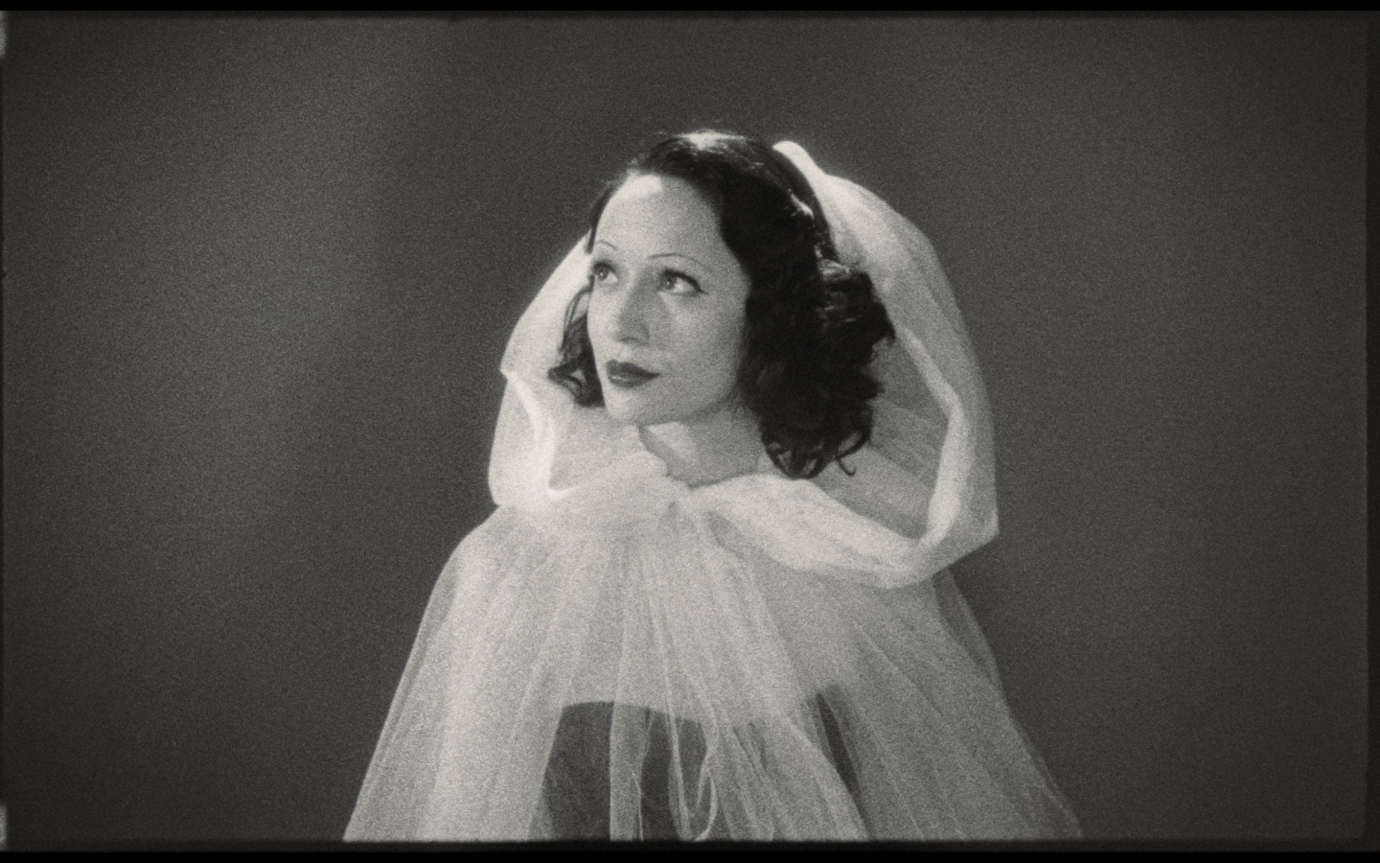
Within institutional archives, time and conservation restrictions impact on my making. I must be more strategic and less leisurely in the process. I was invited in 2023 to the BFI Archive to look at early-career headshot images of Merle Oberon. No specific production was assigned to them, but we believed they were ahead of her potential casting in an Alexander Korda script that was never made into a film, She Had to Dance, which was later developed by Michael Powell and Emeric Pressburger into The Red Shoes (1948). The incredible images from that archive could not be printed without permission, but I was able to document these for research and spent time working in 16mm to produce a close copy of the headshots, imagining the movement and emotions of a young Merle Oberon during the photoshoot.
JM: Nina, your approach has very much been about situating the historical institutional archive as a site of lack, in which you work in an investigative mode to “uncover gaps in the archive” as you once described it. Your reading of the traces in the archive for stories of enslaved and “free black” people brings you close to the life or lives and subjectivity/subjectivities of people, particularly women whose stories and experiences you trace through different entry points in the historical records. What is the process of working through these institutional archival records, which you then suture with critical and creative expressions in your visual practice?
Nina Mangalanayagam: My artistic process is often informed by my own positionality. My mixed heritage has given me an awareness of how and when one’s position shifts. It is from this position that I choose to focus on people from a Swedish past that have also negotiated their different positionalities in a colonial situation. I focus on Ulrica Montgomery, a free black woman who was the daughter of Swedish noble military, and Mary Audain, also a free black woman. She recurs multiple times in the colonial archive, and I was drawn to her because she is often involved in incidents that are violent. Like Michelle, my method has been to try get to know this woman from the few fragments that I have, while also laying bare the impossibility of doing so from my own time, with my own desires and assumptions.
Rather than attempting to narrate a singular story of the Swedish colonial encounter in St Barthélemy, I have chosen one person’s shifting and sometimes multiple positions, depending on what information I bring forward about her.
Until very recently, Swedish archival records of colonial rule in St Barthélemy were limited to a few documents and letters scattered across the National Archives and the Maritime Museum in Sweden. However, during a research project led by the historian Fredrik Thomasson, the colonial archives that are still held in France were fully digitised and made available through Uppsala University in Sweden.[1]
The challenge of working with the archives of Swedish colonial history is that, while enslaved and “free black” people are very present in the colonial archive, the information is always structured and decided on by a few people in control. So, the problem is not necessarily what we think is absent in the past, but what we render absent from our perspective in the present or from a potential future. Whose perspective is brought forward? In other words, the archive is not simply lacking: it produces categories, narratives, absences and ways of seeing. By deciding what and how to archive, certain things will be lost—then and now.
Through conversations with the historian Annika Raapke, I have been made aware that it is not always the archival material that is lacking, but how people who have been interested in the material have looked for stories that suit their own interests. In a talk at the Stockholm City Museum, she pointed out that when Black female scholars and researchers began working with colonial archives, different questions were asked, and so different histories became visible.[2] She argues that in comparison to some other places, there are actually rather good records of “free black” women, but the interest to recover them has been absent.
Raapke’s research shows how archives are often read from the present with the perspective of “default whiteness”, meaning that if we cannot read a racial category attached to an individual in the archive, they are assumed “white”. This blind spot means that we miss many “free black” individuals, who lived among the white population , as well as mixed families that became powerful within a dominant white society.
For me, the archive is a place where different ways of seeing collide. The historical record tells me almost nothing directly about Ulrica’s inner life, but it tells me a great deal about the institutions that named her, classified her, punished her and occasionally allowed her to speak. My work begins with those traces, but with my own encounter with them.[3] The artistic process is not about “completing” the archive or recovering an authentic subject hidden inside it, but about staying with the uncertainty of that encounter and asking how the framing of the fragments continues to shape the way we understand history, belonging and ourselves.
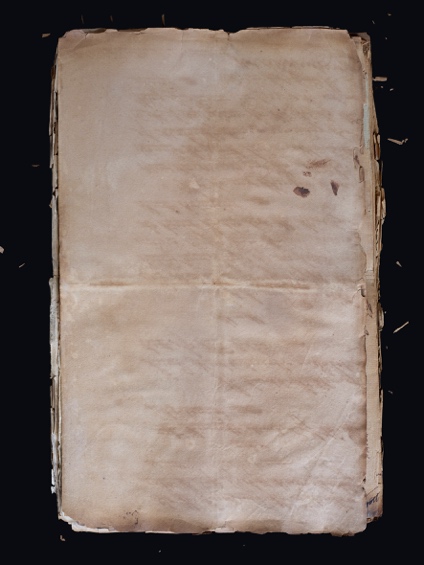
By highlighting the pages in the archive that do not have any information on them in Blank Pages (2026), the gaps in the archive become the focus.[4] Rather than linger on the loss of information, I use the absence to create a productive space for alternative speculations about the past and present and what these might offer for a potential future.
The challenge is how to work with archival records of loss without reiterating absence, when in fact there was presence. In the late eighteenth century and the beginning of the nineteenth century there were more black people in Gustavia in Saint Barthélemy than white. To simply reduce their lives to those of victims or enslaved is problematic and makes their existence stereotypical and simplistic. In a recent lecture, Fred Moten spoke about the dangers of reducing ourselves to stereotypical homogeneous groups, even if this is done to find belonging and resisting dominant whiteness.[5]
In my practice, I speculate on what happens when we make stories that grapple with the deep entanglement of white and black lives within families and entire societies. Instead of the single story, I am interested in speculating around the possibilities of lives lived and decisions made—how a racialised and violent society could have been navigated from a position of “in between”. Hopefully, this sheds some light on how we navigate the present through what we have inherited.
It is striking that one of the recurring interventions with archival and historical material are strategies of anachronistic aesthetics and modes of representation that challenge the historical reading of the sources. Strategic uses of such anachronisms, be they historical, aesthetic or political, address the relationship between past and present and artistic projects deploy these interventions with archival material to make them relevant in a contemporary moment.
JM: Nina, one of the methods you choose to respond to the issue of “lack or gap” you find in the archive with the person of Ulrica Montgomery is to engage through the epistolatory. Through a series of letters, you communicate with a character in the archive, who is at not able to respond but with whom you can express a close bond. The form of the letters and letter writing is intimate, which allows for a documentary realism as well as perspectival shifts. It is a mode of address in which you further implicate yourself by sharing the details of your life in the act of your search for her—Ulrica’s—subjectivity. You share the details of your daughter in the letters as much as you share your experiences of growing up in Sweden and project into these letters a speculation of her (Ulrica’s) life and the multiple ways you encounter her in the archive records. Can you expand on why letters? What are the affordances of this mode of address that are not conceivable through another form?
NM: When visiting the national archives in Stockholm, I found letters, postcards and diaries from men who travelled to the island from the 1780s to the 1990s. Their words inform how I read and interpret the encounters that Swedes have had with the island of Saint Barthélemy. They repeatedly comment on the appearance of women on the island or nearby islands, yet women are peripheral to their larger stories.
These letters informed my encounter with the island when I travelled there. For example, a filmmaker in the 1960s said that coming to the island made him feel sad that “we” no longer “owned” this island. I did not share his position, which might have to do with the fact that, as a non-white Swede, I have never felt that I undoubtedly belong. I arrived at the island, having read about Ulrica in Fredrik Thomasson’s book Det svarta S:t Barthélemy.[6] I walked in her footsteps, found the plot of her house and street, imagined her view and walked the steps to the prison from her house. Walking around, I realised that I had many questions for Ulrica, which came from physically being on the island and not finding the answers that satisfied my perspective or position. Posing these questions through letters makes absences in the archive noticeable. Looking towards her from my position raises different questions from the archive and asks us to reconsider what we choose to archive next.
The practice is also inspired by epistolary video essays with unanswered letters between mothers and daughters. Two major influences are Chantal Akerman’s News from Home (1977) and Mona Hatoum’s Measures of Distance (1988). For me, both works consider matrilineal histories that do not make it into archives and suggest simultaneous parallel worlds. Similarly, I am interested in bringing together fragments from the past with images of the present to consider how we think about past events in their image locations. There is so much to read into the gaps left by unanswered letters and between images that do not immediately seem to correspond with the sound.
JM: Michelle, in a way similar to how Nina seeks a form that is intimate and immediate with the letters, with your installation components and in working with Merle Oberon’s life story and through her film roles in your project Strange Evidence, you created a scenario of a therapy session with an analyst. The staging of the therapy session for an artist’s talk created not only a way to unfold the professional process and its implications personally, but it also produced another way of experiencing the personal and intimate with a clearly voyeuristic gaze through the use of cameras and close-ups that were relayed to the audience outside the set of the therapy room. Can you expand on this choice?
MWG: To preface my decision to stage a therapy session, I want to briefly share the production decisions for Strange Evidence. I wanted to make a film that moved between colour and black and white and that would look at some of the lived body horror that Merle Oberon may have experienced in trying to control her image. At the same time, I wanted to focus on the psychological, to explore why somebody like Merle would have had to mask her identity and what would happen if I made a film that could potentially fictionally heal or psychoanalyse her. This led me to working with Matt’s Gallery to build a film set of a psychoanalyst’s office and to present it as an installation in 2025. The space was purposefully built with holes, offering multiple ways to peer in and out of the film set—through columns, through a fireplace and one-way mirror, a large bookcase and an open door. During the exhibition’s run, we closed the gallery for one week to shoot the psychoanalysis sequences in a film-noir style. As part of the public programme, I felt that I should succumb to the couch I’d placed within the installation; if this was my fictional proposition to Merle, then I too should be able to engage in this mode of exchange.
Having been in analysis with Anouchka Grose for six years, I invited her to be my interlocutor for an artist talk that wasn’t a standard artist talk. In truth, the decision was both experimental and risky, in that I there was no script that either myself or Anouchka followed. We knew one another from my time in analysis, which enabled an ease in sharing, but I am still trying to unpick the decision to turn the camera on myself, to temporarily occupy the role of artist as possible character. I absolutely wanted to create a strong sense of voyeurism for the audience, and for this reason the Live in Analysis session could only be accessed via a live feed in a separate space, away from the installation. The conversation lasted around 50 minutes, the length of an analysis session, and I believe some people in the room thought it was a pre-recorded event. Like analysis, I cannot recall everything I said, but I found the process more exciting than an artist talk because it felt less conscious, despite being on a highly mapped out and constructed set. I do recall speaking about the film set being “leaky”— a word that came from the unconscious, I had never used it before—which brought to my attention a porosity that sits in several of my films exploring film stars across time. I feel the decision was guided by the emphasis on experimental formats within Strange Evidence, to follow a cross-genre film into a hybrid artist talk felt like a cohesive decision. In some ways, I wish I could have been in the audience to encounter this from the other side.
JM: In both these choices—the epistolatory and the therapy session—there is a quest, a search or at least attempts to explore and experiment with forms that invite an authenticity perhaps, a sense of producing a realism that is firmly rooted in the subjective. The desire for a personal position comes to the fore. What are the affordances in the context of “encounters in the archive”, which on the surface can appear distant or distancing on account of the institutional and infrastructural context? It would be useful to hear your thinking about the decision in your artistic practice to make the personal visible against the grain of archive taxonomies and cataloguing.
NM: In my practice I often use the semi-autobiographical as a method to get close to an audience. By using the personal address as artistic form in the video installation Ulrica (2026), I play with the idea of revealing an “authentic” self while navigating the positions of both victim and perpetrator. Few people choose to identify as perpetrators, and few artists take this position, even when actively participating in a system. But what happens if no one manages to own up to that position and the decisions we take within certain structures? I use the self as a persona rather than as an authentic self-portrait: a projection surface onto which different feelings and positions can be placed. I am not interested in making works to defend a position as one thing or the other. Rather, it is more interesting to let the narrator adopt uncomfortable positions, to show that fragments are always framed from a particular position, to tell someone’s story—be it a national or a personal family history.
Even in artworks where viewers think they are getting an insight into my life, I have combined my story with other people’s stories. For example, for my previous piece Balancing Act (2012), I interviewed people in Loughborough about their experience of having a mixed background and interwove their stories with my own. Because the participants became anonymous in the resulting work, both they and I could be more honest in what we revealed. The final “self-portrait” became a collage of experiences.
I have landed on this mode of address from analysing the self-portraits of non-white artists.[7] Our appearances have had fixed stereotypes attached to them, often cemented through photography. They have been locked into certain colonial narratives, and I have experimented with different visual forms to disrupt simplistic readings of the non-white self-portrait. In some ways, my whole artistic practice is an exploration into what affordances the self-portrait gives me. Taking a cue from the artist Josefa Ntjam’s persona: “I am many”, so I cannot be reduced to a mix of only two or even three different countries or cultures.[8] The position of race, class and gender is a negotiation, and it is from this open position that I enter the archive.
When we reduce certain positions to only being this or the other, they become fixed in history and their fluidity is ignored. What would happen if Ulrica was as blond and “white” as my children are? How could or would we read her history differently?
MWG: I am deeply interested in writing nuanced and complex roles for my characters and there is a strong emphasis on offering an intimate gaze and a desire for the personal to come to the fore. With film stars of colour like Sabu, Anna May Wong and Merle Oberon, I have re-engaged with these individuals through my films as Critical Affection (2021–26). By revisiting their labour and personal lives, I acknowledge that their lives are enmeshed in the complicated histories of the films they starred in, their production histories and the film memorabilia that outlive them.
My focus is on the so-called golden age of Hollywood or British cinema’s studio films that are classics, but they embody an uncomfortable spectre of poor practice within filmmaking history. But we have choices; we can love them, which I do, but I can’t let structural inequities pass and only remain in a space of affection. The addition of criticality is about a robust dialogue that ultimately still reinforces the love that I may have for these films. I suppose I am building a new archive, one that speaks back to the past and to film memorabilia and directors that perhaps did not expect critical questions to be posed back to them. I think the type of films I make have also unlocked a space for me to be very transparent about my love for cinema and follow my obsessions. It has given me a right of reply from when I was a teenager, years after first encountering these films and objects, and at times their screen violences.
This conversation is the result of a public seminar: “Activating Histories through Artistic Practice” convened by Professor Onkar Kular (11 December 2025) through the research initiative PLACE (Public Life, Arts and Critical Engagement) in the Artistic Faculty at Gothenburg University.
Footnotes
- Uppsala University. “Different laws in force in Sweden’s Caribbean colony”. 17 December 2025. Available at https://www.uu.se/en/news/2025/2025-12-17-different-laws-in-force-in-swedens-caribbean-colony (accessed 2026-08-29). ↑
- Raapke, A. Public talk at Stockholm Stadsmusem, 17 April 2024. ↑
- The archives used for this research have been repositories at the National Archives, Stadsmuseet Stockholm, the Maritime Museum in Sweden, and Fonds suédois de Saint-Barthélemy (FSB), the Swedish Saint Barthélemy Archive within the national archives in France. The traces I found from Ulrica are about her house ownership, accounts in which she is a witness or a victim of violence, or her sibling’s baptism in the church. They also contain details from life on the island during her lifetime, such as musical notes, maps of existing houses, letters. ↑
- Blank Pages (2026) Bildmuseet. ↑
- Fred Moten in the 9th Annual Stuart Hall Public Conversation at Conway Hall, 23 May 2026, organised by the Stuart Hall Foundation, London. ↑
- Thomasson, F. Svarta S:t Barthélemy. Stockholm: Natur och Kultur. 2022. ↑
- Examples include Adrian Piper, Harold Offeh, Hetain Patel and Zineb Sedira. ↑
- Translation from French”Je suis plusieurs” in Ntjam, J. Melas de Saturne. 2020 HD filmvideo installation. ↑