What is the worst thing an Arab woman could be? This essay traces the titular question across three distinct photographic archives: (1) Colonial-era postcards of nude Egyptian women gleaned through eBay; (2) online contested images of women protestors from the 2011 Egyptian revolution; and (3) social media posts from soldiers in Gaza in 2024. The central question of this study is how we can claim knowledge of, or imaginatively centre, the subjectivities of women who have been photographed, archived, and recirculated without their consent. In an attempt to recover what has been deliberately obscured by the image, this study adopts Saidiya Hartman’s method of critical fabulation as a sustained analytical framework. To fabulate critically in response is not to match violence with fiction, but to refuse the pretence that dominant narratives are natural or inevitable. Through close reading of each archive, the essay argues that violence is never inherent to the female body itself, nor in its nudity, but instead, violence is imposed through the processes of looking, captioning, circulating, and storytelling that surround it.
In 2021, I was browsing eBay for vintage Egyptian memorabilia. I vaguely remember searching for vintage sports jerseys as a gift for my father, or possibly old jewellery as a gift for a friend. Whether it was the algorithm or my search terms, I stumbled upon thousands of listings of colonial-era postcards from Egypt, some depicting landscapes, others depicting flora or fauna, but the majority were portraits of nude Egyptian women.
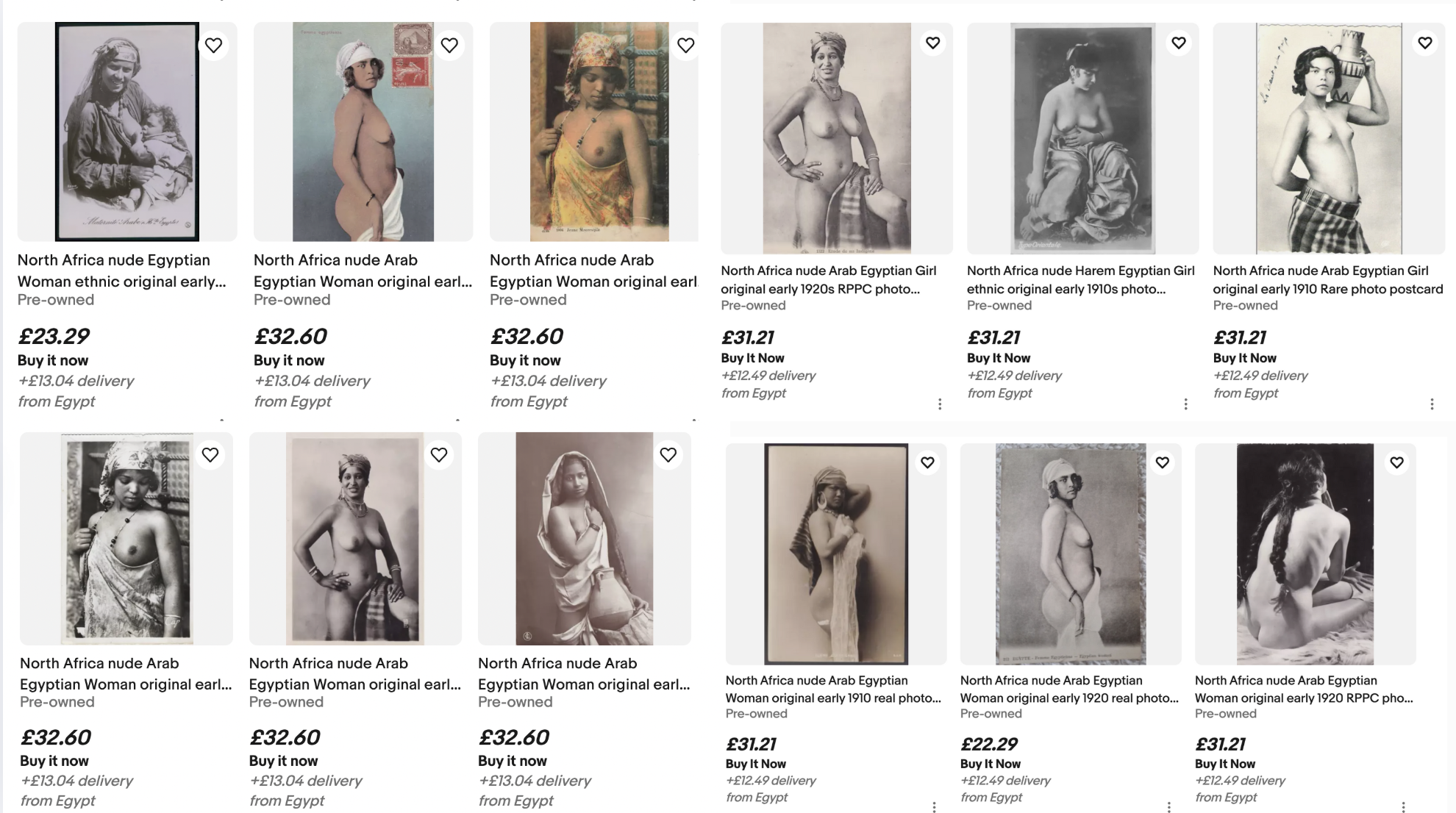
My coincidental discovery set me on a three-year long research project guided by a question that only crystallised gradually: how can we know, claim to know or imagine the subjectivities of the women represented in these images? On the one hand, building the archive felt like accumulating contraband. Knowing the taboos surrounding women’s nudity that pervades contemporary Egyptian society intimately, I felt as if I harboured a dangerous secret that would upend my community. On the other hand, there was a clear element of dramatic irony: as a contemporary researcher, I am bound by my temporal reality, and thus unable to warn any of these women about their inevitable fetishistic digital immortalisation.
Postcards may seem like an inconsequential object of study in our contemporary context, however, prior to the advent of mass media, postcards were a form of financially accessible, mass-produced visual culture, revolutionising art access for the middle and working classes of Europe and the West.[1] At its peak, from the 1890s to the 1920s, over two billion postcards were sent each year worldwide,[2] and many depicted “erotic” imagery.[3] Mireille Miller-Young situates the postcard and other forms of portrait photography within the colonial “economy of images”, profiting off of racial Othering, which “simultaneously titillated and disgusted white spectators.”[4] Therefore, postcards can be seen as a useful tool in unpacking colonial racial Othering.
As an Egyptian woman myself, I dreamed of asking all those women: who are you? What is your name? Where are you truly from? Where do you live? How old are you? Did you know the photographer? Did you want your picture taken? Are we related? What are your hobbies? What are your dreams?
As much as I yearn to know, answering any one of my questions is ultimately impossible. My research managed to narrow down several major postcard producers, such as Reiser or Raphael Tuck & Sons, but I could not determine any names of individual photographers. The unnamed models are merely identified as Egyptian women, so it is even more impossible to discern where to begin to look for answers on their individual identities. What if these portraits were actually taken in London? Or somewhere else in Africa? Or what if these images were infinitely reproduced under different national markers for different commercial audiences, such as Arab, or Sudanese, or North African? I saw myself so clearly in some of these images, but were any of these women actually Egyptian?
It is this precise impossibility of knowing that structures this essay and necessitated my methodological approach. The question of how we can claim knowledge of, or imaginatively centre, the subjectivities of women who have been photographed, archived and recirculated without their consent is not merely an archival problem, but a question of postcolonial ethics. This essay traces that question across three distinct but interconnected image archives: 1) colonial-era postcards of nude Egyptian women; 2) photographs from the 2011 Egyptian revolution; and 3) social media posts from IDF soldiers in Gaza in 2024. In doing so, I utilise Saidiya Hartman’s method of critical fabulation as a sustained analytical framework, and as the very practice through which I attempt to recover what has been deliberately obscured by the image.[5]
Critical Fabulation as Method
Critical fabulation employed in this essay draws on Sadiya’s Hartman’s “Venus in Two Acts”, which poses the question “how does one tell impossible stories?”[6] in relation to transatlantic slavery in an attempt to trace stories of enslaved women, through identifying the “ubiquitous” example of “Venus” in historical archives.[7] Employing the method of critical fabulation, Hartman interrogates the inherent violence of the colonial archive, “[where] [t]he intention… isn’t anything as miraculous as recovering the lives of the enslaved or redeeming the dead, but rather laboring to paint as full a picture of the lives of the captives as possible.”[8] By honouring the “figurative dimensions of history”, Hartman attempts to “both tell an impossible story and to amplify the impossibility of its telling.”[9] Critical fabulation requires “turning the gaze inward” to critically imagine the possibilities of neglected subjectivities.[10]
The archives I examine are already saturated with competing fabulations, narratives that claim to know these women, that assign them roles, motives and meanings. What distinguishes critical fabulation from these competing narratives is not that it claims to tell the truth, but that it is transparent about its own speculative nature and in whose interest it speculates. As I will argue, fabulations that erase, flatten or criminalise these women, such as the narrative of the “calculating femme fatale”, are themselves acts of storytelling that operate violently, projecting certainty where there never was any. Critical fabulation, by contrast, operates in the register of the possible: it insists that we pause, imagine and refuse the violence of the gaze.
The Colonial Postcard Archive
Reflecting on ingrained cultural taboos, I could not recall ever seeing similar contemporary images of Egyptian women as those encountered on eBay. Through her study of daguerreotypes taken of seven enslaved people in the 1850s South Carolina, Miller-Young writes,
It is impossible to know for sure what the diverse subjective experiences of the women in the images entailed, but here I assert that we pause to imagine what these women might have experienced and what their gazes back at the camera may have contributed to the ethnopornographic exchange.[11]
I applied this same pause to the colonial postcards. I wondered if the women in those postcards might have celebrated the rare chance to have their pictures taken. I wondered whether they knew the photographer, supported the staging, picked their clothing or poses. I quite enjoy experimenting with having my picture taken, and maybe they did too. Maybe they were paid, but equally, perhaps they were not. Just as it is possible that they were victimised, subject to the violence of the photographer, critical fabulation invites us to reflect on the equal possibility of their defiant subjectivity. By projecting victimisation, we as viewers manifest a similar form of epistemological violence that strips these women subjects of their agencies.
Moreover, is there truly an inherent humiliation in nudity? Particularly in the colonial postcards, is there anything within their bodies themselves that depict violence? Wilson Chacko Jacob writes,
[The] most radical and deceptively simple reading: the body is. The body, simply and with great complexity, is, and as such it is neither a vehicle of language and symbols nor a site of affect, emotion, memory, power. The body’s radical materiality is in its skin, its hair, its organs, its fluids, its muscles, its permeability, and in the latest scientific jargon in its “gene expression signatures”.[12]
Therefore, if the body simply “is”, then the body is not a “vehicle” to manifest violence or oppression. Instead, it is within what Stuart Hall identifies as the audience’s decoding of the image in which violence is projected onto the body.[13] This understanding is the theoretical link that connects the colonial postcard to the images that follow. Across all three archives, violence is not inherent to the body or its representation, but is imposed through the processes of looking, captioning, circulating and storytelling that surround it.
The 2011 Egyptian Revolution in Two Images
If the colonial postcards represent an archive whose fabulations have accumulated over a century, the 2011 Egyptian revolution produced images whose narrative contests were immediate and publicly visible. I recall two images in particular, and together they crystallise the stakes of competing fabulations and the necessity of critical feminist ways of seeing.
First, I remember when University student Aliaa Magda Elmahdy posted a nude self-portrait on her blog, explaining that “the photo is an expression of my being and I see the human body as the best artistic representation of that.”[14]
|
|
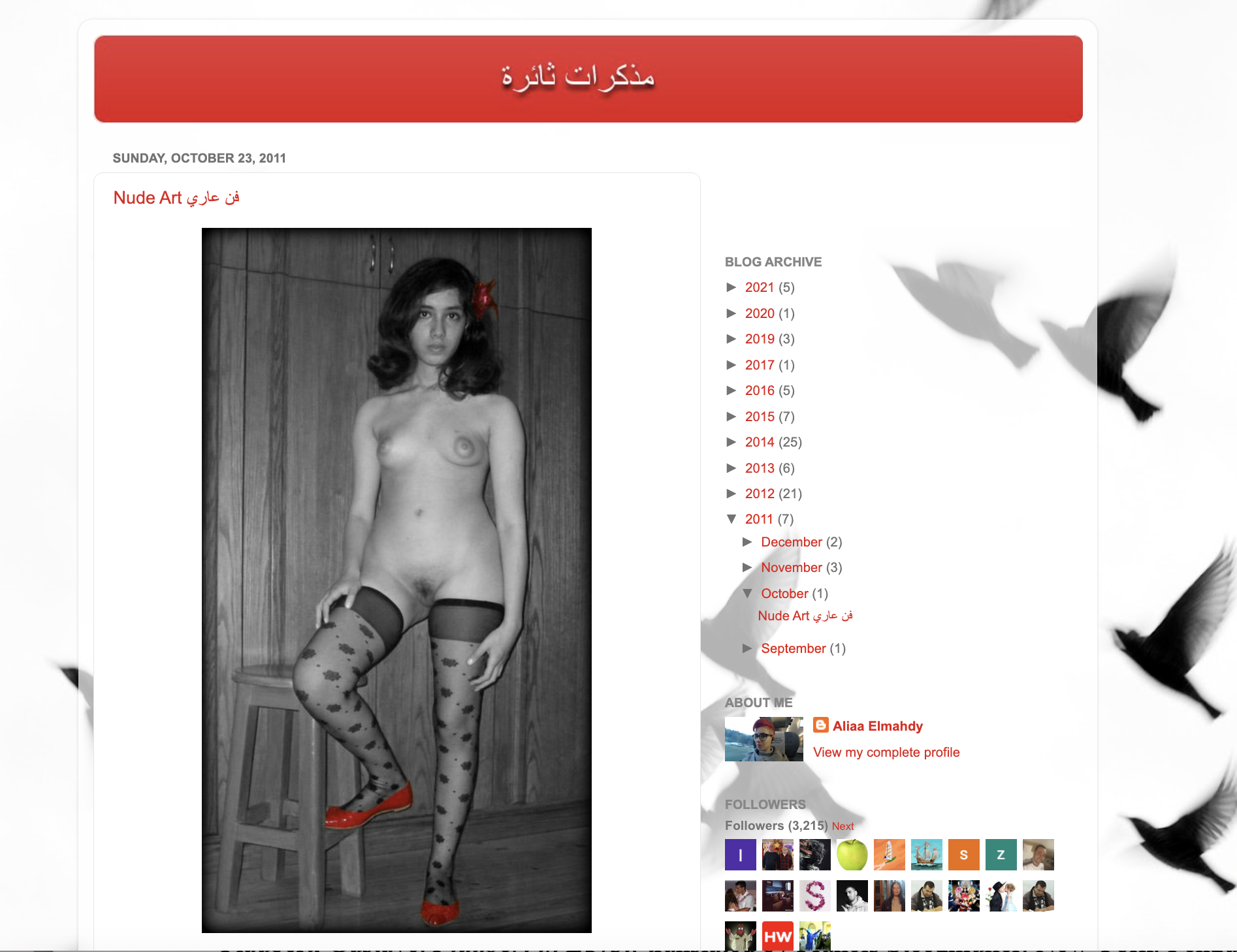
I remember seeing the image endlessly reproduced and censored on the news or on Facebook, alongside vitriol and sexist commentary. After death threats and physical intimidation, Elmahdy currently lives in exile.[15] While not all revolutionaries ostracised her, even the most leftist coalitions publicly ridiculed her for quite literally exposing herself to a society “that was not ready.”[16] A self-portrait published on a relatively unknown blog evolved into what Marwan Kraidy describes as “one of the most heated polemics of the Egyptian revolution.”[17] While protests took to Tahrir Square demanding freedom, Elmahdy was denied that same freedom over her own image and self-representation.[18]
Here, Elmahdy’s self-portrait presents a particular challenge for critical fabulation. Unlike the anonymous women of the colonial postcards, she is a named, living woman who has herself spoken extensively about her intentions. She is not a silenced subject in need of imaginative recovery, but instead, she is defiant, self-representing and a woman who has been forcibly silenced after the fact. Critical fabulation in her case thus operates not to recover an anonymous subjectivity, but to refuse the competing fabulations that have been imposed over her own stated selfhood. The narrative that she was a provocateur, reckless or naive is itself a fabulation, one that attributes motive and consequence to justify her being ostracised. To apply critical fabulation here is to insist on taking her self-representation seriously on its own terms.
It is impossible to make claims on a society’s “readiness” to receive Elmahdy’s self-portrait. Building upon Julia Kristeva’s reference to horrified reactions of disgust, Kraidy rearticulates the concept of abjection to “what disturbs identity, system, order. What does not respect borders, positions, rules.”[19]
Second, I recall another image from the 2011 revolution, featuring a protester brutalised by Egyptian police, exposing her blue bra in the process. The figure became known as the “Girl in the Blue Bra,” her identity remaining unknown. I remember how mainstream Egyptian media attempted to reframe the situation as “a calculating femme fatale who tore her own clothes to expose her body and implicate the security forces.”[20] According to Sherine Hafez, the blue bra thus became “a synecdoche for state violence and the abuse of military power.”[21]
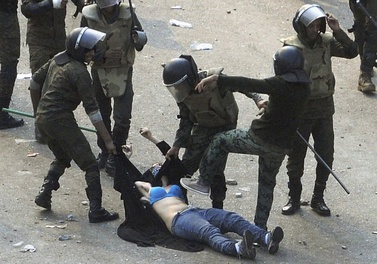
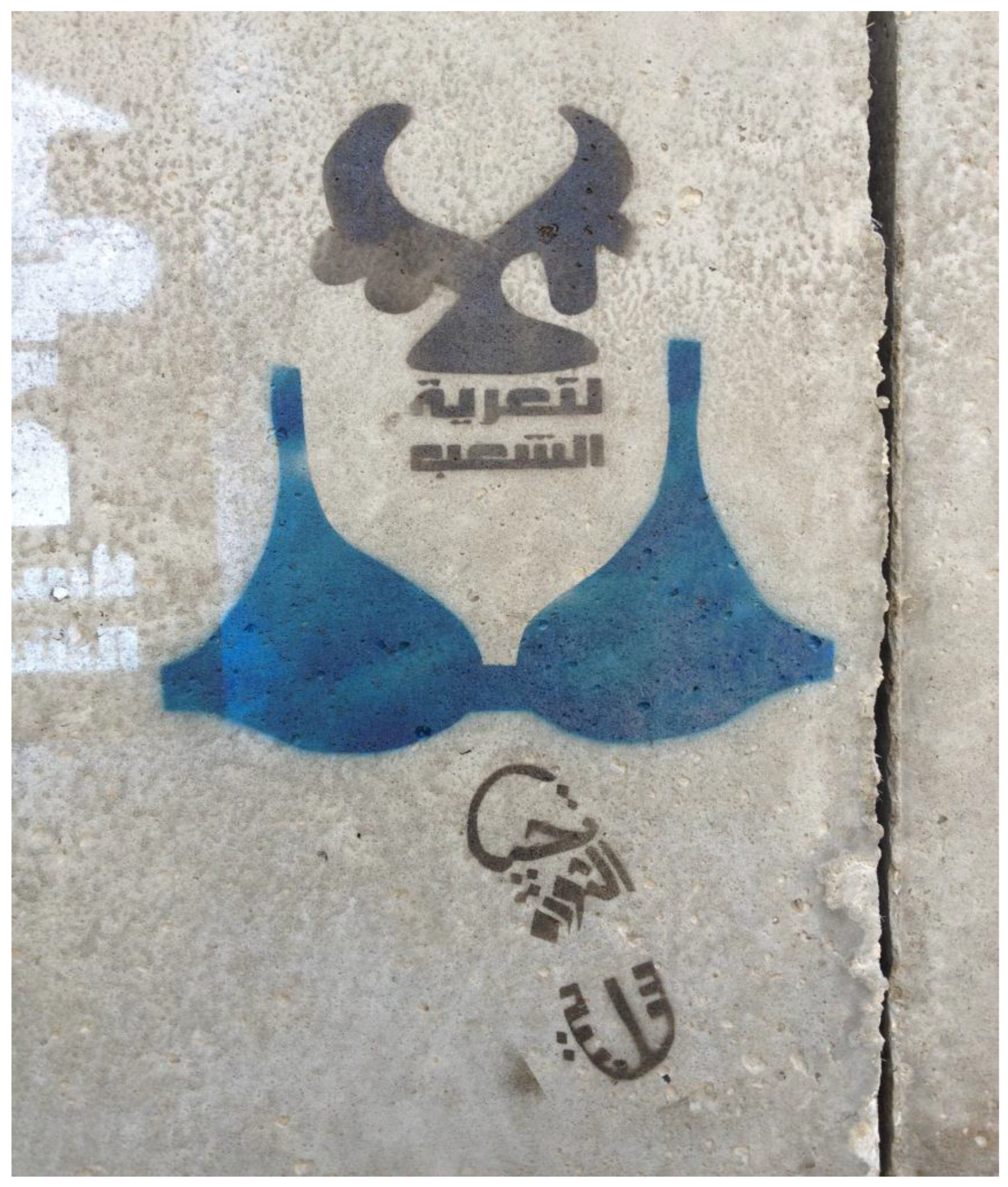
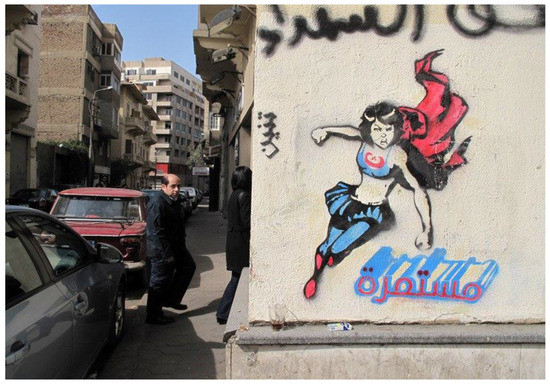
The “calculating femme fatale” narrative is itself a fabulation, as is the deliberate staging of her own brutalisation for political effect. This narrative does the ideological work of deflecting state violence by reassigning it as self-inflicted. Paradoxically, it also reduces her subjectivity, even as it claims to grant her power, transforming her into a calculating instrument rather than a human being with a complex subjectivity. Critical fabulation does not require us to know these things, instead asking what it may have meant to her to be on the ground in Tahrir Square, what her body felt, what she feared or hoped. It requires us to resist complacency in public humiliation to hold open the possibility of her full humanity against the closure that the “femme fatale” narrative performs.
When placed alongside the colonial postcards, the 2011 images reveal that the mechanisms of projection and narrative contest do not require a century of historical distance to operate. Rather, they operate in real time, through media platforms, through political constituencies, through the physical bodies of women who are still very much alive. The underlying common thread across these two archives is the repeated denial of complex subjectivity to women whose images enter public circulation.
Spectres in Social Media: Gaza 2024–Present
If these images were enough to disrupt Egyptian society in 2011, what would the colonial postcards do? And as a young girl watching these events unfold, hearing the vilification from even the mouths of my closest family, I quickly realised that the worst thing an Egyptian woman could do was be naked. That my society would be better equipped to handle images of me brutalised or abused than images of me simply undressed.
In 2024, I encountered another inadvertent archive, but instead of eBay, I found myself sifting through viral social media posts from IDF soldiers in Gaza. Unlike the colonial postcards, no nudity was depicted; here were countless pictures of soldiers holding up pieces of feminine lingerie as trophies of invasion. Although no Palestinian woman was physically depicted in the image, attempting to piece together the subjectivities of lives lost and homes destroyed: their spectres seem to haunt each item of clothing.
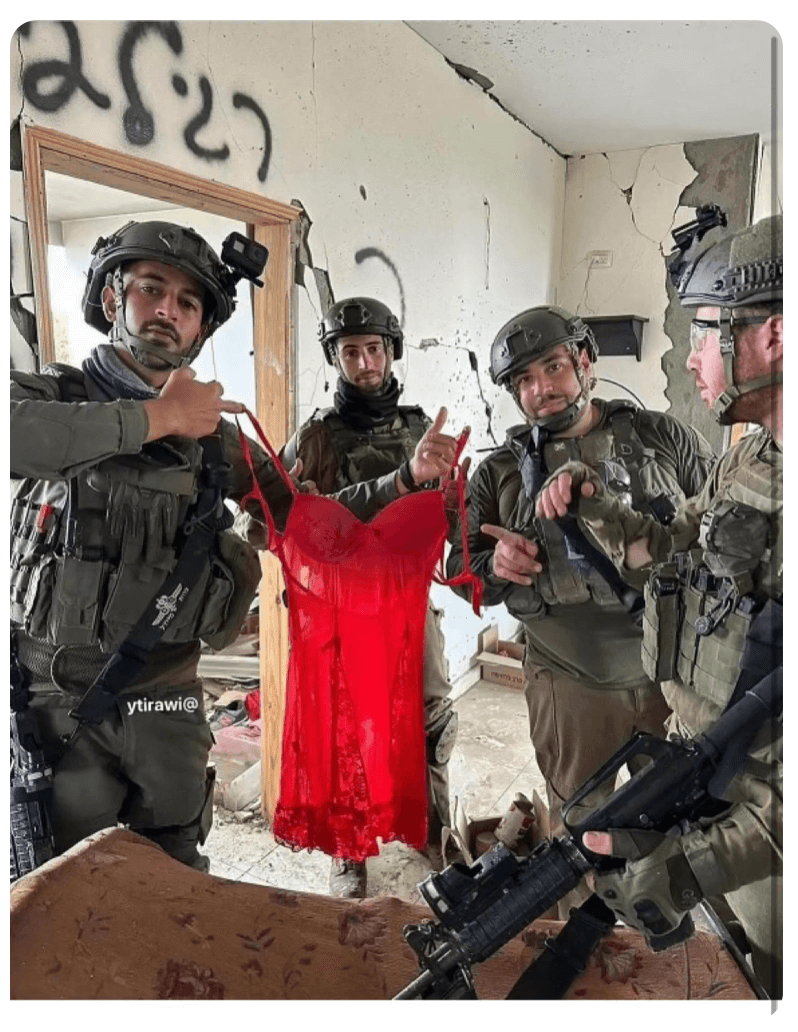
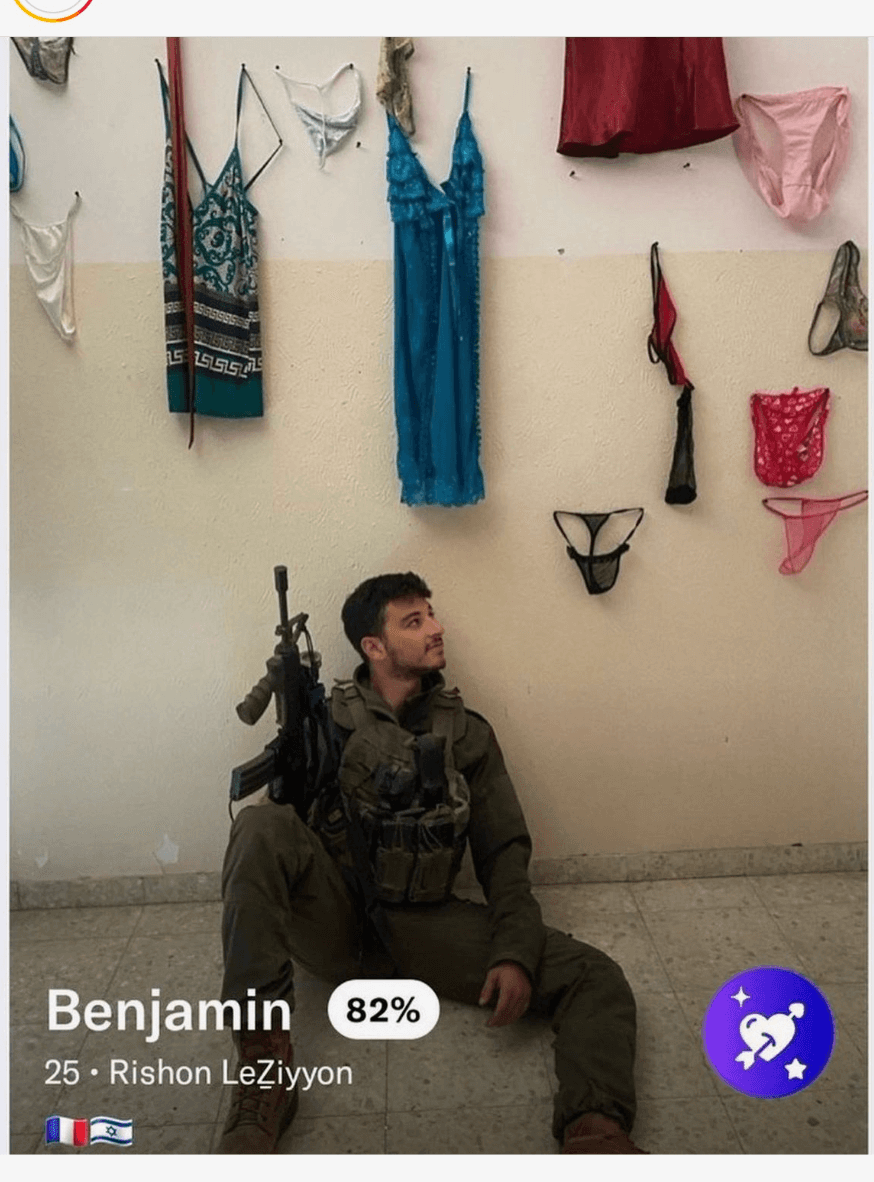
Images 6–7. Taken from an article by Nina Berman, “Violating intimacies”, Mondoweiss, 2024
Nina Berman, an American documentary photographer and journalist whose work examines military culture and its human consequences, describes these images as “performances of masculinity based on humiliation”.[22] The choice of lingerie as trophy is not incidental. In a cultural context where Arab women’s sexuality is so often denied and rendered invisible, these garments are testament to something else entirely: that these women were desired, that they too desired, that they adorned themselves in private with colour and lace and intention. To display that intimacy as a trophy of occupation is to attempt to degrade a form of expression that is dually policed by both the occupiers in the image and within mainstream Arab society. Linking back to the “spectacles” of “lynching images from the Jim Crow American South” and “Abu Ghraib images where American soldiers posed laughing with Iraqi prisoners”, Berman articulates discourses of public humiliation with the mechanism of occupation and racial Othering itself.[23]
This third archive presents the most radical test of critical fabulation as a method. Here, the woman is not merely anonymous or silenced after the fact, she is completely absent. There is nothing to suggest she is even alive either. She exists only as a spectre conjured by her intimate possessions; her lingerie displayed as a trophy of what once was. The ethical stakes of fabulation shift accordingly. When we imaginatively recover an anonymous colonial postcard subject, we speculate about a woman who was photographed, who was, in some sense, present. When we refuse the “calculating femme fatale” narrative for the Girl in the Blue Bra, we defend the full humanity of a woman against documented public humiliation. But when we attempt to imagine the Palestinian women whose undergarments appear in these soldiers’ selfies, we are speculating about women who are entirely absent: women who may be displaced, imprisoned or dead.
Critical fabulation in this context is not a recovery of documented presence but a refusal of deliberate erasure. The soldiers’ selfies seek to humiliate not only through display but through dehumanisation by reducing these women to the objects they once owned, and by making those objects into trophies. The deliberate use of lingerie as the object of display leans into earlier discussions of public humiliation, suggesting an expressed sexuality is inherently oxymoronic to Palestinian women’s identities. Within the logic of occupation, the lingerie-as-trophy both invokes the broader Arab cultural taboos around women’s sexualities, like with the Girl in the Blue Bra, while at the same time reducing their existence to that sexuality alone. To hold up a woman’s underwear as a trophy is to claim that no part of her has been left unclaimed. In contrast, critical fabulation insists that behind each garment is a woman with a name, a history, a set of choices about what to wear and why, a drawer in a bedroom that was hers, in a home that she once lived in, maybe with a family, or a partner with whom she felt loved or desired. To “take the power of these images away from the image makers”, Berman insists “on both imagining and preserving in our minds their full beings and refusing the narrative that attempts to sully and flatten them.”[24]
Across all three archives, the absence or erasure of the woman’s voice and subjectivity is not incidental: 1) colonial postcard photography required anonymous subjects for mass circulation; 2) state violence required a femme fatale narrative to contain the Girl in the Blue Bra and justify her assault; 3) military occupation requires the erasure of the Palestinian woman from the frame entirely. As Hartman writes, it is crucial to “imagine what might have happened or might have been said or might have been done.”[25] Critical fabulation is the method by which we push back against each of these erasures, not with false certainty, but with a principled, transparent act of imagination in the service of those who have been denied the right to represent themselves.
Inspired by the Impossible: Final Reflections
I imagine that the women of the colonial postcards were fascinated by the sight of the wooden box of the old-world camera. Although digital cameras and smartphones have revolutionised the self-portrait, I imagine many women would have marvelled at the chance of memorialising their image, but equally, perhaps many were horrified. Did they know the images would travel? Did they understand the word postcard, or the distances it implied, or that their face, their body, might end up on a mantelpiece in Paris, or equally, in my drawer in London? Did they go home afterwards and feel proud, or did they lie awake? All we can do is continue to imagine who they were, honouring their agencies as individuals with complimenting and opposing subjectivities.
To reiterate my original question: how can we know, claim to know, or imagine the subjectivities of the women represented in these images? What this three-archive study yields, analytically, is not a single answer to my original question, but a more precise understanding of what that question demands of us. Each archive poses the problem differently: 1) the colonial postcards offer anonymity without context; 2) the 2011 revolution images offer contested narratives about named and unnamed women; 3) the images from Gaza offer absence in place of any body at all. Critical fabulation does not operate identically across these three contexts. Rather, its value as a method lies in its flexibility and its ethical transparency, telling us where the limits of the archive are and inviting us to work carefully in the space between what we know and what we refuse to admit.
To propose critical fabulation as a method, is to make a claim towards justice. The competing fabulations circulating around these women, whether through colonial exoticisation, the “calculating femme fatale” or the trophy object, are not simply narratives. They are exercises of power that have material consequences through exile, erasure or occupation. To fabulate critically in response is not to match violence with fiction, but to refuse the pretence that dominant narratives are natural or inevitable. It is to insist, as Hartman does, that the impossibility of telling these stories is no reason not to try. To “amplify the impossibility of its telling” and honour that what we do know is finite, but there are infinite possibilities in the unknown.[26]
My answer to my titular question is that the worst thing an Arab woman could be is naked. But what I have come to understand through this research is that nakedness is not the real threat, the body just “is”.[27] Instead, the real threat, from the perspective of the systems that produce these images and the narratives that surround them, is subjectivity. It is the woman who refuses to be reduced, who poses on her own terms, who chooses to wear a blue bra and is seen doing so, whose lingerie remains when her home does not. Critical fabulation facilitates the possibility for insisting that these subjectivities are real, complex and cannot be taken from the women to whom they belong.
Footnotes
- Miller-Young, Mireille. “Exotic/erotic/ethnopornographic: Black women, desire, and labor in the photographic archive”. In Ethnopornography: Sexuality, Colonialism, and Archival Knowledge. Ed. Neil L. Whitehead, Zeb Tortorici and Pete Sigal. Durham, NC: Duke University Press. 2019. https://doi.org/10.1215/9781478004424 ↑
- Teulié, Gilles. “Orientalism and the British Picture Postcard Industry: Popularizing the Empire in Victorian and Edwardian Homes”. Cahiers victoriens et édouardiens [En ligne]. vol. 89. 2019. p. 11. DOI: 10.4000/cve.5178. ↑
- Miller-Young, “Exotic/erotic/ethnopornographic”, p. 52. ↑
- Ibid, p. 42. ↑
- Hartman, Saidiya. “Venus in Two Acts.” Small Axe: A Caribbean Journal of Criticism. no. 2. 2008. p. 10. https://doi.org/10.1215/-12-2-1. ↑
- Ibid. ↑
- Ibid., p. 1. ↑
- Ibid., p. 11. ↑
- Ibid. ↑
- Rodriguez, Richard T. “On the Subject of Gang Photography”. Aztlán. vol. 25. no. 1. 2000. https://doi.org/10.1525/azt.2000.25.1.109. ↑
- Miller-Young, “Exotic/erotic/ethnopornographic”, p. 48. ↑
- Chacko Jacob, Wilson. “Another Look: ‘The Body That Is,’ Gender, Sexuality, and Power in Post-Ottoman Egypt”. In Fashioning the Modern Middle East: Gender, Body, and Nation. Ed. Reina Lewis and Yasmine Nachabe Taan. London: Bloomsbury Publishing. 2021. p. 137. ↑
- Hall, Stuart. Representation: Cultural Representations and Signifying Practices. London: SAGE Publishing. 1997. ↑
- Fahmy, Mohamed Fadel. “Egyptian blogger Aliaa Elmahdy: Why I posed naked”. CNN. 19 November 2011. ↑
- Kraidy, Marwan M. The Naked Blogger of Cairo. Cambridge: Harvard University Press. 2016. p. 5. ↑
- Ibid., pp. 159–61. ↑
- Ibid., p. 5. ↑
- Ibid., p. 6. ↑
- Ibid., p. 160. ↑
- Hafez, Sherine. “Bodies That Protest: The Girl in the Blue Bra, Sexuality, and State Violence in Revolutionary Egypt”. Journal of Women in Culture and Society. vol. 40. no. 1. 2014. p. 20. https://doi.org/10.1086/676977. ↑
- Ibid. ↑
- Berman, Nina. “Violating intimacies”. Mondoweiss. February 2024. Available at https://mondoweiss.net/2024/02/violating-intimacies (accessed 2026-07-10). In this article, Berman analyses viral social media posts by IDF soldiers posing with Palestinian women’s lingerie in Gaza. Berman situates these images within a longer history of occupation photography, linking them to the visual culture of Abu Ghraib and lynching photography from the Jim Crow American South. ↑
- Ibid. ↑
- Berman, Nina. “Violating intimacies”. ↑
- Hartman, “Venus in Two Acts”, p. 11. ↑
- Ibid. ↑
- Chacko Jacob, “Another Look…”, p. 137. ↑