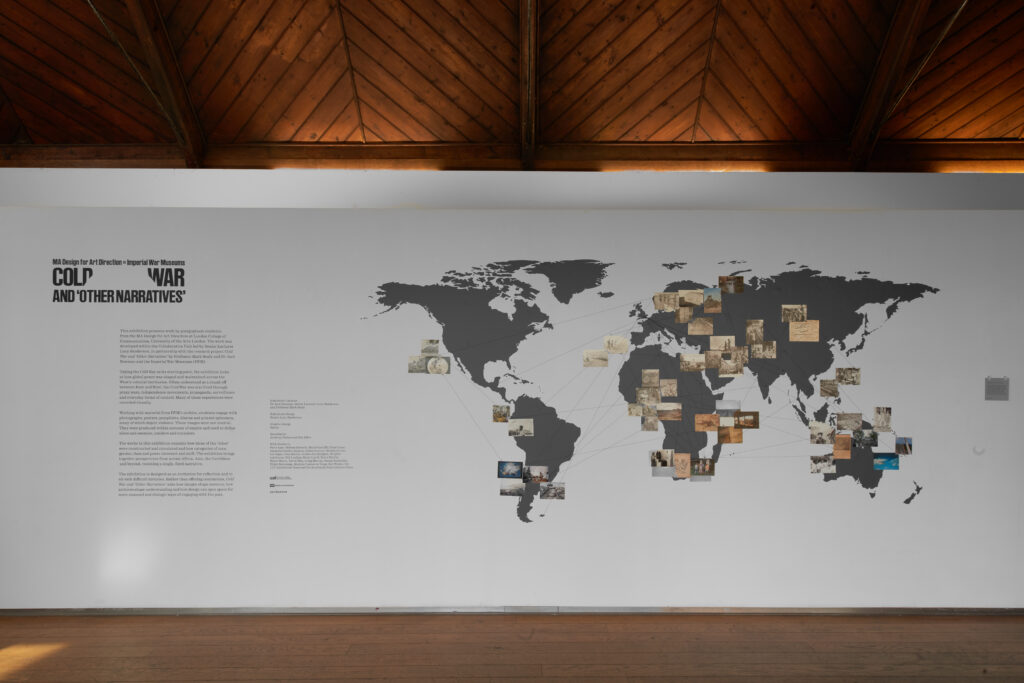
This article begins with an installation. Mapping the colonial camera (2026) is an artwork comprising photographs drawn from the Imperial War Museums’ (IWM) archive, laid across a map of the world and interconnected by overlapping red metal wires anchored by rough metal nails. It is a meditation on Britain’s patterns of visualising, controlling and exploiting colonial subjects, which emerged from two years of forensic engagement with the IWM archive as part of a research project led at the London College of Communication, University of the Arts London.
This article utilises this installation as an entry point to argue that the archive is an emotional body. That is, it is a body of work, of memory and of being; not a cold collection of hard facts or an accumulation of ambivalent data, but a living, breathing and above all emotional body. As any emotional body does, it holds a wealth of responses, often expressed in a fight-or-flight mentality when antagonised. When decolonial practices are enacted upon it through “difficult” conversations or non-traditional archival engagements, it becomes “triggered”. These emotional responses, from the highest levels of institutional practice to the most banal logistics of accessing the physical archive, are the subject of this article.
In doing so, the essay moves from the making of Mapping the colonial camera, the intellectual, methodological and literal processes of entering the IWM archive to find “other” and decolonial narratives, to what those encounters revealed about the archive as a body: its systems of cataloguing and captioning, its structures of access and digitisation, its implicit and explicit responses to the presence of a decolonial practice. Invoking Gayatri Spivak’s assertion that “neutral dialogue is an idea which denies history, denies structure, denies the positioning of subjects”, it shows how rejecting that neutrality generates an emotional response from the archive, and how that response can be read, used and purposefully triggered as a decolonial methodology.
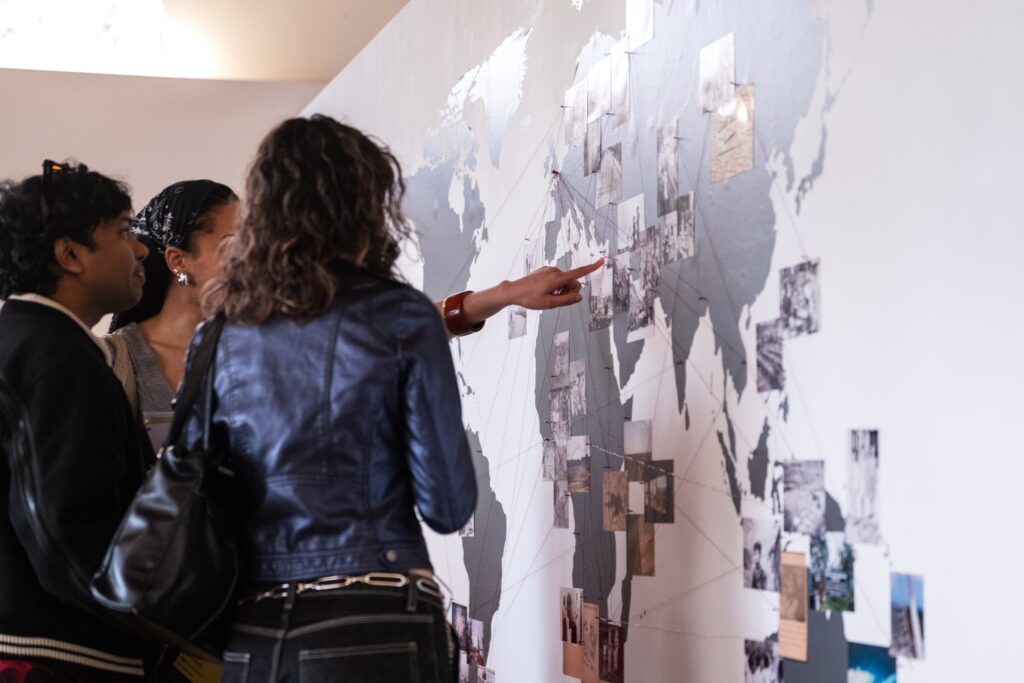
Mapping the colonial camera (2026) was first exhibited at Dilston Grove, Southwark Park Galleries, as part of an exhibition I co-curated with Professor Mark Sealy, Director of Autograph (ABP) and Principal Investigator on the research project, and Senior Lecturer at University of the Arts London (UAL) Lucy Sanderson, developed in collaboration with UAL’s MA Design for Art Direction course. The work comprises a collage of photographs drawn from the Imperial War Museums’ (IWM) archive, laid across a map of the world and interconnected by various overlapping red metal wires anchored by rough metal nails. It is a work-in-progress: a meditation on Britain’s patterns of visualising, controlling and exploiting colonial subjects that resists the clean resolution a finished object might imply. The global picture it traces is often told from metropole to periphery, but Mapping the colonial camera insists on another way of seeing: as messy and violent overlapping exchanges, parallels and echoes, interlinking myriad forms of colonial control across time and space.
The installation is the outcome, or rather, one moment, of a research project that began in January 2024. The project, titled “Cold War and Other Narratives”, took the Cold War as a loose chronological and ideological frame, but was less interested in precise historical demarcations than in the narratives of “otherness” that the period generated and entrenched.[1] The aim was to examine, through the archives of IWM, the diverse stories that had impacted independence movements throughout the West’s colonial territories, and to surface the constructed “Others” shaped by those visual and ideological frameworks. What I encountered in the archive in pursuit of that aim is what this article traces.
It was from the curatorial and critical framework advanced by Sealy, whose decades of work have consistently disrupted institutional ways of seeing and collecting, that I entered the IWM archive. For Sealy, the decolonising of photography means “an act of unburdening it from the assumed, normative, hegemonic, colonial conditions present, consciously or unconsciously, in the moment of its original making and in its readings and displays.”[2] This framing shaped my approach from the outset—not to discover unknown hidden moments, as Ariella Azoulay cautions against, but to join with others; to unlearn the past guarded by the archive and to recognise it as the institution through which the imperial condition is maintained.[3]
The Archive as an Emotional Body
The archive, I want to argue, is an emotional body. That is, it is a body of work, of memory and of being, not a cold collection of hard facts or an accumulation of ambivalent data, but a living, breathing and above all emotional body. I take this understanding from Jacques Derrida’s framing of the archive as an unstable, evolving institution driven by human anxiety and desire, a place of both commencement and commandment, of power as much as preservation, and from Gilles Deleuze and Félix Guattari’s notion of the body as any self-regulating assemblage of desires, drives and connections.[4] Crucially, just as any emotional body does, the archive holds a wealth of responses, often expressed in a fight-or-flight mentality when antagonised and “spooked”.
When Gayatri Spivak tells us that “neutral dialogue is an idea which denies history, denies structure, denies the positioning of subjects”, she points towards what is at stake in how institutions present themselves as neutral custodians of the past.[5] Like many such institutions, IWM has in recent years placed increased emphasis on “retelling” or “re-engaging” with past histories.[6] Yet when decolonial practices are enacted upon the archival body through “difficult” conversations, non-traditional archival engagements or the act of simply looking for what the archive was not designed to show, it becomes “triggered”. These actions generate emotional responses. Reading those responses and understanding how to purposefully provoke them, is the decolonial methodology this project developed.
Stuart Hall’s observation that “identity is always a never-completed process of becoming—a process of shifting identifications, rather than a singular, complete, finished state of being” applies as much to the archive as to the human subject.[7] Similarly, as Hall and Sealy remark elsewhere, “the body is at the one and the same time the ‘container’ of identity and subjectivity, the overdetermined point where differences collide.”[8] In the case of the IWM archive, which is undoubtedly a collision point for difference, this framing becomes acutely legible.
What Mapping the colonial camera attempts to make felt, rather than merely seen, is this conception of the archive as an emotional body: a body that has organised itself around particular desires, silences and fears; that has decided, consciously or not, what to hold and what to conceal; that responds to being handled, questioned and disturbed. The photographs pinned across the map are not neutral documents. They are the archive’s own materials turned against its logic: displaced from their catalogued homes, forced into conversation with one another across geography and time, made to speak in ways the archive did not intend. This builds on Okwui Enwezor’s insistence that the archive need not be approached as a repository of inert historical artefacts but as an unstable, Derridean institution that actively shapes discourse.[9] One in which display, connection and recontextualisation can produce new understandings of identity, memory and history.
In this sense, the installation is as much a record of the archive’s emotional responses as it is a record of its contents. The images that appear in the work are not simply those that were most visually arresting or historically significant; they are, in many cases, the images that were most difficult to reach. They bear the marks of bureaucratic resistance, of digitisation withheld, of cataloguing systems that buried them beneath more legible, more palatable histories. The gaps in the map, the places where wires do not run and where images are absent, are as meaningful as the connections drawn. They index what the archive chose, consciously or not, to keep from view. The work does not resolve these absences. It makes them visible as absences, holding the tension between what the archive offers and what it withholds; between its stated purpose as a neutral site of public memory and its function as a body that protects itself.
Mapping the colonial camera is not just a commentary on one but an enactment of it; it is itself a decolonial practice. It does not describe “other” narratives from a safe critical distance, rather it produces them by forcing the archive’s own materials into configurations it never sanctioned. The process of making the work was the methodology. What the installation stages, finally, is not a collection of images but a way of seeing, one wrested, wire by wire, from an archive and an emotional body that did not always offer it willingly.

Accessing the Archive
The IWM archive comprises over 11,000,000 photographs, 155,000 three-dimensional objects, approximately 33,000 sound recordings and one of the largest collections of twentieth-century British art in the world. Its collections span the globe and, in doing so, run to the edges of the British empire in physical and conceptual scope. It also catalogues, displays and allows access to these materials with varying degrees of imperial residue. As Frantz Fanon put it, “imperialism leaves behind germs of rot which we must clinically detect and remove from our land but from our minds as well.”[10] If the archive is an emotional body, it is one in ailing health, with many hidden, long-standing illnesses.
My approach to finding “other” narratives within it was primarily geographical: by narrowing visual media according to the location or “conflict” under which it had been catalogued, I aimed to develop a global and comparative picture. The geographies I drew from included Bangladesh, Belize, Cyprus, Egypt, the Falklands/Islas Malvinas, Guyana, India, Kenya, Lebanon, Malaysia, Palestine, Sudan, Vietnam and Zimbabwe. This was driven as well as constrained by what the IWM holdings deemed worth preserving in depth. There is, for example, substantial material on Kenya, Malaysia and Cyprus, but considerably less on the Bangladesh genocide, the Belizean-Guatemalan border dispute or Zimbabwe’s liberation war. These absences are not neutral. They are among the most legible emotional responses of the archival body sheltering itself; as Derrida writes, “sheltered, concealing itself”.[11]
Even before reaching the physical material, the archive’s emotional responses were apparent. The IWM online cataloguing system renders only the most specific searches, framed around parameters the archive itself has established, successful. It automatically defaults to displaying only digitised content, meaning that a search for Zimbabwe surfaces World War II memorabilia far more readily than colonial violence in the so-called Rhodesian Bush War. Gaining a staff pass, which I had hoped would ease navigation of the internal catalogue, became instead a protracted administrative process. For members of the public arriving to research family history—I regularly encountered grandparents and grandchildren poring over ration books and wartime diaries—these are not common obstacles. This is precisely the point. The archive is not equally difficult for everyone who enters it, and that differential difficulty is itself an emotional response.
Uncovered Narratives
Over the course of several months, I began to surface a range of decolonial narratives, often by displacing materials from their immediate archival context and positioning them alongside other sources to create a cross-imperial dialogue. This practice, cultivated through consistent attention to how decolonial work destabilises power and reads these narratives differently, shaped the methodology at the heart of Mapping the colonial camera.
One image makes this legible. A photograph shows two British soldiers, captured by a third, posing alongside the bodies of two Argentinian soldiers in the aftermath of the Battle of Goose Green during the Falklands War. It had sat within a United Kingdom Land Forces (UKLF) catalogued album alongside photographs of military hardware and barren scenery, including one of a large missile on a flatbed lorry parked near a children’s playpark. Removed from that context of military significance, the image tells a different story. Complicating narratives of trophy photography that have historically centred on racialised figures and broken Black bodies, it highlights the lived othering enacted on the battlefield. The soldiers’ faces, twisted by exhaustion, are nonetheless celebratory. The dead Argentinian soldiers are afforded no dignity. The posed nature of the image signals clear intent. The violence is both literal—clearly visible—and implied in how it has been catalogued. Derrida’s assertion that the very process of archiving is itself “the violence of power” is starkly rendered here.[12] For Mapping the colonial camera I used this displacing of the image as a point of entry, connecting it to images from the British atrocities in colonial Kenya and the Darfur genocide in Sudan. Its removal in the process of cataloguing becomes an intentional point of reflection in its exhibiting.
Paying attention to the materiality of storage also reveals the emotional nature of the archival body. Some collections, like that related to the UKLF, are held in plastic wallets within larger binders, each image slotted into its own wallet, accompanied by a hand-written reference number. Clean, clinical, precise. Others, like the MAU collection relating to the Mau Mau Rebellion, are held in large green photo albums, pictures affixed to pale green sugar paper with self-adhesive photo corners of the kind used in family scrapbooks. Uniformly 6 x 4 inches, each print sits solitarily on a large page. The contrast is not incidental. The more “modern” and clinical storage of the UKLF materials directly contrasts with the bound green family albums of the MAU collection, which give an altogether colonial feeling, with images standing alone on their pages, unable to speak to one another. The textual materiality reads like a family album, not a testament of torture.
These differences carry through in the captioning. Perhaps the most symptomatic examples are in materials relating to the Malayan “Emergency”, so named because calling it a war would have been problematic for British insurance interests. In this national liberation war, fought from 1948 to 1960, over 11,000 soldiers and civilians were killed, at least 1,000,000 Malaysian civilians were forcibly relocated to “New Villages”, and a pesticide akin to Agent Orange was first deployed as a military weapon. Many materials in the IWM archive relating to this conflict refer to Malaysian National Liberation Army (MNLA) fighters as “communist terrorists”, “communist guerrillas” or “communist bandits”. The use of “communist” as a designator amplifies the political charge of these terms within the Cold War frame. These caption choices institute a particular way of seeing that, whether intentionally or otherwise, reinscribes imperialist power dynamics.
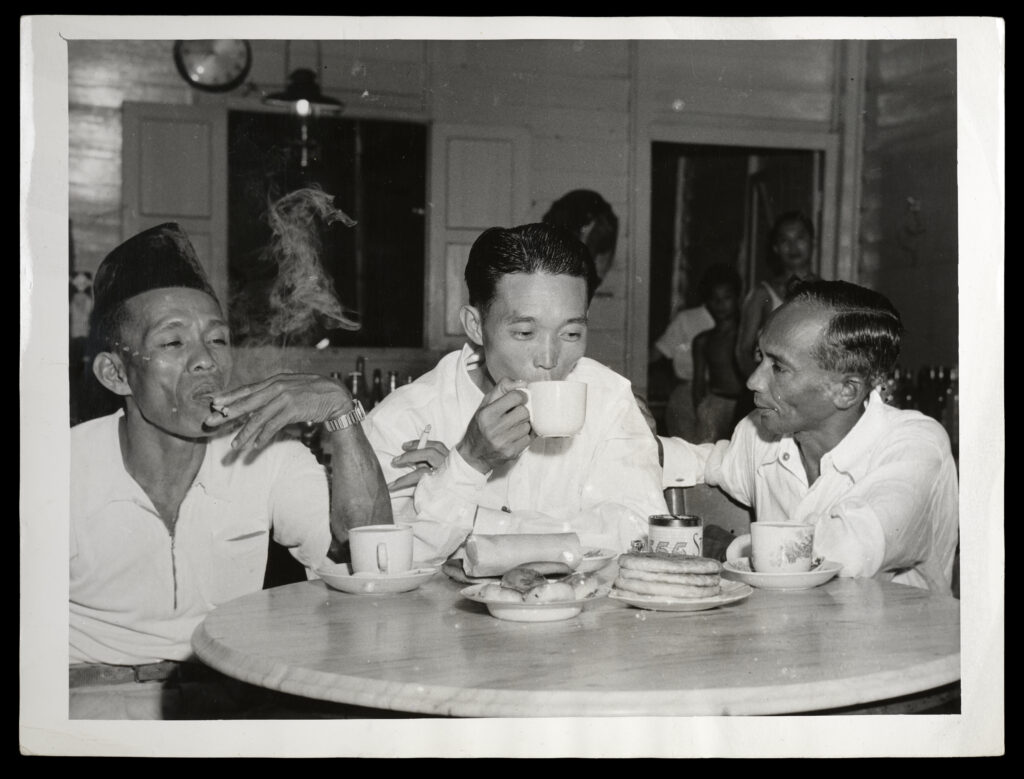
The New Villages are presented not as the concentration camps they were—barbed-wire enclosures with strict curfews and constant colonial surveillance—but as aspirational communities. One representative caption reads:
In the Federation of Malaya over 500 New Villages now give shelter to Chinese, Malayan and Indian families who were once at the mercy of marauding Communist terrorists. The villages have been developed as the result of a plan introduced by the late General Sir Harold Briggs. Pokok Asam, in N.W. Malaya, is typical of the new communities. His day’s work done, Tong Kim Boon (centre) joins his friends and fellow Village Committee members, A.G. Das and Chan bin Malik for a cup of coffee in the local Coffee House, where they have an informal chat about local affairs.
From “give shelter” and “marauding Communist terrorists” to the hardworking men enjoying a coffee and having an “informal chat about local affairs”, this is the archive speaking in its most explicit voice, placing material firmly within colonial power structures and colonial ways of seeing. Moreover, many of these captions shorten “communist terrorist” to CT, itself a collection designator in the IWM cataloguing system applied across numerous images. The overlap between captioning and cataloguing language makes legible the depth of the imperialist mindset underwriting both.
Reading these captions against the grain and attending to what they reveal about the archival body rather than what they intend to project, is one way to begin decolonising these processes. Rather than re-captioning or re-cataloguing, which risks homogenising the archival encounter, remaining attuned to these contradictions is a more fruitful engagement: at once centring, de-centring and re-centring the work and its inherited modes of presentation. This is how one “triggers” the archive into being read differently.
Putting the Archive to Work
The final and most protracted emotional response from the archive came through the process of digitisation. IWM has digitised large portions of its holdings, accessible online in batches. However, vast swathes remain undigitised, a reflection of both the scale of the task and, I would suggest, the priorities embedded in its undertaking. Rights, permissions and sensitivity guidelines are all genuine factors. Yet the patterns of what has and has not been digitised are instructive.
The project began in January 2024, at which point I was informed that the MAU collection was in the process of becoming digitised. By early 2026 only a fraction was available online, and of those many were pushed through, arguably, in preparation for a new IWM exhibition that opened in October 2025. Others were digitised specifically at the request of the “Cold War and Other Narratives” project through repeated advocacy on my part and these are now accessible online. Many more are not. The images most conspicuously absent are those depicting particularly grievous acts of colonial atrocity. Similarly, a well-known photograph of a wounded MNLA fighter sufficiently prominent to have appeared on a Wikipedia page for many years, has only recently become available on the IWM catalogue, despite the museum having held it throughout its existence.
Digitisation matters because it displaces images from their catalogued homes and places them in the digital public realm, accessible without travel to the IWM Lambeth Road site. It is, in some ways, a democratisation of the archive. Many scholars, activists and members of the public, predominantly from the Global Majority, know well how knowledge exchange has historically been made impossible for them. The work of artists like Sim Chi Yin, whose project One Day We’ll Understand (2021–ongoing) centres her own family history and the decolonisation of Malaysia, demonstrates what becomes possible with proper archival resource.[13] Digitisation is a small but meaningful step towards making materials accessible to those to whom they most pertain.
For this project, the emotional response the digitisation process triggered was one of sluggish progress, bureaucratised approval and long wait times, each built into the archive’s body to prevent these actions from happening easily. The institutional privilege I carried as a white, Western researcher, along with the relative support of a UAL-IWM knowledge exchange partnership, still resulted in requesting approximately forty items for digitisation becoming a drawn-out undertaking. This is not incidental: it is the archival body emotionally shutting down and closing up when probed to release some of its most difficult materials.
The same dynamic emerged around rights and permissions. The project’s methodology required a one-off special case license, given that the liminal position I occupy as a researcher affiliated with both UAL and IWM had not been previously encountered by either institution in quite this configuration. Even in something as ostensibly administrative as requesting permission to use digitised images in a collaborative art piece, approaching the archive with a decolonial practice in mind yielded distinctly more resistant responses. The archive, faced with a request it had not anticipated, reacted emotionally: it reached for its most bureaucratic tools.
Mapping the colonial camera is, among other things, a response to and record of these encounters. The red metal wires that connect its images across the world-map are not decorative. They materialise the overlapping and entangled circuits of colonial power that the archive both contains and obscures. The rough metal nails that anchor them carry the texture of the encounter: resistant, occasionally painful, leaving marks. The work does not resolve the tensions it traces. It holds them, as the archive itself holds them, though with rather different intentions.
Eliciting Emotional Responses Moving Forwards
Silvia Rivera Cusicanqui has written that “there can be no discourse of decolonisation, no theory of decolonisation, without a decolonising practice.”[14] This essay has tried to hold theory and practice together, not by declaring the archive an emotional body and then illustrating it, but by letting that argument emerge from what the encounter with the IWM archive actually revealed. From cataloguing systems and the language of captions to the material storage of albums, from digitisation timelines to licensing processes, the archive has consistently responded to the presence of a decolonial practice with the full range of its emotional repertoire.
Acknowledging the archive as an emotional body is not a fact to tacitly accept, it is a point of entry that should lead decolonial practice. Knowing that the archive will be “triggered”—that it will respond with avoidance, slowness, bureaucracy or outright resistance—allows the researcher to understand those responses as evidence and testimony rather than obstacles. It is an understanding that can drive methodology and approach, and an embrace of agency that purposefully and consistently probes the archive’s most defended territories.
In doing so, we can reshape how we approach identity formation, cultural representation and anti-colonial dialogue within archival institutions. As Spivak reminds us, “neutral dialogue is an idea which denies history, denies structure, denies the positioning of subjects.”[15] By reclaiming that dialogue, reframing how we speak, and listen, to the archive, both in it and on it, we can also begin to destabilise the denial of history and its subjects within our public-facing, knowledge-producing, cultural institutions.
As Hall argues, identities are not recovered but positioned: “the names we give to the different ways we are positioned by, and position ourselves within, the narratives of the past.”[16] Treating the archive as an emotional body means doing more than unearthing “other” narratives. It is a practice of positioning ourselves and our historical subjects within the narratives of the past, the realities of the present and the potentials of the future. Mapping the colonial camera is one attempt at that positioning. The wires are still being strung.
Acknowledgements:
My deep thanks to Josefine Wikström and Niclas Östlind for their thoughtful feedback and comments; to Gerrie van Noord for her close reading and copyedits; to Jyoti Mistry and Nina Mangalanayagam for their insightful editorial suggestions and assistance; to Helen Mavin, Craig Murray, Maria Castrillo and Erica Martin for their consistent generosity at IWM; to Amanda Crawley-Jackson, Brigitte Lardinois and Kat Wesley at UAL for championing the project; to Lucy Sanderson for opening up the space of MADAD and exhibiting the work; and to Jessica Bowman for the unerring love and steadiness. Thanks most of all to Mark Sealy: it has been an honour to think alongside him and a privilege to be on the receiving end of his inspirational guidance and intellectual probing these past few years.
Footnotes
- The Cold War frame was chosen not to prioritise that ideological contest above others but because its chronology, broadly 1947–1991, maps usefully onto the period of most intensive anti-colonial struggle and national liberation across Asia, Africa and the Caribbean, and because Cold War politics actively shaped how colonial powers framed and prosecuted their colonial campaigns during this period. ↑
- Sealy, Mark, Decolonising the Camera: Photography in Racial Time. London: Lawrence & Wishart. 2019. p. 2. ↑
- Azoulay, Ariella Aïsha. Potential History: Unlearning Imperialism. London: Verso, 2019. ↑
- See Derrida, Jacques. Archive Fever: A Freudian Impression. Trans. Eric Prenowitz. Chicago: University of Chicago Press. 1995; Deleuze, Gilles and Guattari, Félix. Anti-Oedipus: Capitalism and Schizophrenia. Trans. Robert Hurley, Mark Seem and Helen R. Lane. London: Athlone. 1984. ↑
- Spivak, Gayatri with Bhatnagar, Rashmi, Chaterjee, Lola and Rajan, Rajeshwai Sunder. “The Post-Colonial Critic”. In The Post-Colonial Critic. E. Gayatri Spivak and Sarah Harasym. New York: Routledge. 1990. p. 72. ↑
- See, for example, the recent “Provisional Semantics” project, a collaboration between UAL, IWM, Tate, and the National Trust, which looked at “how museums and heritage organisations can develop ethical, equitable and transparent readings of the objects they hold.” Pringle, Emily, Mavin, Helen, Greenhalgh, Tate, Dalal-Clayton, Anjalie, Rutherford, Ananda, Bramwell, Jane, Blackford, Katie and Balukiewicz, Kim. “Provisional Semantics: Addressing the challenges of representing multiple perspectives within an evolving digitised national collection”. 2022. DOI: https://doi.org/10.5281/zenodo.7081347. ↑
- Hall, Stuart and Schwarz, Bill. Eds. Familiar Stranger—A Life Between Two Islands. Durham, NC: Duke University Press. 2017. p. 16. ↑
- Hall, Stuart and Sealy, Mark. Different: A Historical Context. London: Phaidon. 2001. p. 36. ↑
- Enwezor, Okwui, Archive Fever: Uses of the Document in Contemporary Art. New York: ICP. 2008. Enwezor’s curatorial argument that the archive need not be approached as a repository of inert historical artefacts but as an unstable institution that actively shapes discourse is an important precursor to my argument and practice. ↑
- Fanon, Frantz. The Wretched of the Earth. Trans. Constance Farrington. New York: Grove Press. 1966. p. 203. ↑
- Derrida, Archive Fever, p. 3. ↑
- Ibid., p. 7. ↑
- Sim Chi Yin’s One Day We’ll Understand (2021–ongoing) draws on IWM holdings, among those of other archives, to trace the history of the Malayan Emergency through her own family history. ↑
- Cusicanqui, Silvia Rivera. “Ch’ixinakax utxiwa: A Reflection on the Practices and Discourses of Decolonization”. The South Atlantic Quarterly. vol. 111. no. 1. 2012. p. 100. https://doi.org/10.1215/00382876-1472612. ↑
- Spivak, The Post-Colonial Critic, p. 72. ↑
- Hall, Stuart. “Cultural Identity and Diaspora”. In Identity, Community, Difference. Ed. Jonathan Rutherford. London: Lawrence & Wishart. 1990. p. 225. ↑