Editors note:
A digital edition of selected texts from the monograph Tintin Wulia: Things-in-Common (Hiroshima City Museum of Contemporary Art, 2024). Supported by the European Research Council (ERC) through its funding for Things for Politics’ Sake: Aesthetic Objects and Social Change (THINGSTIGATE, Grant Agreement No. 101041284), based at HDK-Valand – Academy of Art and Design, University of Gothenburg.
Introduction & editing: Tintin Wulia ● Essays: Karen Strassler, Ariel Heryanto, Naoko Sumi, Tintin Wulia ● Conversations: Vincent Bevins with Tintin Wulia; Deborah M. Gordon with Tintin Wulia ● Co-editors of the original monograph: Naoko Sumi and Tintin Wulia ● Editorial Assistant: Renjana Widyakirana
“Movement,” as curator Naoko Sumi argues, “generates new memories, which, in turn, inspire further movement.” Sumi describes this in reflecting the bodily immersion of viewers moving across the retrospective of things-in-common she curated, Tintin Wulia: Things-in-Common (Hiroshima MoCA, 2024-25), but she addresses several registers at once. Her notion speaks to migration and mobility, and equally to social movement—where memory does not only belong to the past, but propels new action: generative and iterative. Writing for the same exhibition, anthropologist Karen Strassler, turns to the science of memory to explain why: remembering is never simply an act of recovery but is always a form of “imaginative reconstruction”.
The selection of texts presented here in a digital edition may itself be seen as one such imaginative reconstruction. This edition, published at PARSE’s Things for Politics’ Sake theme, marks the texts’ entry into the broader research conversation that the THINGSTIGATE team members and I are building through the research project Things for Politics’ Sake (THINGSTIGATE, ERC, 101041284).
These texts originally form part of a monograph published in December 2024 by the Hiroshima MoCA. Co-edited by Sumi and me, the monograph accompanies the Things-in-Common exhibition. In these essays and conversations, contributors are invited from across disciplines, centred on things-in-common, a framework developed through THINGSTIGATE. Among the texts, a conversation between myself and journalist Vincent Bevins, author of The Jakarta Method (2020), moves through distinct viewpoints on social movement and political transformation, tracing how movement and collective memory shape—and are shaped by—the possibility of change. Postcolonial scholar Ariel Heryanto offers a cultural-historical account of the Indonesian political context in which my practice emerged—itself a layered history built upon iterations of violence, and of the recurring question of whether and how change is possible. In another conversation with myrmecologist Deborah M. Gordon, author of The Ecology of Collective Behavior (2023), I use ants’ collective behaviour—following Gordon’s move away from emergence—as an analogical lens through which to understand human worlds. This reveals that what appears as intentionality to me—in ant colonies at least—dissolves when each mechanism is fully accounted for.[1]
For Sumi, the exhibition’s significance lies in the need to “ensure these memories are preserved for future generations without fading into obscurity”; my essay traces how things-in-common—felt before it was named—develops through a research practice attending to moments of aesthetic reassembling and the momentum such moments may carry for sociopolitical change. As Sumi writes of the works in the exhibition, every encounter with them not only generates new experience but reshapes the memories we bring to them. Such encounters are instances of what I call counter-anaesthetics—a mechanism of aesthetic reassembling through which objects shift into sensitising beings, reciprocally transforming—and being transformed by—everything connected to them through the relations they hold. A selection of twenty-five works from across the past twenty-five years of my exhibitionary career—during which the things-in-common concept takes shape—were shown in the exhibition and are documented in the monograph. Collectively, these artworks function as instruments enabling what Sumi describes as a “connection to the memories of someone, somewhere”. Strassler, meanwhile, pushes this further: drawing on her work in Demanding Images, she reads these works as image-events. She argues that as image-events, these works reverberate beyond the gallery towards futures yet to be made, gathering people together “in common experiences of affective responsivity” (emphasis mine). After all, things-in-common could only be named and written after they were sensed—they were felt before all else.

Impossible but necessary: reflections on Wulia’s things-in-common and the work of memory
Karen Strassler
In 2012, Tintin Wulia mused. ‘Time, as Cummings has written, is what keeps everything from happening all at once. My time, however, keeps everything happening all at once.’[2] Whereas ‘history’ is made up of chronologies, dates, facts, and documents forming linear narratives of cause and effect, memory is a more elusive, jumbled material, where time refuses to stay still. Events pile up and blend into each other, and sometimes everything happens all at once. If history’s time is the time of clocks and calendars, a steady march divided into standardised, uniform units, memory’s time is messy and heterogeneous: it can be dreamlike and foggy, it can emerge in a vivid flash, it can repeat in a traumatic loop, it can haunt and produce feelings of uncanny dread. In his famous discussion of ‘screen memories,’ Freud argued that our memories rarely correspond to reality as it actually happened.[3] Instead, desire and fantasy mix with fragmented traces of past impressions, and, as with dreams, elements drawn from disparate moments appear together, having undergone a process of symbolic condensation. Far from haphazard or random, these processes of compression and convergence across divergent times and spaces operate through an associative logic, a logic of resemblance or resonance, revealing connections otherwise obscured in more conventional spatial and temporal orderings.
Memory—a personal and a collective activity of bringing the past into the present—provides not merely the content but also the form of much of Wulia’s corpus. In her work, understandings of the past emerge when the ordinary regularities of linear chronology are abandoned in favour of the more convulsive and recursive, thickened and patchy, affective time of memory. Likewise, as in our memories, which leap from place to place with no respect for borders and fixed identities, Wulia’s work offers new spatial maps by which to see unseen connections and relations linking people and events. Both the potentials and the challenges of memory’s form become more pronounced in a context of repression and fear, such as in Indonesia during the 32 years of dictatorship following the mass killings of 1965. When history is monopolised by the state, memory becomes fugitive, shaky, full of holes—and urgently needed. When pasts have been forcibly erased, silenced by fear, or distorted beyond recognition, the task of memory calls for creativity and imagination. It requires art.
Born in 1972, just seven years into the dictatorship of General Suharto, Wulia grew up in the repressive atmosphere of the New Order regime. As a member of Indonesia’s ethnic Chinese community, a minority community subjected to both official and popular forms of discrimination, Wulia sensed that her belonging was always uncertain, that there was something about her that people did not like. She also sensed that certain questions could not be asked and certain stories could not be spoken aloud. A shroud of secrecy surrounded the story of her own grandfather, who was forcibly disappeared during the anti-communist purges that killed an estimated half a million to one million people. She writes, ‘My family never talked much about 1965, but I knew that their house was looted and burnt down. I was born seven years later and therefore had no memory of the facts. Yet however well the facts were hidden, the memory of feelings kept lingering within my family. I grew up with these memories, of which the most subtle yet perhaps strongest was the memory of fear.’[4] It was only in 1998, when she witnessed the violence against ethnic Chinese communities that erupted at the end of Suharto’s regime, that she began to better understand the roots of the fear and secrecy that had pervaded her childhood. ‘I thought perhaps what happened to many families in 1998 was similar to what happened to my family in 1965.’ The affective resonance between 1998 and 1965 allowed Wulia to gain new insight into experiences that had happened to her family seven years before her birth. Momentarily collapsing the distance between then and now, 1998 allowed Wulia to remember what she felt but could not recall.
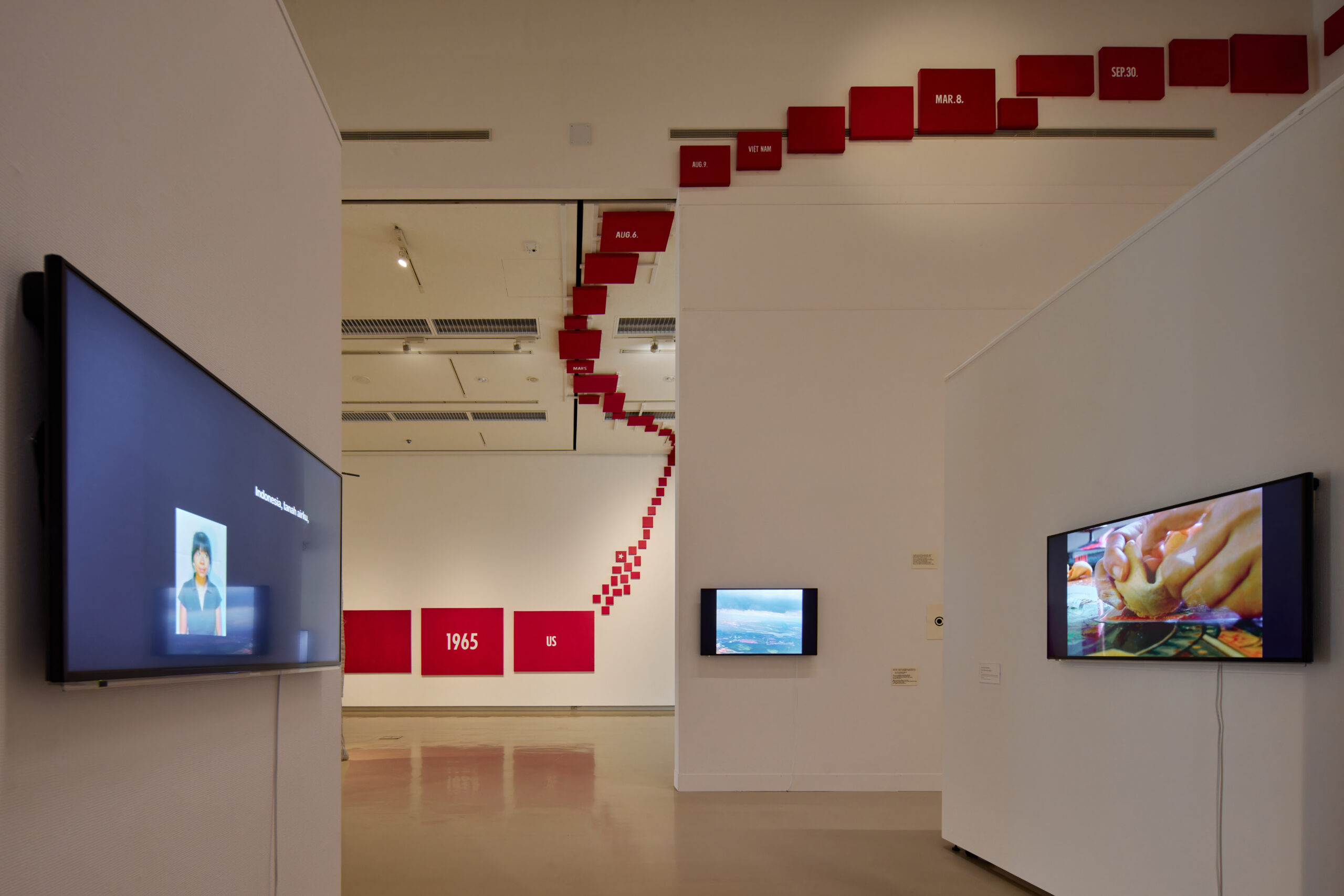
Potent convergences—here, across space—also animate Wulia’s 2019 work Subtext—After Kawara’s Title, 1965 [Fig. 1], making geopolitical connections between the Vietnam War and the ‘1965’ killings in Indonesia visible while also commenting critically on the ways these relations have remained obscured. The date ‘1965’ becomes a compressed symbol—a thing-in-common—that evokes shared experiences of Cold War violence. These experiences have been kept apart by nationalist historical narratives that treat Indonesia’s killings as a discrete, internal affair (and by official secrets that, until recently, kept the United States’ imperialist involvement in them out of the picture). Kawara’s original tryptic consists of three square canvases, painted red, on which appear white letters spelling out, ‘One Thing’, ‘1965’, and ‘Viet-Nam’. Wulia’s restaging of the work comments on the uneven distributions of attention that have largely occluded the Indonesian experience on the world stage. It also inserts personal memories into global conflicts. She writes, ‘Most Americans might remember 1965 as the year the US combat troops were first deployed into Vietnam. I remember 1965 as the year my grandfather was forcibly disappeared in the “paradise island” of Bali, Indonesia, as part of the US-backed mass killings led by General Suharto.’[5] Fracturing the singularity of Kawara’s ‘One Thing’, she creates a total of 68 red panels that spill outward in intensifying red color from the pivotal date 1965, linking Indonesia and Vietnam in a shared context of global geopolitical conflict. It is not just the date, 1965, but the colour red—red for blood, red for Communism—that forms a sensorial and symbolic link between distant places (the pigment she uses, Quinacridone magenta, carries its own history of violence; it was invented in 1859 and named after the Battle of Magenta). The ‘deep, blood red’ colour, she writes, conjures up the memories of 1965 recounted within her own family. As the killings swept through East Java and Bali, her father’s uncle warned him to stay in the safer city in which he was studying: ‘Are you mad? Don’t go home—stay where you are. The river in Surabaya is red with blood already!’[6] Indeed, during the Indonesian dictatorship, this image of ‘rivers clogged with bodies and red with blood’ was the most commonly spoken—or whispered—memory of the massacres. Like the focal date ‘1965’, the shared image of the red river suggests a condensed, even ossified, traumatic memory that, because to recount more of what one saw or heard or experienced was too dangerous, often had to stand in for all that could not be said.
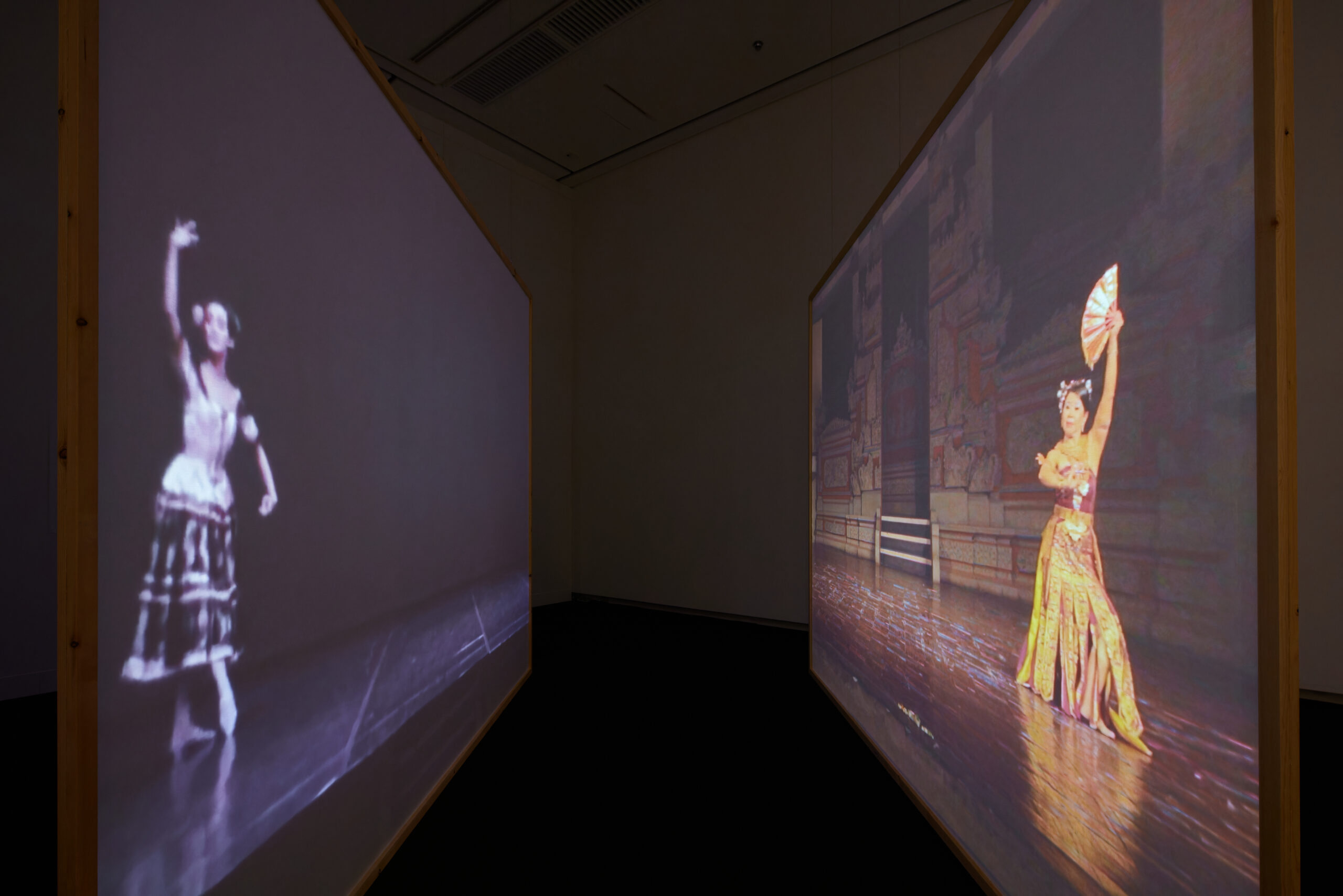
The science of memory tells us that remembering is never a simple act of recovery; even when we have a sensation that we are calling to mind a perfect record of a past scene, we are in fact engaged in a form of imaginative reconstruction. Far from fixed contents stored in our minds, our memories are remade and reworked every time we recall them. By its very nature, then, memory confounds any search for authentic origins or singular truths. Wulia’s video installation from 2018, Dos Cachuchas [Fig. 2], dramatises this process of continual reworking. The piece is a meditation on hybrid identities in the context of histories of migration, and on art-making as a continual, layered process of creative appropriation and translation that foils notions of authorial originality or cultural authenticity. In the piece, dance is a ‘thing-in-common’ that traverses and forges links across disparate times and places. In 1836, the Austrian dancer Fanny Elssler translated a Cuban-Spanish folkdance, La Cachucha, into the form of a ballet. The resulting dance, which Elssler toured around Europe and the Americas to great acclaim, was a scandalously thrilling refashioning of the (perceived) exotic, savage, racial-cultural Other within an elevated, courtly, Christian-European form of dance. Of course, no recording of Elssler’s dance exists, but by using texts and visual illustrations of Elssler’s famous dance, a British authority on dance notation reconstructed it in 1967, allowing the dance to be performed again. In her restaging of the dance, Wulia juxtaposes a British ballet dancer’s performance of the reconstructed La Cachucha from 1981 with her own translation of the ballet into the style of Balinese dance. By using her body to perform this encounter with Balinese dance, Wulia brings the piece into an intimate, personal register as a commentary on identity in the context of migration. Just as audiences experienced Elssler’s dance as an unsettling melding of apparently distinct things, so too, the movements of Wulia’s body as she performs Balinese dance are—for those raised in Indonesia’s racialised social order—jarringly at odds with the ‘Chinese’ appearance of her face. She writes, ‘I began dancing Balinese as early as I started to walk, making Balinese dance a kind of a “native language” to me. During the legal ban of Chinese culture in Indonesia, however, I often had to assert my Balinese dance skills … to avoid Othering and stereotyping based on my so-called “Chinese looks”.’[7] The body is itself a hybrid medium of memory, conveying both genetic inheritance and the embodied learning of culture, place, and time. Mimicking the ongoing reconstructive work of memory, extending the dance’s reverberation across space and time, Dos Cachuchas suggests the futility of searching for singular origins in both art and identity.
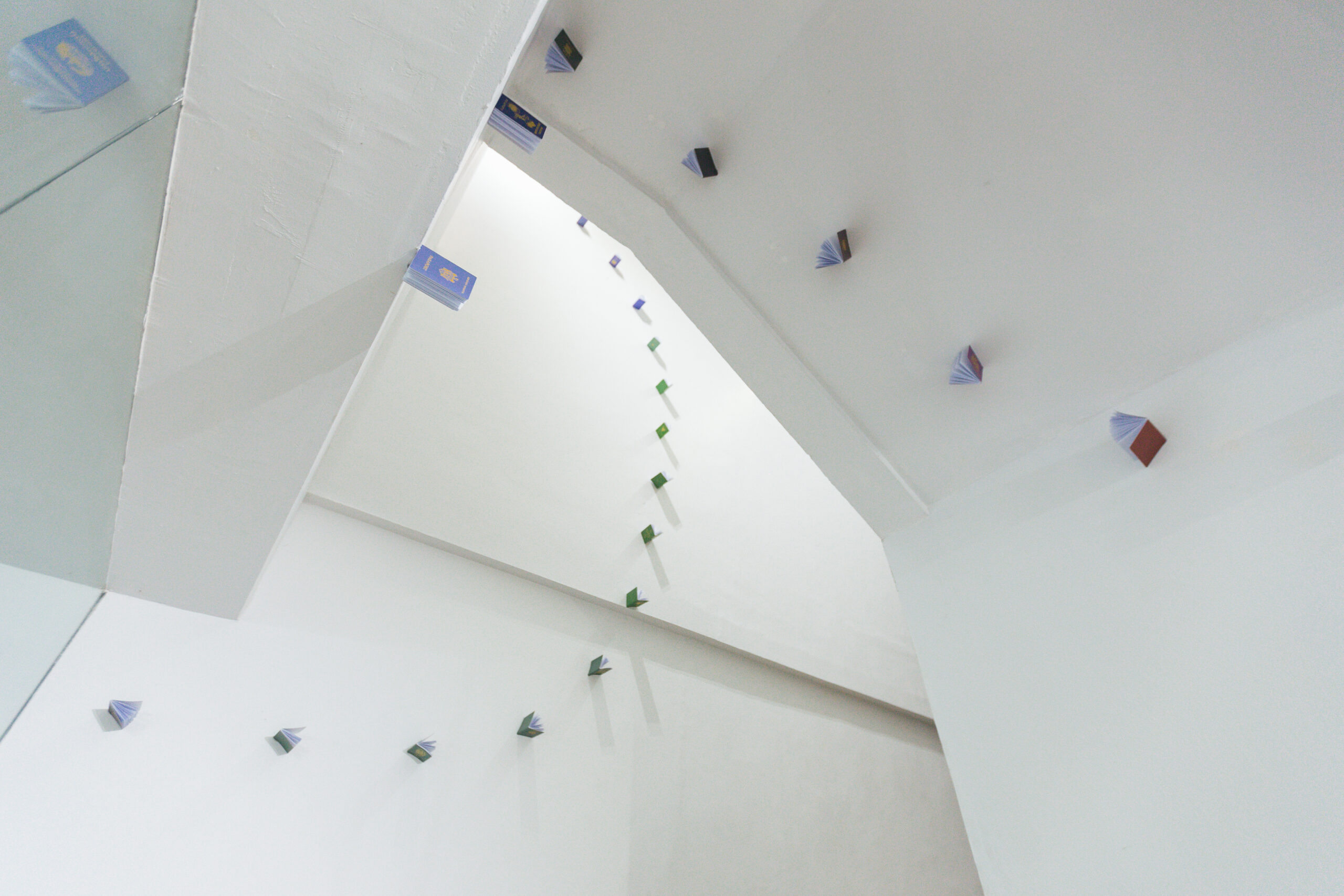
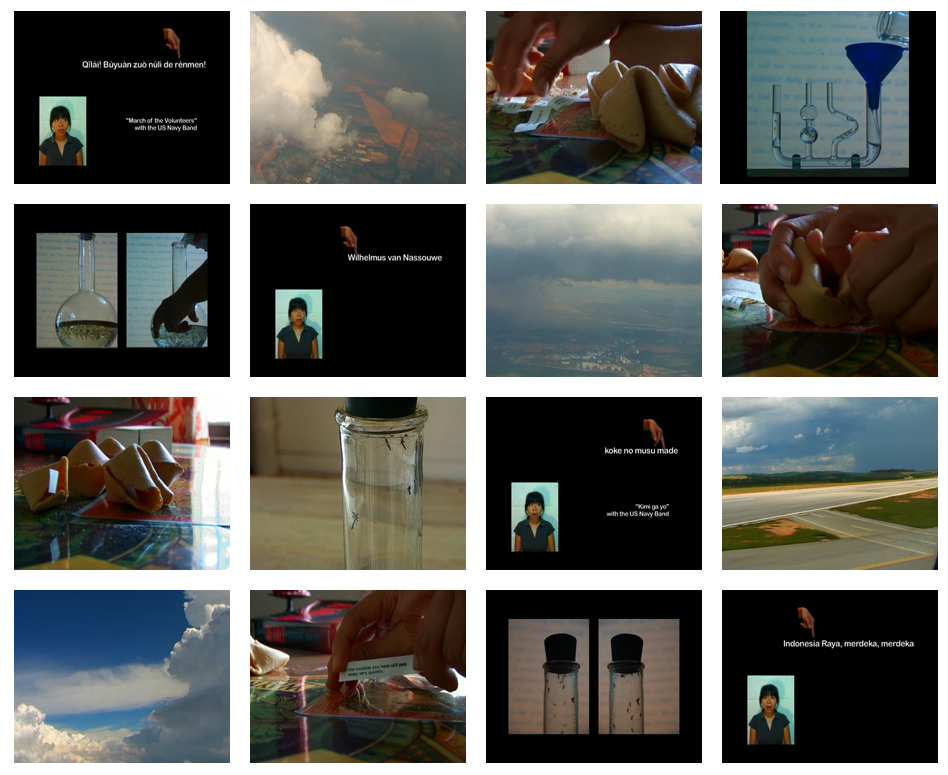
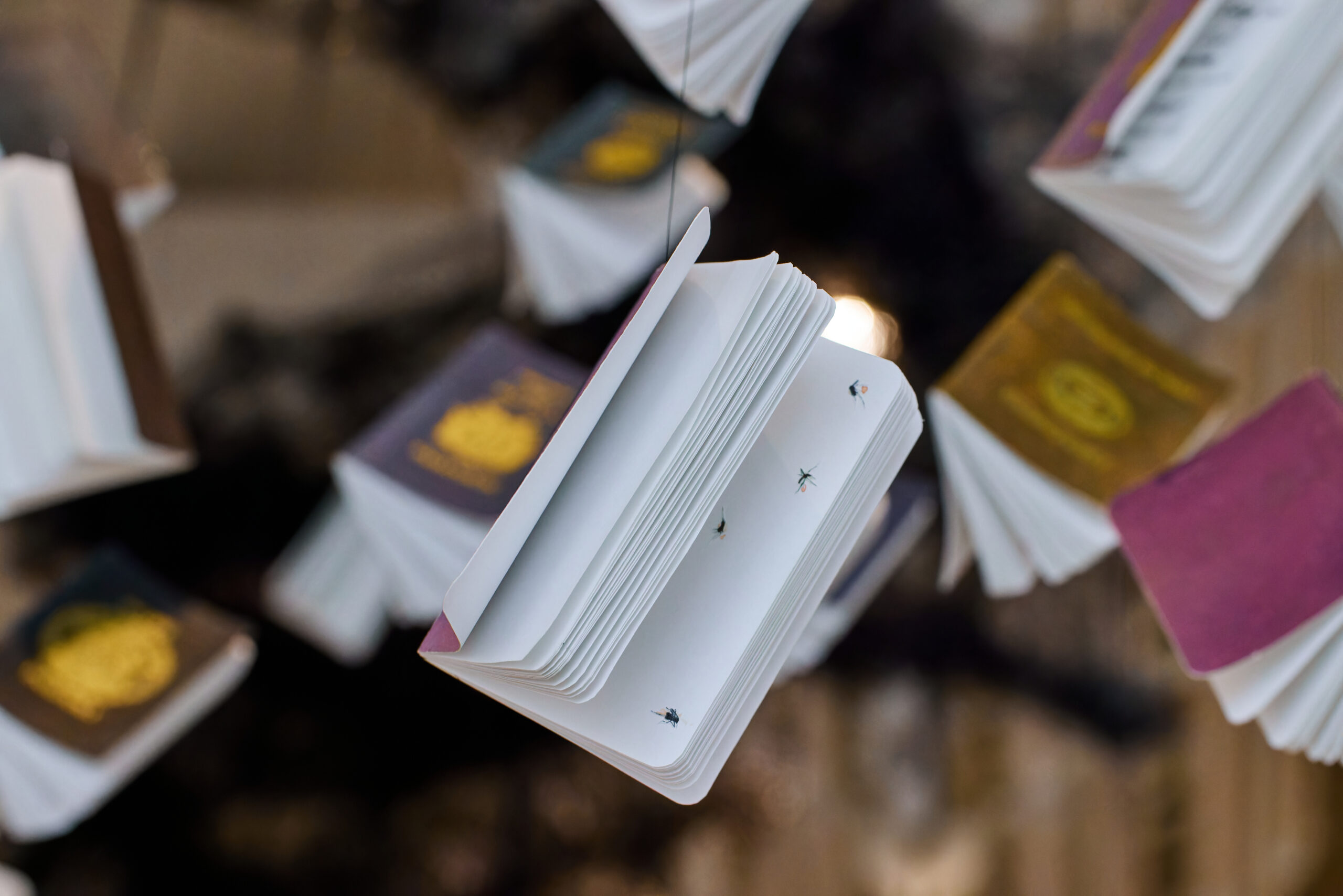
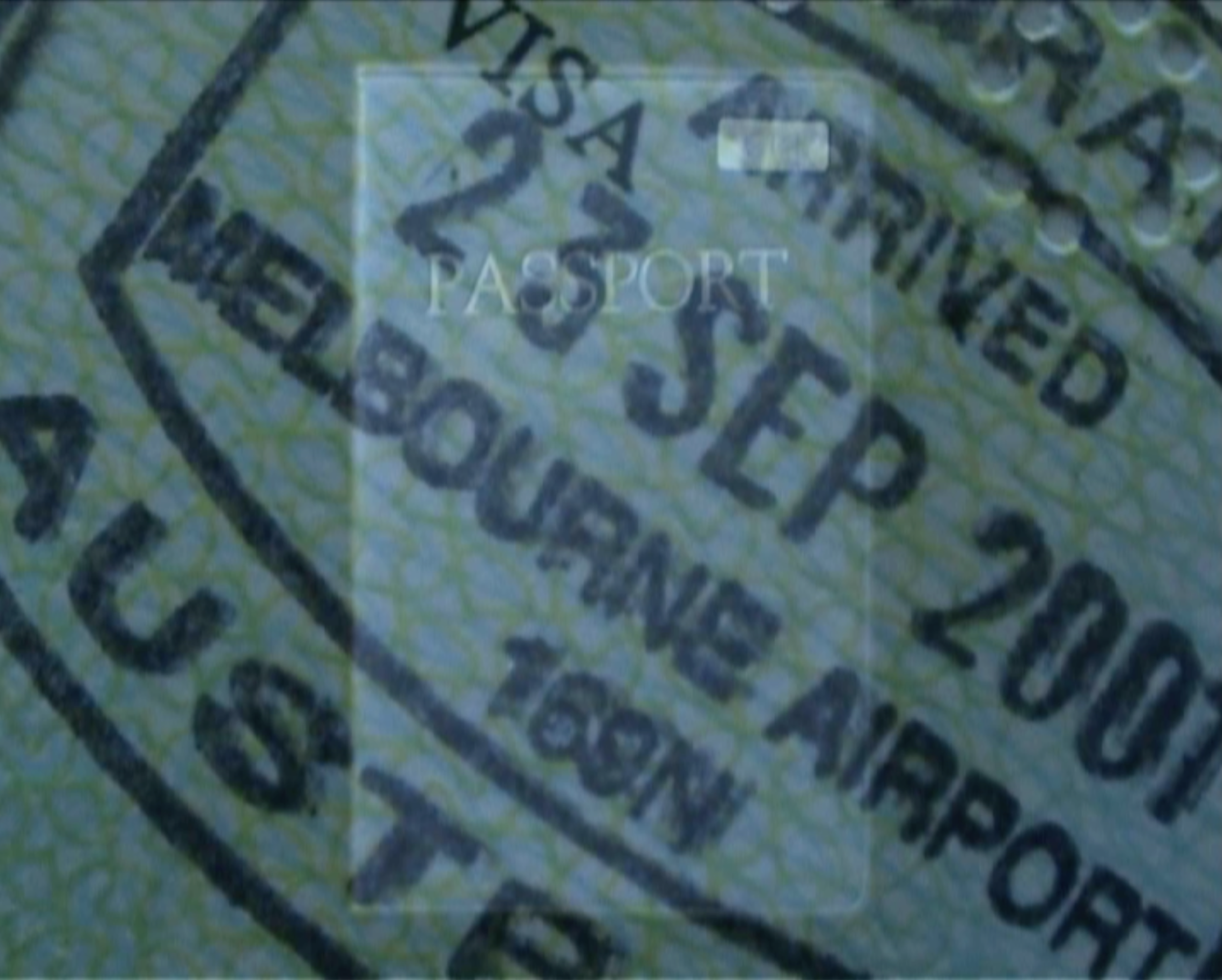
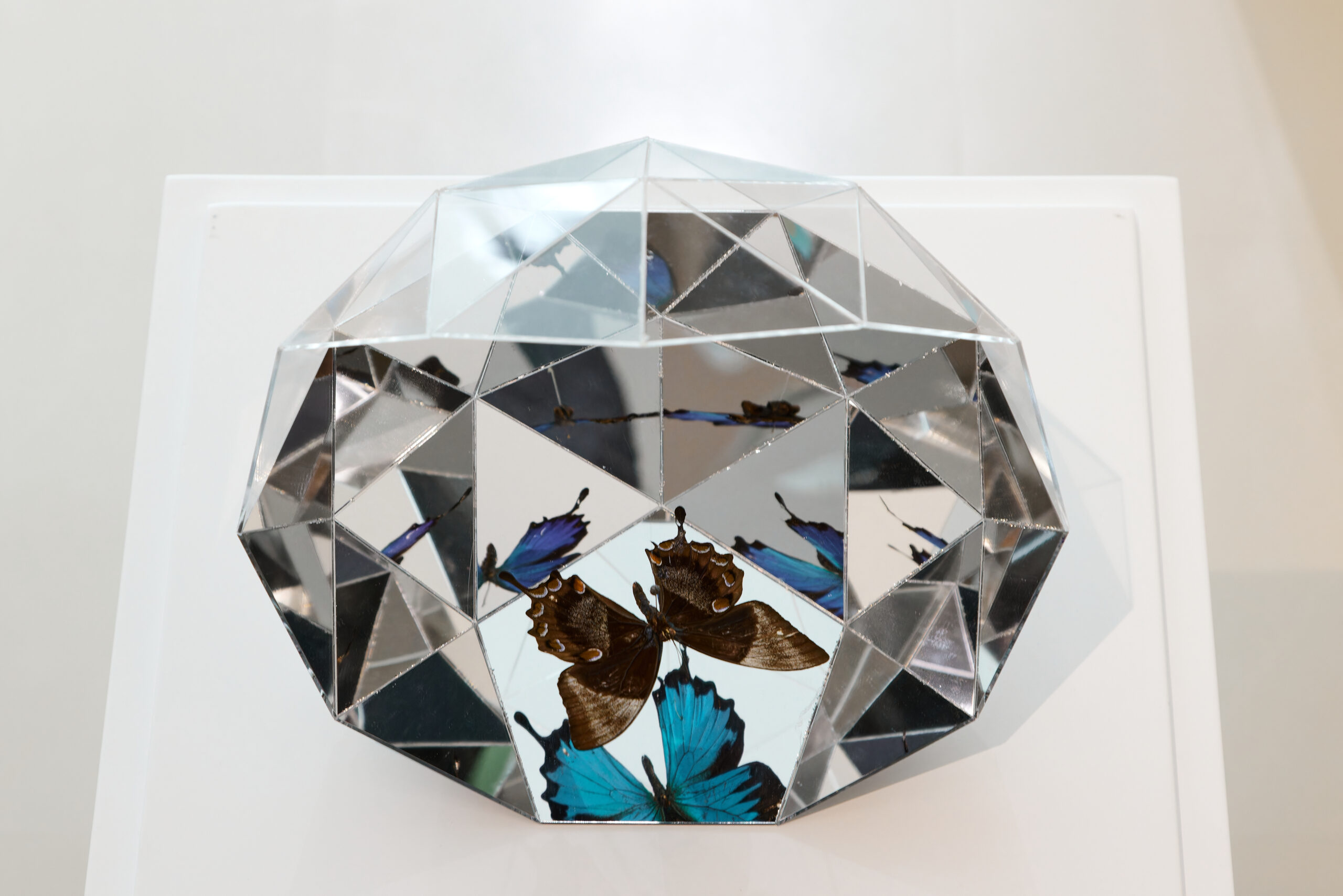
A frequent target of Wulia’s irreverent and critical interventions is the nation-state’s effort to thwart or deny such processes of continual reworking, hybridisation, and movement across borders. She invites people to take into their own hands the tools by which the state seeks to fix origins, impose identities, and enforce boundaries. Passports figure prominently in her corpus as material ‘things-in-common’ that she defamiliarises in playful, participatory experiences. By enabling people to manipulate these state fetishes, she demystifies their power and provokes people to question ways of ordering that have become naturalised within the global nation-state system. In Lure (2009) [Fig. 3], for example, national identity becomes an arbitrary game; which passport one receives (and whether one receives one at all) is mostly a matter of chance. In Study for Wanton (2008) [Fig. 4], Wulia attempts to sing the four national anthems (Chinese, Dutch, Japanese, and Indonesian) that mark her own familial history of migration and shifting state sovereignty. In a blog post, she writes, ‘even though I, my mother, and my grandmother were all born in the geographical area known as Indonesia—my birth certificate was issued by the Indonesian government, my mother’s was by the then-current Japanese government … and my grandmother’s was by the then-current Dutch government …’[8] The continuities of family lineage—materialised in Wulia’s face and voice—counter the discontinuous histories of state sovereignty embodied in the anthems. In the piece (Re)Collection of Togetherness (2007-2024) [Fig. 5] the mosquito—an insect that traverses borders with ease, carrying human blood in its body—becomes a counter-symbol to the passport, representing the ease of movement and fluid intermingling of bodies that for millennia characterised most of life on earth. While attempts to stop mosquitoes, human, and viruses from crossing borders are ultimately futile, the squashed mosquito in the passport represents the nation-state system’s violent attempts to restrict this natural mobility. Like mosquitoes, fugitive memories can pass through the mesh of state-imposed stories; but like mosquitoes, they are vulnerable.
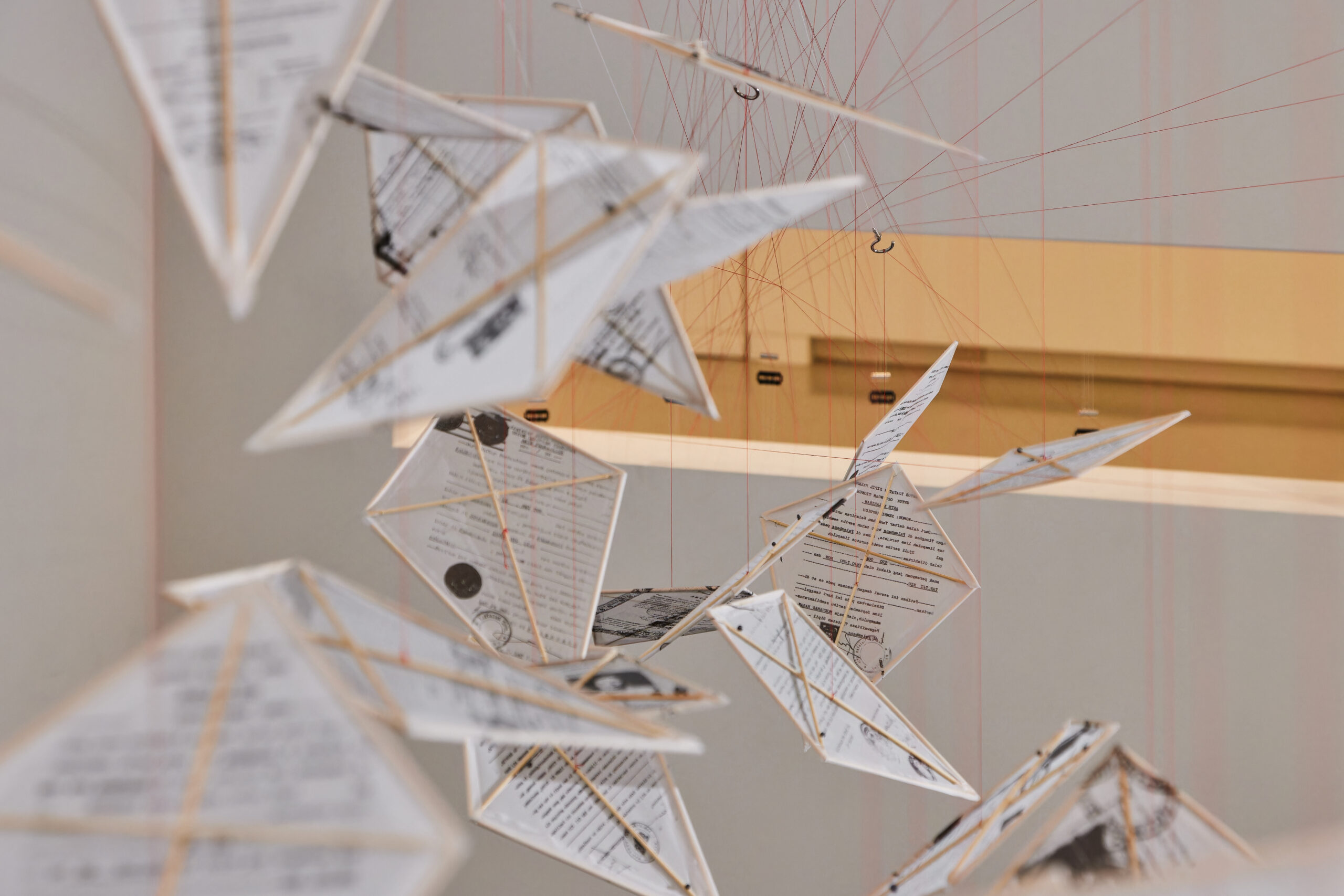
If these works are subversively ludic, other pieces poignantly ask: Can documents issued by the state—artifacts that were themselves instruments of state violence—be made to tell other stories? Wulia describes Invasion (2008) [Fig. 6] as a commentary on the forced rootlessness of Chinese Indonesians, what she calls their ‘floating identity’. In the installation, Wulia attaches copies of her family’s various identification documents to fragile white paper kites. One of the most important ways that people in Indonesia became marked as ‘Chinese’ was through official bureaucratic documents that identified them as Indonesians of foreign ancestry. These documents, which were required to ‘prove’ that ethnic Chinese had become citizens of the Indonesian nation, were carefully stored for safekeeping even as they were often objects of shame and secrecy. Surrounded by official stamps, signatures, and lines of text, the faces staring out from the identity documents on the kites appear both trapped and isolated, buffeted by the winds of shifting regimes. They are neither flying free nor grounded. Suspended from the ceiling, the paper kites are moored to earth by red threads that pass through a hole in the wall and are anchored in pots filled with red sand on the other side. Delicately balanced and dangerously close to the threads tethering the kites, razor blades suspended on other threads and held in place by magnets reinforce a sense of precarity. The work suggests that far from affirming ethnic Chinese belonging in Indonesia, identity documents actually enact an un-rooting by continually reinforcing the tenuousness of their position. The nation-state system renders impossible a cosmopolitan dream of borderless global citizenship. At the same time, it is precisely its insistent documentation of ethnic origins that prevents a more settled grounding, continually reminding Chinese-Indonesians that their place in the nation is dependent on official bureaucratic recognition, and that this connection can be severed at will.
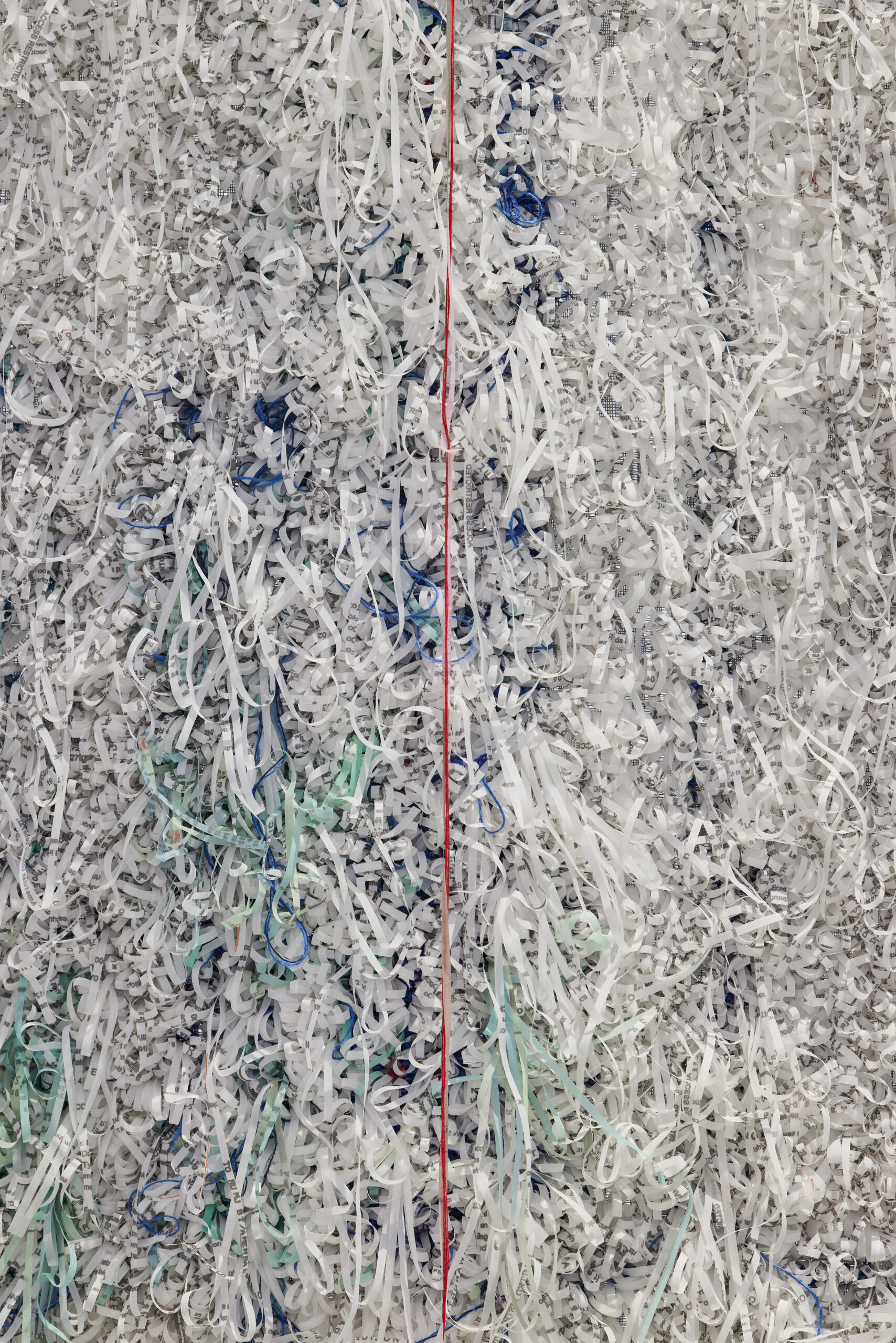
In Invasion, Tintin manipulates and transforms bureaucratic tools of state violence, making them do new work in and for the present. Documents provide the ‘thing-in-common’, a material link between past and present, between state intentions and individual lives, between artist’s expression and viewer’s aesthetic experience. But what happens when there is no ‘thing’ that can be retrieved and reworked, when the past is marked not only by silence but by intentional erasure? One strategy is to make something where there is nothing, to create a tangible, visible artwork out of silence itself. This is the path Wulia pursues in Absence in Substantia: Density (2023) [Fig. 7], part of her Protocols of Killing project examining the archive of 35,642 communications to and from the US Embassy in Jakarta in the period surrounding the 1965 killings. The documents were made public in response to a Freedom of Information Act request, but before releasing them, the US government withdrew almost 800 documents whose public exposure, it claimed, would threaten national security. Analysing the dates of the 798 withdrawn documents, Wulia created graphs revealing a pattern of intensifying secrecy peaking around the pivotal date of October 1, 1965. Evoking documents passed through a shredder, the piece makes the denial of disclosure speak eloquently of US government complicity in the massacres. Wulia links this recognition of the substance of absence to her own family memories: ‘Here I co-opt the act of closure into disclosure. I know this cooptation quite well. My grandfather’s liminal death left an unfiled lacuna, a particular hole right in the heart of my family, so to say. But we knew that there is no point filling this hole with anything else, because without this hole in its heart, my family’s heart is never whole.’[9] It is the gaps and silences, as much as what is known, that give form to our memories of the past.
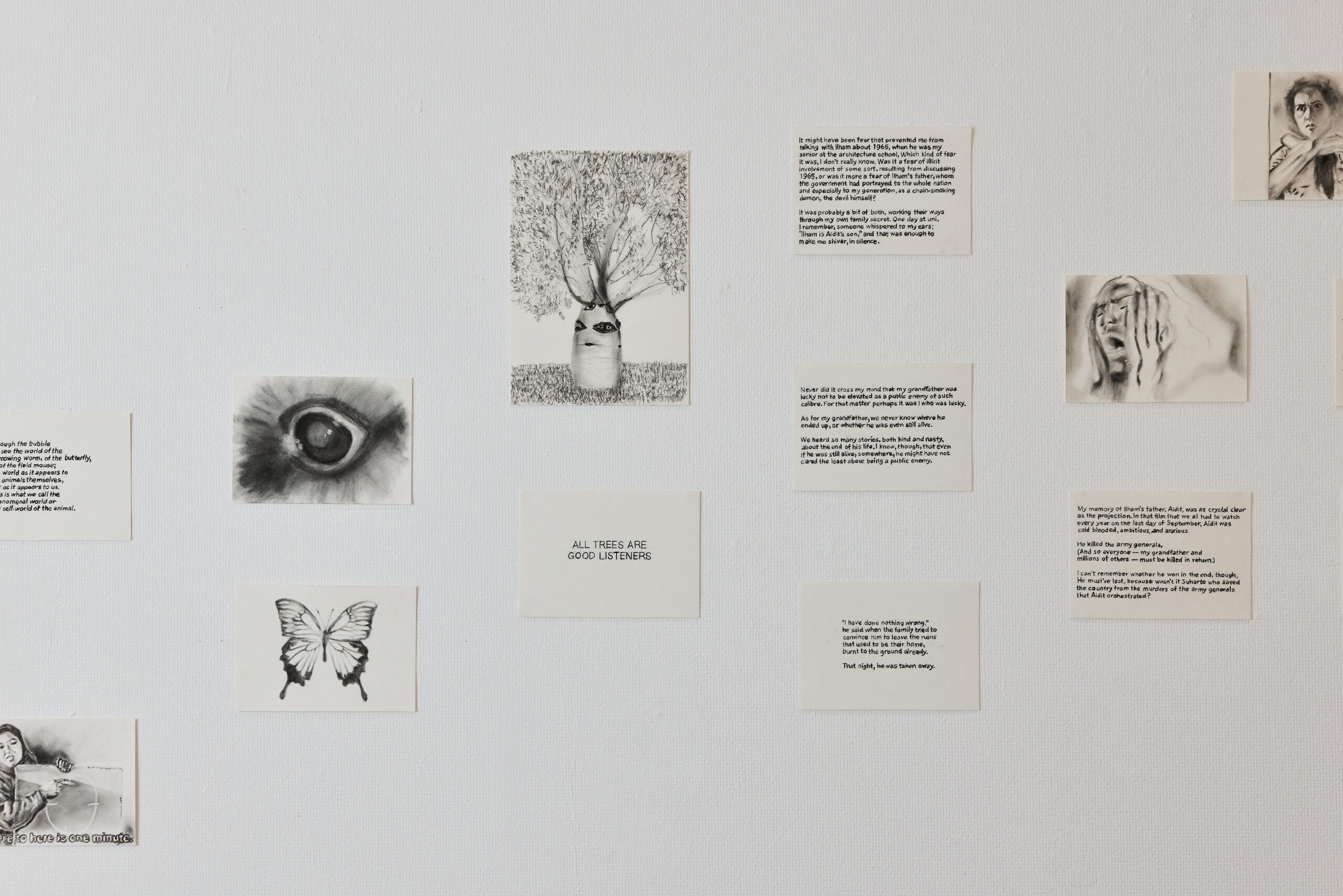
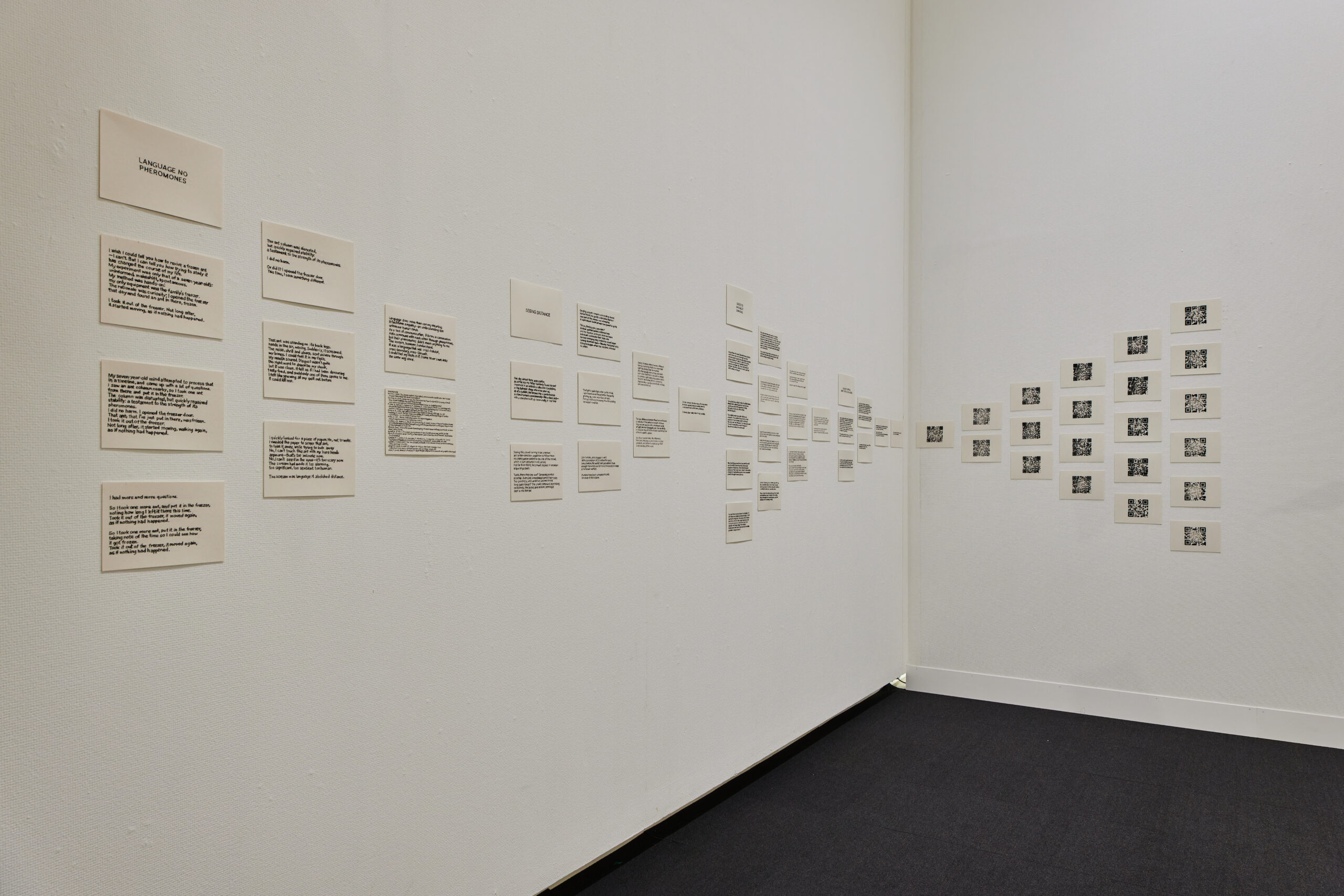
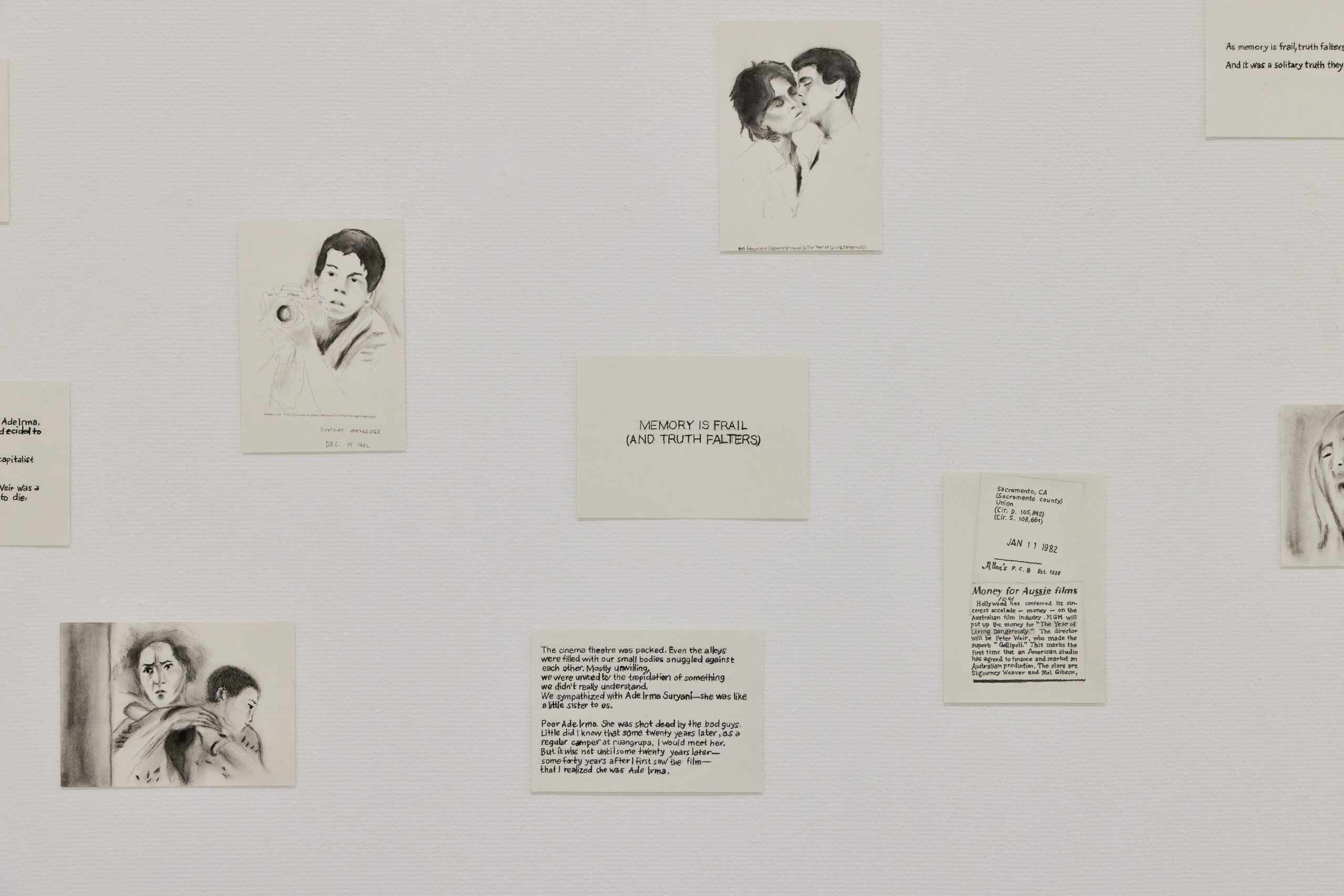
In contexts of state violence and repression, popular memories of violent pasts sometimes congeal into potent, shared images, such as the river red with blood, while the state supplies its own singular narrative that seeks to overwhelm and supplant other stories. In Indonesia, the official narrative of the 1965 killings found its ultimate expression in the 1984 film, The Treason of September 30, 1965/Communist Party, a gory, pseudo-documentary that all school children were required to watch each year on television. Between potent but unelaborated images, heavy-handed state propaganda, official silencing, and self-censorship, what memories persist? What form do they take? Forming itself around the negative spaces of secrets and erasures, memory fails to cohere; it is shot through with holes. A sense of the past must be cobbled together from scraps culled from different sources. This is in fact how our memories always work. Fashioned from fragmentary traces of our own experiences and impressions, they are scaffolded by narratives and images drawn from media and from the stories of those around us, and fleshed out by our imaginations; even the personal memories of which we are most certain often prove to have been inaccurate or to have belonged to someone else. But these characteristics of all remembering are heightened in contexts of state repression. Wulia’s ambitious installation, Memory is Frail (and Truth Brittle) (2019) [FIg. 8] mimics the fragmentary, non-linear, and associative form of memory. The installation features 115 black and white drawings, reproductions of images drawn from films, family photographs, art, scientific illustrations and so on, interspersed with handwritten texts. These images and texts are drawn from an array of events and sources that are loosely linked by resonance and association (including, 9/11, Orson Welles’ 1938 The War of the Worlds radio drama, the Indonesian state’s 1984 propaganda film about 1965, her grandfather’s killing in 1965, the 1972 coup in Chile, NASA and the Cold War Space Race, the experiences of Indonesian political prisoners, St. Exupery’s The Little Prince, news reports, scientific treatises, and personal recollections). Redrawn and rewritten in Wulia’s own hand, each of these elements appears as a reworked copy. There is no original truth to grasp, no clear storyline to follow. Arranged as an unfolding constellation, the images and texts suggest convergences and echoes across time and space, the uncertain evidence of our senses, and the mediated nature of remembering.
Of her efforts to recuperate the lives of young enslaved women from archives in which they appear only as disposable property, Saidiya Hartman observes, ‘The task of writing the impossible … has as its prerequisite the embrace of likely failure and the readiness to accept the ongoing, unfinished, and provisional character of this effort, especially when the arrangements of power occlude the very object that we desire to rescue.’[10] Wulia’s engagement with memory’s form suggests the critical role of art in this ongoing and unfinished work of remembering the past. Elsewhere, I have suggested that we think of images not as static things but as events that unfold across time and space as people recirculate and rework them, generating affective and discursive engagements in the process.[11] Similarly, Wulia’s artworks are not objects of contemplation that refer back to a closed past. They are image-events that gather people together in common experiences of affective responsivity, engaging them in the impossible but necessary work of memory. While these encounters may take place within a museum gallery, they linger and ramify in the imaginations of their participants. They reverberate beyond the walls of the museum and towards futures yet to be made.
Open Access version (including pagination) is available here.
Racial discrimination as paradox: the case of Chinese Indonesians
Ariel Heryanto
Indonesians often take pride in belonging to one of the world’s most diverse nations, ethnically, culturally, and linguistically. Dutch colonialism brought their separate ancestors together under one state administration for many years until Japan took the territory under its rule (1942–1945). As soon as World War II concluded, local nationalists declared independence in August 1945. Since independence, however, differences in skin colour or religion have repeatedly threatened the nation’s unity. Violent inter-religious or inter-ethnic conflicts flared up from time to time. This essay focuses specifically on the remarkable discrimination that has been targeted at Indonesians of Chinese descent, who constitute approximately 1.2 per cent of the population. I will highlight the paradoxes of such discrimination, and discuss its broader historical context and the general situation at present.
Chinese Indonesians are not the only minority group to suffer from significant discrimination. However, for a combination of reasons, the status of Chinese ethnicity is historically specific, making the discrimination against this group distinct and intriguing. Except for their compatriots of Indian descent, no other minority group has occupied the same economically privileged position as that which is enjoyed by a small percentage of wealthy Chinese Indonesians. However, state official insinuations and public imagination about this ethnic group’s wealth are often riddled with overstatement and stereotyping.
Of special interest to visitors to the exhibition Tintin Wulia: Things-in-Common, many Chinese Indonesians have leading roles in the history of visual, literary, and performing arts since the early twentieth century, well before Indonesia’s independence, along with those designated as being of European descent. Today a number of Chinese and Indian Indonesians occupy salient positions in the contemporary art scene and entertainment industry. However, until very recently, the historic role of these various ethnic minority groups has been almost entirely erased or put under erasure in the strongly nationalist narratives and public memory.
More than any other ethnic minority group, Chinese Indonesians have been the easiest and most frequent target of mass violence. The May 1998 incident was but one of the worst cases in many decades. It is the most recent and most documented case of large-scale anti-Chinese violence. Curiously, it also marks the beginning of a significant change in a long history of such violence.
MAY 1998
The full story of what happened in May 1998 and the precise scope of the destruction may never see the light of the day. One of the earliest formal and authoritative reports of the incident came from Volunteers Team for Humanity, a loosely organised group under the leadership of three highly respected human rights activists: Father Sandyawan Sumardi, Ita Fatia Nadia and Karlina Supeli-Leksono. They contended that between 13 May and 13 July 1998, as many as 168 females between the ages of 10 and 50 were gang raped. Nearly all of the victims were ethnic Chinese. Some attacks took place as a spectacle to be watched either coercively by the victims’ families, accidentally by passersby, or consensually by a cheering crowd. Some 138 of those rapes took place in the greater Jakarta area, and most of them (132 cases) occurred on the two days of 13 and 14 May 1998. During these two days, 1,200 people were killed, mostly burned in buildings, but 27 from gunfire. The total death toll in various cities as of 9 June 1998 amounted to 2,244. More than 4,000 shops and shopping malls were burned down, while several thousand vehicles and houses being set afire.
All this unfolded without the culprits having to confront the state security forces, then under the military dictatorship of the New Order. No serious legal investigation, let alone charges, has been attempted. While no hard evidence is yet available to prove that specific individuals or institutions within the military committed these hideous crimes, we have strong reasons to doubt that the masses could have the capacity and resources required to do so. No racial or ethnic groups in Indonesia, no matter how agitated, could inflict systematic violence with abundant high-powered ammunition simultaneously in 27 areas in a capital city of 10 million inhabitants in less than 50 hours. For these reasons, the wide use of the ‘mass riots’ to refer to the incident is highly questionable. From early on, I described it as a case of racialised (as distinct from racist) ‘state terrorism.’
There were reports of individual rapes in Jakarta and several other cities weeks after the dust settled in ruined Jakarta. They appear to be spillover or residual cases. In the months that followed, the Volunteers Team for Humanity were accused of blowing up or purely fabricating the issue of rape. For instance, non-governmental groups such as the Indonesian Committee for Global Islam Solidarity (Komite Indonesia untuk Solidaritas Dunia Islam or KISDI) and the Coordinating Body for Islam Missionaries throughout Indonesia (Badan Koordinasi Mubalig se-Indonesia) condemned the Volunteers’ report. They suspected it was an attempt to discredit Islam. Individual members of the Volunteers experienced repeated harassment and threats. One of them (who might be a rape victim herself) was tortured to death in her home only days before she was due to depart to the US in order to testify about the May 1998 violence.
By no means was the May 1998 unique. For most of the twentieth century, anti-Chinese mass violence had been regular and regulated (state-sanctioned). Anti-Chinese discriminatory policies were extensive and vigorous during the New Order rule (1966–1998). However, those policies and their enforcements were full of inconsistencies and paradoxes, as will be elaborated in a moment. While the scale of the May 1998 violence is overwhelming, the incident also prompted an unprecedented backlash. For the first time, a large number of ethnically non-Chinese people and groups publicly condemned the racialized violence. A wide range of non-state individuals, groups and institutions organized events and support activities for the victims of the May 1998 incidents. To understand the conditions of possibility for the May 1998 violence to take place, as well as the backlash, we must examine the rise of the New Order regime in 1966, its resilience during the 1980s, and the crises that led to its downfall soon after the May 1998 violence.
RACIAL DISCRIMINATION AS PARADOX
Before we examine the emergence of the New Order, let us take a few steps back. In 1945, Indonesia declared its independence. It did so swiftly, during a political vacuum that emerged after Japan, the occupying force, lost the War and before the Allied Forces were prepared to reinstate the Dutch Colony (The Netherlands East Indies). It took four bloody years of revolution before a formal transfer of power from the Netherlands to Indonesia (1949) took place. Unfortunately, freedom and sovereignty alone did not guarantee an easy nation-building project. In the first two decades of independence, Indonesia continually faced political instability, internal rebellions, and hostility from the Western Bloc during the Cold War. The latter perceived President Sukarno to be leaning too far towards the People’s Republic of China (PRC), despite his earlier attempts to build a neutral association of the Third World nations (e.g. the famous Bandung Summit, 1955).
The instability eased with the establishment of a military dictatorship under the leadership of Major General Suharto. With the generous support of the Western Bloc in the Cold War, Suharto took over the state power from his commander-in-chief, then President Sukarno. For the next three decades, Suharto became the sole head of state for the entire life of the militarist rule of the New Order. For the first time since independence, a semblance of political stability set in, and substantial economic growth proceeded for the next three decades. However, the cost of this stability is staggering. The New Order was founded on top of one of the worst massacres in modern history (1965–1966).
Throughout its rule, the New Order regime conducted a series of nationwide anti-communist, anti-left, and anti-Sukarno campaigns. The anti-communist overkill was so successful that it became a handy tool for the New Order and its successors to silence, intimidate, and discredit dissidents and political rivals alike by accusing them of having associations with communists. Until recently, even rival members of the top political elite within these anti-communist governments were not exempted from being target of hoaxes and being accused of associating with the bygone Party.
The Indonesian Communist Party was banned in March 1966 after hundreds of thousands of its members and suspected supporters were killed in late 1965 and early 1966. Chinese Indonesians were also targeted, as they were perceived to be loyal to the PRC, or deeply attached or essentially susceptible to communism. This ethnic group was declared to be essentially non-Indonesian or less Indonesian. Officially dubbed as ‘non-indigenous’, they were expected to become more Indonesian through the state-sponsored program of ‘assimilation’, by eradicating their ‘Chineseness’. They were coerced to change their personal names, and adopt more ‘Indonesian-sounding’ alternatives. Mandarin and all other Chinese languages were banned, and so were all Chinese traditional festivals, sports and celebrations, including Chinese songs and moon cakes for the Lunar Year. Access to public services, including education, was also subject to limitation. Tintin Wulia was born and raised in a Chinese Indonesian family during this period.
The assimilation program was full of contradictions. Chinese men were highly praised for intermarriage, but such intermarriage did not turn a Chinese groom into an equal fellow citizen. Chinese men marrying native women still had to carry special identification cards and were subject to extra administrative requirements and extortion. Their children were still classed as ‘non-indigenous’, regardless of how ‘purely native’ their mothers were. The pariah status continued indefinitely along the male line, as did the stigma of being ‘communist’.
Adopting non-Chinese-sounding names did not allow the ethnic population to disappear into the native crowd in state documents and files. Access to public service still required those categorized as Chinese descendants to declare their original names so that their background could be recorded and their stigma retained. With one or two exceptions, badminton world champions of Chinese descent were known by their Indonesian names. But criminals of the same ethnic background often appeared in media reports under their Chinese names.
Despite those wide-ranging, racist state policies and practices, the wealth of top Chinese Indonesian businesspeople rose dramatically during the same period. Thus, the paradox. Instead of being driven by genuine racist hatred, the New Order launched and utilised an anti-Chinese campaign for pragmatic reasons. In attempts to defer or undercut the emergence of a domestic bourgeoisie, the New Order preferred to boost the national economy in partnership with Chinese and foreign businessmen alike, at the expense of their capable counterparts from so-called ‘indigenous’ ethnic backgrounds. Top business people with Chinese and foreign backgrounds enjoyed the state’s favouritism, as these two minorities had no prospect of forming an independent force in the nation’s political dynamics. The combination of their economic dominance and political/cultural deprivation are not mutually contradictory. They are two integral components of one strategy.
This strategy required periodic anti-Chinese violence. These incidents were regularly reported, narrated, analysed, and remembered as a spontaneous act of angry masses demanding justice. The violence served the interests of the regime in multiple ways. It reproduced and deepened Chinese dependence on state officials for protection through extra fees. The violence discredited opposition figures, who were accused of having masterminded the ‘riots’. It also deflected the popular outrage away from both the state and the security apparatus, which played hero. Occasionally, the Chinese minority was even blamed for the occurrence of anti-Chinese violence on the pretext that they had dominated the national economy and displayed luxurious lifestyles that caused ‘social jealousy’.
Despite appearing to be anti-Chinese, the New Order never wanted to wipe out Chinese identities. On the contrary, their identities were continually reproduced, if only under erasure or in stereotypes. The negation was a necessary ingredient in the making of this ethnic group as the nation’s Other. The New Order regime could not possibly want the assimilation program that it sponsored to succeed. To dissolve Chinese identities in an effective ‘assimilation’ program would mean an end to the division of labour by race, upon which the status quo depended.
No regime lasts forever. From the mid-1980s, the New Order elite began to split. Their division worsened in the early 1990s and became increasingly visible to the public. Chances for reconciliation were slimmer with the arrival of the 1997 economic crisis across the region. Large anti-government rallies intensified across the archipelago in 1997 and 1998, some with fatalities amongst new martyrs. Then, the May 1998 violence erupted that shook the entire nation. Apparently, the racialised violence was an attempt by certain segments within the ruling elite to deploy an old and now outdated instrument to create a state of emergency, enabling them to grab further extrajudicial power. As it transpired, the violence brought no gains to anyone.
What about the backlash of May 1998 that altered the long history of the anti-Chinese campaign? What is the situation like these days in Indonesia for people of Chinese descent? Has anti-Chinese sentiment gone, or has it continued unabated? I wish to conclude this essay with some answers to these important questions.
RETURN OF THE DRAGON
The New Order government might take credit for a high level of economic growth for most of its three-decade-Iong rule. Ironically, this success gradually but also profoundly undermined the New Order’s power. Under the military dictatorship, Indonesia underwent significant social, economic, and political changes. One such changes was the rise of the so-called urban middle classes, which is the most relevant to our current discussion, and it can only be outlined in the briefest fashion here.
Massive investment from the West, export revenues from the oil bonanza of the 1980s, and the elimination of any opposition facilitated the rapid and steady growth of the nation’s economy for a while. Indonesia became one of several Asian countries that made headlines under the rubric of the ‘rise of Asia’ or the so-called ‘Asian century’. Amidst these developments, particularly in the mid-1980s, the nation’s professionals and intelligentsia were preoccupied with a self-reflective discussion on the emergence of the so-called ‘middle class’.
The first and foremost benefactors of the economic windfall during the New Order were obviously military officers, their families and close allies. Their prosperity spilled over or had some trickle-down effects on the urban population. Over time, the rise of Indonesia’s new rich brought about major shifts in social relations in two separate directions.
First, the growing number of the new rich among the sons and daughters of high-ranking officers, technocrats, and high-ranking civil servants reached a critical mass, and not at the expense of the old rich, such as wealthy Chinese Indonesians. Together these new and old rich of diverse ethnic backgrounds went to school, went on vacation, and went shopping, globally. They engaged intimately with each other in business, golf courses, or karaoke rooms. Gradually but consistently, the old racial prejudices and barriers melted. Unlike previous generations, big businessmen and ‘native’ elites saw themselves as equal, if not superior, to their ‘non-native’ and expatriate associates. Cross-racial middle-class solidarity began to gain momentum.
Second, at the peak of the state elite, a new animosity grew over sharing a slice of the nation’s expanding wealth and the state’s power. The bitter division between Suharto’s family members and his immediate circles on the one hand and the military on the other became irreconcilable. While this intra-political elite exacerbated the crisis and lent an extra push to the downfall of Suharto and his New Order government, the newly built cross-racial middle-class solidarity explains the backlash of May 1998, and the improved status of the Chinese descent in subsequent decades.
In the 1990s, when Suharto could no longer rely on support from the military, he courted Islamic political forces. His maneuver did not save him from a disgraced exit. Still, the new alliance unleashed an unprecedented and unstoppable burst of energy from the Muslim communities in various forms and directions. From the early 2000s, Islamic qualities became a potent source of authority and political correctness. Contested notions of Islam and Islamness became the central battleground for political rivals to gain legitimacy and make populist appeals, further reducing the relevance of racial issues.
Already in the early 1990s, there was a noticeable decline in public hostility towards the Chinese and an easing of restrictions against their activities. The significant accomplishments of Indonesian Chinese individuals as fellow citizens in various areas other than business and trade enjoyed public recognition. Most significantly, from the early 1990s, there was a new wave of reassertion of Chinese ethnicity in public culture, as Chinese Indonesian reclaimed the right to celebrate their cultural heritage. Against the backdrop of these recent developments, the May 1998 violence appeared both anachronistic and shocking to many. It troubled the conscience of the younger generation of the ‘native’ middle class. Many felt ashamed and expressed outrage.
This does not mean that racism has totally disappeared. As elsewhere, it has been and will continue to be a part of private and day-to-day social life. The fundamental change since 1998 is that racism is no longer formally incorporated in a wide range of state or other non-state policies and enforced zealously, as before 1998. As a legacy of the New Order, an essentialist conception of ethnicity lingers on. Since the New Order regime has been portrayed as being responsible for denying and suppressing ethnic Chinese culture and identity, there is a strong tendency among many intellectuals and art workers of diverse ethnic backgrounds to restore, rediscover, or revive aspects of Chinese history and legacies that they perceived to have been lost, denied or destroyed in the past. The essentialist conception of ethnicity itself is left unchallenged. Ethnicity is taken for granted as a ‘thing’. Only a few embark on more adventurous explorations of how or why ethnicities have been constructed as ‘common things’ and ‘things in common’.
Open Access version (including pagination) is available here.
The Jakarta Method: Patterns and Possibilities in the World System
Vincent Bevins in Conversation with Tintin Wulia
Tintin Wulia (TW): Your book The Jakarta Method: Washington’s Anticommunist Crusade & The Mass Murder Program That Shaped Our World (2020) has been translated into thirteen languages including Japanese—with five more translations coming. In it you uncover how the 1965-66 Indonesian mass killings became a template for US-backed military operations targeting leftist movements, which were a significant power in the Third World, during the Cold War. You skillfully weave together personal and global narratives revealing how the US Cold War foreign policy has shaped our world today.
I began exploring the Cold War context of the 1965-66 Indonesian massacre in my work A Thousand and One Martian Nights (2017). A longer-running theme in my work, however, is migration—which I see prominently featured in your book as well. For example, you begin with the story of Ing Giok Tan’s family’s migration from Indonesia to Brazil, only to find that the Cold War soon caught up with them. In my documentary Pulang – draft 3 (2008), author Sobron Aidit, the brother of Indonesian Communist Party (Partai Komunis Indonesia/PKI) leader D.N. Aidit, describes how the term eksil (exile) entered the Indonesian language as a result of the 1965 pogrom. In your view, how did the Cold War impact patterns of migration?
Vincent Bevins (VB): There is a direct answer, and an indirect answer, and the latter I think helps to explain the very nature of mass migration in the 21st century. The most obvious and direct consequence, shaping thousands if not millions of lives, is that people fled conflict and violence, or were forced out of their homelands, as a result of the First World assault on the Third World in the second half of the 20th century. We see Indonesians flee to Brazil, or exiled without passports in China or USSR; we see Salvadorans running from brutal civil war and arriving in Mexico or the US.
But then there is the larger question of decolonisation. Fundamentally the Third World movement was about the belief in full decolonisation of the global system, not just the formal decolonisation of national governments. The idea—and it was widely believed that obviously, this would happen—was that after throwing off the foreign domination of Africa and Asia in the middle of the 20th century, the peoples of the Third World would rightfully take their place as equals alongside rich nations like the US, Germany, and Japan. In the end, I think the ‘Cold War’ was the way that the US intervened to stop this from happening, to maintain the same basic North-South dynamics that existed under formal colonisation. What does this mean? It means that by far the most important factor that will determine your outcome in life, economically speaking, is still where you are born. The difference between opportunities in the Congo and Canada are simply enormous—if you are a citizen in the right country, you can expect to accumulate, on average, up to ten times the wealth of someone from the South over your lifetime. Since there was no real decolonisation of the global system, it is rational for someone born in a very poor country to try to seek opportunity in the rich world; but these spaces are limited. So, in the broadest sense the ‘Jakarta Method’ is related to the shape and size of migration flows in the world today.
TW: This flow also manifests in the individuals you follow, like Benny Widyono (né Hong Lan Oei). Born in Indonesia in 1936, Benny received a US scholarship in 1959, then served as a UN official, first in Thailand during the Indonesian massacres, and later in Pinochet’s 1975 Chile, where he witnessed remnants of the graffiti saying ‘Djakarta se acerca’ (Jakarta is coming) all over Santiago. I couldn’t help but think of Agrajag, Douglas Adams’s character in The Hitchhiker’s Guide to the Galaxy series (1979-1992), who was repeatedly killed by Adams’s main character, Arthur Dent, in every possible incarnation. It’s simultaneously ridiculous and tragic. You describe how Winarso, head of Sekretariat Bersama ’65, an advocacy organisation for survivors of the Indonesian massacre, explained the secret behind the U.S.-centred capitalism’s victory: ‘You killed us.’ Thinking about how these killings have shaped today’s world, how do you think they, in every possible incarnation, continue to perpetuate themselves?
VB: That’s one of the things I found in my research—that many of my interviewees found through the experiences of their long and heroic lives: some of the same things kept happening over and over. Something horrible would appear on the horizon; people would issue a warning, and then it would happen anyway—then, it would happen somewhere else, again and again.
Some of this I think is a consequence of US hegemony. If you are the most powerful country in the world, and you have a clandestine operations unit like the CIA, then there is no referee to hold up a red card and stop you when you break the rules. Before the 1954 coup in Guatemala Jacobo Árbenz discovered the plot against him, and it was revealed in the national press. So what? They did it anyway. In many countries you had the US trying one thing, then failing, and trying another, until something eventually succeeds. You have the luxury of repeating yourself if there is no one interrupting you.
TW: And you remarkably trace that luxury of repetition across eleven countries, where instances of the ‘Jakarta’ metaphor in military-led coups and mass murders are interlinked. Among other nuances, you also found strikingly detailed reverberations of the Brazilian legend Intentona Comunista in Suharto’s justification for the Indonesian massacre. You cite historian Bradley Simpson, leader of the Indonesia Documentation Project at the National Security Archive (NSArchive), who describes the presence of black propaganda demonising the PKI in Indonesia as ‘highly likely’ despite the lack of access to classified evidence. Following journalist Seno Gumira Ajidarma, whose collections of short fiction on the 1991 Santa Cruz massacre in Timor-Leste—published during his reporting ban—among other works shaped my early understanding of my own government’s violence and ways to resist: ‘If journalism speaks with facts, literature speaks with truth. Facts can be embargoed, manipulated, or obscured, but truth emerges on its own, like reality’ (1997, my translation). As a journalist, you are expected to report facts, yet facts are often fragmented. How do you navigate the spaces between the absence of facts and truthful reporting?
VB: A problem that I think we have, paradoxically, is both the absence of some key facts and the oppressive over-abundance of facts in general. For example, when it comes to the 1965 killings, we still do not have access to some key materials; this is the consequence of a global system comprising governments that keep secrets from us. What was the background of the beginning of the invasion of Ukraine in 2022; what were the US and Russia thinking; what other possibilities existed? That was not clear to us as the full-scale war exploded. On the other hand, the proliferation of cell-phone cameras and citizen journalists, both good things overall, have made possible the production of billions of reproductions of little slices of reality that are all, strictly speaking, accurate. Any savvy actor with control of dominant media or a large platform can selectively compile a number of facts and use them to tell a story that may be wildly misleading.
TW: Sincere reporting is more crucial than access to facts—that’s a great point. Talking about over-abundance: in 2020, I began wading through what I later call the Protocols of Killings archive, the 35,000-page Jakarta US Embassy files from between 1964 to 1968, declassified in 2018 by Simpson’s team at NSArchive. Looking at the archive, one might think that all the state secrets were aired, as the collection contains no visible black marks of redaction. As I later discovered, though, entire documents within the collection had been retracted due to their sensitive nature, and replaced with ‘withdrawal notices,’ containing the original document’s date. Can you imagine the significance of why these documents remain too sensitive to declassify, even after 50 years?
Analysing the entire archive, I found an increasing number of withdrawn documents as the first day of the 1965-66 massacres approached. The frequency and density graphs of these retracted documents over time clearly show a peak in secrecy that coincides with the onset of the massacres. My series Absence in Substantia (since 2023, various mediums) attempts to iconise this pattern of document retraction alongside the killings, emphasising how silences can speak volumes.
VB: Those who control the raw material of history can easily trap us in an impossible situation. All they need to do is nothing—simply decline to publish one thing or another—and we are forced to speculate. Then, we can be accused of conspiracy theories—because, by definition, these governments do conspire to withhold information, leaving us to theorise their reasoning and what is hidden. If we do begin to guess, there’s a very good chance we’ll be wrong, and they have the power to step forward and prove that we are. It’s an impossible corner created by the world of secretive, powerful states. I would go even further to say that much of the conspiratorial thinking in the so-called ‘post-truth world’—which I agree can be very misguided or dangerous—has its roots in real secrets that were kept from us, or the revelations of some insane things that were done in our name in the past. It drives people crazy.
So, your approach seems good, to be one that is both possible and coherent in such a situation. To look carefully at what we do know, and what is missing.
TW: Well, silent treatment is an invitation for a game—we could try not to play. There are different kinds of silences you also explore, though, like ones surrounding former US president Barack Obama’s childhood in Jakarta.
VB: Obama moved to the Indonesian capital because of the events of 1965; his step-father, Lolo, was called back after Suharto seized power. What stands out is how honest he is about the events in Dreams from My Father (1995). He notes that his mother works at the Embassy, and realises very quickly something is not right, everyone is actually a spy, apparently lying about what they are really doing in the country. Lolo is darkened by something going on, something unsaid, as other topics like Sukarno are very clearly prohibited. Those passages would lead one to believe that Obama would be a very different President than the one he turned out to be.
TW: The Protocols of Killings archive came from the office where Obama’s mother worked. I found 798 withdrawal notices in this archive, with intriguing anomalies. Two of the retracted documents, for example, were dated 1954 and 1955—over a decade before the official timespan of the collection. One may see the connection, though, especially recalling your discussion of the Colombo gathering, which led to the 1955 Asia-Africa Conference in Bandung. Talking about Seno’s truth emerging on its own! Date-wise, these documents were not supposed to be in the collection, but of course they belong there. Historian Matthew Jones’s After Hiroshima: The United States, Race, and Nuclear Weapons in Asia, 1945-1965 (2010) discusses the significance of Hiroshima—where this exhibition is held—on the independence of numerous Third World countries. Before the bombing, ‘Asia for the Asians’ was the rallying cry, but by 1955, it had evolved to unite over half the world!
VB: The mid-1950s were crucial for the ultimate derailment of Sukarno’s version of Indonesian independence. As I said, hegemony allows you to try many different things, and try again. In 1954 the CIA helped to overthrow the government of Jacobo Árbenz in Guatemala. Also in 1954, as you said, Sukarno and other Third World leaders began to plan the Bandung conference. That conference was one of two things that, in 1955, convinced the US that something must be done in Indonesia. The other was the success of the PKI in elections. The first thing tried by the US, based on a successful campaign in Italy, was to fund money to a conservative religious party in the hopes that they would stop the rise of Communist popularity. The second thing tried—based on the model of Guatemala—would lead the CIA to fomenting, then participating in, a civil war, until being caught in 1958. So, the 1965 mass killing, the ‘final solution’ as it were, came after several other attempts in the 1950s.
TW: Fittingly, I also found a document withdrawn from 1958. These global alliances and transnationalism of state security make me think of the migration of weapons in The Jakarta Method. The global network becomes strikingly evident, for example, when I read about Guatemala getting their weapons from Israel and Taiwan in the late 1970s when Washington imposed a ban. This circulation of killing technologies reminds me of the bomb that destroyed Hiroshima, marking the beginning of the Cold War. Some discuss whether an object can be inherently bad. During our preparation for this exhibition, curator Naoko Sumi remarked how after the Hiroshima bombing, nuclear power was quickly promoted for peaceful purposes. But this trajectory eventually led to the Fukushima Daiichi nuclear disaster in 2011, another destruction.
VB: That’s right. In the case of the use of atomic bombs in Japan, my understanding of the real heart of the conversation, is not the use of a specific tool in general, but when and why this horrible death machine was deployed in concrete reality. One can dream up potential and justifiable uses for nuclear detonations, of course, even lethal ones in pivotal moments in wars, but the actual kernel of the matter here is the actual bombs dropped on Japan in 1945 in the real world.
Similarly, what you say about Central America is true. Briefly, the US government—at one level—banned the sale of weapons to gross human rights violators in the region. So the solution was simple—Taiwan and Israel were very willing to help. These days of course the US is deeply dependent on the sale of weapons as a core feature of our capitalist system, which has really alarming consequences.
TW: While today’s world is so romantically interconnected, one of the things The Jakarta Method has demonstrated is how these global alliances also make destruction faster and easier to do, especially when compared to nonviolent, capillary peaceful actions that the PKI, for example, seems to have dreamed of. In a 2017 polemic with art historian and critic Grant Kester, art historian and theorist Mikkel Bolt Rasmussen claims that Socially Engaged Art (SEA)—a focus of my current research, partly traced through my practice in this exhibition—is not revolutionary enough. Kester, however, defends SEA’s emphasis on collaboration and community involvement, where change occurs through ‘capillary action’ that emerges in new solidarities. But current global networks of humans and their technologies—whether physical or bureaucratic—depict a world quite different from the one political scientists Erica Chenoweth and Maria J. Stephan’s large-scale research suggests in their 2011 book: that nonviolent civil resistance is more successful than violent resistance. You described a glimpse of victory through Benny, who lobbied for years to raise awareness about the Khmer Rouge’s violence, and eventually helped establish Cambodia’s UN-coordinated coalition government, but also how Ing Giok’s activism against the election of Bolsonaro failed. In your second book, If We Burn (2023), you focus on activists and social movements that failed. What do you feel is your most important contribution through this second book?
VB: I do think that nonviolent civil resistance is a powerful tool for change, that is proven. But violence is pretty clearly effective in a lot of situations! There is a reason that nearly every state maintains a military force and every government employs police officers who will deploy violence in the final instance to reproduce order in a given society. Even when you successfully transform a given state with non-violent action, you are transforming an entity within a society that believes it has the right to employ violence as a matter of course. The fact that the state is in this position is sort of why you are targeting it for change in the first place. In more recent work, The Revolutionary City: Urbanization and the Global Transformation of Rebellion (2022), political scientist Mark Beissinger has come to a more depressing set of conclusions about the phenomenon of ‘civic revolutions’ and their long-term consequences.
Looking at the larger issue of revolution, especially ‘social revolutions’ that re-structure the actual configurations of power in all of society, not just who runs the government, there has been a horrible truism with a long history: revolutions succeed when existing security forces defect, or, after a civil war. You just can’t have a government if the biggest and most violent people around—the military—will not let you.
So, my second book attempts to be a history of the 2010s, a decade that I think was defined by explosive mass protests of a particular type—seemingly spontaneous, leaderless, coordinated on social media, horizontally structured, demonstrations in public squares of public spaces—that created real opportunities, and effected real changes to the global system. We are still living in the wake of what was called the ‘Arab Spring’, for example, and the 2013 Euromaidan uprising in Ukraine is, arguably, still not over.
Here I do think the Arthur Dent reference is apropos once more. We saw an acceleration of the reproduction of words and images in recent decades, and that meant that there was often a kind of copying and pasting of a given form of revolt, from one national context to another. This not only occurred when economic and political contexts were vastly different; it also occurred after the original inspiration—say, Tahrir Square—had actually led to failure.
So one contribution is simply to tell this strange story; another is to show that these changes could be, and indeed were, tragically different than what the original organisers and protesters planned. A third contribution is to start a dialogue that takes place between my interviewees and the readers, about what kinds of organisations, tactics, movements, strategies can be effective as we move forward. There is, clearly, a huge well of desire to change the global system. It will change. The question is how, and that is, in the largest sense, up to us.
Open Access version (including pagination) is available here.
Tolerance as the baseline: collective behaviour and citizenship
Deborah M. Gordon in conversation with Tintin Wulia
Tintin Wulia (TW): In your latest book, The Ecology of Collective Behavior (2023), you describe how Donna Haraway’s Crystal, Fabrics, and Fields (1976) gave you a historical context and intellectual reassurance to go forward with your thinking about animal behaviour within relational systems. Your book has a similar effect on me. Your accessible writing helped me see that what I have been describing as ‘border dynamics’, for example, where everything constantly interacts with and reshapes itself and others, can be understood as a form of collective behaviour. It also gave me a clearer view on the different ways that we could think about these dynamics, which I hope to translate into my further thinking on socially engaged art and sociopolitical change. This crossdisciplinary impact is not new to you, though. Over the past four decades, you’ve studied ants, but your work bridges across many disciplinary boundaries: ecology, evolution, cancer research, immunology, and even physics. And now, art! Your cross-disciplinary work seems to embody the saying that boundaries are arbitrary—what I communicate through my work is similar. This is where I would like to begin our conversation.
You discuss Shelby Sturgis’s experiments putting ants from different colonies together in a small container, to observe whether and how a fight would happen. Simply put, you and Sturgis both ask how ants establish their group boundaries. One of your discoveries is that an ant’s way of recognising their nestmates is similar to the way in which our body identifies pathogens. Could you tell us more about these experiments, and what you found out?
Deborah M. Gordon (DMG): Ants distinguish nestmates from other ants by smell. It was thought that every ant in the colony has the same odour, and that these odours do not change, so the odour would function as a passport. When one ant smells another, it would check its passport and either accept the other ant as a nestmate or reject it as a stranger. However, we found, as others have also, that an ant’s odour changes over time, so not all ants in a colony smell the same. In addition, an ant’s response to the odours of the other ants it encounters changes over time. Young ants work inside the nest, while older ones go out to collect food and take out the waste. The ants that go out of the nest are likely to meet ants from neighbouring colonies. We found that ants that work outside the nest, and encounter ants from other colonies, shift to distinguish the odours of the neighbouring colonies from those of their nestmates.
This is a distributed system, like the adaptive immune system of mammals, including us. Immune cells become tuned to recognise particular pathogens, and then react to those pathogens when they encounter them. This is why vaccines work; when pathogens are introduced, some cells develop the capacity to respond to that pathogen, while others react only to different intruders. In the same way, while the young ants inside the nest don’t react much in experiments to ants of another colony, who they rarely or never meet, the older ants, with previous experience of meeting the neighbours, are more likely to respond. This all shifts over time as ants move from working inside the nest to working outside where they meet other ants, just as a person’s immune response shifts over time as they encounter different pathogens.
One similarity between the immune system and an ant colony is that cells, like ants, are initially tolerant. Thomas Pradeu argues in The Limits of the Self (2012) that the immune system’s main role is not to enforce a separation between the self and non-self. Instead, the immune system manages relations among many cells in the body and other internal systems, such as a growing embryo. Only some of the immune systems relations are with pathogens of external origins, and antagonism is only one of immune system’s many functions. Similarly, in an ant colony, engaging with ants from other colonies is only one function that ants perform. Ants begin their lives working inside the nest, and they tolerate each other.
TW: In some ways, I don’t seem to be one of these ants inside the nest that was tolerated as an Other. I grew up legally discriminated against, and experienced many issues with official, static identification that are imposed by the state. I may have started off tolerant of these objects, but as they became a means for bureaucracies to challenge my existence, I grew to contest the power structure that imposes them upon me. Early in my practice I started questioning passports with my video work Where Do You Originally Come From (2003) [Fig. 9].
When I started making spatial installations, I made them out of numerous small components and arranged them in various configurations as site-specific installations. The ongoing work (Re)Collection of Togetherness (since 2007) [Fig. 5], for example, comprises a changing number of handmade passports. Together they create a larger, cohesive work of art, shown in stages. In another installation, Invasion (2008) [Fig. 6], I use copies of my family’s legal identity documents that we had to safeguard with great care, because without them, we had no rights. The components in these installations are interconnected, with each one dependent on the others. While each unit carries its own meaning, together they make up another significant manifestation. This multi-component structure also makes their physical form adaptable: as each iteration brings new meanings to a new space, the place and cultural context of their installation also shape their final form and meaning. More recent works like Subtext – after Kawara’s Title, 1965 (2019) [FIg. 1] and the Memory Is Frail series (2019-) [Fig. 8, 10, 13], for example, were made with similar principles.
Reading your book gave me a new language to think about how these objects are composed. If the components of installations are seen as individuals, their varied manifestations can be understood as results of interactions between these individuals—including myself—within shifting contexts. You discuss how this framework for collective behaviour helps us move beyond the concept of emergence, which you once relied on. Why have you moved away from emergence?
DMG: Emergence is a way of referring to what we don’t understand about how systems work collectively. The term was introduced by philosophers of science like Carl Hempel in the 1940s, developing a theory of types of explanations. What is emergent in many natural systems is what cannot be explained about how a system works merely from examining the parts. We have all become familiar with emergence because the results of the interplay of individual elements have become part of our everyday lives, in the form of the internet, search engines, the cellphone network, and now AI. In biology, it has become clear that we can’t understand how natural systems work by identifying the parts and how they interact. Emergence is the name for the lack of that explanation. But as we figure out how collective behaviour works, we don’t need to treat it as a mystery.
TW: And how do you now explain collective behaviour without resorting to emergence?
DMG: We can learn how the participants interact and how the interactions work to adjust to changing conditions. We do that with observations, and with experiments that change conditions to see how the system responds.
TW: Ant colonies seem ideal for case studies, then. They offer a way to observe everything in action as it is happening, as well as how everything relates to the surroundings, as you explain further in your book. You also say that you knew you learn best by seeing—and clearly, one of the most important aspects of your research practice is fieldwork. You chose to study animal behaviour, for example, because it would require you to spend time outside of the lab. One of your most notable contributions comes from your long-term fieldwork on harvester ants in New Mexico, which began more than forty years ago when you were a graduate student.
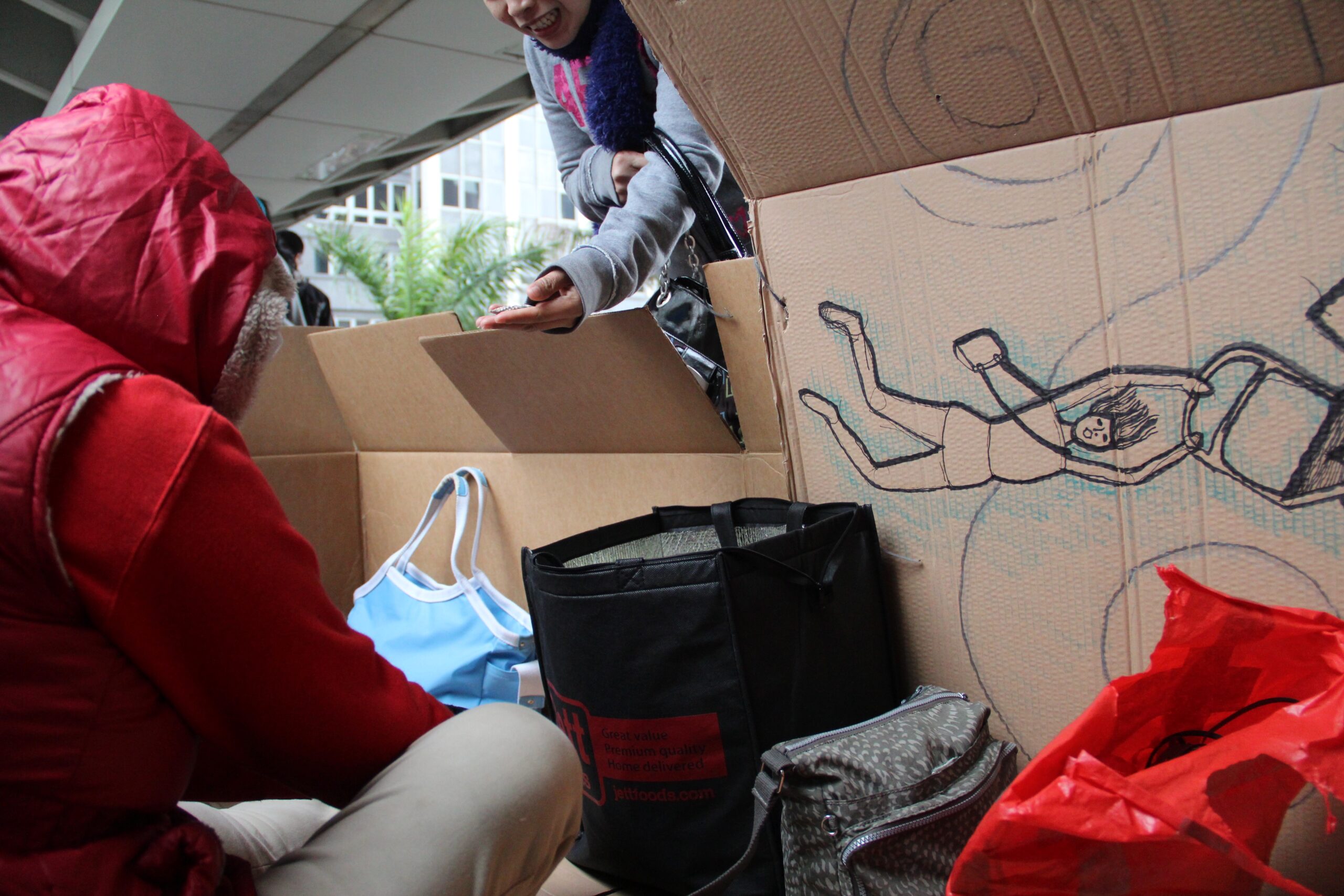
When you were a graduate student, I was still in primary school in Indonesia, where collective behaviour meant being crowded with a hundred other students in the cinema aisles, watching the mandatory film about how then-President Suharto saved the country from communism. My first fieldwork experience was as a videomaker in the development industry, where villagers wondered why they were part of Indonesia if they had no electricity and running water, and the first thing greeting them on shortwave radio each morning was Radio Australia. My interest in objects grew much later, as an artist. In white cube galleries, I see how they tease viewers who have to resist touching and must stay politely quiet. This was why I began doing fieldwork in 2014, when I followed cardboard waste in its informal trade route in Hong Kong, for example: to understand objects in everyday social situations, within their networks of relations.
So, I recognise your insistence on doing fieldwork, as we can only understand how an entity behaves, empirically, in relation to other parts of their environments. This is even more so when we want to understand objects, because they behave only in relation to other parts of their social environments. You might call this kind of approach ecological, but because of the bottom-up model, perhaps it is also similar to what Bruno Latour called a ‘sociology of association’ in his 2005 book Reassembling the Social, which introduced Actor-Network-Theory. You mentioned that in sociology and physics, collective behaviour has also been studied quantitatively, and mathematical models are another crucial part of your study. How do these two methods—deep empirical engagement in the field and abstracted, quantitative modelling—work with each other in your research?
DMG: Mathematical models describe how a system works. To learn more about nestmate recognition, I worked with Fernando Esponda on a model of the system in which ants change their responses to a particular odour over time, depending on their experience. It was known from earlier work that the results of experiments on nestmate recognition are more predictable in larger groups of ants. Our model helped to explain this trend.
The model describes a distributed process that involves interactions among many ants over time, rather than recognition based on a static ID or passport. It predicts that whether an ant reacts to strangers or not depends on its past experience of encounters with many ants. If an ant has never met an ant from another colony, it may accept a stranger. Later, when it has met more ants of other colonies, it may identify the odour of a stranger as different. We can test this model with experiments where we put ants of different colonies together to see if they are aggressive. Past research using experiments like this shows that larger numbers of ants give more predictable results. The model explains why: in a larger group of ants, there are more likely to be some that identify the odour of a stranger. In the same way, a vaccine increases the chance of an immune response to a pathogen because it generates more cells likely to recognise the pathogen as dangerous.
Modelling can also be used as a tool for figuring out what we don’t know. A model can predict what will happen in certain conditions. We can test the model’s predictions. If the reality is different, it means the model is wrong. Asking why the model made the wrong prediction opens the way to more investigation.
TW: Thinking about checking predictions against the reality—or being aware of our own assumptions within the reality of fieldwork—art critic Hal Foster, in his 1995 essay The Artist as Ethnographer?, warns about artists’ positionality when doing ethnography. This call for a respectful and responsible stance urges artists to critically reflect on how their position influences their practice and relationship with the subjects of their ethnographic work. I see a similar kind of responsibility when you alert readers, for example, that the eye of a mammal and that of a crab function differently and evolved along separate trajectories, even if they look similar. This, in turn, brings to mind Jakob Johann von Uexküll’s concept of the Umwelt (1909): just as ants don’t see the world as humans do, humans also don’t see it as ants do.
I understand that you are working with ants to understand how ant colonies function without central control. Your finding, as you discuss in your book and touched upon earlier, that tolerance serves as the baseline for young ants in terms of boundary recognition, also made me wonder. Your and Esponda’s model explains, through a distributed process, why larger ant groups are likely to engage in conflict. Mark W. Moffett (2019), meanwhile, has drawn comparisons between large ant colonies and human societies, particularly in their shared tendency to engage in warfare—comparisons I reference in Memory Is Frail (and Truth Elsewhere) (2024) [Fig. 10]. Let’s risk simplification for a moment: I can suggest that the state’s baseline is not tolerance—it’s the opposite, focused on guarding boundaries. If we assume that tolerance is also a natural baseline for young humans, does this imply that the state operates as an organism of its own?
Where I grew up, I sensed powerful aspects of collective behaviour without central control, yet I can’t deny the presence of the state. My dissertation opens with a discussion of my experience being refused entry at a border, where one of the border officers, acting independently within a rigid system, helped me find a way out. Similarly, in Keiji Nakazawa’s Barefoot Gen, Gen’s father is among those who protested against the war—these are independent forces, like self-directed cells in Michael Levin’s xenobot simulation-driven experiments. But it often feels as though citizens and the state live in different dimensions—different Umwelten, if you will. The government may be made up of citizens, but the state is another entity. I, as a human, can’t directly experience what my cells experience, so perhaps my cells do have their own Umwelt, distinct from mine. Alluding to James Scott’s 1998 concept of ‘seeing like a state’—just as the state may not see the world as its citizens do, citizens may also not see it as the state does. Or am I just trapped in metaphors?
DMG: States, like all social institutions, are complicated. Power, resources, and access to information about what is going on are not distributed equally among people. But a state is not a separate thing, independent of the citizens—it is a network of interactions among people. Citizens are the actors in states. As an artist, you contribute to understanding how collective behaviour works and contribute to our capacity to function as citizens.
TW: But aren’t ant colonies just as complicated? If the queen doesn’t reproduce, the ant colony would cease to exist. Doesn’t that mean that the queen has the highest biological power? Resources are also not distributed equally among ants in a colony. Ants also cannot sense the pheromones of all their nestmates, or the colony’s pheromones, if that exists—doesn’t this mean that access to information about what’s going on are also not distributed equally among the individual ants?
DMG: The queen lays eggs, like the ovaries and uterus in a female mammal are the place where offspring are formed. But neither ant queens nor reproductive organs tell anyone else what to do. Ants respond only to local information, and people have access to both local and more globally spread information. A difference is that in human societies, some people can actively suppress information or provide false information. Ants don’t do that.
Open Access version (including pagination) is available here.
The Interplay of Movement and Memory in the Works of Tintin Wulia
Naoko Sumi
Arriving at the end of the gently curving line of passports that have been affixed to the floor, walls and ceiling of the gallery, you come across an arcade-style claw machine that is filled with handmade passports. The machine invites you to participate in a game of chance; it is uncertain whether you will win a passport at all or, if you do, which country’s passport you will get. This interactive installation work by Tintin Wulia, which is titled Lure (2009) [Fig. 3], was one of the works featured in the special exhibition What a Wonderful World, held in 2012. The exhibition aimed to re-examine our world through the expressions of artists from Asian countries and to inspire reflections on the future. At that time, Wulia was already known for her works using handmade passports that closely resembled real passports from around the world. In preparing for the exhibition, I learned a great deal from her. Her grandfather, she shared, had gone missing during the mass killing in Indonesia in 1965, and her family, being of Chinese descent and a minority in Indonesia, had faced numerous forms of discrimination. Despite holding a government-issued passport, she had encountered various difficulties at immigration in the past. I tried to recall conversations that I had shared with my grandparents when I was little, and to summon memories of past trips, but I had never experienced anything similar. I had a passport issued by the Japanese government even from when I was a student, yet I had never felt any discomfort about possessing a passport with the word ‘Japan’ on it. To me, a passport was merely a convenient certificate that allowed me to travel freely anywhere in the world. Encountering Wulia and her work marked the first time that I deeply reflected on the complex issues caused by the national systems underlying passports, as well as the tragedy that befell Indonesia during a period when post-war Japan was experiencing economic growth. Looking back, I have always felt that I should seek another opportunity to introduce the works of Tintin Wulia.
Twelve years have passed since then. When I organised Wulia’s first solo exhibition in Japan, held in Hiroshima, I recall telling her that I wanted to include not only her recent works but also some of her earlier pieces, essentially making it a retrospective. Her early works as an artist took the form of short films. These films, characterised by their brief duration, were rich in symbols and metaphors. They showcased her intelligence, wit, and humour, as well as her remarkable sense of cohesion, integrating numerous elements seamlessly. Over time, the filmic elements expanded into material-based forms and eventually leapt into spatial dimensions, liberating themselves from the constraints of time. This evolution led to the style that now defines her work, which comprises multifaceted installations consisting of numerous interconnected components. Rooted in themes of movement and border-crossing, Wulia’s art not only explores these ideas conceptually but also embodies them physically within the exhibition space, moving and transcending boundaries.
As you stand at the gallery entrance, a range of vibrant elements will immediately catch your attention. When installing the works in the limited space of the gallery, we focused on the following key points. First, in order not to detract from the sense of ‘openness’ inherent in Wulia’s works, we intentionally created a composition where different works interact, rather than isolating each one. Second, we aimed to design a space where the multitude of ‘connections’ could not only be made more visible but also be experienced directly. By doing so, we sought to intentionally disclose a wealth of information simultaneously. Even when viewers focus on a single piece, they will naturally glimpse other works in their peripheral vision. While it may initially feel overwhelming to process and organise all of this information, but as viewers continue to engage with the exhibition, they will gradually uncover its underlying themes. These include Wulia’s Chinese-Balinese roots and the tragedy that her family endured during the Indonesian mass killings of 1965–66. Using these events and family memories as a foundation, Wulia’s interests expand to explore themes such as migration and border crossings, the experiences of ethnic minorities and discrimination, the formation of identity and belonging, and the distortion of history by state power. Her works also delve into the silence and fear that is imposed on individuals, the trauma that can be embedded in communities, and the conflicts and wars that surround geopolitical borders.
The method with which the installation (Re)Collection of Togetherness (2007–)[Fig. 5] changes iteratively each time it is exhibited; in Hiroshima, the colourful passports were suspended from ‘clouds’ that appeared to represent a cloudy sky. This imagery evokes the ‘black rain’ that fell on Hiroshima after the atomic bombing of the city. Consisting of mud, dust, and soot generated by the explosion, as well as oil smoke from the massive fires that ensued, the black rain is known to have contained radioactive materials. If we view rain as a blessing that pours down from the heavens, it might symbolise a convenient and welcome tool enabling us to move freely around the world. However, if we think of it as the black rain that contaminated vast areas with radioactivity and caused immense suffering for many people, how does that shift our perspective? As mentioned above, black rain refers specifically to ‘toxic rain containing radioactive materials.’ Yet, in a broader sense, it also serves as a metaphor for the invisible horrors and suffering that is caused by war and the indelible scars that it leaves behind. In Masuji Ibuse’s novel Kuroi Ame (Black Rain) (1966), one soldier’s words linger: ‘We wanted to be born in a country without a state,’ as he silently carries decaying corpses that lie before him and throws them into a hole. The passports pouring down from the black clouds covering the upper space of the gallery are not only clear evidence of the existence of nations but also a reminder that some borders cannot be freely crossed and that wars continue to be waged over these borders even today.
The title of the exhibition, Things-in-Common, refers to the way in which a ‘common thing’ can catch an individual’s attention through some kind of trigger (which Wulia describes as an ‘aesthetic object’), or appeal to us in another way. I understand this as a form of encounter. For example, the ‘passport’ becomes a ‘thing-in-common’ through Wulia’s work. Similarly, ‘1965’ also becomes a ‘thing-in-common’ through her encounter with On Kawara’s work Title (1965). In her work Subtext – after Kawara’s Title, 1965 (2019) [Fig. 1], Wulia expands ‘1965’, which Kawara represented as ‘one thing’ across three canvases, into 68 canvases, thereby unfolding both its temporal and spatial dimensions. These canvases traverse the gallery space like migratory birds, crossing over the boundaries of the spaces where other works are installed, moving high above the other works and across the ceiling.
If you look around the gallery again, you will notice that the principle of ‘movement’ applies not only to humans, but also to insects. For example, the mosquito, often believed to travel long distances by hiding in containers and riding on clouds, repeatedly appears in Wulia’s works as a symbol of movement. Another motif is the butterfly, and in particular the Papilio Ulysses, which is found in the eastern part of Indonesia, Papua New Guinea and northern Australia, which is featured in the work Some Memory Unfurls (2023) [Fig. 11]. Butterflies are often seen as symbols of magnificent metamorphosis, transforming from unappealing caterpillars into beautiful, glamorous, winged adults. However, Wulia is particularly intrigued by the process of metamorphosis itself, where, even as the caterpillar liquefies and dissolves into a sludge inside the chrysalis, it retains its ‘memory’. In other words, the butterfly in Wulia’s work serves as a metaphor for ‘memory’. Through the presence of this small butterfly, we are invited to reflect on the (traumatic) memories that are passed down through generations in communities that have been alienated from society and have migrated.
Wulia also observes the principle of ‘movement’ in the cardboard waste (Old Corrugated Cardboard/OCC) that is a ubiquitous sight on the streets of Hong Kong. Cardboard boxes, originally used to safely transport goods, become waste once they have fulfilled their purpose. However, they are not literally ‘discarded’. Collected by waste pickers, OCC is compressed into large, heavy bales and transported to mainland China as material for recycling. After closely observing this cycle, Wulia discovered an ‘unofficial’ trade embedded within the process. Filipino workers (primarily female domestic workers) in Hong Kong would obtain OCC on weekends and use it to construct cardboard houses resembling shelters. Using fieldwork methods, Wulia personally tracked the movement of these cardboard boxes and presented a history of cardboard box migration—rather than ethnic migration—in her video work Proposal for a Film: Within the Leaves, a Sight of the Forest (2016) [Fig. 12]. The cardboard boxes, constantly moving through the streets of Hong Kong and transforming their appearance and purpose at each stage, almost resemble insects undergoing metamorphosis. In this way, Wulia, grounded by her own origins and experiences of movement, expands the application of the principle of ‘movement’, extending it beyond the movement of humans across various scales and historical timeframes to encompass the movement of insects and objects, creating works that embody the encounters and realisations that such movement makes possible.
If we are to discuss ‘memory’, one of the central themes in Wulia’s work, we must address the Memory is Frail series. The first work in the series, Memory is Frail (and Truth Brittle) (2019) [Fig. 8], was followed by Memory is Frail (and Truth Falters) (2023) [Fig. 13]; the third work, Memory is Frail (and Truth Elsewhere) (2024) [Fig. 10], was created as a new work for this exhibition. This series is an installation composed of charcoal and graphite drawings and text, in which the representation of space (geography) and time (history) are woven together in a looping narrative. The foundational question posed by the series is how our understanding of the world is constructed through sight and recorded through memory. Scattered throughout the work are various images, portraying personal memories and familial memories, as well as the memories of others in the form of films and photographs. The work explores how reality is formed through fragmented memories and how knowledge is constructed through the interpretation of perceived reality, ultimately questioning whether truth is established or rendered ambiguous in this process.
In Memory is Frail (and Truth is Elsewhere), which is based on Wulia’s own childhood memories, the artist compares ants to humans, discussing how humans rely on their sense of sight to guide their actions and how the dominance of sight enables them to understand the world even from a distance. If this work appears slightly different from the previous two in the series, it may be because the QR codes are depicted as drawings rather than concrete images. By scanning these QR codes at the venue, viewers are transported to various websites. Although extensive, the websites covered include the following: ‘withdrawal notices’, which revoke the declassification of a document due to its sensitivity, addressing documents exchanged between the US government and the US Embassy in Indonesia before and after the Indonesian mass killings (1965–68); the International Military Tribunal for the Far East (IMTFE, Tokyo Trials) (1946); Japanese language education during the Japanese occupation of Singapore (1942–45); Dutch East Indies banknotes issued by the Japanese government during the occupation (1942–45); the Nuremberg Trials (1946–49); the Japanese military conquest and occupation of the western Aleutian Islands (1942); the Allied occupation and reconstruction of Japan (1945–52); the final report of the International People’s Tribunal (IPT) on the 1965 Indonesian mass killings (with the verdict announced in 2016); Indonesian youth undergoing training during the Japanese occupation (1943); and Burmese banknotes issued by the Japanese government during the occupation (1942–45), among others. These websites contain detailed accounts of Japan’s occupation of various Asian regions, the country’s invasion of the United States during the Pacific War, and other historical events, which are all presented in a matter-of-fact manner. Audiences are transported back to the time before Hiroshima (ヒロシマ) through the pages displayed on the small screens of smartphones. While most people have no personal memories of that time, by encountering external records of past events that they are unfamiliar with, they can undoubtedly learn something new or reaffirm something that they already know. This experience can also trigger the recollection of individuals’ memories. The chain of memory stimulation enables a connection to the memories of someone, somewhere.
It seems evident that dropping atomic bombs on Hiroshima and Nagasaki was not necessary to achiev the aim of bringing a swift end to the war. Similarly, the massacre of communists in Indonesia cannot be justified as a means to create a better national system. Coincidentally, the presence of the great power of the United States is intricately tied to the tragedies that befell both countries. The genocide carried out through the use of nuclear weapons in August 1945 and the Indonesian mass killings, which are said to have started nationwide in October 1965, differ in terms of their time periods, social contexts, and the circumstances in which they occurred. Nevertheless, I propose that we reflect on these events from a humanitarian standpoint, focusing on their shared characteristics. Both were tragedies caused by organised violence perpetrated by human beings; both were clearly influenced by the political power games of major nations; both resulted in the suffering of powerless, innocent, ordinary people; and both continue to evoque deep trauma in individuals and society. How and can we ensure these memories are preserved for future generations without fading into obscurity? Tintin Wulia’s activities and works offer profound insights into addressing this challenge.
Let us once again reflect on the entire exhibition in the gallery. Guided by the intricately layered elements of the works, you will have moved from one piece to another, engaging in a dialogue with each. In doing so, did fragments of your own memories—or perhaps those of others—resurface? As I immerse myself in Wulia’s works, the interplay between memory and movement becomes increasingly evident. Movement generates new memories, which, in turn, inspire further movement. This reciprocal relationship suggests that every experience of movement—or, in a broader sense, the act of ‘moving’—stimulates our senses, thereby reactivating our memories. Through movement, action, observation, investigation, and communication with others, we not only gain new experiences but also inevitably recall past memories, interpreting those memories in new ways that may profoundly alter them. This experience itself becomes a newly recorded memory. Tintin Wulia’s works are etched into people’s memories as instruments that make such interpretations and productions possible.
Open Access version (including pagination) is available here.
Things-in-common and the aesthetic reassembling of identities: moments, momentum, and change
Tintin Wulia
What are ‘things-in-common’? Put simply, things-in-common are objects during moments when they contribute to communal connection through an aesthetic reassembling. This simple definition easily raises further questions though: What do I mean by ‘objects’? ‘Moments’ suggests both a temporal and situational nature—what do I mean by these moments? What do I mean by ‘communal connection’, and what is ‘aesthetic reassembling’? While I can’t answer all these questions thoroughly in a brief essay, I will start exploring them here.
Context is where I begin, and this exhibition provides much of it. My understanding of things-incommon developed gradually through experiences of making and exhibiting, so it is naturally embedded in my body of work. However, moments of clarity—social encounters that are to varying degrees political—have driven my understanding forward. To address the questions above, I will describe three such encounters in this essay: the first during a residency in
Yogyakarta in 2008; the second in 2014, while initiating the workshop-performance Make Your Own Passport in Windsor in Canada and Detroit in the US; and the third in 2016, on the informal cardboard waste trade route in Hong Kong. Seeing things-in-common as objects during moments of change, I draw on earlier writings and previously undiscussed details to highlight these moments’ potential to build momentum for further change.
The first encounter, in 2008, was during a residency at Cemeti Art House in Yogyakarta. Among other works, I began The Great Wallpaper (2008-), a series of giant, blue watercolour murals of my family’s legal documents. These were documents I grew up with—objects I was taught to prioritise if and when the house burned. In other words, they were second only to our survival— our ‘bare lives’. These documents set us apart from society against our will and were nothing to be proud of. Understandably, we kept them close, locked away, and only brought them out when required by government officials. As objects, their social network is limited—their route simple, moving only between our homes and bureaucratic offices. Perhaps because of this, they exposed us to a precarious, albeit unspoken, power dynamic with respect to our relation to the nationstate.
Seeing them as giant murals, I thought, would create a striking contrast to this unspoken reality. That was why I did it: I imagined it would stir something in me, and perhaps in others too. My intention was simple—to communicate in the most basic sense: to make something common. This communication turned out to also provoke the work’s viewers, generating moments of communal connection, as their responses confirmed. As I have mentioned elsewhere, filmmaker Edwin— whose early work also explored Chinese-Indonesian issues—remarked that seeing the mural was the first time he had seen these documents.1 It wasn’t that his family didn’t have them—rather, his parents had shielded him from the humiliation of proving their rights as citizens, whenever the documents were requested.
The response from Yanto—not his real name, as I have noted before—the night guard at the gallery, had a greater impact on my understanding of things-in-common. When I was finishing up these works, he struck up a conversation after insisting to help.2 He said his family had the same documents. I was puzzled at first—I wouldn’t have assumed that Yanto was Chinese-Indonesian and thus required to carry an ‘SBKRI’ (Surat Bukti Kewarganegaraan Republik Indonesia, or Proof of Citizenship of the Republic of Indonesia) or a name change certificate. Soon, however, I realised that he was referring to another document that similarly separated his father from society because of the anti-communist pogrom since 1965. Like Edwin’s parents, Yanto’s father had withheld the details, but the consequences were undeniable. Yanto only discovered the existence of the document when it led to the cancellation of his much-needed high school scholarship. Like my family’s case, this document placed his family in a precarious power dynamic with respect to the state, because his father was an alleged communist.
My conversation with Yanto made me realise that my Chineseness is not separate from being Indonesian—it is inherently a part of it. That we were marginalised, like some other Indonesians, simply meant that our existence was crucial in defining what being Indonesian was. Without The Great Wallpaper, I wouldn’t have experienced such a shift in my understanding. We can describe this process through Rancière’s term ‘distribution of the sensible’, whereby art makes something hidden visible and speakable, thereby changing our perception of the current reality.3 However, Rancière doesn’t deeply discuss how this distribution occurs—a gap that my hands-on work with art allows me to address by engaging with its micro-mechanisms as they emerge in practice. The first aspect of this process involves what Susan Leigh Star calls a ‘boundary object’—a ‘sort of arrangement that allow[s] different stakeholders to work together without consensus.’4 I will discuss objects, boundary objects, and things-in-common further in the following paragraphs, before addressing a second aspect of these micro-mechanisms: namely, how this boundary object became a thing-in-common between Yanto and me, through an aesthetic reassembling.
What is an ‘object’? Star defines an object as ‘something people […] act toward and with.’5 A thingin-common, rather, is something we interact with and through. For Star, an object’s materiality ‘derives from action’,6 whereas a thing-in-common materialises through interaction, and ceases to exist when that interaction ends. This is what I mean when I say things-in-common are objects during particular moments. A physical object may take on the identity of a thing-in-common at one point in time, and something else at another. Judy Attfield’s ‘wild thing’, for example, refers to an object that ‘escape[s] the boundaries of categorisation.’7 Such an object physically remains unchanged but can function as a boundary object or a thing-in-common, depending on its relational network—which is, after all, how objects behave: in relation. Star contrasts objects with ‘prefabricated things’—and here language can get a bit confusing. Jane Bennett, by contrast, uses the term ‘things’ to emphasise their independence from subjects in her discussion of vibrant matters. Drawing on W. J. T. Mitchell, Bennett views objects as ‘the way things appear to a subject—that is, with a name, an identity, a gestalt or a stereotypical template.’8 So, freed from the association with subjects, Bennet’s things can be seen somewhat as emancipated objects— vibrant and dynamic without pre-established identities or stereotypes.
However, we can think of objects as emancipated without severing their relational ties. Unlike Star’s prefabricated things, which are stabilised within systems, or Bennett’s things as independent objects, things-in-common emphasise the centrality of relations and interdependence. The notion of things-in-common highlights how objects’ shifting identities result from the relational assemblage that they participate in. Identity, as Stuart Hall argues, is always relational—this applies to objects as much as humans. Just as interactions reveal different aspects of humans’ identities, an object’s role shifts according to its social circumstances. Grammatically, objects can even become subjects, taking on central roles around which other elements revolve.
The documents above, for example, began as objects—state representatives, Yanto, and I acted toward and with them. As relational objects, their behaviour shifted depending on who engaged with them. For state representatives, they functioned as instruments of control within a bureaucratic system. For my family, however, these documents were tied to our ‘bare lives’— although we’d rather not have them, they were essential to our survival. They were boundary objects: despite these differing perspectives and the lack of consensus, they perpetuated ritual power dynamics, even when the participants understood them in fundamentally different ways. In The Great Wallpaper, I approached these documents aesthetically, aiming to evoke specific imagination and emotions in viewers by representing them in subtle blue watercolour on the white gallery walls. When Yanto first saw the work and helped me move the ladder and the projector that I was using, the murals may have functioned as a boundary object—we worked together even without exchanging words, let alone reaching consensus, about the object that was central to our interaction. However, the durational performance of creating the work provided Yanto and I with a space to renegotiate each other’s memory, imagination, and the emotions that the work stirred. This aesthetic experience sparked a long conversation that led to a new understanding of the documents as a precarious tether to state representatives. At this point, the boundary object morphed into a thing-in-common for Yanto and me, through a shared aesthesis.
What is ‘aesthesis’? Aesthesis refers to the process of sensory engagement and perception, the core of what we call aesthetics. As Ben Highmore reminds us, the idea of aesthetics is best understood in relation to its antonym, anaesthetics—the substances used before a surgery to desensitise us.9 I will discuss aesthetics through the second encounter, during a residency with the Art Gallery of Windsor. I began staging the workshop-performance Make Your Own Passport (2014-) in the two bordering cities of Windsor and Detroit, in Canada and the US respectively, where I built upon my long-standing explorations of passports as aesthetic objects—a motif in my work since the early 2000s. By ‘aesthetic object’, I mean a material entity that captivates the senses through an immaterial excess—symbolically condensed social meanings beyond its material form. These objects act as binders of imagination and emotions. Imagination, as Benedict Anderson suggests, enables us to envision collective identities, and is central to his concept of imagined communities.10 Meanwhile, emotions, as Sara Ahmed argues, ‘stick’ to objects as they move and circulate in social contexts.11 Both imagination and emotions are closely tied to memory and meaning-making processes. As they bind imagination and emotions, aesthetic objects are inherently political. They attract people through their implied meanings, which exceed what is immediately visible. As individuals draw interpretations from their varied cultural backgrounds, aesthetic objects become powerful platforms for renegotiating perspectives.
For (Re)Collection of Togetherness (2008-) [Fig. 5], a series of site-specific installations shown in stages, I have been imitating an ever-growing number of passports from around the world. Noticing the way in which viewers struggle to resist touching this iconic object within the white cube’s unwritten rules, I have incorporated touch into my passport works. In Lure (2009) [Fig. 3], an installation featuring an arcade-style passport claw machine, viewers were invited to play for a chance to win a passport that they could take home. Observing how viewers flocked to exchange opinions and tips on winning, I extended my method into performance as the next natural step. By 2014, I had also developed a deep interest in the role of aesthetics in everyday life. Following Jeffrey Alexander’s cultural pragmatics,12 the white cube’s social scripts differ from those of everyday life. We know that we’re not supposed to do or say certain things in a white cube, even in participatory artworks. Make Your Own Passport attempted to see how these aesthetic objects behaved outside of the white cube.
Designing the workshop-performance for public places where people are visually engaged, actively looking for things—such as markets—allows the iconic assemblages of colourful passport-making kits to act as visceral portals, catching the attention of unsuspecting passersby. During one of my first stagings, as I have described previously,13 a man barged into our booth in a Downtown Farmers’ Market, clearly enraged. We had rows and rows of passport assembly kits on one of the folding tables, and some participants making their own passports were having conversations around their new, randomly assigned citizenship and statelessness. The man saw us from a distance and rushed in aggressively. Others in the booth understandably shied away, but I felt responsible, as the creator, to engage. As the man raised his voice, his face became flushed. He angrily pointed at the passports and accused me of smuggling people across the border—one that, quite fittingly, was just a ten-minute walk away. This border separates the city of Windsor in Canada, with its superior social security system, from the bankrupt city of Detroit in the US. Another appropriate mise-en-scène complementing this social performance—drawing on Jeffrey Alexander’s framework14—is the celebrated history of the Underground Railroad in the area, which helped enslaved African Americans escape to freedom in the early-to-mid nineteenth century—this secret network could also be seen as a form of ‘smuggling’.
I resorted to a typical answer to calm the man down: ‘This is an art project.’ At first, this didn’t seem to work. He raised his voice, questioning, ‘How can this be art?’ Having struck me with this, he stormed off in a fury. My encounter with Yanto allowed for a long conversation, but this encounter was brief. It was nevertheless emotionally intense, filled with imagination and assumptions that unfolded through metaphorical cultural scripts. Essentially, to my implied
‘Don’t worry, it’s harmless,’ the man protested, ‘Why did it disturb me, then?’ (a relevant question): his rage was a result of an aesthesis, or sensitisation. Seeing the ‘passports’ in this context triggered him emotionally, differently from if it was in a white cube. The ‘passports,’ initially a boundary object, momentarily transformed into a thing-in-common, reflecting a shift in our memory, imagination, emotions, and identities.
In Stuart Hall’s framework of identity production—the necessary and the impossible—the necessary ‘discovers’ the common historical experiences. However, a fully constituted identity, distinct in place of another, is impossible.15 As Lawrence Grossberg explains, ‘[i]dentities are always relational and incomplete.’16 Donna Haraway’s post-anthropocentric framing is complementary: ‘Any objects or persons can be reasonably thought of in terms of disassembly and reassembly’.17 This disassembly-reassembly is embraced in things-in-common’s micromechanisms. Provoked by this object in the assemblage, the man directed his anger at me, a stranger he held responsible for disassembling something in himself. His question, in turn, also reassembled something in me. I call this aesthetic reassembling, mediated by two key elements: the aesthesis, and the evocative thing that produces it. The thing didn’t only generate aesthesis—it further connected me with another actor. We become participants as the thing shifted to become an interface. Through this interfacing, associations can be traced, and identities reassembled. This aesthetic reassembling of identities is what shifts boundary objects into things-in-common.
As far as Make Your Own Passport shows how aesthetic objects behave in everyday life, it is important to note that they were objects that I had created. Even though I brought them into everyday life, I remained a host in the constellation—as I have discussed elsewhere.18 What would happen if I was a guest instead? To further discern the role of aesthesis in the micromechanism of things-in-common, I took my aesthetic objects out of the equation in a study in Hong Kong, Trade/Trace/Transit (2014-16) [Fig. 14].19 There, I looked for a ‘naturally existing’ object in everyday life that could be a boundary object. Cardboard waste—prominent and distributed across the city—suited the criteria. The multiple locations hinted at mobility—a route; nodes; a network—and the actual movement of the cardboard waste being delivered to recycling points by waste collectors confirmed it. This is where I will contextualise the third encounter where I, a guest who became a participant of this network, witnessed the other participants’ moments with things-in-common, after two years of engaging with the informal trade route.
As I followed the cardboard waste, I saw how it entered different worlds in the different nodes along the informal trade route: at the shop it was waste, then a recycling commodity on the waste collectors’ trolleys; once it entered the Filipino domestic workers’ node where they spend time in the weekends, it became material for shelter; after shapeshifting again, it returned to the state of being a recycling commodity. My host-mentor, Ate Manang, as I came to call her, understands this regimes of value well: when I drew the port on our cardboard shelter’s walls, and explained that the things loaded on the boats were the very cardboard that we sat in, compiled into bales to be transported to recycling facilities in mainland China, she asked ‘how much is it sold for there?’
Arjun Appadurai’s description of this shift in the significance of an object as it enters different regimes of value is widely cited.20 However, micro-shifts into things-in-common occur over a much shorter timescale—sometimes within seconds, as instantly as the response of that angry man in Windsor—through the hands-on act of creation. The moment I began drawing on the cardboard waste, its material—and immaterial—identities began shifting. As my first host group remarked, ‘It now feels like wood’, or ‘like curtains.’ With the ‘murals’, the cardboard shelter transformed: ‘It feels like a living room now.’ What had merely shielded us became, through aesthesis, a gift imbued with imaginal and emotional meanings—so much so that one of my hosts requested to keep it, to ‘warm’ her tiny ‘cold room’ at her employer’s house. In the next node, my drawings on the cardboard waste sparked questions and conversations that, over time, made recycling workers aware—for the first time in a decade—of Filipino domestic workers at another point on the route. As Karen Strassler observed in her discussion of image-events, images transcend barriers more readily than texts, capturing shared attention from people with vastly different backgrounds.21 The desensitisation shaped by monotonous labour and structural power dynamics had previously limited the possibility for workers to notice broader connections. However, amid the recycling point’s fast-paced workload, a bale worker, noticing how my drawings had evolved from decorative to narrative, eventually paused at a node they didn’t recognise, and asked, ‘Who are these women? Where are they? What are they doing?’
Through these drawings, the cardboard waste was sensitised, becoming a thing-in-common that opened new potentials of an imagined community. This remarkable shift in how the workers understood the route they had been part of for so long was sparked by an aesthetic shift in their everyday object. This process is a micro-mechanism for Rancière’s distribution of the sensible, where aesthetics reassembles things-in-common, which reorganises relations. While Star’s boundary object tends to be disinterested in commonality, a thing-in-common reorganises social topology by deliberately bringing differences together through aesthetic reassembling.
One question remains: How does this all relate to change? Early in this essay, I mentioned things in-common as objects during moments of change. Their in-commonness aligns with Jean-Luc Nancy’s ‘being-in-common’,22 Bruno Latour’s network,23 and Deborah Gordon’s collective behaviour 24—it is an infinite process that needs to be constantly performed to exist.25 This constant performance may build momentum for a potentially larger scale change. If things-incommon gain and maintain momentum, they may become more similar to Strassler’s imageevents, which are political processes—dynamic objects—that carry multiple meanings, unfolding over time in a network of interconnected occurrences.26 After I stopped drawing on the cardboard shelters, the cardboard waste shifted back into being a boundary object. As for the passports made during Make Your Own Passport: participants brought them home as mementos, allowing them to keep forging new relations. As part of Butsu-butsu Ko-kan (2024-) [Fig. 15], a participatory work by Thingstigate in this exhibition, one of the passports from Lure was put back to swap, twelve years after it was acquired, and was soon taken by another participant. Meanwhile, the memory of all my encounters persists within me—and through this essay, some may travel with you too.
Open Access version (including pagination) is available here.
Footnotes
- T. Wulia, The Name Game, or, the Years of Living with No One to Blame, Inside Indonesia, October 12, 2008,
https://www.insideindonesia.org/the-name-game.↑ - Ibid.↑
- J. Rancière, The Politics of Aesthetics: The Distribution of the Sensible (London: Continuum, 2006).↑
- S. L. Star, ‘This Is Not a Boundary Object: Reflections on the Origin of a Concept’, Science, Technology, & Human Values 35, no. 5 (September 2010): 601–607.
https://doi.org/10.1177/0162243910377624↑ - Ibid., 603.↑
- Ibid.↑
- J. Attfield, Wild Things: The Material Culture of Everyday Life (Oxford & New York: Berg, 2000), 74.↑
- J. Bennett, Vibrant Matter: A Political Ecology of Things (Durham: Duke University Press, 2010), 2.↑
- B. Highmore, Ordinary Lives: Studies in the Everyday (London: Routledge, 2011).↑
- B. R. O’G. Anderson, Imagined Communities: Reflections on the Origin and Spread of Nationalism (London: Verso, 1991).↑
- S. Ahmed, The Cultural Politics of Emotion (New York: Routledge, 2004).↑
- J. C. Alexander, ‘Cultural Pragmatics: Social Performance between Ritual and Strategy’, in Social Performance: Symbolic Action, Cultural Pragmatics, and Ritual, eds. J. C. Alexander, B. Giesen, and J. L. Mast (Cambridge: Cambridge University Press, 2009), 29–90.↑
- T. Wulia, ‘How Things-in-Common Hold Us Together’, Antennae: The Journal of Nature in Visual Culture Summer V2, no. 55 (2021): 35–52.↑
- Alexander, ‘Cultural Pragmatics’.↑
- S. Hall, ‘Cultural Identity and Diaspora’, in Identity: Community, Culture, Difference, ed. J. Rutherford (London: Lawrence & Wishart, 1990).↑
- L. Grossberg, ‘Identity and Cultural Studies: Is That All There Is?’, in Questions of Cultural Identity, eds. S. Hall and P. du Gay (London: SAGE Publications Ltd, 2011), 87–107.↑
- D. Haraway, ‘A Cyborg Manifesto: Science, Technology, and Socialist-Feminism in the Late Twentieth Century’, in Simians, Cyborgs, and Women: The Reinvention of Nature (Routledge, 2013), 149–181.
https://doi.org/10.4324/9780203873106↑ - T. Wulia, ‘How Things-in-Common Hold Us Together’.↑
- T. Wulia, ‘Trade/Trace/Transit’, 2016,
https://www.tintinwulia.com/tradetracetransit/.↑ - A. Appadurai, ‘Introduction: Commodities and the Politics of Value’, in The Social Life of Things: Commodities in Cultural Perspective, ed. Arjun Appadurai (New York: Cambridge University Press, 1986), 3–63.↑
- K. Strassler, Demanding Images: Democracy, Mediation, and the Image-Event in Indonesia (Durham: Duke University Press, 2020).↑
- J.-L. Nancy, ‘Of Being-in-Common’, in Community at Loose Ends, ed. Miami Theory Collective, trans. J. Creech (Minneapolis: University of Minnesota Press, 1991), 1–12.↑
- B. Latour, Reassembling the Social: An Introduction to Actor-Network-Theory (Oxford: Oxford University Press, 2007).↑
- D. M. Gordon, The Ecology of Collective Behavior (Princeton, NJ: Princeton University Press, 2023).↑
- T. Wulia, ‘Aleatoric Geopolitics: Art, Chance and Critical Play on the Border’, RMIT University Research Repository, 2013.
https://researchrepository.rmit.edu.au/esploro/outputs/doctoral/Aleatoric-geopolitics-art-chance-and-critical/9921861425001341?institution=61RMIT_INST↑ - K. Strassler, Demanding Images.↑