This essay unfolds through the interplay between fragments of a performance-lecture and theoretical reflections on archives, narrative and fabulation. Articulating the use of photography, film, performance and archival appropriation, the text probes the potential of fabulation as a method to create a performative narrative that understands archives not as stable repositories, but as a notion that needs to be constantly (re)activated.
Focusing on my research for the development of a piece that delves into a story that intertwines archival gaps and mineral exploitation in Brazil, I suggest that performance-lectures can be an ideal medium for the construction of a narrative through fabulation, while also setting in motion the performative quality of archival materials. Engaging with Saidiya Hartman’s concept of “critical fabulation”, I juxtapose memory and oblivion, history and imagination, images and words in the making of a performative narrative that stems from a long story of absence shared by my own family. Moreover, I approach fabulation as a way to transcend the dichotomy between fact and fiction, aligning with Hartman’s call to search for other narratives through archival exploration. This also allows for interrogating whose histories are worth preserving and whose are erased in the writing of history.
By examining the echoes of Brazil’s “gold fever” through archival silences and omissions, I demonstrate how fabulation can serve rethinking the power of archives and critically reimagining history as well as confronting erasures in personal and collective memories. By activating a performative approach to archives, this essay reveals how performance-lectures can become powerful tools for fabulating, challenging official history and embodying alternative narratives.
He who seeks to approach his own buried past must conduct himself like a man digging. Above all, he must not be afraid to return again and again to the same matter; to scatter it as one scatters earth, to turn it over as one turns over soil. For the “matter itself” is no more than the strata which yield their long-sought secrets only to the most meticulous investigation.
—Walter Benjamin[1]
The dead turn those who remain into story makers.
—Vinciane Despret[2]
Note to the Reader
Rather than separating analysis from artistic practice, this essay deliberately moves between critical reflection and doing. Fragments I, II, and III are excerpts from a larger performance-lecture and should be read as both a script and a record of a narrative constructed during the performance. These fragments are interwoven with sections that expand theoretically on the questions emerging from my research process.
I
On 22 December 1981, the law establishing Rondônia as one of Brazil’s 26 states was enacted. The celebration, however, was postponed to the beginning of the following year.
On 4 January 1982, over 10,000 people gathered in front of the Palácio Getúlio Vargas, the seat of the government at the time, to celebrate Rondônia’s elevation to statehood. Despite the heavy rains of the Rondônian winter, the crowd did not disperse and for the first time witnessed the raising of the state flag.
Designated a federal territory in 1943—when it was still called the Territory of Guaporé, named after the river—Rondônia was one of the last areas colonised by the Portuguese. The name Rondônia pays homage to one of the so-called “pioneers” of northern Brazil, Marshal Cândido Rondon.
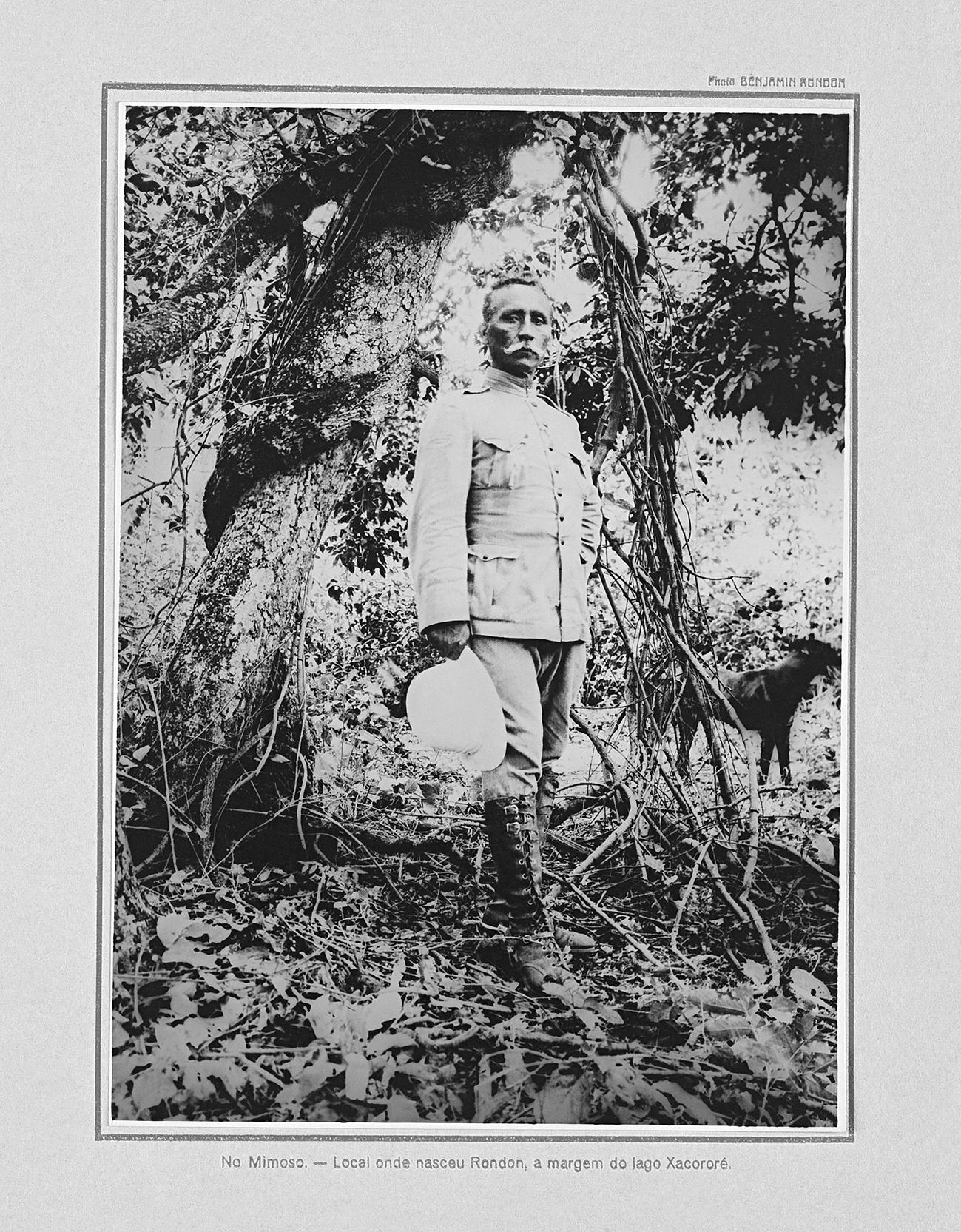
Between 1910 and 1950, Rondon was such an emblematic figure that his name was bestowed upon streets, squares, buildings, museums, an airport, as well as the cities of Marechal Cândido Rondon, Rondon, Rondonópolis and Rondon do Pará.
Rondon became not only known for making contact with various Indigenous ethnic groups and advocating for the creation of the Brazilian Indian Protection Service (SPI)—the precursor of the National Foundation of the Indigenous People (Funai)—but also for charting the region’s rivers and conducting geographical and geological surveys, such as the one undertaken between 1913 and 1914.
This expedition, which followed the course of the River of Doubt, one of the tributaries of the Madeira River, was conducted together with former US President Theodore Roosevelt.
After the journey, the river, whose course had been unknown until then, unfortunately lost the poetry of its name and today is known as the Roosevelt River.
On 5 May 1982, the Rondônian newspaper Alto Madeira reported that “Communications Day”—a commemorative date that coincides with Marshal Rondon’s birthday—was being celebrated across Brazil.
This coincidence is not accidental.
After all, it was Rondon who was responsible for installing telegraph lines throughout Brazilian territories, enabling communication between cities from the north to the south of the country.
It was also in 1982, between September and October, that a prospector from Catas Altas, a small city in southeastern Brazil, travelled to Rondônia and stopped communicating with his family. The silence lingered for a long time.
Long enough for suspicion to take hold.
Long enough to prompt the writing of a letter I would find in my father’s archive 32 years later.
Left by my father, who passed away in 2004, this material remained untouched by me—or anyone else—for ten years, until I finally decided to face it.
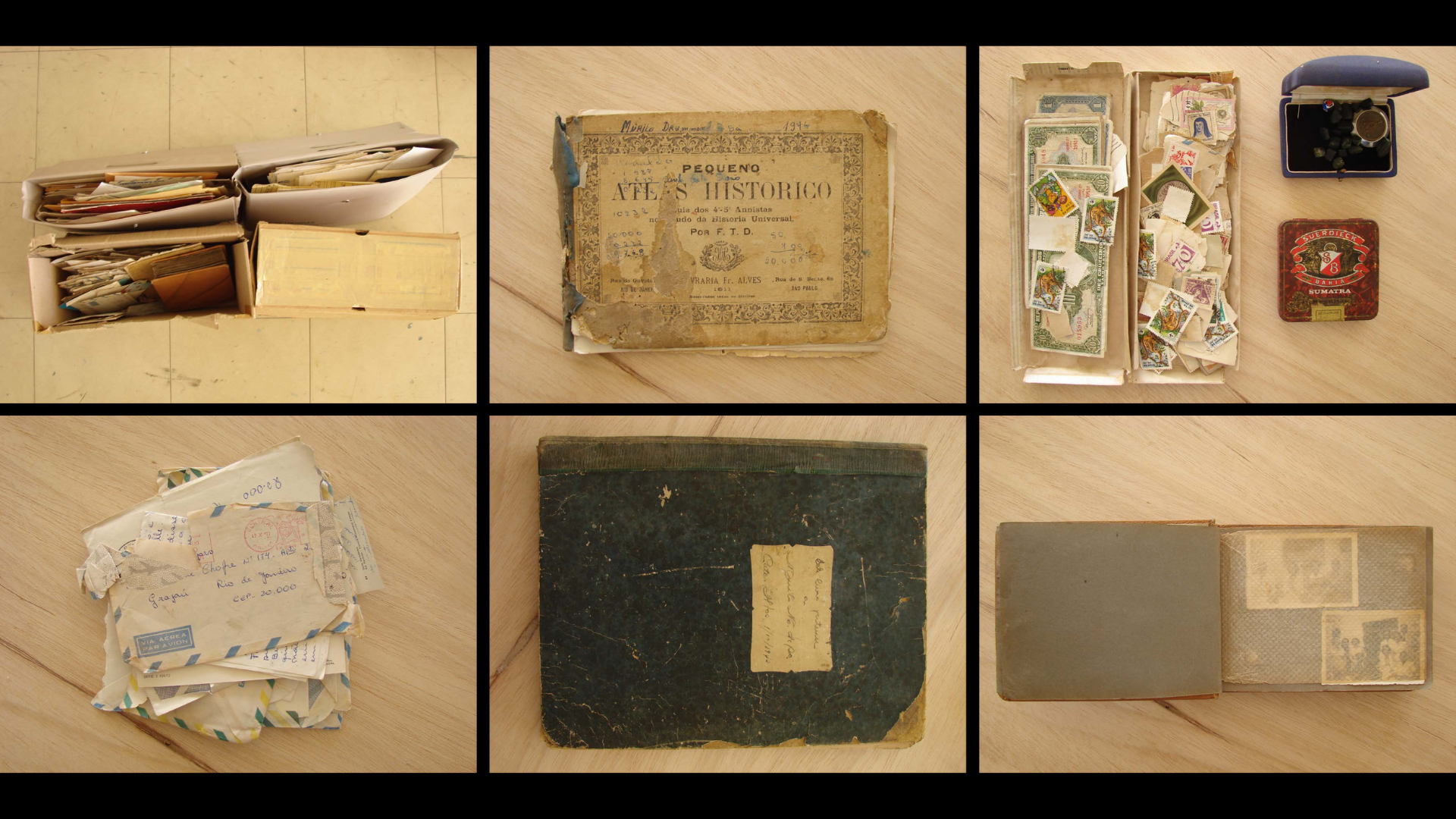
In this dive, I discovered a profusion of photographs, family albums, letters, postcards, telegrams, books, vinyl records, small collections of stamps and banknotes, some memorabilia and stones—yes, stones.
There was also this special stack of light-green ruled paper from which I tried to understand what happened—not to my father, but to a man who travelled to the north of Brazil and never returned.
The letter consists of six pages covered front and back.
A letter never sent now resting in this archive,
or perhaps it is only a draft,
I will never know for sure.
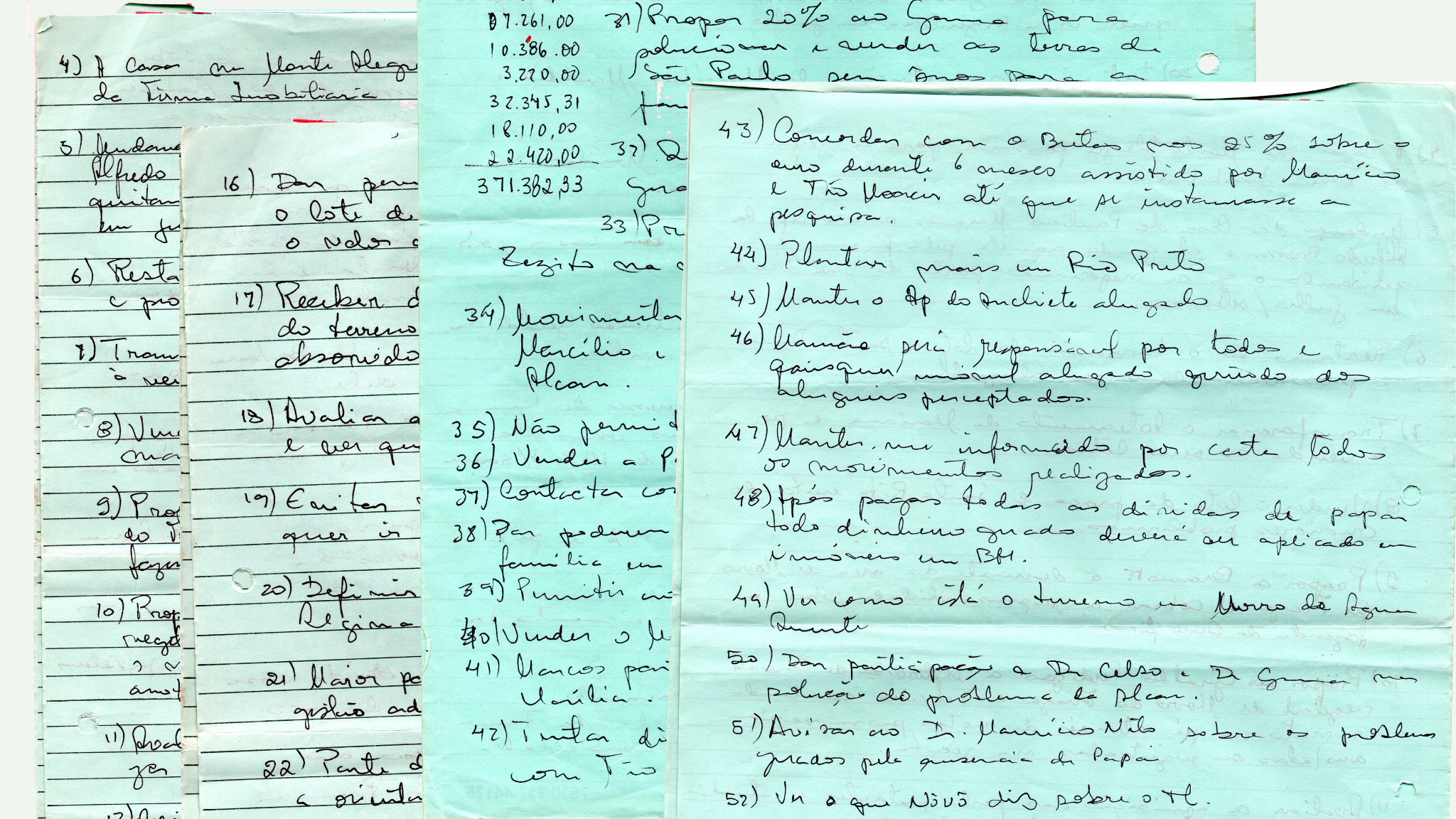
The header indicates that it was written on 25 January 1982.
In the opening lines, the sender greets everyone:
he asks for his mother’s blessing,
sends a longing kiss to his wife,
blesses the baby (not yet born),
and greets his sisters, brothers and brother-in-law.
The letter is unsigned, yet at this point I can say with some certainty that it was written by my father.
One detail hooks me: not the fact that this same father was speaking to an unborn child—as addressing a baby still in the womb seems to me a parental compulsion—but the date.
There is an inconsistency between the year marked on the letter and the birth of his first child, my brother, in March 1983.
There is a year’s gap between ink and birth.
Perhaps it was a simple January slip of the pen, with the old year’s ghost lingering. Or perhaps the discrepancy points elsewhere, or more precisely, to the very subject that motivated the letter:
a missing father.
Despite the sender’s attempt at clinical detachment—
with 55 instructions for his family regarding debts,
a lawyer’s name,
a reference to a “homologated document” that raises more doubts than answers
—the letter remains disconcerting and unsettling.
I wonder if such a document can be considered proof of absence, given that no other records of this disappearance exist. There is no police report, nor a death certificate. Beyond these pages, which effectively explains nothing, I know little about what happened. The biggest and most profound gap in my father’s archive was the story of my father’s father.
A man I never knew—an absence that preceded me.
Archives and Narratives: Moving Past Binarism
The fragment presented above do not merely illustrate a personal story, it exposes the unstable nature of an archive. Even though it has a dictionary definition and attributes established in archival manuals, the “archive” remains a term difficult to delineate.[3] Commonly seen as a repository of the past, archival records are used to register and preserve facts, either in their personal and familiar form or as collective and institutionalised ones. But what emerges from these materials is not an unquestionable narrative, even if a belief surrounding its neutrality and objectivity has taken hold and spread over the centuries.
Although it has its origins in the eighteenth century, it would only be a century later, when technologies of control began to produce an ever-growing volume of information, that the public archive ceased to function merely as a repository of legal titles and came to be understood as the place to which historians turn in search of “sediments of time itself”.[4] Driven by a positivist conception of science and a certain obsession with time, the nineteenth century came to be marked by a belief in the supposed neutrality of the archivist, even as the definition of what could be considered a document expanded. The archive came to be seen as a site for the storage of information and historical research, becoming a place of reverence for time, memory and the notion of linear history. For art historian Sarah Callahan, it is therefore no coincidence that History as a modern discipline and the archive share a common past.[5]
In Staging the Archive, Ernst van Alphen approaches the transformation of the place given to narratives in Western society over time, linking it primarily to the ascent of the archive as a dominant symbolic and cultural form.[6] From myths and religious texts providing narratives essential for the comprehension of life, passing through Renaissance novels and their influence on the (trans)formation of the notion of identity, Van Alphen eventually arrives at the postmodern condition discussed by Jean-François Lyotard.[7]
For the French philosopher, the decline of grand narratives, or more precisely, the scepticism towards metanarratives that attempt to account for the explanation of the world in a single story, would be linked to the scientific, cultural and social changes that occur with the rise of computerised society. As the author points out, the circulation of technological information “is already changing the way in which learning is acquired, classified, made available, and exploited.”[8]
Lyotard was not, however, the first to notice the decline of narrative as a form of knowledge transmission, or the “crisis of narratives” as he himself labels it.[9] A few decades earlier, Walter Benjamin had already pondered this issue. In “The Storyteller”, the German author suggests that, like wisdom itself, the narrative act was in decline, and that this was the reflection of a long process that would be further accelerated by the impacts on everyday life of capitalism and its technologies.[10] In the 1930s, when Benjamin wrote his text, European society was undergoing profound transformations instigated by World War One, which, for the philosopher, played an indispensable role in what he identifies as the loss of experience and, consequently, the capacity to narrate it.[11]
The decline of the experience of narration and the narration of experience are, in reality, two sides of the same Benjaminian concern, which I will here not expand on. For now, it is enough to recall that, as the author states, the mode of transmitting experience, or “the ability to share experiences”, was precisely one of narration.[12] For Benjamin, it is shared experiences, passed from person to person, especially through oral stories, that become the source for the best narrators. After all, Benjamin reinforces, “the storyteller takes what he tells from experience—his own or that reported by others. And he in turn makes it the experience of those who are listening to his tale.”[13]
With the scientific and technological advances of the twentieth century, communication occurs increasingly on a larger scale and at greater speed—a rhythm profoundly at odds with the transmission of narrated experience. This made it even easier to circulate information about events in an “objective”, explanatory and commonplace manner, leaving little space for interpretation or the imponderable, something that, for Benjamin, indeed profoundly affected the experience of narrating. With the technological developments of the capitalist system, time itself also becomes an economic measure, so that the time required for transmission in the Benjaminian sense no longer finds its place.[14]
If the emergence of new techniques for circulating and storing information was sufficient to support the paradigm shift proposed by Lyotard, it seems no coincidence that he, like other thinkers, positioned narrative and the database system on opposite sides of the same dispute—a system which, as Van Alphen reminds us, is nothing more than a contemporary archival model. From this perspective, “whereas the role of narrative is declining, the role of archive, in a variety of forms, is increasing.”[15]
Important shifts can also be observed in the ways in which contemporary society engages with archival memories rather than oral transmission—which does not depend on a written documents as much as on a “repertoire of embodied practice/knowledge”— and this distinction is insightfully discussed by professor Diana Taylor, especially regarding the notion of performance in both social and artistic fields.[16] As she suggests, the repertoire is a non-archival system of transferring knowledge[17], one that requires us to move beyond writing and to considering the body as a means of learning, storing and transmitting verbal and non-verbal practices. The repertoire is, thus, composed of embodied memories and behaviors that are passed down through generations with the learning and repetition of gestures, oral stories, songs, dances, reinforced actions and cultural performances which are ritualised, formalised and reiterated over time[18].
For Taylor, this dichotomy is not (only) based upon the materiality of archival documents and images versus the supposed ephemerality of spoken language, dance, rituals etc., but also related to how societies have valued either as forms of knowledge production. After all, from the moment it becomes possible to transmit information and to store and hierarchise it—first with the aid of the written word and later information organisation data—the notion that knowledge transmission occurs through narratives seems relegated to forms of traditional knowledge often excluded from the contemporary scientific episteme. As the American author observes, “[e]ven though the relationship between the archive and the repertoire is not by definition antagonistic or oppositional, written documents have repeatedly announced the disappearance of the performance practices involved in mnemonic transmission.”[19]
In light of this paradigmatic shift, Van Alphen argues that the narrative’s symbolic form takes on a more modest role in culture, or, in other words, the narrative “is no longer the encompassing framework in which all kind of information is embedded, but the other way around. It is in the encompassing framework of archival organizations that (small) narratives are embedded.”[20] We must therefore consider how the archive reshapes how contemporary society deals with the production and transmission of narratives and their meanings, as well as how our own identity is constructed.
On the other hand, Van Alphen suggests that this loss of credibility of grand narratives did not completely erode the role of narrativity, but rather, it opened up space for the emergence and coexistence of a multiplicity of small stories.[21] These “minor” narratives, however, function rhetorically, which means that their value lies not in the truth they transmit but in their performativity.[22] Within this framework, the emergence of the archive contributes to a shift in how we engage with the past, memory and history—collectively and individually—as well as with the modes through which knowledge is narrated and transmitted.
While my aim is neither to oppose written and oral forms of cultural transmission nor to treat the notion of the repertoire and the idea of “minor” narratives as equivalents, it does not seem accidental that within a logocentric society, common sense would favour the written, archival form of knowledge to the point of forgetting to ask, as Taylor does, “[w]hose memories ‘disappear’ if only archival knowledge is valorized and granted permanence?”[23]
Might it not be productive, then, to consider the archive’s potential agency in relation to the production of these small narratives? And, at the same time, to overcome this rift between the archive and the repertoire? Rather than understanding them as mutually exclusive or one supplanting the other, we might instead approach the archive as a site (not merely a physical one) to be entered for the purpose of reproduction, but also to uncover and disseminate the minor narratives that are often lying dormant, nestled in its gaps.
II
My whole life I have heard that my grandfather was an austere man— disciplined, focused, responsible, rigid, severe. A man who believed focus was the key currency for succeeding in life.
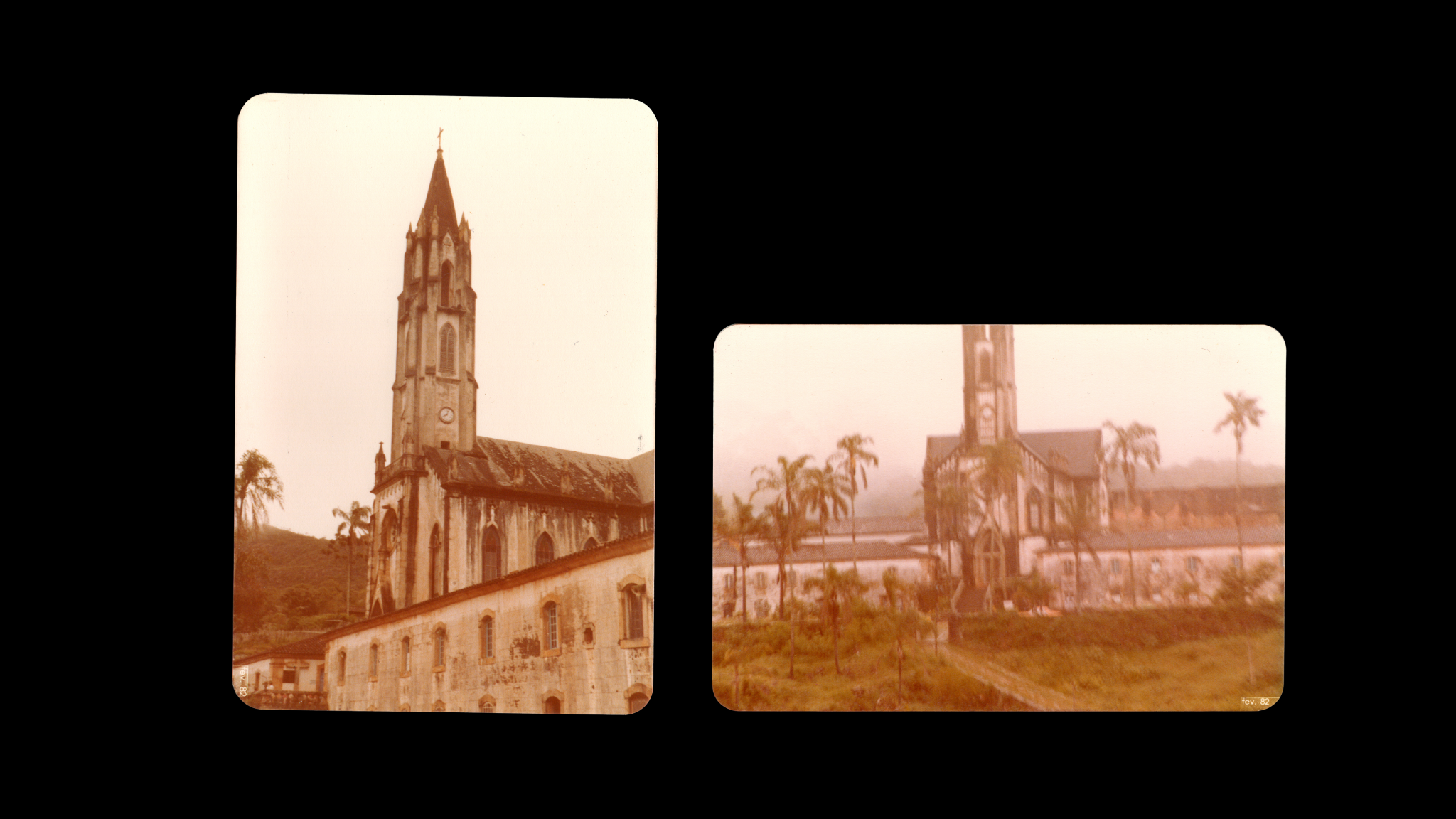
Perhaps this belief was shaped by his years studying at the Caraça Sanctuary.
Or perhaps,
on the contrary,
it was precisely the reason he left.
Instead of a priest, he became a prospector.
A dealer in gold, emeralds, diamonds and other precious stones.
No one knew where and when his fascination with stones began, but his instinct for mineral-rich lands was razor-sharp. So sharp that within just a few years, he was able to secure exploration permits for sites across the states of Minas Gerais, Pará, Bahia, São Paulo and Goiás.
Rondônia was last.
I did not find many records of his life besides a few family photos. I have travelled to Catas Altas, the city he was born in, and visited the Caraça Sanctuary trying to understand whatever happened to make him leave it.
In the book of registers, which contains more than 10,000 names, he was reduced to a single line: “For not enduring in his studies, he left in 1937.”
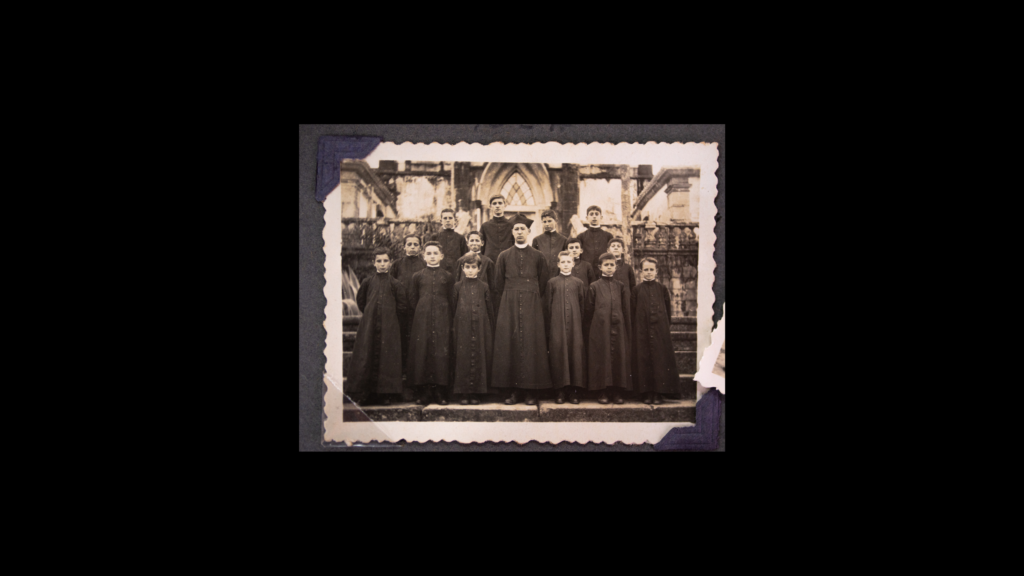
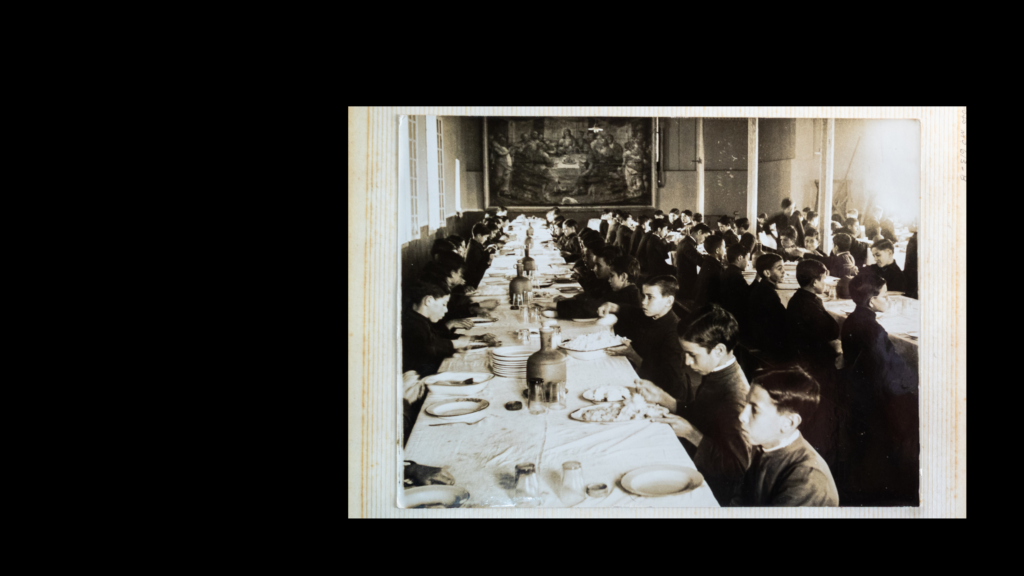
I have retraced his footsteps, scanned through the Sanctuary’s archives, but found only nameless faces staring back at me from old photographs. Grouped in albums that follow no specific theme, chronology or criteria, most of the photographs are accompanied by the words “not identified”.
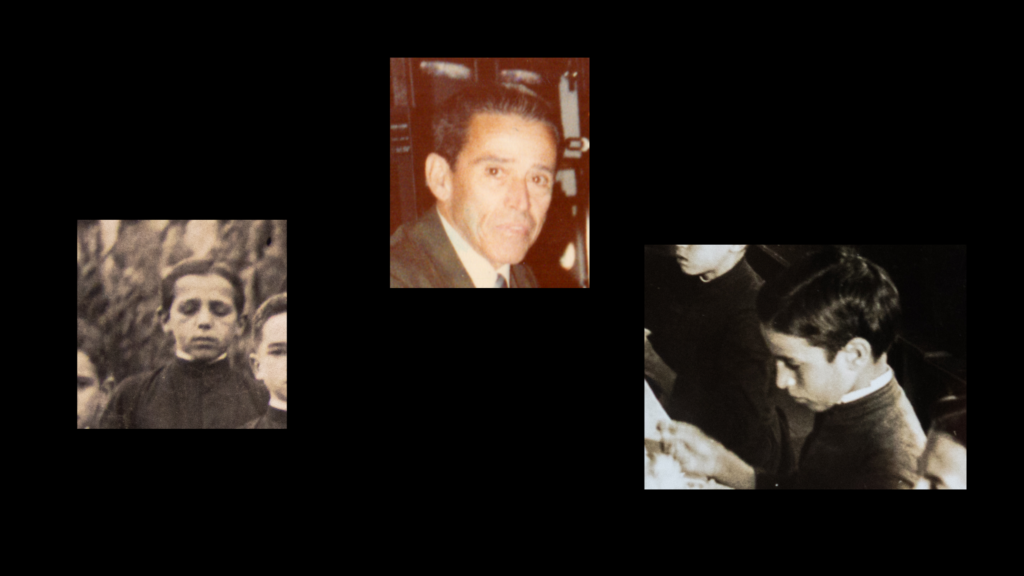
Flipping through their pages, I found two photographs of students that caught my attention. One of them, according to the description list, was supposedly taken during the years my grandfather would have been at the boarding school. The other was not.
With their hair carefully brushed and parted down the middle, and with a gaze that evades the photographic capture, the two boys somehow seem familiar to me.
I am overcome by the sensation that I have seen them somewhere before.
In my father’s archives, I found no images of my grandfather as a child, only a single photograph of him as a baby, too young to allow for a comparison.
I decide, then, to juxtapose the two photographs found at Caraça with the last images I have of my grandfather, dated 1981. I hold the interval between them, considering the vast temporal and spatial distance. And then I bring the three fragments together, making them coexist on the same plane.
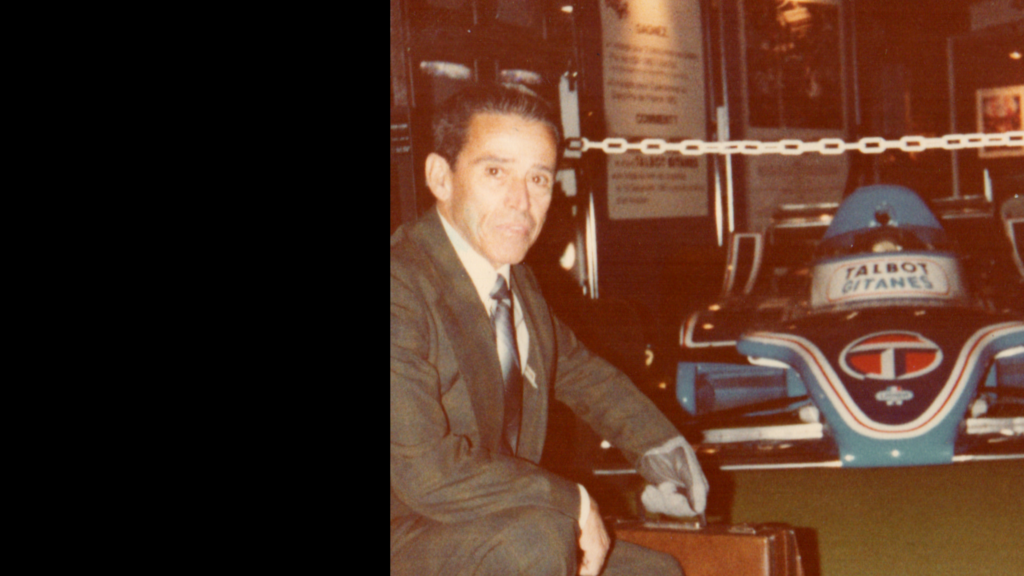
My mother recalls my grandfather’s excitement about his first grandchild: he even offered to take her and my father on a trip to Portugal before the baby was born. Fearful of the long hours of air travel, she refused. It was at the train station that would take my mother and father back to Rio de Janeiro, where they would board a flight to Natal, that, in August or September of 1982, my parents saw my grandfather for the last time.
On my father’s side, however, I don’t have many sources these days: the dead outnumber the living.
Only one uncle remains who could tell me about what happened, but he still repeats the same symptomatic pattern of non-answers I was fed as a child.
—No one knows…
Some things are better left…
—…
What survives is the refusal to speak—a second inheritance.
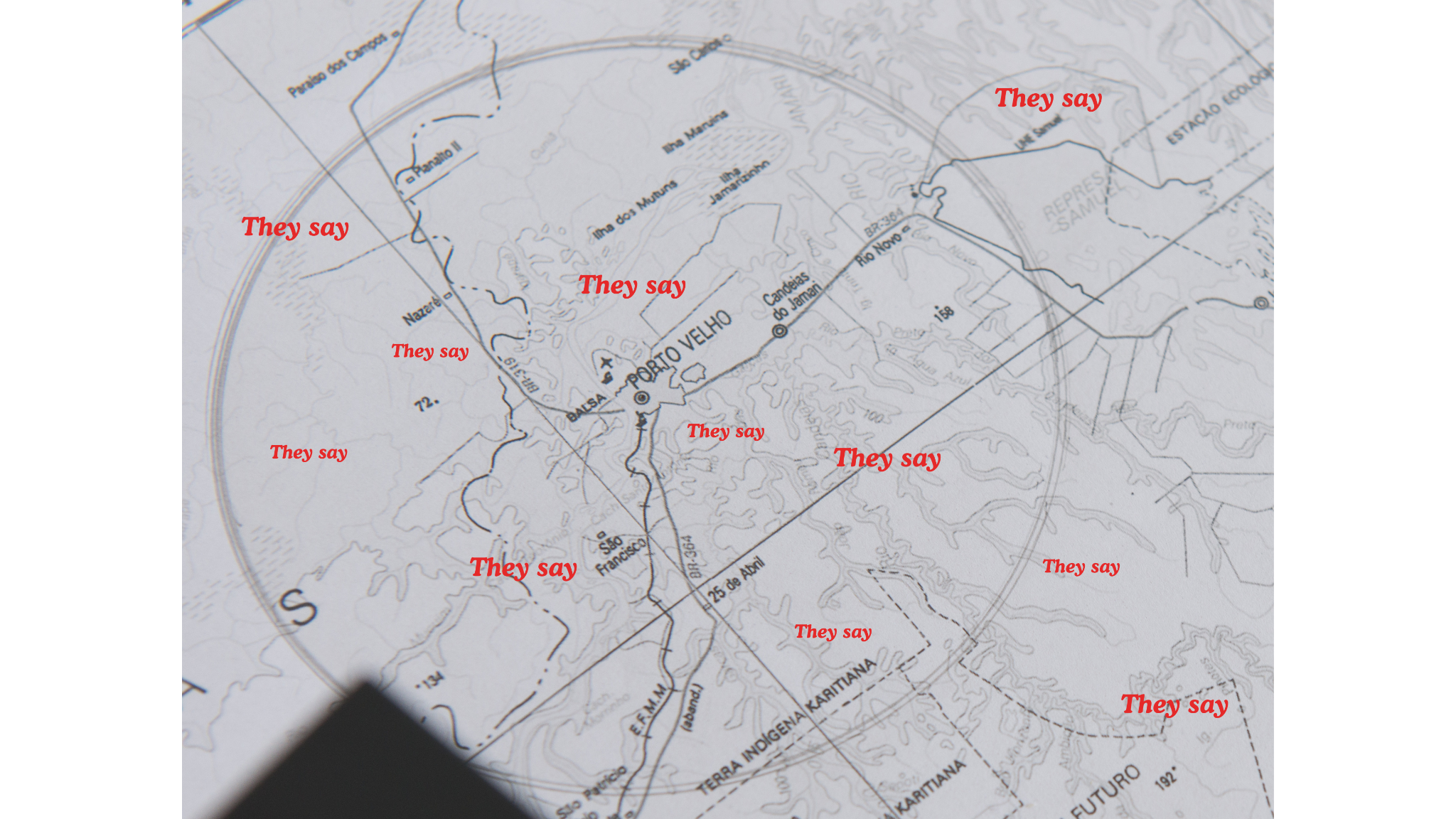
They say my grandfather travelled to Porto Velho, the capital of Rondônia, called there by one of his foremen to verify rumours of gold—thick veins of it—in one of his lands. Thieves must have ambushed him after the findings were confirmed.
They say that when he arrived in the north of the country, it was his own men, who, overcome by greed and eager to bamburrar (slang for “strike it rich”) threw him off the ferry as they went down the Madeira River. His body must have been swallowed by its current or eaten by piranhas.
They say that long before, my grandfather met an Indigenous woman on those lands, with whom he planted new roots in Rondônia’s soil. After discovering this unimaginable fortune in gold, he chose to remain in there and must have forged his own disappearance.
They say…
There was never any proof to validate any of these stories. No trace was archived, no irrefutable evidence. Only this: my grandfather did go to Rondônia, and from there, he did not return. He left his hotel room and became a man of pure “they say”.
But whatever happened to him, my grandfather was not the only one who is still missing—vanished from home and from public records. Rummaging through public archives and old regional newspapers, like Alto Madeira (the same that glorified Marshal Rondon), I found a variety of brief notes, all concentrated in the months during which my grandfather was last seen.
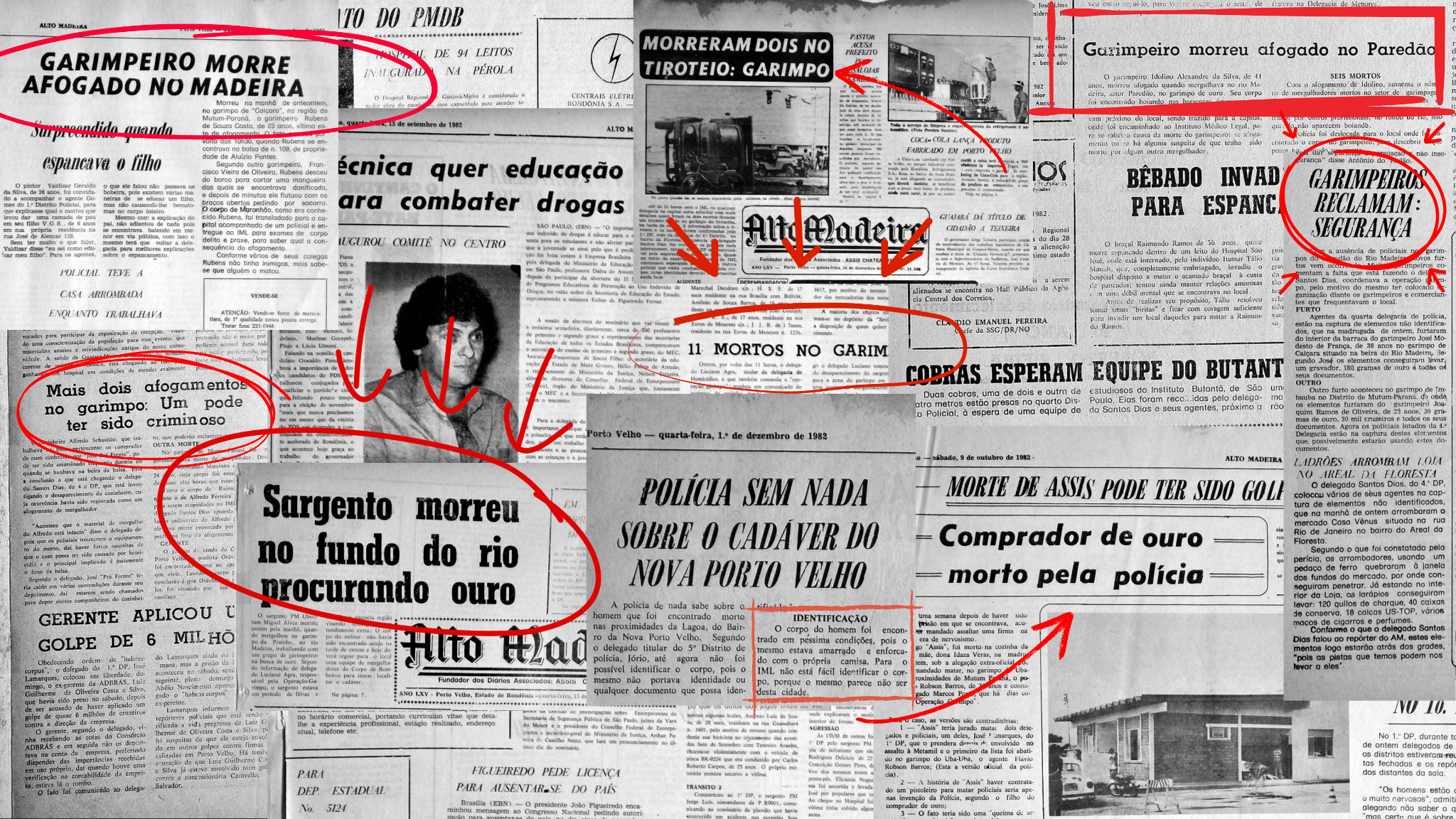
Fragments of news reports about disappearances, drownings, dredge accidents, fights that ended in death, clashes between prospectors and the police, or among the prospectors themselves—whether over drink, gold or women…
Bodies and more bodies floated down the river,
unidentified.
Malaria itself was the least of the problems.
Beyond the physical pain,
the high fever had another origin.
Meanwhile, around the same time, another mining area in the north of Brazil became widely known. The world was fixated on Serra Pelada (Naked Mountain), in Pará, where the earth split open in the world’s largest open gold mine area in the 1980s.
Large enough to draw attention from international media, which produced reportages and documentaries about the anthill workers that came to this land seeking for even a fleck of gold.
Large enough to also catch the eyes of artists such as Alfredo Jaar and photographer Sebastião Salgado.
And large enough to overshadow other mining areas such as the one in Rondônia.
The year after my grandfather’s disappearance marked the peak of gold extraction in Serra Pelada. Approximately 14 tons were extracted manually by the more than 100,000 men who descended upon the mine, hoping to wrest from the soil their own share.
The 1980s saw the eruption of a new fever.
A second gold cycle,
but one with a distinct character.
No longer required to pay the “royal fifth” to the crown and with the mineral exhausted in the lands of Minas Gerais, the prospect of keeping the entire sum they found displaced thousands of men towards the north of Brazil.
Caked in mud, they too were among those trying to find gold along the banks of the Madeira River.
Leaving their families behind, they went alone or in gangs, submitting to whatever it took for the promise of
an alluring and shimmering reward.
To Fabulate: Within The Gaps and Against the Grain
Faced with the absence that structures both my family archive and the story of my grandfather, my own act of narration becomes inseparable from imagination. The impossibility of verifying what really happened does not stop the narrative; it demands another mode of engagement, one that operates within gaps and silences of my family history and against the grain of official accounts. It is in this productive space that fabulation emerges as both a methodological and critical tool.
Writer and scholar Saidiya Hartman posits that however tempting it may be, the gaps in the stories of those excluded from official archives cannot be filled to create an optimistic resolution.[24] Although Hartman’s work emerges from the specific context of the Black North American population and Afrodiasporic experience, her critical thinking and methodological approach can inspire us to rethink power accorded to archives and the stories we tell through them. After all, to dwell into the lives of the multitude—the dispossessed, the enslaved, and, in this case, the garimpeiros (small-scale miners and prospectors)—is an act of struggle, a wrestle “with the power and authority of the archive and the limits it sets on what can be known, whose perspective matters, and who is endowed with the gravity and authority of historical actor.”[25]
From a Benjaminian perspective, we must remember that official history does not favour those who are in the margins and that the limits of the archive must be reckoned with as well. This is why we must not accept the images and documents found in archives as complete, for they are ontologically lacunary; it is impossible to document everything, and there is always a question of power in every archival gesture.[26] What remains for us in the face of these gaps is to engage without settling, to converse with these images, to unearth them from the depths of the archive, to pull them from the piles of remnants, from the piles of bodies left at the margins of History with a capital H – that which cares only for the victors, as Benjamin reminds us.[27] After all, as Hartman aptly notes, “history is how the secular world attends to the dead”,[28] and “each generation confronts the task of choosing its past.”[29]
There will always be a limit to what is verifiable, Hartman reminds us. Yet, this does not foreclose the possibility of engaging with the gaps we find and remake the document, assembling and reassembling alternative narratives.[30] This remaking can take many forms, such as close narration, speculative history, documentary poetics or what Hartman terms “critical fabulation”. This approach transcends the archive’s constitutive limits and challenges its inherent power and authority, refusing to accept the confines of a strictly historiographic dimension.
To critically fabulate is to create a counternarrative in which events are woven in through the use of language and imagination. This, however, does not mean that whatever story one is about to tell departs from reality. On the contrary, the narrative that is constructed through fabulation must be grounded in archival findings. As Hartman states, this practice demands extensive archival research. To fabulate, it is necessary to engage with preserved documents and images and to dig through oral histories and interviews, to look for death certificates and criminal records, to exhume photographs and fragments of stories that, at first, appear only as the loose threads of narratives lost to time.
Extrapolating from the materiality of what was found is imperative. Ultimately, one fabulates critically by keeping a close eye on what was not archived, on the loss of information, the gaps and the absences that power entails. These gaps are precisely the place to keep “advancing a series of speculative arguments and exploiting the capacities of the subjunctive (a grammatical mood that expresses doubts, wishes, and possibilities)”.[31] It is this very mode that leads us to expand the narrative that can be told from the archives. By employing the subjunctive, we can investigate what could have been, rather than accepting what official History dictates.
Even if common sense treats archives as mere repositories of facts and verifiable events, Hartman warns us that “the past is neither inert nor given”—and for that very reason, it is possible to construct narratives which investigate what could have happened.[32] Through fabulation, I keep encircling the records, rearranging and reassembling the stories that follow them. This method also allows me to engage with archives in my practice without necessarily yielding to their claim as definitive proof of reality. By critically fabulating, I can “imagine what cannot be verified”, as Hartman proposes.[33] I can listen to the rumours and dig through the documents, weaving together my findings through a performative narrative.
Following the traces of the gold fever throughout Brazil, it is not as if I wanted to reveal the truth of what happened 43 years ago—I do not fantasise about getting to the bottom of what really happened to my grandfather. Rather, I long to understand what the absence of a record, a document in an archive, could mean and what can be made from that void. After all, as philosopher Achille Mbembe states in a Foucauldian reading of the archive, knowing its limitations and the constraints it imposes, to examine it is to take an interest in life’s leavings: its traces and its debts. For “the final destination of the archive is therefore always situated outside its own materiality, in the story that it makes possible.”[34]
There seems to be an imperative articulated by Vinciane Despret, that the deaths of those around us compels us to articulate their existence and memories through the act of narration. Like Despret, Hartman also grapples with the challenge of accessing those who are no longer alive. Confronting their absence, she states, “there were remains but no stories that could resurrect the dead except the stories I invented.”[35]
For my own practice, I have chosen the performance-lecture as a medium through which to critically fabulate and perform narratives constructed through archival research. As its name suggests, this artistic genre operates between a lecture and a performance, and it has been adopted by artists across multiple fields, rather than belonging exclusively to performance art.[36] In a performance-lecture, the artist prompts us to question the common characterisation of artistic production as a non-discursive practice, and therefore was much used by artists who in the 1960s sought to challenge the notion of the artwork by foregrounding the process of its making.[37]
At the same time, the performance-lecture should not be seen as a mere conversation for sharing processes or an “artist talk”. As the artist speaks, the work itself is being created on stage. In this sense, research and artistic practice are driven by the same intention, and their presentation is inseparable from the work itself. The artist performing a lecture demonstrates the ability to unpack the conventional elements of the academic lecture, dismantling and reassembling them alongside elements that are often rejected from the objective and aseptic characterisation typically attributed to scientific discourse.
In this context, a performance-lecture is a subversion of the format of the academic lecture—traditionally understood as a site for knowledge transmission and the construction of an alleged truth—rendering it permeable to ironic comments, ambiguities, paradoxes, illogical observations, imaginative role-playing, irrational thoughts, and speculative or mystifying reflections.[38] However, as performer and researcher Daniel Ladnar points out, a performance-lecture should not be regarded as “less legitimate” or as a “failed attempt” to produce and present knowledge in comparison to traditional lectures.[39] Rather, what is at stake in such a method is delineation of art as a form of knowledge in its own right, as Rike Frank suggests.[40]
Although this form of practice is not new, I found myself attracted to the possibility of bringing together both archives and fabulation within a visual and performative piece. It allows me to challenge common-sense notions of truth and stability attributed to the archive, while critically engaging with the messy debris of official history. The critical space of the lecture is thus transformed into a performative one, enabling me to speculate across archival gaps by weaving new narratives from photographs, films, documents, letters and memorabilia.
As I employ fabulation in the construction of my performance-lecture, I create a space in which the archive meets the repertoire, minor narratives can emerge, and the public can engage with questions of archival authority, intergenerational trauma, and historical and political silences. Taylor suggests that “the repertoire, on a very practical level, expands the traditional archive” and this is the form through which I can provoke this, establishing the importance of embodied memory within both social and artistic contexts, while also affirming it as a practice that enables learning and the transmission of knowledge. [41] Would this not also be one of the potentials of the performance-lecture?
Taylor further reminds us that etymology connects the repertoire with “a treasury, an inventory” while also pointing to “the finder, discoverer”, or the act of finding out.[42] The repertoire, therefore, requires a body, a discoverer and transmitter of its knowledge, and the same happens in a performance-lecture. If we recall that the archive, as discussed previously, is also mediated; in a performance-lecture, this mediation happens through the spoken language. It is through speech that I, as an artist, can reinscribe the document in an alternative chain of events in which fact and fiction can coexist in the production of knowledge.
In this encounter, my fabulation meets the memories and narratives of those who witness me sharing this story. Each performance gives rise to stories in return—relatable, intimate, minor—and each time I find myself more drawn into the gaps of the archive. Through fabulation, I propose a form of archival intervention and the performance-lecture becomes the means through which this same intervention is made public. Fabulation fosters dialogues, it creates space for inventing new imaginaries around both public and private stories, such as the ones woven through the silences and violence of the so-called “late” gold fever in Brazil.
To critically reassess this public matter, I return to what I found and also what I did not encounter in both family records and public archives. I imagine what remained of my grandfather’s stay in Rondônia and was later returned to the family: a properly locked suitcase—as one might leave it in a hotel room, expecting to return; a small travel bag with toiletries; his health insurance card and a few stones.
Through fabulation, I can imagine that being a man fascinated by precious minerals, he always carried some of his findings with him, whether to sell, to attract a new investor or to showcase his discoveries. Yet the stones found in his hotel room were nothing more than pyrite, or what is commonly known as “fool’s gold”.
I like to think he carried them with him to feel closer to the ground.
III
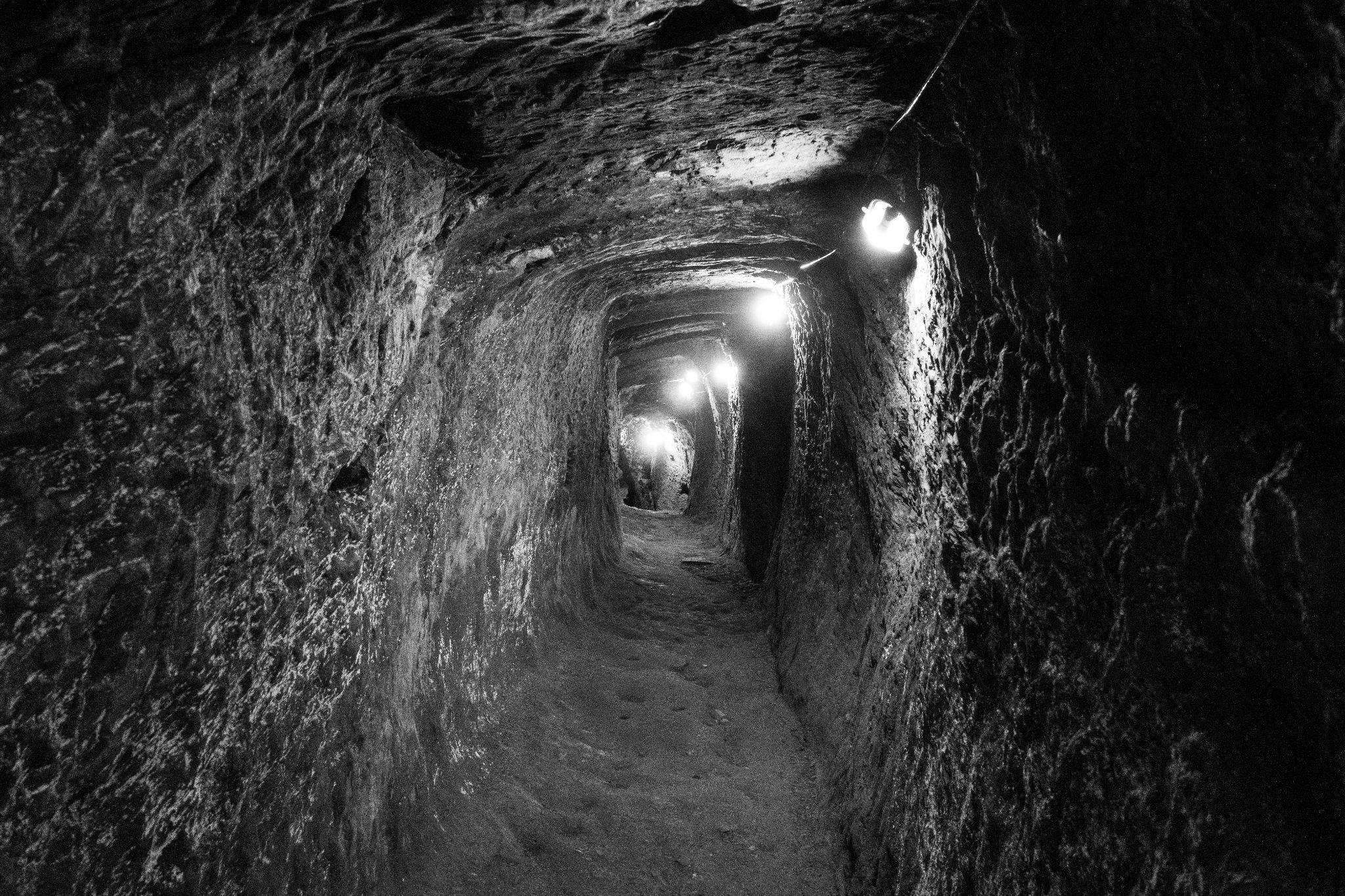
The encounter with an archive reveals a path to be followed, it is a sign that there is always more to excavate.
Sometimes I feel I could build bridges and tunnels between documents in distant places and of distinct origins.
But if I dig too much,
it can all collapse, just like in a mine,
where removing the wrong stone, the one that supports the entire gallery,
can bring everything down.
Just like in prospecting for gold, the search through archives demands patience but also a repetitive, sustained effort.
There is, of course, a whole intellectual investment at play, but over the years I have come to realise that my body, too, is being summoned.
I must enter the reading room and sustain the silence.
I must also endure the cold,
as the space is often kept at temperatures lower than outside,
for the sake of preserving and conserving the documents.
I sit for hours on end,
carefully leafing through catalogues,
or books,
or albums,
or lists.
It may be necessary
to wear disposable gloves and masks—
and when there are no masks and the documents are very old—
the body feels it too,
especially the nose.
At times, it is the eyes that suffer,
as I strain them in an effort
to see more clearly
and make sense of centuries-old writings
in a hand so ancient it feels
like another language.
At times, it is my hands that are called upon:
they must turn, turn, turn and turn
the handle of the microfilm reader.
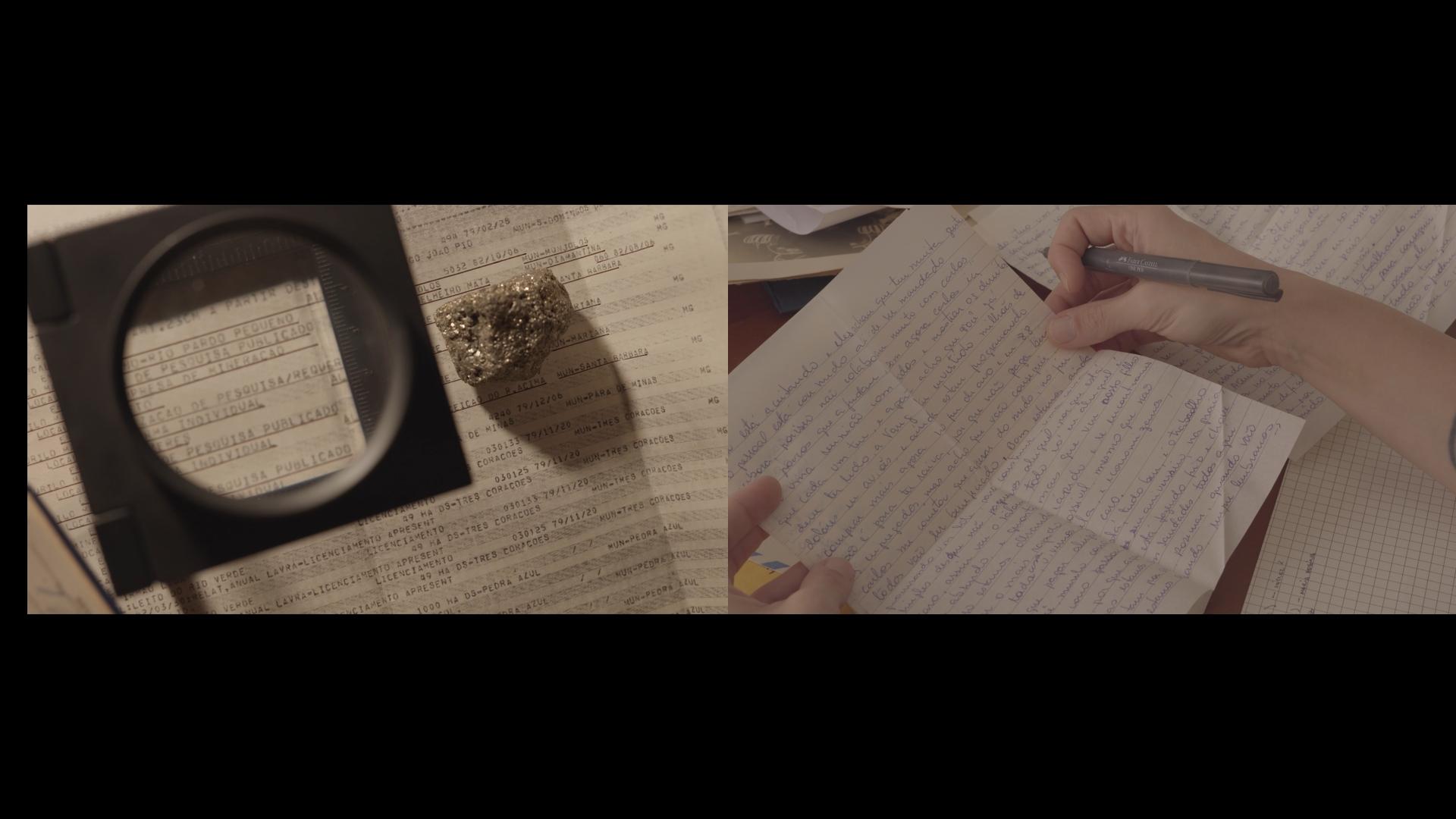
Simultaneously, as I engage in this exercise of speculation, I continue to excavate through geological fissures and archival depths. In this process, every image I find is, for me, a spark of the real, glinting like gold.
Footnotes
- Benjamin, Walter. “Excavation and Memory”. In Selected Writings. Vol. 2, part 2, 1931–1934. Trans. Rodney Livingstone and others. Ed. Michael W. Jennings, Howard Eiland and Gary Smith. Cambridge, MA: Belknap Press. 2005. p. 576. ↑
- Despret, Vinciane. Our Grateful Dead: Stories of Those Left Behind. Trans. Stephen Muecke. Minneapolis: University of Minnesota Press. 2021. p. 11. ↑
- Following discussions raised by Argelian philosopher Jacques Derrida, I consider “the archive” more of a notion rather than an enclosed concept. See Derrida, Jacques. Archive Fever: A Freudian Impression. Chicago: University of Chicago Press. 1995. p. 29. ↑
- Spieker, Sven. The Big Archive: Art from Bureaucracy. Cambridge, MA: MIT Press. 2008. p. 6. ↑
- Callahan, Sara. Art + Archive: Understanding the Archival Turn in Contemporary Art. Manchester: Manchester University Press. 2022. p. 58. ↑
- Van Alphen, Ernst. Staging the Archive: Art and Photography in the Age of New Media. London: Reaktion Books. 2015. ↑
- Lyotard, Jean-François. The Postmodern Condition: A Report on Knowledge. Minneapolis: University of Minnesota Press. 1984. ↑
- Ibid., p. 4. ↑
- Ibid., p. xxiii. ↑
- Benjamin, Walter. “The Storyteller: Observations on the Works of Nikolai Leskov” [1936]. In Selected Writings. Vol. 3. Ed. Howard Eiland and Michael W. Jennings. Cambridge, MA: Belknap Press. 2002. pp. 143–66. ↑
- Ibid., p. 144. ↑
- Ibid., p. 143. ↑
- Ibid., p. 146. ↑
- However, it is important to remember that while the German philosopher laments the impacts of modernity on the act of narration, Lyotard’s thought is directed towards post-industrial societies—a time when advances in information technology are enabled by the emergence of computerised data systems. In any case, it is not difficult to imagine how much more pessimistic Benjamin would have been regarding the changing role of narratives in society had he lived through the period analysed by Lyotard, or, even more so, our present moment. ↑
- Van Alphen, Staging the Archive, p. 7. ↑
- Taylor, Diana. The Archive and the Repertoire: Performing Cultural Memory in the Americas. Durham, NC: Duke University Press. 2003. p.19. ↑
- Ibid., p. xvii. ↑
- Ibid., p. 20. ↑
- Ibid., p. 36. ↑
- Van Alphen, Staging the Archive, p. 74. ↑
- Ibid., p. 8. ↑
- Ibid., pp. 8–9. ↑
- Taylor, The Archive and the Repertoire, p. 36. ↑
- Hartman, Saidiya. “Venus in Two Acts”. Small Axe. vol. 12, no. 2. 2008. p. 12. https://doi.org/10.1215/-12-2-1. ↑
- Hartman, Saidiya. Wayward Lives, Beautiful Experiments: Intimate Histories of Social Upheaval. New York: W.W. Norton & Company. 2019. p. xiii. ↑
- Although the reasons for the emergence of gaps within an archive are manifold—from the Derridian “archive fever” to the matters of discourse raised by Foucault —their genesis varies according to questions of power, visibility and the very act of memory. See, for instance, Foucault, Michel. “The order of discourse”. In Untying the Text: A Post-structuralist Teader. Ed. Robert Young. Boston: Routledge & Kegan Paul. 1981. pp. 51–78. ↑
- Benjamin, Walter. “On the Concept of History” [1940]. In Selected Writings. Vol. 4, 1938–1940. Ed. Howard Eiland and Michael W. Jennings. Cambridge, MA: Harvard University Press. 2006. pp. 389–400. ↑
- Hartman, Saidiya. Lose your Mother: A Journey Along the Atlantic Slave Route. New York: Farrar, Straus and Giroux. 2021. p. 18. ↑
- Ibid., p. 100. ↑
- Hartman, Saidiya. Intimate History, Radical Narrative. 2020. Available at https://www.aaihs.org/intimate-history-radical-narrative/ (accessed 2025-11-03). ↑
- Hartman, “Venus in Two Acts”, p. 11. ↑
- Hartman, Lose Your Mother, p. 133. ↑
- Hartman, “Venus in Two Acts”, p. 12. ↑
- Mbembe, Achille. “The Power of the Archive and its Limits”. In Refiguring the Archive. Ed. Carolyn Hamilton, Veme Harris, Jane Taylor, Michele Pickover, Graeme Reice, Graeme, Razia Saleh. Dordrecht: Kluwer Academic Publishers. 2002. p. 21. ↑
- Hartman, Lose Your Mother, p. 116. ↑
- For an in-depth discussion on that, I recommend Ladnar, Daniel. “The Lecture Performance: Contexts of Lecturing and Performing”. PhD Thesis Aberystwyth University. 2013; Frank, Rike. “When Form Starts Talking: On Lecture-Performances”. Afterall: A Journal of Art, Context, and Enquiry. No. 33. Summer 2013. pp. 4–15; and Rainer, Lucia. On the Threshold of Knowing: Lectures and Performances in Art and Academia. Wetzlar: Transcript. 2017. ↑
- Also known as performative conference and lecture performance, this artistic form can be traced back to works by artists such as Joseph Beuys, Andrea Fraser and Robert Morris. ↑
- Catalão, Marco. “Uma genealogia para a palestra-performance”. Urdimento. No. 28. 2017. https://doi.org/10.5965/1414573101282017004. ↑
- Ladnar, “The Lecture Performance”, p. 13. ↑
- Frank, “When Form Starts Talking”, p. 9. ↑
- Taylor, The Archive and the Repertoire, p. 26. ↑
- Ibid., p. 41. ↑