Fabulations are stories we make together—partial, messy and emergent. They are fleeting arrangements of words, gestures and materials that come undone as easily as they cohere. Like the ephemera of workshops—smudged prints, collages, fragments of conversation, notes—they exist in the blur between intention and accident, fact and fiction. Fabulations linger in the traces left behind, rejecting fixed narratives and offering ambiguous invitations to keep telling, to keep making sense together.
In this text, I discuss fabulations as co-constructed in the small gestures of collective making, in the shared weight of the roller and smudges of ink on our fingers. In this essay, I trace a moment of collective lino-cutting as a way of thinking-with pre-figuration in which futures are not only imagined but enacted through the hands that cut, print, and tell stories together. Working through feminist technoscience and craft, fabulation becomes less a speculative tool than a situated practice of care—a way of composing worlds in the present tense. The collective poster-making of the Nordic Fabulations Workshops invited stories to travel beyond the event, carried in prints hung on walls and retold in passing conversations. These prints are not representations but remainders; tokens of shared labour that invite continuation and re-interpretation. Through them, fabulation is understood as pre-figurative making “in the small”: as storytelling that folds thought into matter, and matter into relation, where each mark becomes a trace of a world already partly here.

Prologue
At the end of the third Nordic Fabulations Network workshop, four of us were taking turns kneeling on the concrete floor around a pile of papers, enthusiastically rolling black ink onto the soft linoleum blocks. During the previous two days, we had drawn and cut pieces of a collective print—making marks and stabbing blocks while listening to a keynote on unmaking. Traces of the previous workshop transpired in the imagery, memories of the witches in Norway. Our joint labour in replacing a printing press with our bodies made it possible for participants to take away a poster; a small token of their shared experience. Around us, the rest of the organising team moved tables and hoovered the floor. As the last participants said goodbye and wrapped up conversations, they also waved around freshly inked prints, devoid of serial number, signature or specific title.
Fabulations in the Small
Fabulation, as developed in feminist technoscience, provides a way of telling stories that resist singular or authoritative accounts. Donna Haraway introduces the notion of speculative fabulation as a practice of world-building that entangles fact and fiction, offering partial, situated and accountable narratives in place of universal-truth claims.[1] Rather than projecting distant utopias, fabulations centre relationality and care, inviting us to “stay with the trouble” of the present. Daniela Rosner extends this approach within design research, using critical fabulations to challenge dominant narratives of technological progress and to surface histories that are often erased, such as those of maintenance, gendered labour or colonial infrastructures.[2] This use of critical fabulation is indebted to Black feminist scholarship, particularly Saidiya Hartman’s articulation of critical fabulation as a method for the narrating of lives and histories that have been systematically excluded from the archive, by combining historical research with speculative narrative while remaining accountable to archival violence and absence.[3]
Feminist fabulation has become a generative method in design research. Building on Rosner’s exposure of the erased histories of maintenance, repair and women’s labour in technology, Marie Louise Søndergaard and colleagues employ fabulation as a way of design futuring, engaging with bodily materials and more-than-human relations.[4] Here, fabulation intersects with craft, whether through mending practices or the speculative crafting of alternative futures explored by feminist design researchers.[5]
I choose to look at fabulations as a pre-figurative practice. Pre-figurative practices, originating in anarchist and radical political movements, consider the enactment of desired social or political futures in the present, rather than treating them as distant goals to be achieved later. Pre-figurative politics, as defined by Paul Raekstad and Sofa Saio Gradin, for instance, is the practice of creating the social relations and organisational forms in the present that one wishes to see realised in the future.[6] Rather than deferring justice, equality or freedom to some distant point ahead of us, pre-figurative politics enacts these values in the here and now. It emphasises horizontality, mutual aid and participatory decision-making, insisting that the means of social change must reflect the ends strived for. In this sense, pre-figurative politics is both ethical and strategic: it demonstrates that another society is possible by living it through collective practice, rather than merely theorising or campaigning for it.
Examples of pre-figurative politics can be found across a range of social movements and collective practices. In anarchist and autonomous circles, occupied spaces such as social centres or community gardens are organised horizontally, with decisions made through consensus rather than hierarchical authority, modelling the egalitarian structures they aspire to. Feminist collectives and co-operatives often implement pre-figurative approaches by embedding care, shared labour and inclusive participation into their daily routines. In the digital realm, open-source projects can also embody pre-figurative principles, experimenting with collaborative, non-proprietary modes of production that prioritise transparency and community governance. Even movements like Occupy Wall Street illustrate the potential of pre-figurative practice: general assemblies, working groups and mutual aid networks were structured to reflect the participatory, non-hierarchical society activists were advocating for, making the process of organising as important as the political demands themselves.
These ideas are resonant of mattering care as a profoundly contextual and immediate mundane action. The idea of gräv där du står (dig where you stand) comes from a Swedish workers’ education and history movement in the late 1970s, initiated by Sven Lindqvist and the Gräv där du står-gruppen.[7] It invited workers to document and research their own workplaces and local histories to uncover the invisible labour, social relations and material conditions of their everyday environments. Rather than relying on external experts or official archives, people were urged to begin their enquiry from within their own lived experiences, recognising themselves as knowledge producers. This recognition is a way of carrying the story of the workplaces through the lens of the workers rather than having a managerial perspective mandated onto them. The phrase has since travelled, becoming a metaphor in feminist and participatory research forfo grounded, situated and collective ways of knowing, which I here suggest as a framing for fabulations too.
Digging where we stand aligns closely with what Carl DiSalvo,[8] alongside other known researchers in participatory design, describes as working “in the small”.[9] Both articulate an ethos of grounded practice that privileges the local, the situated and the collectively enacted over universal or large-scale approaches. In participatory design, the small designates an environment where democratic experimentation unfolds through everyday acts of collaboration, negotiation and care: a domain where design prioritises civic enquiry over solutionist interventions. Whereas DiSalvo discusses the notion of in the small for democratic design experiments, here I turn attention to fabulations as a profoundly relational form of making. Beyond thinking of fabulations as a practice of storytelling, I turn the spotlight to the small gestures we make in the material composition of the stories we tell—considering the micro.
Within design research, this translates into approaches that create artefacts of alternative ways of living, working or relating to technology here and now, rather than only imagining them in speculative narratives. This attitude is somewhat at odds with some of the outputs of critical and speculative design, where the designed pieces end up in the confinement of exhibitions and museum spaces. However, if the utopias we want to fight for are to become reality, the relational practices considered in design research must also include the relevant visible labour—even when they are actions done in the context of “digging where you stand” and “in the small”. The case recounted here relies on fabulations as work in the small that centres care and relational threads, troubling the boundaries of designer/user or designer/audience. These examples stay with the actual trouble of being and becoming a design researcher, while still carrying an attitude that sees materialities, experiences, friendships and encounters as forms of knowledge beyond text or polished design artifacts.
Collective Poster-Making
The focus of my reflections here is a series of workshops that I was invited to with the intention of starting a new network of Nordic fabulators, developed with participants with pre-existing established working relations as well as new early-career members.[10] Through the organisation of three workshops, they produced fabulations that act as possible trajectories for Nordic care futures, developing a toolkit for fabulating that can travel, as well as reflections on how Fabulation works, what it is good for and strategies and tactics for developing meaningful shared futures. The first Fabulation workshop on “Concepts”, was focused on conceptual work around fabulations; the second, “Approaches”, on driving fabulation as a mode of designing futures; while in the third, “Interventions”, special attention was paid to how fabulation might be made more relevant to the “real” world.
This section seeks to describe the material practices of craft that shaped these workshops, with a particular focus on collaborative poster-making and linoleum-cutting as visual methods for fabulation. In the words of Rosner:
By questioning whose histories, expertise, and knowledges organize design, critical fabulations demand continually reconfiguring those inhabitances. They call on investigators to question the four pillars of a dominant design paradigm (individualism, objectivism, universalism, solutionism) to explore what worlds might be possible in their wake.[11]
I do not quite remember why or how I was invited to the very first event (“Concepts”), but because I could fund my own trip, I found myself on a night train to Umeå without any specific idea of what fabulations even meant. The organising team had asked participants to bring a story or book that would represent a community they come from. While sharing these, many of us (including me) noted how this task was unexpectedly difficult. Not only did we feel that we did not belong anywhere in particular, but it was also difficult to find specific stories to share. I ended up bringing a book from my childhood with a loose connection to the Nordics. First published in 1958, A Menina do Mar (The Sea Girl) is one of the most beloved works by Portuguese poet and writer Sofia de Mello Breyner Andresen. Originally written as a children’s story, it weaves poetic prose with mythic imagery to explore friendship, curiosity and the fragile boundaries between worlds (the sea and the land), the human and the more-than-human. The narrative follows a boy who lives by the shore and befriends a sea girl, their encounters revealing both wonder and loss as they navigate the limits of their respective realms. Like a fabulation “in the small”, A Menina do Mar works through tenderness and attention to the everyday, crafting a world in which connection is only possible through reciprocity and respect for difference. This workshop awoke a myriad of thoughts for me, and a distancing from the notions of design fiction I had carried before.[12]
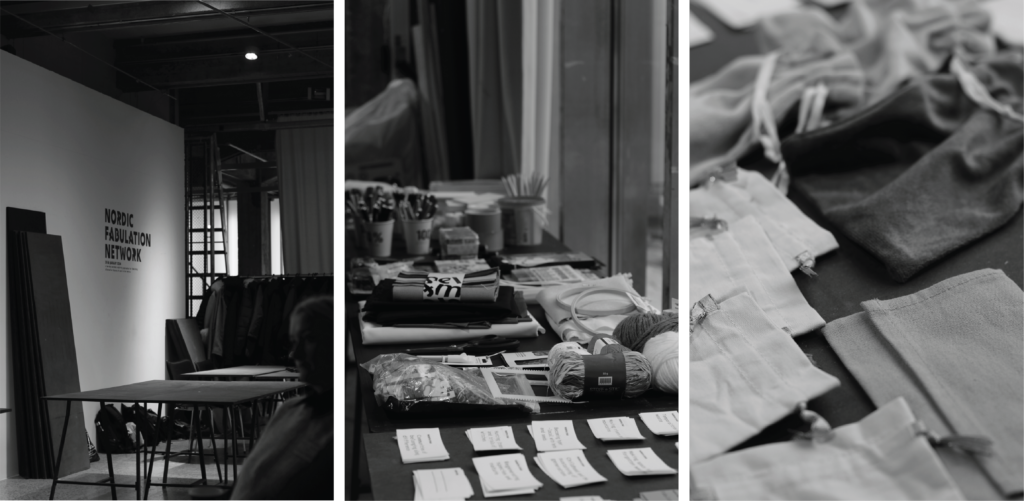
In between workshops, I struggled with the value of fabulations as a self-contained idea without a material practice beyond text. I thought of how stories travelled beyond the culture of oral re-telling. At the time, a friend was visiting and we organised a small event at home during which we did lino-cutting as we shared stories. This gave me an idea to bring to the next workshop. Without asking the organising team, I brought with me a large (A3) piece of softcut lino, split into pieces resembling a broken mirror.
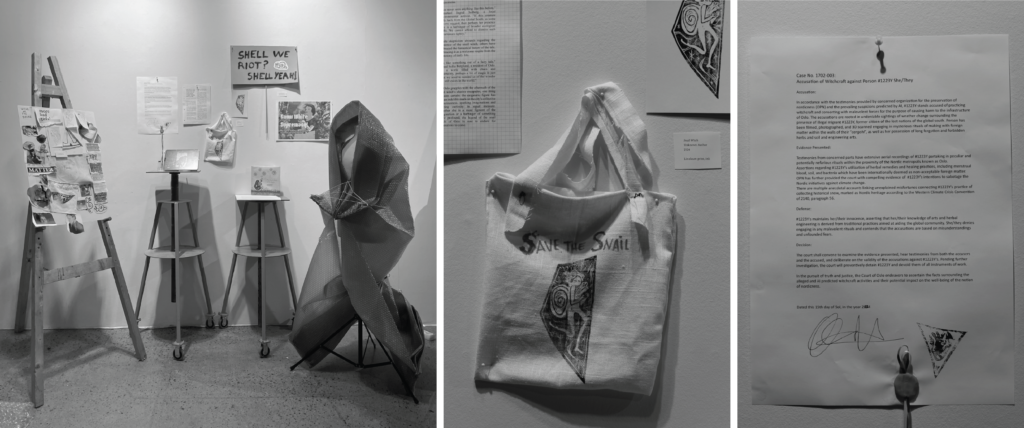
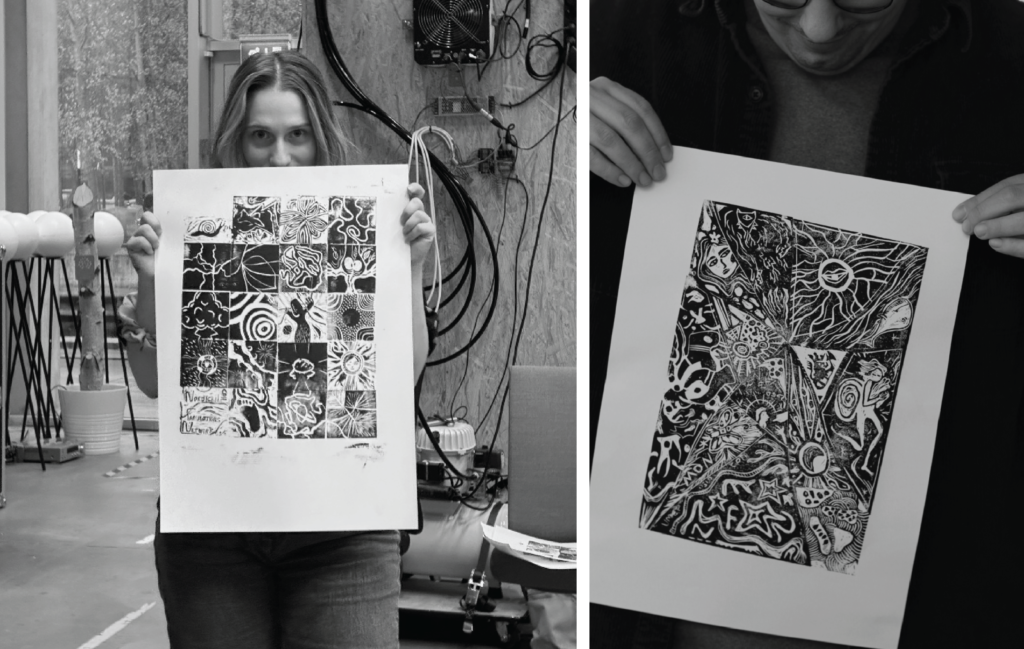
The second workshop of the Nordic Fabulation Network, titled “Approaches”, was hosted at the Oslo School of Architecture and Design in January 2024, bringing together 27 researchers to drive fabulation as a mode of designing futures. Camilla Mørk Røstvik delivered a keynote on “Remembering Witches: Memorials, Memory and Magic in Public Space”, framing the workshop’s engagement with memory, materiality and more-than-human imaginaries. On the first day, we used familiar methods of interaction design, including first-person reflections and low-fidelity prototyping, to explore how fabulation can generate new connections between technologies and care-oriented futures. On the second day, those emerging fabulations were refined and presented openly to each other. Our project was centred on creating a set of artefacts that would show the trial of a witch (the Snail Witch) in a slightly different and not necessarily likely future. As part of this process, we made two pieces of linocut that were used in the designed artefacts. In the end, I collected the softcut pieces and printed some copies of the poster. The metaphor of the broken mirror worked neatly, as the pieces put together created a composition that required interpretation, but also invited enough detail to paint a somewhat chaotic but rich picture.
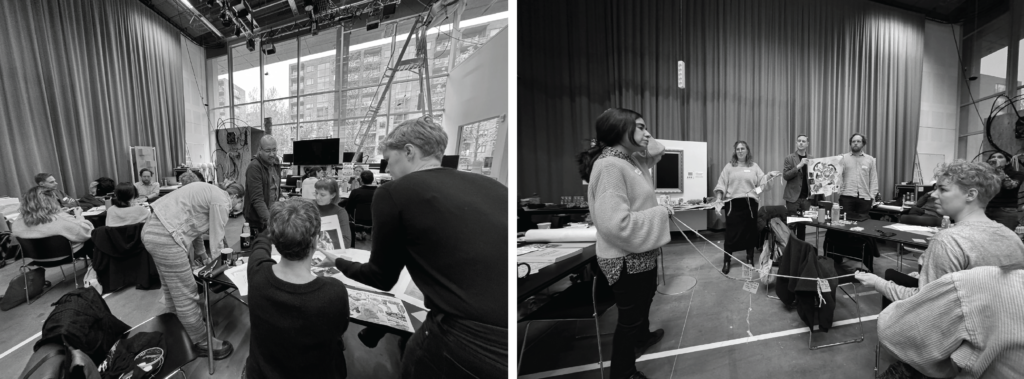
The third workshop, titled “Interventions”, convened around thirty researchers at the IT University of Copenhagen over two days in November 2024. to further refine and make operational fabulation as a mode of designing futures of care in a Nordic context. On the first day, participants built on themes of care and Nordic values explored in earlier network events, with keynotes from the Un/Making Studio (Åsa Ståhl & Kristina Lindström) providing provocations about how imaginaries drive design practices. Throughout, the emphasis was on testing the generativity and limitations of the method. Since the collective lino-cutting was appreciated in the second workshop, I brought it again, this time with a different approach. Because stories are built in pieces, told and retold, I cut a series of squares inspired by the board game Tsuru.
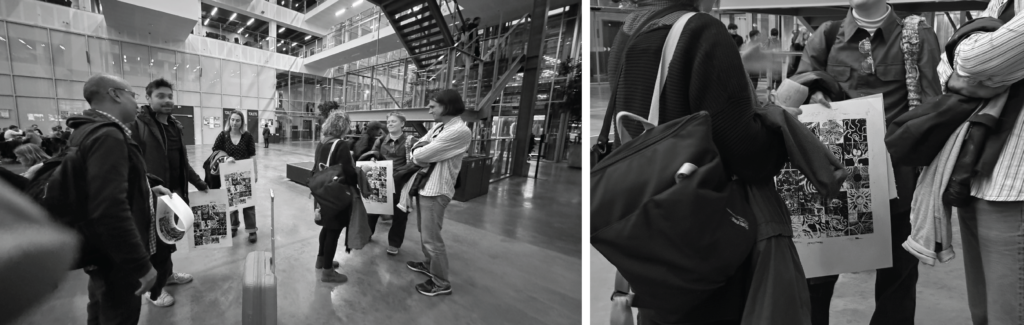
In Tsuro, the tiles are marked by eight points along their edges and connected through meandering paths that link and loop in unpredictable ways. Each tile offers multiple possible continuations; when placed next to others, these pathways align, diverge, or collapse, creating an evolving network of connections. Tsuro can be understood as a spatial and relational form of storytelling: a practice of composing and recomposing narratives through adjacency. Like building tiles in craft or design, the pieces do not determine a single story but invite emergence through placement and relation. Each configuration generates a different trajectory, suggesting that stories, too, are built iteratively, as provisional alignments shaped by both context and chance, not as linear plots. Arranging and re-arranging the tiles becomes an act of fabulation: a way of experimenting with connections, testing possibilities and tracing the patterns of meaning that unfold when fragments meet. While participants found the instructions on how to connect to these eight points unclear, the resulting poster had the curious effect of offering different configurations but a uniform aesthetic. The slightly diverging order of the tiles was barely perceivable.
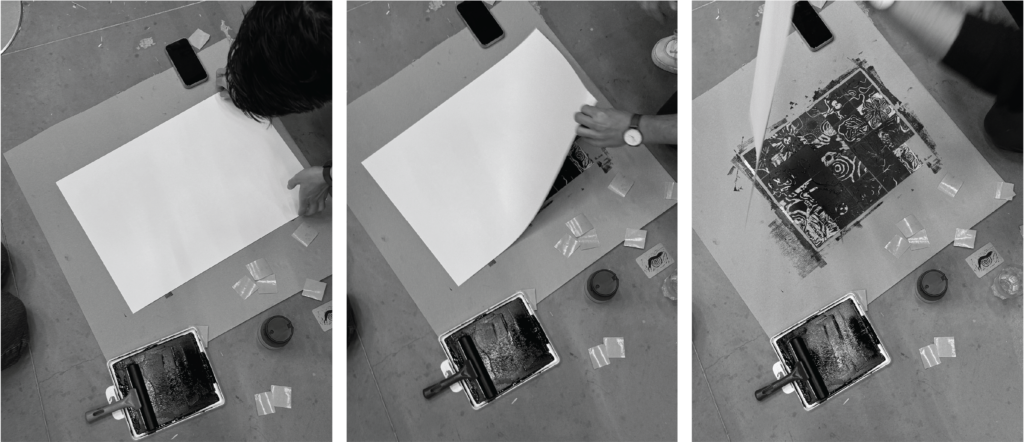
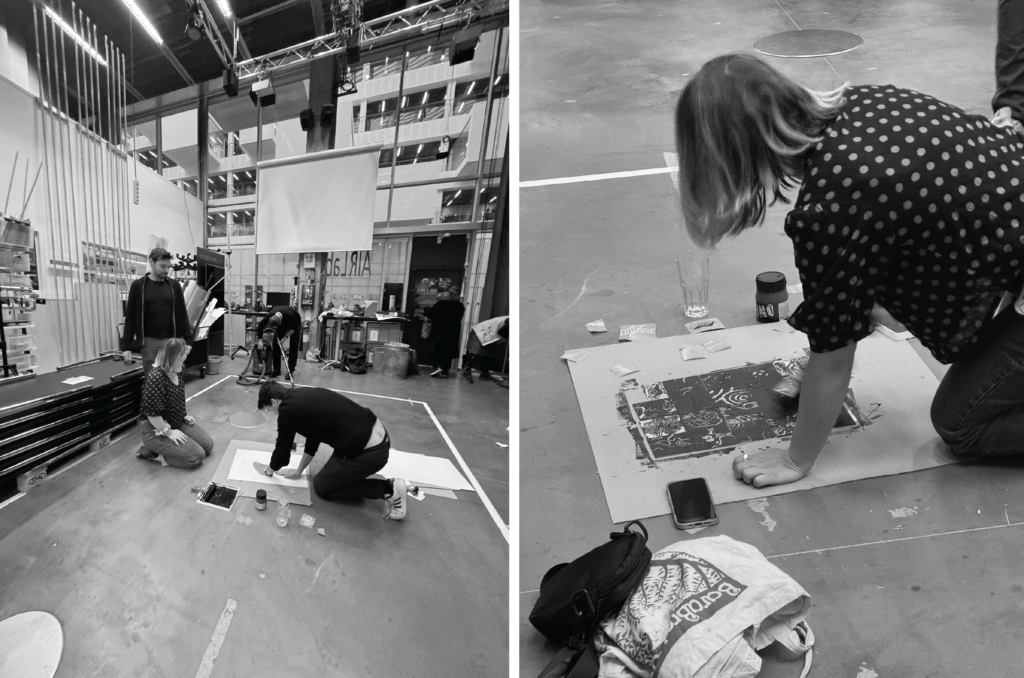
At the end of the workshop, producing enough posters required a collective effort. While the organisers were cleaning, sorting materials and closing up, a number of us took up space on the floor. hoping not to disturb them as we made a series of prints. As some people were not quite finished with their tiles, the poster ended up changing slightly. Each print came with residues of ink, or of less or more experienced ways using the body as a printing press. As people left, some of them held on to their poster as they prolonged the conversations just outside the room.
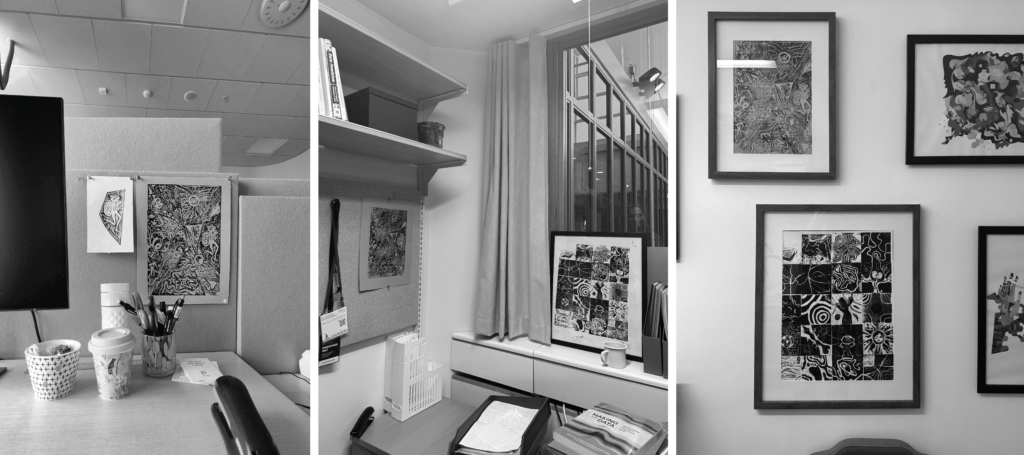
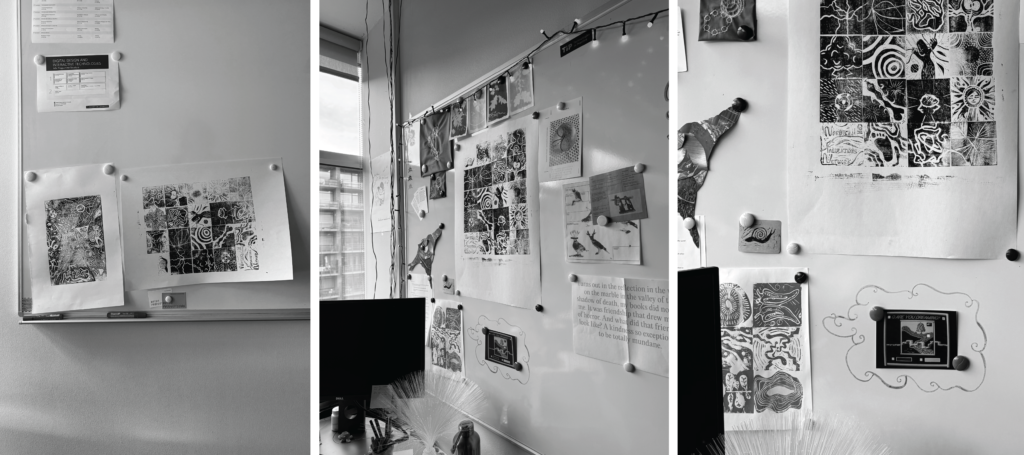
After the event, I ended up visiting a number of the participants in their hometowns, sometimes at random, sometimes as the after-effect of the workshops. Many of them had the posters hanging in their offices (Fig. 8). During these informal chats, I noticed how the stories functioned as a kind of prompt towards storytelling, carried over from the workshops to their spaces. On my latest visit back into ITU, I learned that at a small local event a group of researchers had taken inspiration from the square poster composition to make their own (Fig. 9). In the abstract, but “in the small”, this is a clear demonstration of how fabulations is the telling of tales that are passed along as not only futures but also enacted practices.
Pre-Figurative Fabulations
The results of each workshop were hard to convey and summarise within traditional academic approaches, even in design. As Rosner argues, the dominant design paradigm is structured around four interrelated intellectual commitments: individualism, universalism, objectivism and solutionism. Their roots lie in pragmatism, cognitive science and Cold War systems thinking. Among these, individualism is particularly central and problematic. While derived in part from John Dewey’s notion of a socially constituted “new individualism”, later design traditions strip away its collective grounding and instead position the individual (both user and designer) as the primary unit of analysis and intervention. This individualist orientation is reinforced by universalist assumptions that design methods can be applied anywhere, objectivist claims that design can be neutral and scientific and, lastly, solutionist tendencies to frame problems as discrete. These paradigms obscure structural inequalities and limit the scope for collective or political forms of action. Even critical and practice-based approaches, while challenging aspects of rationalism and formalisation, frequently retain an underlying commitment to the autonomous individual, thereby failing to fully account for differences in access, power and lived experience. The work I present here is a pre-figurative attempt to do away with at least one facet of design practice: individual authorship.
Fabulations place themselves strongly in the effort of dissolving the boundary between fact and fiction, whereas most academic outputs are meant to present co-constructed agreed fictions as facts. Our work in fabulating together was not positioned as imagining technological futures, but rather towards arguing for alternative presents to what we already know, seeking less complicated solutions and at times finding the value of evident simplicity. Most importantly, it focused on redesigning our immediate world by crafting material expressions of our shared stories. The importance of pre-figuration here is relevant. Once, when travelling to Luxemburg I faced an excellent example of shifting facts reduced to one simple reaction. When taking the bus from the airport into town, I asked the driver how I could pay for the ticket. He glanced back at me and exclaimed, “it is for free!”, as if I had asked him an absurd question. In that moment, I imagined a world in which when looking for a new apartment and asking how much the rent was, the (non-)landlord would answer, “what is rent?” At times, the answer to a simple question is enough to disrupt an entire world view. The exercise in pre-figuration I present in this paper is a small gesture in liberating the possibilities of participation within workshops in producing collective stories that can remain in spaces and are reminders of the potential of enacting the worlds we fabulate in our daily life.
For many, the workshop offered a moment of rest in turbulent times. It was an opportunity to lean into storytelling as a means of community-making—to treat fabulation as a shared space rather than a method. The stories we tell and pass on are fluid and impermanent but fight strongly against technological determinism and inevitability. Within the Nordic Fabulations Workshop, artistic practices became essential to the interweaving of a tapestry of incommensurable notions. The outcome is a set of inexplicable ideas that resonate in the interdisciplinary spaces between the researchers and practitioners that sat around the metaphorical space of fabulations—the campfire where truth and fact were told together as ghost stories of worlds we want to live in, and partially already do. By documenting these practices, it aims to make the subtle traces of those imagined worlds a little more tangible, as if those worlds actually already are by just acting them into being, as if saying, “it is free”.
Fabulations as Patchwork
Here, I would like to use the metaphor of the patchwork as a form for fabulations, deeply in line with its craft- and lore-oriented core. Patchwork can be defined as a layered, stitched-together, provisional composition of story-fragments, material traces and collaborative labour. Haraway’s notion of “speculative fabulation” regards our narratives as “a mode of attention, a theory of history, and a practice of worlding”.[13] Similarly, the notion of patchwork gives notice that in this making-together, nothing is seamless or finished; seams remain visible, overlaps and mis-matches persist and these very irregularities become indicators of process, relation and care. Rosner describes “critical fabulations” as interventions into dominant design narratives—retrieving hidden histories of maintenance, care, craft and labour—thereby patching new threads into the fabric of design’s story.[14]
In the case of our collective lino-cutting and postermaking, the broken mirror and tiles are both forms of patching together different stories. But beyond the method, it is in the enactment that we create a material narrative; in the bodies involved in collectively printing a limited series of posters. This story continues as the lines are added towards new versions of the same stories or similar narratives. This patchwork nature refuses the unity of a single author, single outcome or predetermined future; instead, it embraces the entanglements of participation, materiality and temporality. It is in the stitching, this slow making “in the small”, that the story finds its ways to becoming reality. In doing so, fabulation as patchwork aligns with pre-figuration: the future is not distant but stitched into present practices and stitched together through collective making.
Thinking with the idea of patchwork invites an attentiveness to incommensurable notions and to the tensions that arise when knowledge is diffracted rather than unified. It calls for accommodating the difficulties and frictions inherent in expressing such plural ways of knowing. Each poster may retell a different story, yet all stem from a shared root, branching outwards in search of new connections. Like stories passed on and transformed across generations, fabulations do not depend on a singular, coherent truth; they flourish through multiplicity—through the coexistence of many truths and many simultaneous presents.
Fabulations as Relational Practices
Beyond compositional patchwork, fabulations are fundamentally relational. They are practices of weaving together people, materials, stories and places in ways that enact social worlds. Famously, in a much repeated and reiterated sentence, Haraway noted that “it matters what matters we use to think other matters with; it matters what stories make worlds, what worlds make stories.”[15]
This means that fabulation is not just about telling stories, but about enacting relations and entanglements: between human and more-than-human, between maker and material, between present and future. Rosner’s redesign of design histories entangles relational labour: craft workers, maintenance technicians, women machinists—their stories held in materials and methods—bringing them into relation with design’s future or parallel present possibilities.
In our collective fabulatory work, the shared labour of kneeling on the floor, rolling ink together, tracing lines on softcut board, aligning tiles, then carrying home posters to hang in offices becomes a relational practice. The posters don’t just represent something; they circulate among people, provoke conversation, invite reinterpretation and misrepresentation. They become nodes in a network of relationships: workshop to office, print to viewer, memory to future. As such, fabulation as relational practice enacts the very social forms one hopes the future might embody: mutuality, care, co-making, ongoing re-telling.
Maybe collective making also opens up to a relational approach that needs no permissions and has no particular care for intellectual property or a coherent faithful retelling. Just as folklore stories travel without clear starting points, so can the design practices of fabulation be transferred from one to the other without a need for authors or serial numbers. Rather, fabulations can become small rituals to reinforce the commitments we want to make real in our everyday life. To fabulate is to create the space for those collective relationships to become matter. Such matter must travel and operate within the ontology of fabulation, through existing in the world as stories that can return, as exemplars of worlds that exist as parallels to the one(s) we perceive as “real”. To make pre-figurative fabulations is to give away the need for the primacy of fact and threading fiction into the fabric of the everyday fabric. A fable and world imagined becomes pre-figurative when it weaves itself into mundane narratives, reconstructing the interpretations of our current lives.
Footnotes
- Haraway, Donna. “Situated Knowledges: The Science Question in Feminism and the Privilege of Partial Perspective”. Feminist Studies. vol. 14. No. 3. 1988. p. 575. https://doi.org/10.2307/3178066; Haraway, Donna J. Staying with the Trouble: Making Kin in the Chthulucene. Durham, NC: Duke University Press. 2016. https://doi.org/10.1215/9780822373780. ↑
- Rosner, Daniela K. Critical Fabulations Reworking the Methods and Margins of Design. Cambridge, MA: MIT Press. 2020. https://doi.org/10.7551/mitpress/11035.001.0001. ↑
- Hartman, Saidiya. “Venus in Two Acts”. Small Axe: A Caribbean Journal of Criticism. Vol. 12. No. 2. 2008. pp. 1–14. https://doi.org/10.1215/-12-2-1. ↑
- Søndergaard, Marie Louise Juul et al., “Fabulation as an Approach for Design Futuring”. Proceedings of the 2023 ACM Designing Interactive Systems Conference. Pittsburgh. July 2023. pp. 1693–1709. https://doi.org/10.1145/3563657.3596097. ↑
- Forlano, Laura et al. “Making, Mending and Growing in Feminist Speculative Fabulations: Design’s Unfaithful Daughters”. DRS2016: Future-Focused Thinking. Brighton. 2016. ↑
- Raekstad, Paul and Gradin, Sofa. Prefigurative Politics: Building Tomorrow Today. Cambridge: Polity. 2019. DOI: 10.1080/09644016.2020.1741768. ↑
- Lindqvist, Sven. Gräv Där Du Står: Hur Man Utforskar Ett Jobb. Stockholm: Albert Bonniers Bokverlag. 1978. ↑
- DiSalvo, Carl. Design as Democratic Inquiry. Cambridge, MA: MIT Press. 2022. https://doi.org/10.7551/mitpress/13372.001.0001. ↑
- Binder, Thomas et al. “Democratic Design Experiments: Between Parliament and Laboratory”. CoDesign. Vol. 11. Nos. 3–4. 2015. pp. 152–65. https://doi.org/10.1080/15710882.2015.1081248; Ehn, Pelle. “Learning in Participatory Design as I Found It (1970–2015)”. in Participatory Design for Learning. New York: Routledge. 2017. pp. 7–21. https://doi.org/10.4324/9781315630830-3. ↑
- “The notion of caring for own citizens is at the basis of the Nordic welfare state. However, shifting power relations, new forms of public private partnerships, rapid emergence of technologies, and novel forms of service provision are transforming how states, communities and caregivers plan and improve living conditions of the population. These challenges thus require new forms of participation to ensure that emerging technologies are designed and adopted to support citizens in an equitable way. This network explored how collaborative design via Fabulation (Haraway, 2013) can be used to imagine and extend care practices in the Nordic context, encouraging broader forms of participation in society, building stronger connections among citizens, and ultimately fostering more resilient futures. Fabulation is part of a new approach using storytelling in design futuring, borrowed from Science and Technology Studies and feminist technoscience, oriented towards alternative forms of critical and radical world-making. However, the use of fabulation in design futuring, while having enormous potential in being able to bridge the aforementioned challenges of participation, is currently tentative and understudied. How should or could fabulation be deployed within collaborative design in the context of emerging technologies to imagine new forms of caring?” For more about this network and the organisers, see https://nordicfabulation.net/ (accessed 2026-05-17). ↑
- Rosner, Critical Fabulations Reworking the Methods and Margins of Design. ↑
- A summary of this workshop exists in video format at https://youtu.be/uCrl1X0IPgg (accessed 2026-05-17). ↑
- Haraway, Donna J. Staying with the Trouble: Making Kin in the Chthulucene ↑
- Rosner, Critical Fabulations. ↑
- Haraway, Donna J. Staying with the Trouble: Making Kin in the Chthulucene ↑