This essay explores how fabulation and embodied gestures of remembrance can unsettle dominant frameworks of memory and reconciliation in “postwar” Guatemala. It approaches memory as a contested field shaped by competing narratives, in which official discourses of peace and humanitarian reconciliation have displaced the revolutionary and collective aspirations that informed Guatemala’s civil war (1960–96). Against these hegemonic accounts, the text proposes “walking backwards” as a fabulative and disorienting approach that resists linear temporality, archival neutrality and reconciliatory closure. Drawing on a family archive linked to Guatemala’s armed resistance, the exploration considers how walking backwards enables alternative engagements with archival materials—not as stable records of the past, but as traces that foreground absence, opacity and relationality. Using this methodology, the archive becomes a site of collective rehearsals of memory through which personal and social histories are reworked by way of affective, speculative and embodied approaches. Particular focus is given to “The Names of the Camps”, a text written by a guerrilla fighter, and its reactivation in “The Silence of the Volcano”, a curatorial research project that brought together Guatemalan artists to engage with memory as a shared and relational process. By tracing these “rehearsals” of memory, the essay argues that fabulation opens up to alternative modes of memory-making that allow for contradiction, asymmetry and the entanglement of Indigenous and ladino-mestizo histories. In doing so, it challenges the erasures imposed by neoliberal and colonial regimes of representation and instead foregrounds memory as a space of ongoing struggle. “Walking backwards” thus emerges as a methodology of unlearning the singular narrative of the official archive and of imagining futures through the latent traces and resonances that persist within vernacular archives.
From time to time I walk backwards, it’s my way of
remembering. If I walked only forwards, I could tell
you what oblivion is like.
–Humberto Ak’Abal
What are the movements and orientations that memory affords? What topographies of memory and forgetting are rendered visible and invisible when walking backwards? What kind of generative disorientation can fabulative memory afford? Can walking-backwards be a gesture, a guideline, a score to walk with/in an archive?
In the San Sebastián neighbourhood of the historic centre of Guatemala City, a house stands out. Its façade is covered with wallpaper that displays portraits of people who disappeared or were murdered during the civil war (1960–96). Beneath the windows, a plinth painted in red, yellow and black frames this intervention, which calls on passers-by to remember the victims of the war. When the organisation that created this work, HIJOS Guatemala, calls for remembrance, they do not do so to mend ruptured lines of descent and filiation, but rather they honour a shared horizon of loss, irreparability and an understanding of the enduring legacy of violence in Guatemala.[2]
Created in 2014, The House of Memory Kaji Tulam is a grassroots initiative committed to highlighting the complex web of systemic oppressions that led to a series of social uprisings in Guatemala, culminating in the civil war and its aftermath. Kaji Tulam’s permanent exhibition brings together works and materials that reveal a society profoundly shaped by historical and ongoing violences, which include: extreme concentrations of wealth; a semi-feudal labour system that forced many Indigenous peasants into debt on export estates; widespread anti-Indigenous racism, despite more than half the population identifying as Indigenous; and a long history of dictatorship marked by violent extraction and erasure.[3] Here, history is not portrayed as a closed event, but as a reality that bursts through the cracks of past and present. Despite its modest infrastructure, the museum makes visible the continuity of violence and resistance in this country.
This museum challenges the dominant rhetoric of public memory, which often relies on conciliatory narratives that equate state and guerrilla violence, despite extensive evidence that the state was responsible for the vast majority of human rights violations during the armed conflict.[4] This is what David Stoll has termed the “two-fire narrative”, in which the population is portrayed as a passive actor, caught between two opposing forces, the guerrillas and the army.[5] As has been extensively argued by others, Stoll’s interpretation overlooks the asymmetries in weaponry, soldiers and alliances, as well as the social and political conditions that gave rise to guerrilla movements and shaped people’s decisions to join them. Instead, it asserts that most of the population was coerced into participating—either as guerrilla combatants or as members of army patrols.[6] In the “postwar” period, this two-fire narrative has been actively promoted by the state, as it minimises the extent of social dissent by implying that only a small segment of the population was genuinely discontented. By denying the existence of forms of active participation, it obscures the underlying causes of the war and undermines the revolutionary and political agency of the communities involved. Over time, this has contributed to an ahistorical understanding in which to be recognised as victims, people—particularly the Mayan population—must be portrayed as entirely innocent and detached from any political struggle.
Somewhat surprisingly, today this narrative has also been taken up by sectors of civil society. One example is Memorial para la Concordia (Memorial for the Concord), a non-profit organisation coordinated by Julio Solórzano Foppa—a relative of the poet and activist Alaíde Foppa, who was disappeared during the war. Created in 2010, the platform “seeks to bring together and foster alliances aimed at promoting memory, truth, justice, peace, and the defense of human rights.” It invites a wide range of political actors—regardless of their role in the war, including former guerrilla fighters, activists, businesspeople and members of the military—to participate, based on the premise that they were all affected by the violence the war unleashed.[7]
In an effort to move beyond antagonistic or dichotomous frameworks for understanding political violence, Memorial de la Concordia flattens ideological differences and recasts all actors as victims. In doing so, it reproduces what Enzo Traverso has described as the “responsibility of memory”, a neoliberal humanitarian discourse that foregrounds violence and victimhood while sidelining the political struggles and aspirations that shaped these uprisings—as if remembering the victims could not coexist with recalling the economic and social transformations they sought.[8] Scholars such as Anelí Villa Avendaño have expressed scepticism towards this initiative, calling for a crucial reassessment of the very notion of reconciliation. She argues that forgiveness towards the military or the state should not be advanced while these same actors continue to reproduce strategies of annihilation against Indigenous communities.[9] Although the Memorial’s narrative is framed as inclusive, it ultimately has an absolving effect. Through what Mihaela Mihai terms “unreflective complicity”, it leaves the social foundations of violence intact—the normalised hierarchies, relationships, institutions and affective registers that sustain inequality in Guatemala.[10] Such interpretations of the past risk enabling ongoing forms of systemic exclusion and violence.
Today, memory remains a central battleground in Guatemala. Nearly three decades after the signing of the Peace Accords, tensions among social groups continue to unfold through competing narratives of the past. Memory thus becomes a site where different worldviews come into conflict, involving not only interpretations of the past but also projections of possible futures. As these examples suggest, what and how we remember shape collective understandings of political agency and contestation: they can reinforce or challenge dominant interpretations of political violence, valorise or marginalise certain forms of resistance, and critique and obscure or silence dissenting voices. In the following section, I examine the affordances of “walking backwards” as a methodology and a mode of ethical relationality that challenges the logics underpinning these hegemonic tropes of memory. Through fabulation, relationality and rehearsals of memory, “walking backwards” emerges as a way of generating alternative pathways for memory-making.
Walking Backwards as Fabulative Gesture
At the entrance of The House of Memory Kaji Tulam, a poem by Humberto Ak’Abal, welcomes visitors:
From time to time, I walk backwards
it’s my way of remembering.
If I walked only forwards,
I could tell you what oblivion is like.[11]
Inspired by Ak’abal’s proposition of walking backwards as a mode of remembering, I engage with my family’s archive as a practice of fabulation and political imagination.[12] I am interested in how walking backwards becomes a gestural practice, in the sense described by Marie Bardet—as a way of attending to how embodied movements and habitual actions shape relational and social worlds.[13] Within this frame, walking backwards as a fabulative gesture projects and patterns possible worlds, opening up to alternative modes of relating across different experiences, temporalities and positionalities within a shared history.[14] When I walk backwards with(in) this archive, I trace and connect stories that exceed the archival record itself—not to reveal or uncover “the truth”, but to cultivate forms of connection that remain attentive to the asymmetries and tensions inherent in such encounters.
Though personal in its origins, this collection grounds me within a broader topography in which what might seem as belonging to the most fundamentally personal, nonetheless plants me in a collective history. Comprising photographs, clandestine publications, letters, drawings, films, books, newspapers and recordings, amongst other materials, this archive is tied to my family’s involvement in Guatemala’s armed resistance. It emerged from histories of revolutionary struggle that are both Indigenous and ladino-mestizo,[15] and is therefore marked by the contradictions of what Aruna D’Souza calls “imperfect solidarities”, as well as by the enduring asymmetries of power that shape social and historical relations in Guatemala.[16]
My own positionality as a ladina-mestiza—formed through the displacements of war, as I was born in Mexico, where part of my family fled to during the counterinsurgent conflict—situates me within these entangled histories.[17] I grapple with their tensions across multiple and intersecting geographies of belonging. Both the archive’s heterogeneous composition and my situated relation to it shape how fabulation operates in my research: as a practice of embodying connections and frictions—such as the uneven relations between guerrilla imaginaries and Indigenous struggles—and of attending to how histories of violence and resistance persist into the present.
The work with this archive has unfolded in rehearsals of memory, in which I return again and again to stories within, around or alongside the objects as a way of remembering with others. These repeated and imaginative engagements produce affective imaginaries and economies that move across time, positionalities and experiences. The archive has thus become a space where individual and social remembrance is modulated. It does not intend to “speak for” Indigenous histories or other revolutionary struggles, nor simply document my family’s past; rather, it allows me to trace and imagine how histories of resistance, violence and memory remain intertwined. It is an environment in which to ruminate on the uneasy oscillation between continuity and rupture, belonging and displacement. In this sense, this archive is always being undone, always open up to new paths and traces.
A straightforward reading of Ak’Abal’s poem might take it as an invitation to walk towards the past. Yet, to walk towards—or to face—the past would already undermine the very notion of backwardness. Walking backwards instead suggests that this movement can be a conscious, culturally inflected act rather than a means to an end. It is an unusual and often uncomfortable gesture that disrupts the habitual orientation of walking. In doing so, it unsettles linear conceptions of time as continuous or progressive, generating pause, discomfort, slowness, attentiveness and a perspective otherwise.
As an ordinary gesture, walking suggests orientations, paths and encounters. When steps are firm, the ground trembles: bodies vibrate, muscles tense, the brain rages. Walking implies movement and transition, a passage from “here” to “there”. It can be a way of touching and being touched by the ground, an expression of singularity in space and time. Walking is a fracture against permanence; in its repetition, it continually reintroduces discontinuity and difference.[18] This is what Laurie Anderson evokes in “Walking and Falling” when she says, “with each step we fall slightly forwards and then catch ourselves from falling, over and over again.”[19]
If this happens when we walk forwards, what happens when our bodies move against the direction of our feet? What if we cannot fully control our orientation? When walking forwards or backwards, are we equally at risk of falling or stumbling? Does walking backwards rely on memory? Is it an act of return? Is it at all possible to go back, to retrace, and in doing so, heal?
Walking backwards carries an invitation to visit the past within the present. In this gesture, life and remembrance become two parts of a whole—distinct, yet mutually constitutive. It suggests that our now is textured by the presence of ghosts: that encounters, dreams, possibilities, lineages and hopes are all marked by them. To walk backwards is to live on the basis of the trace, to inhabit a present encroached by the persistence of living-dead remnants.[20] It is to recognise that such traces carry forms of knowledge and, as Saidiya Hartman suggests, that regardless of their form, they signal the founding correlation or resemblance between a then and a now that coeval.[21]
Walking backwards within an archive also becomes a way of questioning the archive itself. It calls attention to how archival practices, often presented as ostensibly neutral procedures, have historically organised and divided the world through exclusionary categories that undermine other modes of relation and imagination. In this sense, walking backwards becomes a practice of unlearning the archive: a way of refusing its spatial and temporal regimes, disregarding the boundaries set by its guardians, and contending with the archive in the company of those it has excluded.[22]
To walk backwards within my family archive is to engage its materials not as direct registries of history, but as traces that might reveal what remains illegible, erased or what has not been considered to be decisive for what we consider “History”. Doing so attunes us to the oscillatory trajectories between experiences of death and the ongoing crises of life shaped by trauma and loss in postwar contexts. In this sense, walking backwards speaks to the ways in which trauma has shaped—and keeps shaping—the body after having been confronted with death, and how such experiences reframe identity, positioning and relationality beyond those who directly endured and survived them. Walking backwards creates space for ghosts, for that which has been repressed, whether as a means of survival or through external imposition. It reveals the relational conditions that make remembering possible. Rather than seeking to reconstruct a stable or complete account of the past, walking backwards unfolds as an open-ended, affective practice of engaging with and dwelling alongside the stratified histories embedded in the archive’s objects.
The Names of the Camps
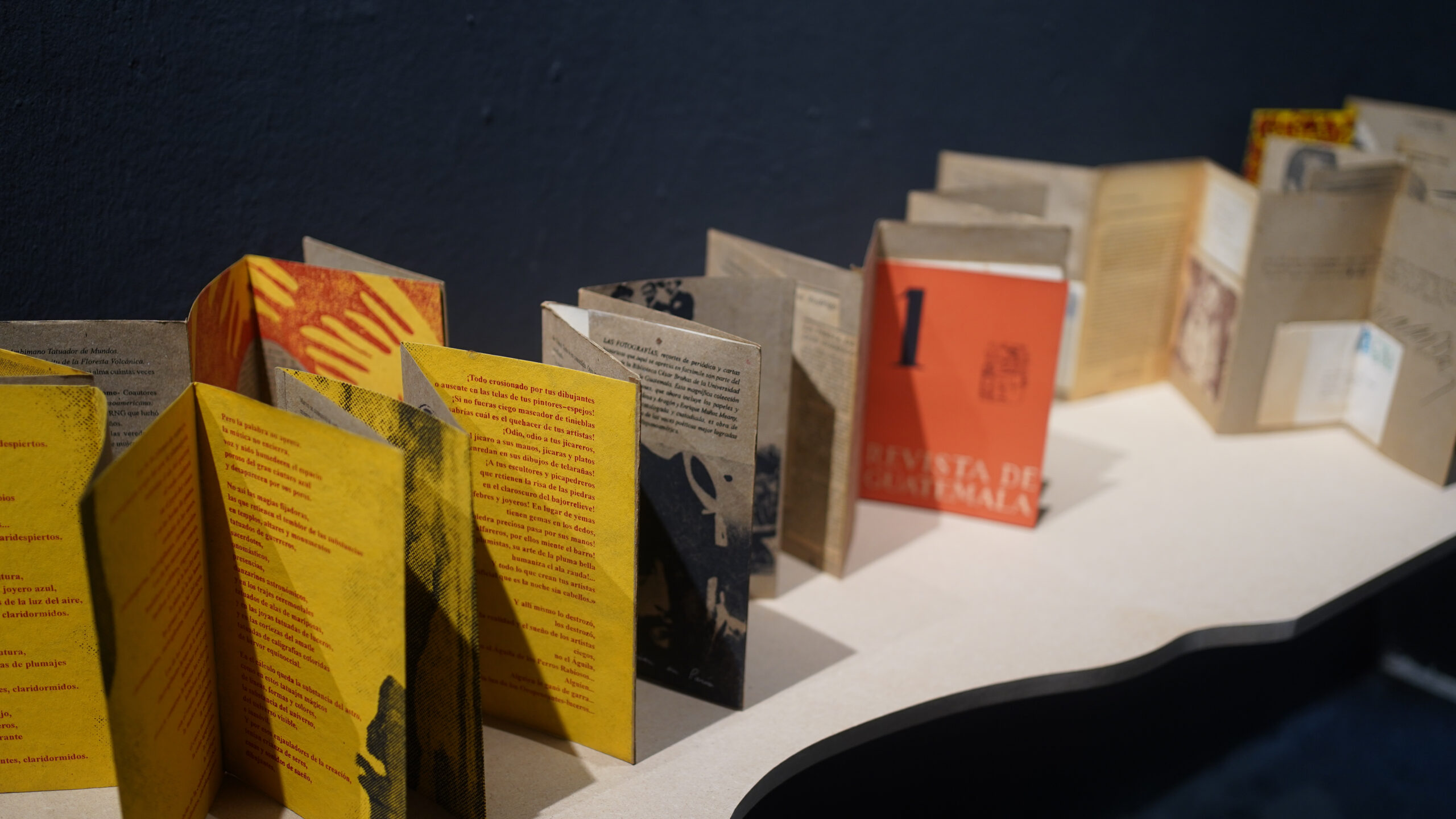
In the heart of a high plateau, a two-metre-tall avocado tree grows against all odds in the inner patio of an adobe house in San Cristóbal de las Casas, casting a soft shade. For more than fifty years, this place has been home to the Taller de Leñateros, a publishing collective of Mayan artists in Chiapas whose practice is often described as dabbling in magic and witchcraft—a kind of spiritual-political labour committed to affirming the re-existencia of Indigenous peoples.[23] I arrived at this place in search of “The Names of the Camps”, a text signed by Captain Ana and published by this collective in the 1990s. In it, the author recounts the names given to the camps of the guerrilla front on which she fought. The text sketches shared experiences and significant moments among fighters who, like many others during the war, were forced to make the mountains and volcanoes their home. When I first encountered it in 2010, it resonated with stories and images I had heard from my stepfather in my early teens. Although the text makes no explicit reference to Guatemala, I initially assumed that the author might have been a guerilla fighter from ORPA, the group in which my stepfather and other family members had participated.[24] The text likely reached San Cristóbal de las Casas because, from the onset of the tierra arrasada campaigns until the end of the war in 1996, guerrilla groups used the southern Mexican state of Chiapas as a supply route, a corridor for transferring fighters, a site for operational contacts, and a place to treat the wounded and, at times, shelter leaders and militants.[25] San Cristóbal functioned as an important hub for comrades. Further research revealed that the text, dated 1993, had in fact been written by my stepbrother’s mother, just two years before she was killed.[26]
Ana recalls The Quetzal, a camp in the cloud forest named after the majestic bird that inhabits it. Often associated with the reincarnation of Quetzalcóatl or Kukulkán—spiritual entities embodying creative force and life—these birds nest in the hollows of decaying trees. The Dove took its name from a white dove that visited the camp each morning at breakfast. Olga’s Tlacuatzin refers to an incident in which a comrade was made to carry a dead marsupial in her backpack—known as tlacuache in Mexico and tlacuatzin in Guatemala—under the assumption that it would later be cooked for dinner. The word tlacuatzin, meaning “the little one who eats fire”, comes from a Mesoamerican narrative in which this creature brings fire to humans at a time when it belonged exclusively to spiritual entities. Despite this significant role, and its importance in Mesoamerican cosmology, cuisine and healing practices, this small mammal became stigmatised under colonial rule.
As the text unfolds, it becomes clear that the names of the camps lack any geographical references. Instead, they reflect a kind of walking backwards; places are named not for where they are, but for affective anchors—who passed through them, what lingered. Some camps took their names from what was available to eat, like in Poporopo—the Guatemalan Spanish word for corn—Cabbage and Banana. In the face of food shortages, surrounding communities provided not only sustenance but also forms of situated knowledge that fighters from urban contexts often lacked.
Tomorrow I Will Die took its name from a comrade’s cry of hunger and exhaustion: “If supplies don’t arrive tomorrow, tomorrow I will die!” María’s Outcry recalls a comrade who became lost in the forest and was found by following her screams. René’s Nightmare refers to a terrifying dream during one of the shortest nights. In The Ruins, the group camped among what seemed to be the remains of an ancestral Mayan town, naming it after the traces of abandoned stone houses. El Fantasma was believed to be haunted. Drawing on a well-known line by Bertold Brecht, Los Imprescindibles honoured those who “fight for a day and are good… those who fight for many years and are better… but those who fight all their lives are indispensable”. In The Crew-cuts camp all the female comrades cut their hair. And the list goes on: The Unit, Coup d’Etat, The Divorce, The Revenge, The Helicopter, The Spank (nalgazo), The Snake, The Dishes, The Coyote, The Grenade, The Lizard, The Turkeys.
In refusing official cartography, these names generate an alternative system of memory—one built from relational markers, affective remnants, storytelling and humour. The map Ana traces is not static; rather, it reveals the ongoing mutability of territory and the ways in which those who inhabit the land, shape and transform it through presence, movement, perception and creation. These memories produce a form of geography that challenges conventional cartographic representations. In doing so, they challenge the patriotic idea imposed by nation-states: that we must draw physical borders in order to narrate ourselves within a territory.
If these names yielded guerrilla fighters the possibility to orient themselves during the war, today they open up a fabulative space of memory marked by clandestinity and resilient forms of resistance. In Ariella Aïsha Azoulay’s terms, the text enacts a “potential history”, generating the conditions for new appearances of events and for renewed ways of seeing ourselves as their narrators.[27]
El silencio del volcán / The Silence of the Volcano as Archival Fabulation
Ana’s text “The Names of the Camps” is an object in the archive I repeatedly return to. Initially, I read and reread it in solitude; over time, I began to share it with others. I became interested in how—positioned at the thresholds of the intimate, the personal, the public and the social—this “object” could surface unexpected narratives and connections when encountered collectively and through repetition. This process of sustained engagement, and of tracing adjacent stories, informed “The Silence of the Volcano”, a curatorial research project that brought together ten Guatemalan artists for “rehearsing” memory.
The title of the exhibition is drawn from A veces despierto temblando (Sometimes I Wake Up Trembling), a 2022 novel by Ximena Santaolalla. Based on extensive archival research, the novel fictionalises first-person accounts from both perpetrators—soldiers responsible for killings and sexual violence during the war in Guatemala—and survivors. In one chapter, a woman who survived a massacre reflects: “The silence of the volcano is my silence and that of my kin. From afar it looks serene, but it is not. It carries force and heat, it is the snout of this land that is mine, always lurking.”[28]
The shared silence she describes resonates with Michael Pollak’s notion of “subterranean memories”, the memories of marginalised or excluded groups, sustained through informal networks of oral transmission and embodying acts of resistance and subversion against official memory—the version shaped and imposed by dominant power structures.[29] These memories surface only intermittently, often obliquely and in moments of crisis, yet they remain active even when not publicly voiced. They persist as partially hidden worlds of opacity, in which alternative forms of perception take refuge from processes of enclosure and containment.[30] This perspective invites a different understanding of silence; rather than a void to be filled, silence can exert a besieging force that sustains particular stories, memories and practices, and can therefore function as a form of resistance in itself since, as James C. Scott suggests, “between hidden discourse and practical resistance, there is an important dialectic.”[31]
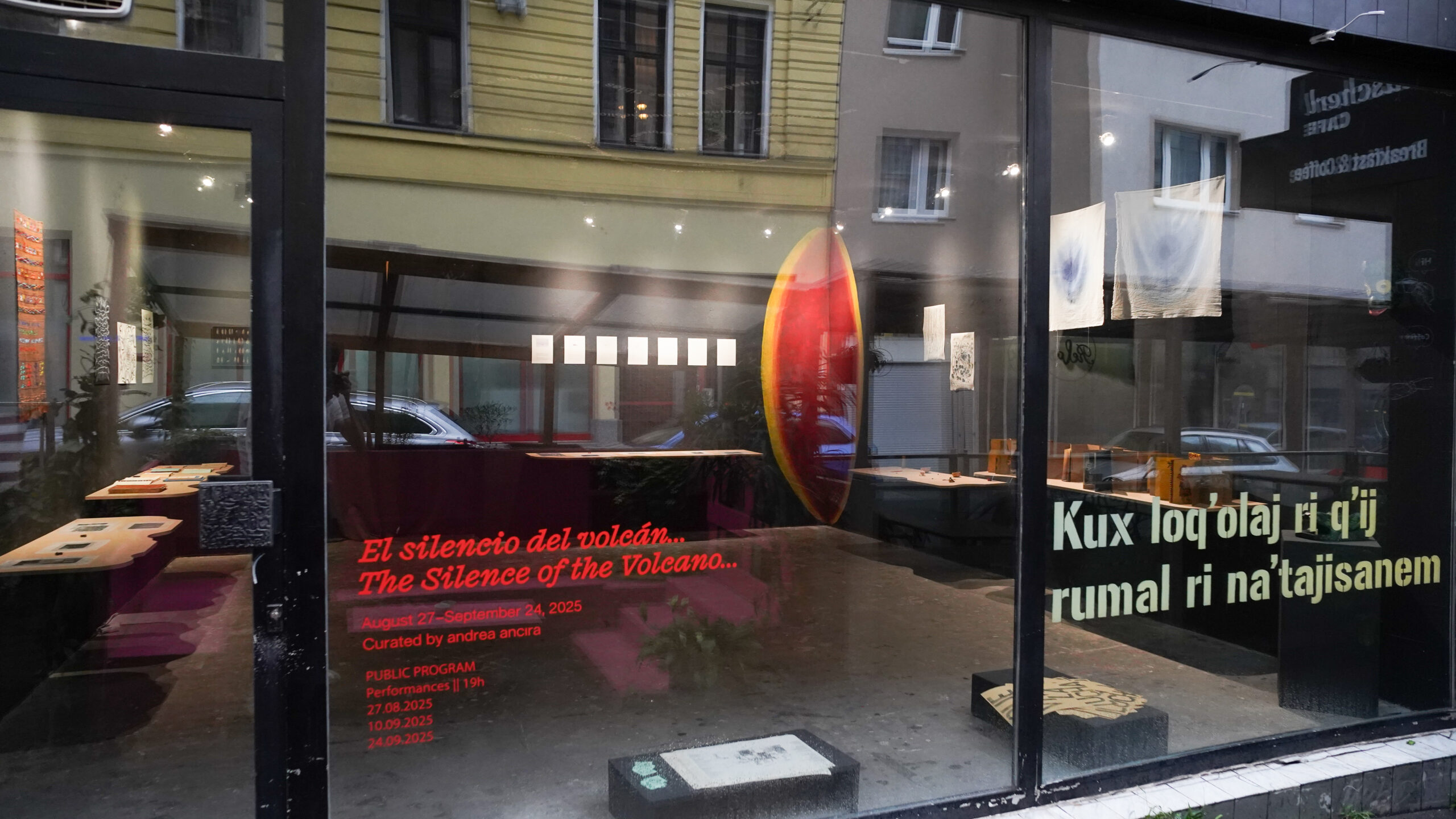
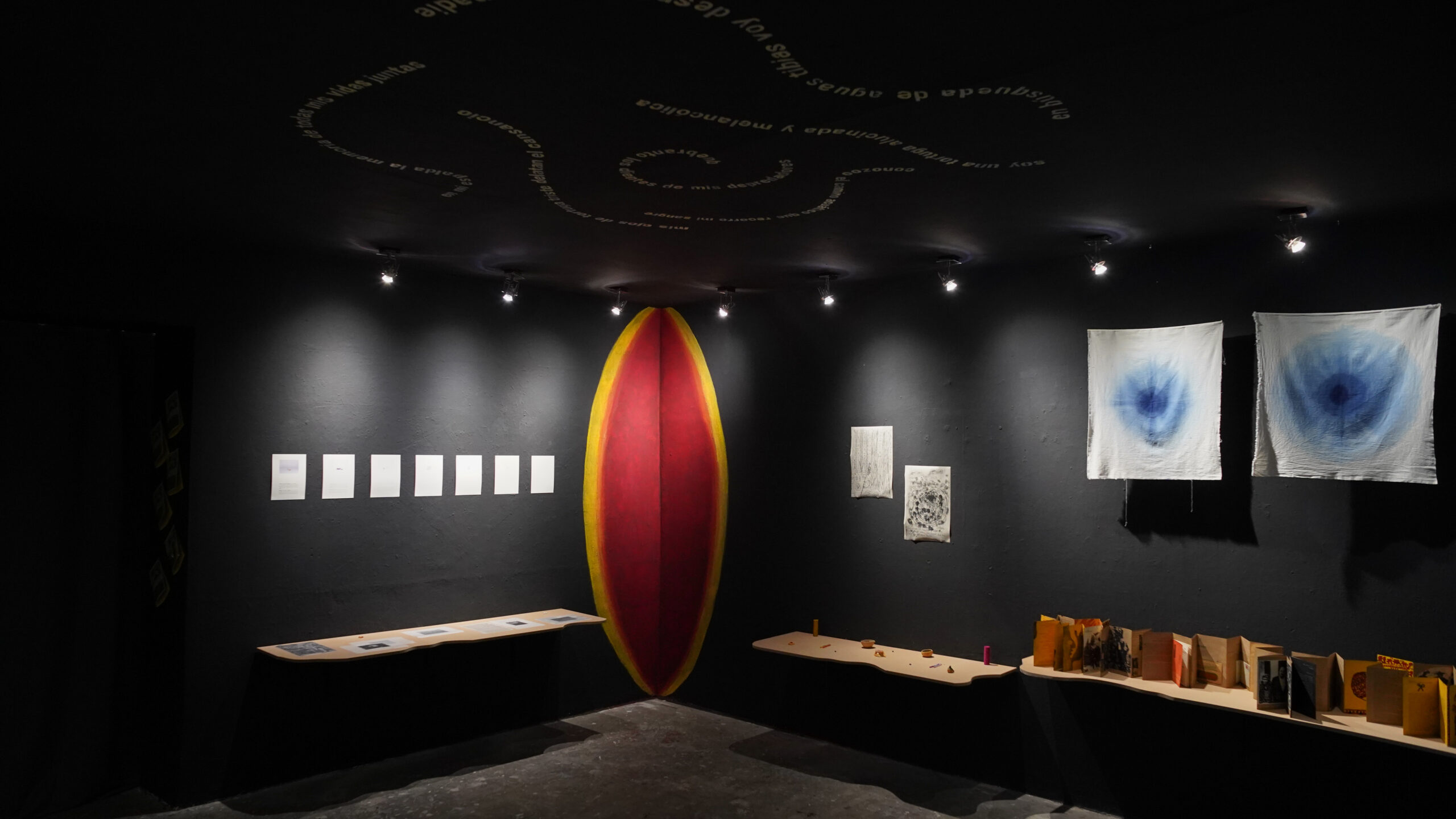
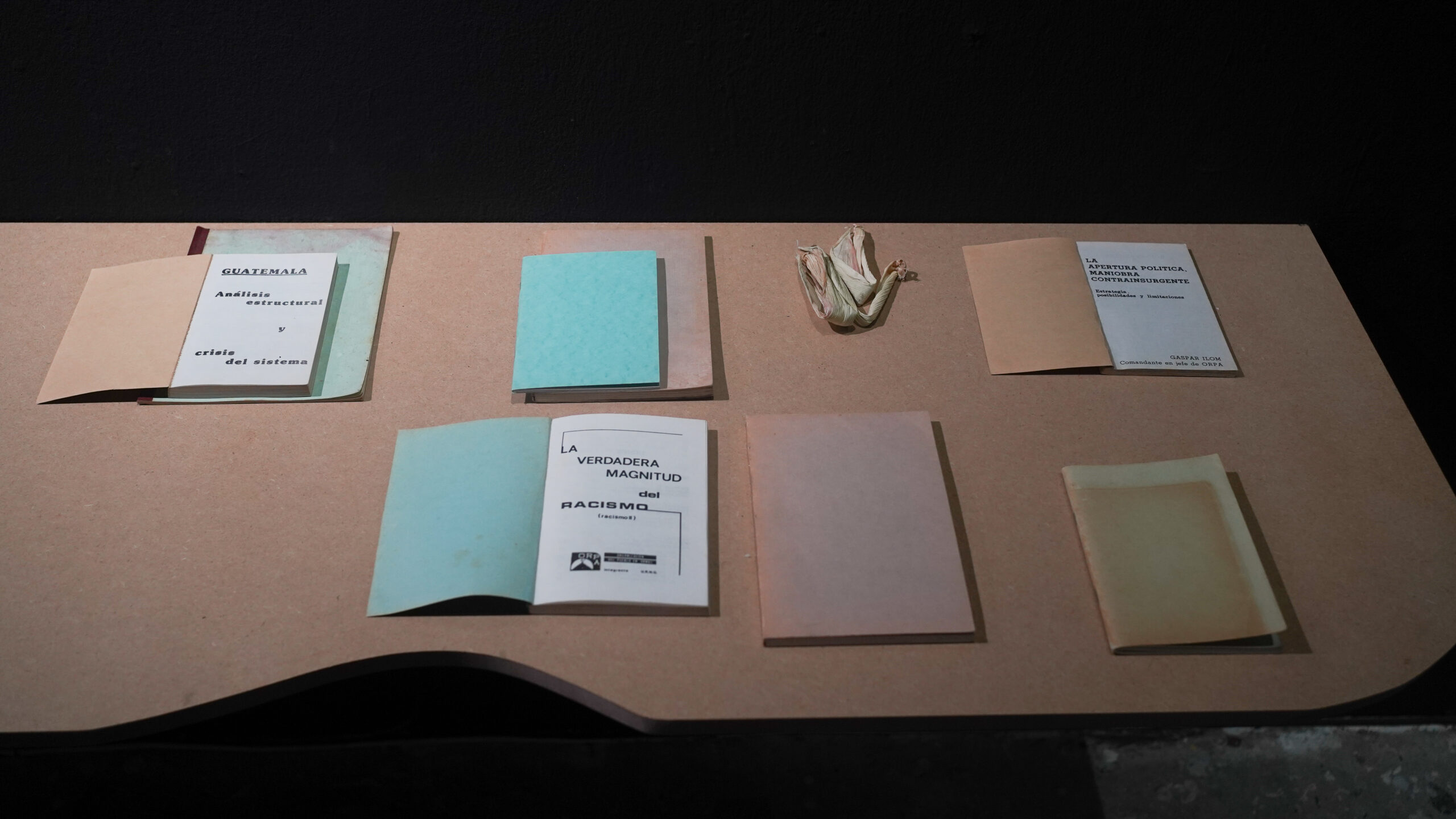
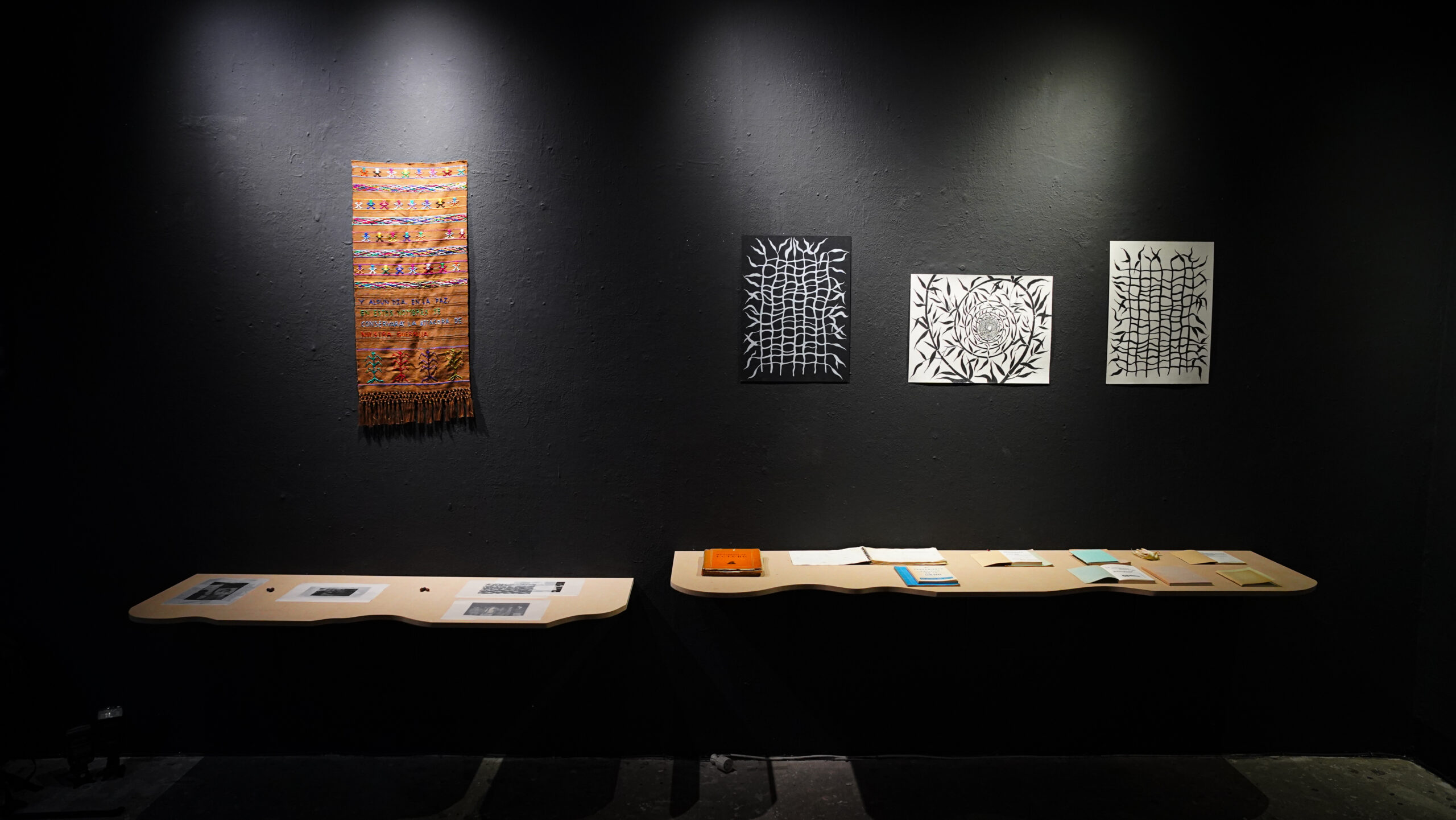
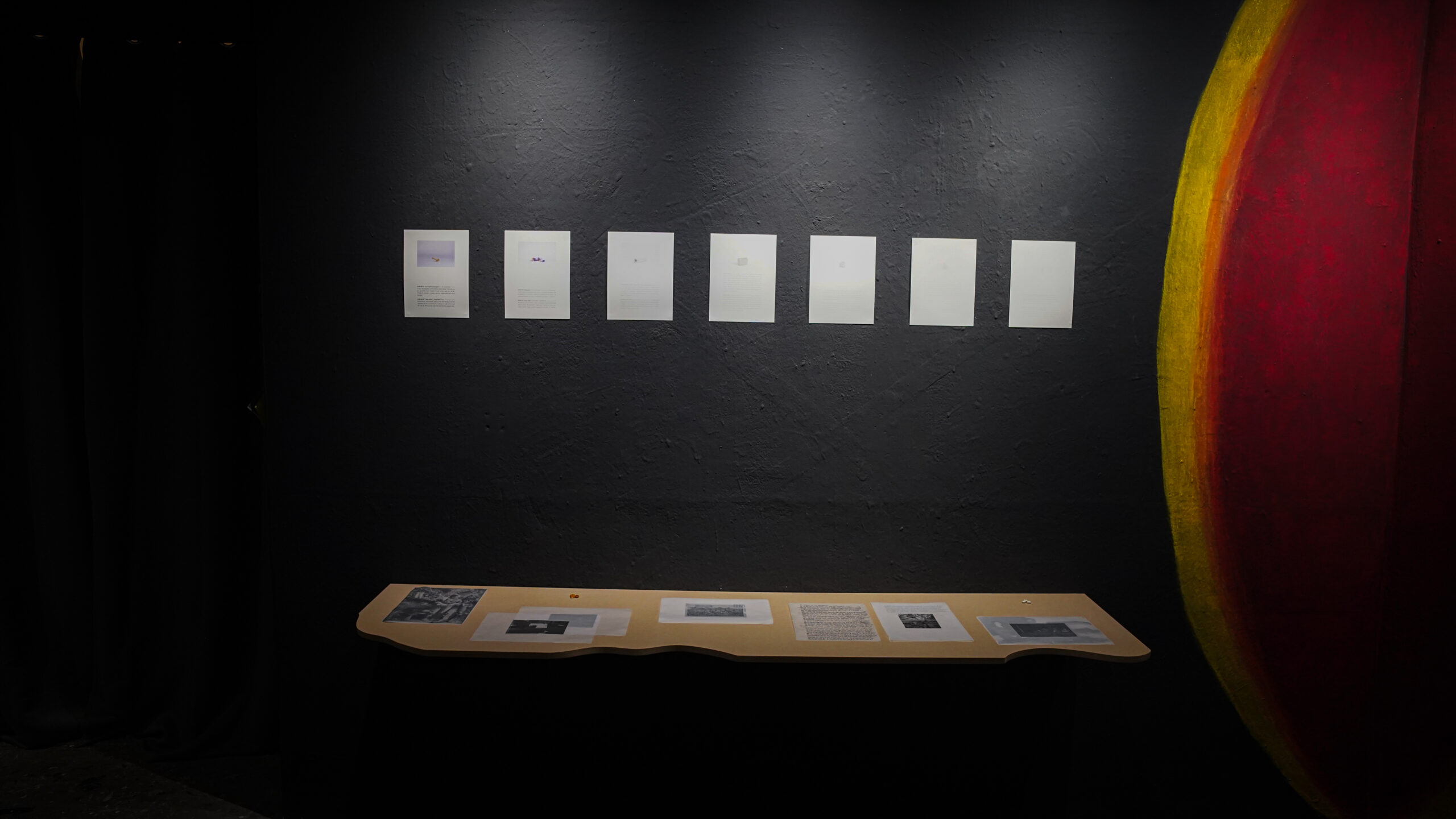
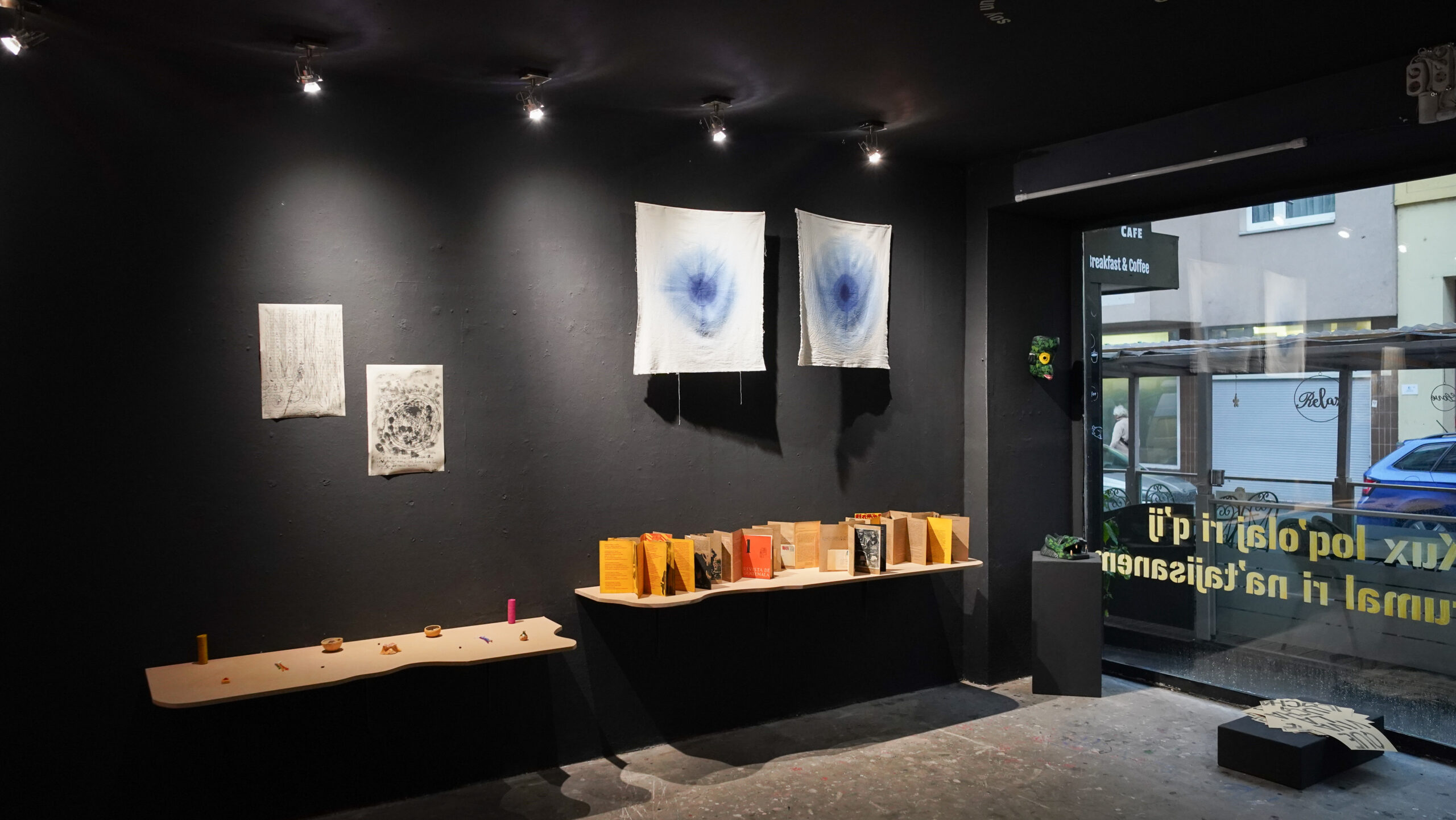
The exhibition took place at Improper Walls, a one-room artist-run space in Vienna’s 15th district. The space was conceived as an attempt to imagine what it might mean to inhabit the interior of a volcano—understood as a site of resistance that simmers and exert pressure from within—and to approach this as an act of “rebellious mourning”. Rather than framing grief as private or oriented towards closure, Cindy Milstein’s notion points to mourning as a collective and insurgent practice—one that holds pain and loss while opening up to forms of protest, care and solidarity that unsettle narratives imposed from above, which render certain lives ungrievable or unworthy of liveable conditions.[32] The walls were painted black, and the works were installed across both walls and ceiling. Six undulating table-shelves beneath them held materials from the archive, including photographs, publications, coffee beans, corn leaves, copal and myrrh incense and candles, as well as the leporello book in which Ana’s text was originally published by Taller de Leñateros.
By generating a set of spatial relation shaped by clandestine memories and affects, Ana’s text opens up onto a form of memory that embraces what remains unreadable or foreclosed in dominant accounts of Guatemalan history. In contrast to what Svetlana Boym describes as “restorative memory”—which seeks to reconstruct the past as a coherent and stable narrative—the opacity of Ana’s writing aligns more closely with a “reflective” mode of memory, one that dwells in fragmentation, ambiguity and the unresolved.[33] Rather than stitching the past into a single, orderly account, this opacity offers a way of mapping memory that allows for the coexistence and entanglement of multiple, overlapping stories.
From this starting point, I invited Esvin Alarcón Lam, Edizon Cumes, Marilyn Boror Bor, Edgar Calel, Jeff Cán Xicay, Rosa Chávez Tijax, Regina José Galindo, B’alam Waykan García, Mena Guerrero and Gabriel Rodríguez Pellecer to engage with Ana’s text from real, fictional or imaginary autobiographical perspectives. These artists’ practice approach the politics of memory through what Kency Cornejo describes as “decolonial aesthetics”—understood as “an anticolonial reconfiguration of visuality, art, and its principles from the perspective of those whom colonial logics have placed outside the frameworks of Western art histories, theories, and practices.”[34] Their work is grounded in ways of seeing, feeling, thinking and creating that emerge from embodied experiences of erasure, subjugation and colonisation, and affirms these situated practices as valid forms of knowledge and world-making. In this sense, their imaginative engagements with the body, matter, time and space mobilise conversations that centre queer, feminist, Afro-descendant and Indigenous perspectives and forms of autonomy in the face of Guatemala’s ongoing histories of erasure, femicide, criminalisation, colonial and anti-LGBTQ+ violence. Rather than merely representing suffering, their practices interrupt, expose and challenge dominant narratives, offering counter-narratives and alternative ways of seeing—and in doing so, positioning themselves as active agents within broader struggles for liberation.
Over the course of a year of sustained conversations, Ana’s text became a shared ground for relation, friction and political imagination. Each rehearsal of memory contributed to a collective process of fabulation, documentation, co-construction and poetic negotiation of situated narratives shaped by past and ongoing violence in Guatemala. Through the entanglement of experiences, stories and memories, each artist walked backwards in their own way with—and within—“The Names of the Camps”. What emerged through these encounters was a set of recurring gestures—ways of approaching memory through naming, inscription, relation and embodiment. Ana’s camps began to appear less as fixed sites and more as unstable constellations of experience, in which names do not designate location but trace encounters and naming becomes a situated and contingent act rather than a neutral act of designation. Several artists engaged this instability by working with inscription, language and classification as modalities in which memory is both produced and contested.
Maya Kaqchikel artist and weaver Jeff Cán Xicay uses the backstrap loom as a communal, political, and epistemic tool. Drawing from knowledge transmitted through the women in his family, in Transcripción de la memoria (2025), Cán Xicay inscribed Ana’s words into the warp and weft of a huipil, activating the garment’s role as a carrier of histories, communal affiliations and personal narratives. The phrase “Someday, in peace, these names will preserve the logbook of our guerrilla” threads the archive into textile form, situating remembrance within intergenerational practices that sustain Indigenous presence. In a context marked by ongoing (settler-)state violence, the denial of genocide and persistent impunity, this gesture affirms memory as a sustaining force of Indigenous struggle in Guatemala, one that both precedes and exceeds the war in which Ana took part.
Also working through the politics of inscription, Marilyn Boror Bor approaches language as a medium in which memory is both produced and foreclosed, shaped by the intergenerational effects of anti-Indigenous violence. In The Dictionary of Forgotten Objects (2016–25), she gathers everyday words and objects from her community, many of them pushed towards disappearance through colonial and capitalist processes. Marked by experiences of self-censorship, assimilation and linguistic rupture—including her parents’ decision not to teach her Kaqchikel to shield her from racism—her practice explores language both as a terrain of loss and recovery. By repurposing a colonial-modern classificatory tool such as the dictionary, she conjures the potential worlds that the systematic erasure of Indigenous languages enacted by the nation-state renders precarious. In doing so, she exposes how systems of classification participate in the erasure of Indigenous epistemologies while simultaneously opening up a space for their rearticulation. Rather than a nostalgic gesture, this work rehearses memory as an ongoing political and aesthetic practice, deploying language itself to reclaim the present and imagine otherwise.
Shifting from textile and linguistic forms of inscription to scientific regimes of naming, Esvin Alarcón Lam responded to Ana’s text as a document in which acts of naming contain their own logics of ordering, extraction and control. From this point of departure, he extends questions of identity and diaspora through his Chinese ancestry and family migration history into a queer re-reading of systems that organise and represent the world. Across Imaginary Seeds (2023), Living Micrography (2024), Living Micrography (Negative) (2024), Echo of Silence (2024) and Logo of the United Fruit Company Experimental Center (1925–1971) (2025), botanical and scientific imagery function as regimes of representation through which life is catalogued and administered. Taking Lancetilla—the largest tropical botanical garden in Central America, established by the United Fruit Company—as a point of departure, these works revisit scientific imaginaries that underpinned plantation economies, in which plants were catalogued within agro-industrial systems of control. Here, the language of experimentation becomes inseparable from histories of dispossession and the violent reordering of life in Guatemala. Alarcón Lam reworks these visual systems to expose their fragility, and in doing so makes room to indeterminate forms of legibility.
Ana’s naming of the camps not only displaces cartographic logics but also reconfigures the relation between memory and territory. Many of the names—El Quetzal, El Fantasma, La Culebra—do not describe location but signal encounters with beings and forces that exceed the human. Lands and memory appear not as stable grounds but as relational fields shaped by movement and coexistence.
Maya Kaqchikel artist and poet Edgar Calel engaged our conversations through dreaming as a mode of perception and relation. In Rachik nu Kaslemal (The Dream of My Life, 2025) and Achiq’ Chua Nimach’e Chixot Iximulew (Great Dream of Chixot, Land of Maize, 2025), drawing becomes both record and conduit for oneiric experiences that remain open and in movement. Rather than representing dreams, these lines hold their vibration, articulating what he refers to as Naoj, a form of knowledge grounded in communal life that resists translation into Western epistemologies. Read alongside Ana’s text, Calel’s works suggest memory as something that is not fixed nor linear and emerges through ongoing relations between body, land and ancestral presence.
Edizon Cumes, Maya Kaqchikel from Semët Ab’äj in the Lake Atitlán basin, similarly situates memory within relational practices grounded in the land. In Leer las nubes (Reading the Clouds, 2024), a dyed cotton textile suspended from the ceiling, he translates the everyday practice of peasants reading the sky and soil to anticipate social and environmental events. As recalled through his grandmother’s memory, such forms of attunement were crucial during the counterinsurgency, enabling movement and survival under conditions of violence. Cumes’s practice foregrounds land as a living system of knowledge production, which resonates with Ana’s practice of naming: both refuse external systems of orientation and instead emerge from situated, relational ways of inhabiting territory.
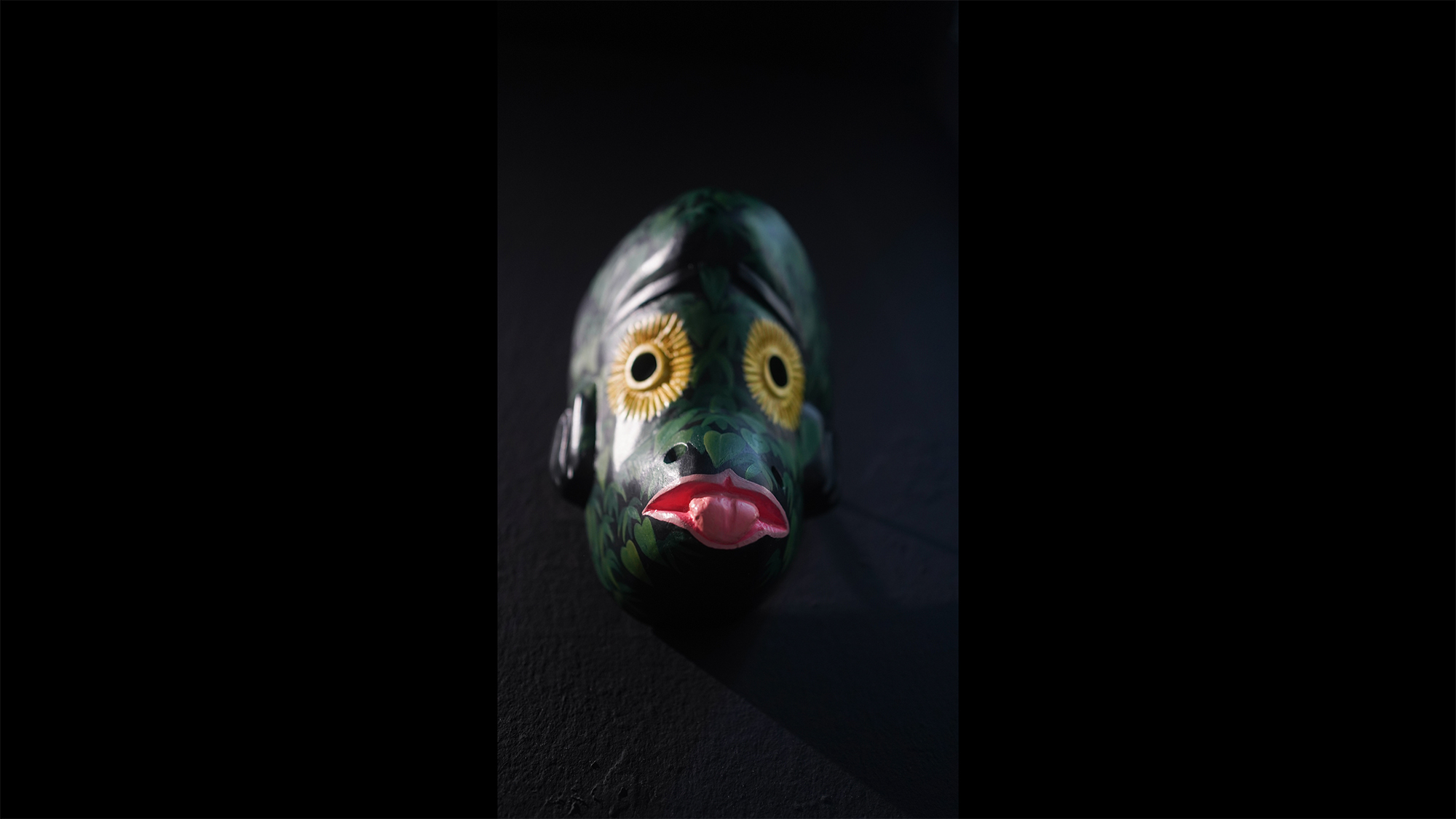
B’alam Waykan García extends this relational field through figures that inhabit the threshold between human and non-human. In Characotel (2024), carved masks evoke beings from Kaqchikel oral tradition capable of transforming into animals and moving through liminal nocturnal spaces. These figures are not only cosmological but also echo strategies of survival during the war, during which concealment and transformation were necessary conditions for existence. In dialogue with Ana’s camps—where dwellings are often marked through emotions, non-human presences or spectral traces—García’s work frames memory as a practice of moving across unstable boundaries.
Many of Ana’s camp names do not refer to places or events but to shared bodily conditions: exhaustion, fear, presence, anticipation. Several artists rehearsed memory with gestures and interventions that operated as conditions for encountering the past’s lingering presence. Mena Guerrero’s Cráter, Portal, Amuleto (2025), for instance, evolved into a spatial and affective device composed of drawings, ceramics and a large-scale wall painting that framed the exhibition space. Conceived as both portal and amulet, the work was activated during the opening through a performance in which Guerrero “opened” the portal, situating the installation as a threshold rather than a fixed object. Drawing on what she describes as “affective paraphernalia”—everyday materials and sensations that mediate relations between bodies, memories and environments—the work created a sensorial field in which memory, loss and presence converged. Rather than stabilising meaning, it allowed memory to circulate as an experience of encounter and transformation.
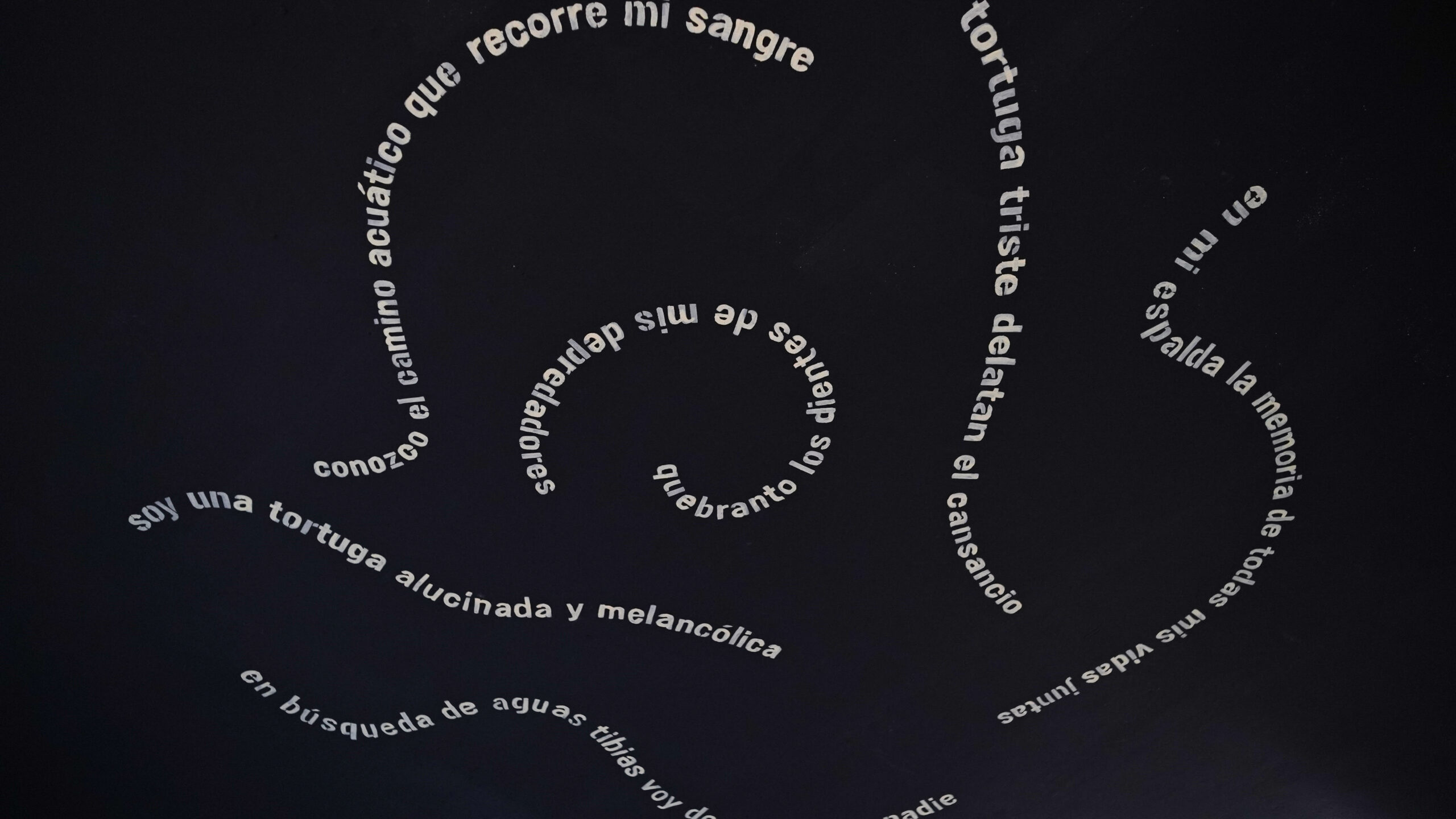
Rosa Chávez Tijax, a Maya K’iche’ and Kaqchikel poet, educator and activist, approaches memory through language as a spatial and temporal intervention grounded in feminist and decolonial struggles. In Kuxloq’olaj riq’ij rumal rina’tajisanem (Memory Makes Time Sacred, 2025), a phrase in Kaqchikel painted on a street-facing vitrine addressed both exterior and interior audiences, situating memory as a force that reorganises time while insisting on Indigenous language in public space. This concern extended into Mis ojos de tortuga cansada (My Tired Turtle Eyes, 2025), in which a poem stretched across the ceiling, reorienting perception so that visitors moved underneath language. Through the figure of the turtle—slow, vulnerable and persistent—the work evokes temporalities of survival and exhaustion shaped by ongoing violences against Indigenous peoples and women, while sustaining memory as both a poetic and embodied practice.
Regina José Galindo, in collaboration with Juan Esteban Calderón, engages the visual grammar of protest in Guatemala City, where empapelado—the widespread posting of printed matter in public space—functions as a key form of political intervention in the “postwar” context. The series of posters Que viva la lucha (Long Live Lucha, 2020), produced during the pandemic, weaves together friendship and political urgency through its reference to journalist and activist Lucía Escobar (“Lucha”), whose work in independent media has developed under increasing conditions of censorship, criminalisation and exile. Circulating between the street and the exhibition space, the posters situate memory within an ongoing struggle over visibility and speech, where to appear or name publicly is already to contest erasure.
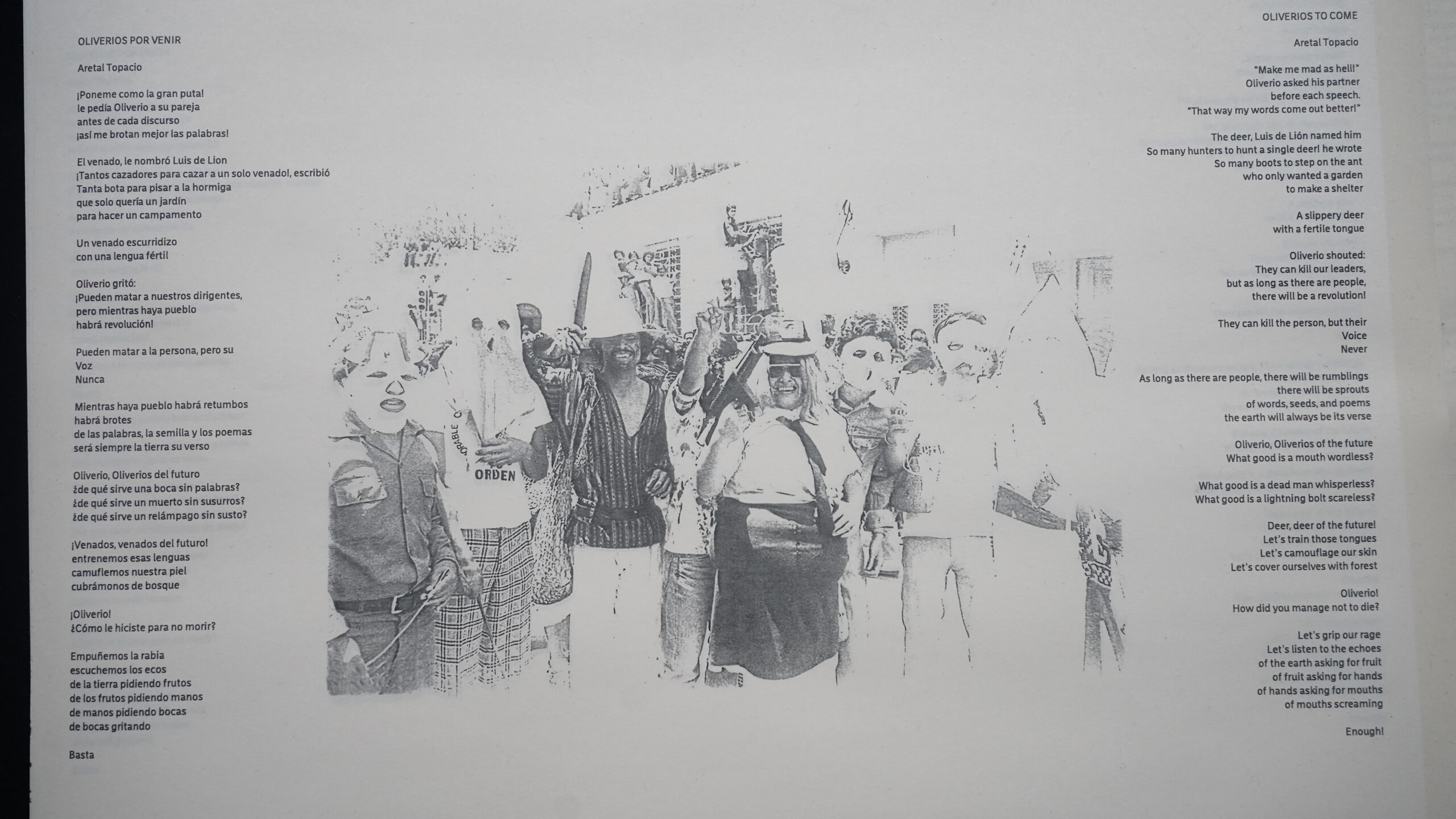
Ana’s naming of the camps emerged from lived experience that produces a narrative field across which memory is shaped through partial and at times unverifiable accounts. The camps are not only places but stories that circulate between testimony, imagination and collective narration. Gabriel Rodríguez Pellecer engaged these conditions of the text in Future Oliverios (From the Aretal Topacio Archive) (2024), a series of prints reproducing a page from a set of poems attributed to the enigmatic figure Aretal Topacio. The name—believed to be a pseudonym—was uncovered by the artist in documents reportedly found buried within an old house, framing the archive itself as both discovery and construction. Accompanied by a note describing the poems as reimagined memories of relatives, martyrs and writers, voiced through fictional characters and shifting identities, the work deliberately unsettles the boundaries between testimony and invention. Rather than reconstructing a coherent past, the Aretal Topacio archive proliferates voices, temporalities and narrative positions that complicate historical legibility and as the artist describes, that evoke “eras never lived”. In resonance with Ana’s camps, Rodríguez Pellecer’s work treats fiction not as a departure from truth but as a strategy for inhabiting memory otherwise.
In these collective rehearsals of memory, shared and divergent stories met, overlapped and at times strained against each other. By walking backwards within the archive, these encounters challenged dominant rhetorics that seek to neutralise conflicting narratives about the civil war and its aftermath in Guatemala, rather than exposing the structural conditions that sustain social violence and war.
Mihai underlines the epistemic and political significance of artistic practices in disrupting entrenched and dominant tropes of collective memory. She argues that through their formal and aesthetic qualities, certain artistic gestures can loosen the knots of memory and open up interpretative space for more complex accounts of historical agency.[35] These “decolonial gestures”, render visible the layered and intermeshed forms of subjugation that shape social and historical experience: “they contest and reject the authority of foreign powers, the criollo state, heteronormative regimes, and both ancestral and colonial forms of patriarchy.” [36] In doing so, they assert existence in the face of erasure and work to decentre colonial structures and dominant frameworks of knowledge, history and memory.
Through affect, storytelling and relation, these encounters have created pathways towards inhabiting, however imperfectly and without claims to mastery, the murky terrain of systemic violence. They also bring into view the differences and tensions that traverse practices of resistance, which are often framed as homogeneous or grounded in an imagined equality. Walking backwards within my family archive, in relation with others, thus emerges as both a fabulative gesture and a method that enables the disentangling of the war and its aftermath from a distinct embodied positionality and relational horizon. At the same time, it serves as a means of confronting the internalised attachments to dominant—comfortable and reductive—narratives of the past.
Against the grain of conventional historiography and hegemonic modes of memory-making, archival work here became a form of imperfect encounter—one in which grief, rage and memory are held in common, without flattening the different positions from which violence was inflicted or experienced. To walk backwards is to acknowledge that while neither linear nor conventionally “productive”, memory work can nonetheless generate openings towards possible futures.
Footnotes
- The term “postwar” appears in quotation marks to underline its problematic usage. While the civil wars and counterinsurgency violence of the 1960s until the 1990s officially came to an end, as in much of Central America, Guatemala has since experienced sustained and, in some cases, heightened levels of violence. This continuity challenges the idea of a clear temporal break implied by the term “postwar,” just like the term “postcolonial” fails to capture the persistence of colonial structures in contemporary Latin America. ↑
- Hijos e Hijas por la Identidad y la Justicia contra el Olvido y el Silencio (HIJOS Guatemala) is an organisation created in 1999 by sons and daughters of people who were forcibly “disappeared” or displaced by military dictatorships in Guatemala. This group emerged out of a growing concern to denounce the impunity of institutional justice and the limits of the peace accords signed in 1996 to end the war. Their interventions in public space are characterised by their appeal to the power of creativity, joy and collectivity used as tools for protest. ↑
- Casaús Arzú, Marta Elena. Guatemala: Linaje y racismo. Guatemala City: F&G Editores. 2007; Martínez Peláez, Severo. La patria del criollo. Guatemala City: Ediciones en Marcha. 1994; Smith, Carlo. Ed. Guatemalan Indians and the State, 1540–1988. Houston: University of Texas Press. 1992; Arenas Bianchi, Clara, Hale, Charles R. and Palma Murga, Gustavo. Eds. Racismo en Guatemala? Abriendo debate sobre un tema tabú. Guatemala City: Avancso. 1999. ↑
- The Commission for Historical Clarification (CEH) report published in 1999 estimates that the State and its repressive apparatuses—the Army, Civil Self-Defence Patrols, military commissioners, other state security forces and death squads—were responsible for 93% of the recorded violations, while the guerrilla forces accounted for 3%. ↑
- Analogous to the “two-demons theory” in Argentina, this interpretation of political violence suggests that in the Guatemalan highlands there was no popular organisation, and that the participation of Maya groups in the revolutionary struggle was both forced and transitory. Stoll, David. Between Two Armies in the Ixil Towns of Guatemala. New York: Columbia University Press.1993. ↑
- Sanford, Victoria. “Between Rigoberta Menchú and la violencia: deconstructing David Stoll’s history of Guatemala”. Latin American Perspectives. vol. 26. no. 6. 1999. https://doi.org/10.1177/0094582X99026006; Arias, Arturo. “¿Hacia dónde nos dirigimos desde aquí? Consecuencias teóricas de la actitud de Stoll para los estudios culturales centroamericanos”. Istmo. Revista virtual de estudios literarios y culturales centroamericanos. 2011. Available at http://istmo.denison.edu/n03/articulos/consec.html (accessed 202026-05-07); Palencia, Sergio. “¿Entre dos fuegos? Neutralización de la lucha ixil en David Stoll y la cuestión de la memoria revolucionaria en Guatemala (1970–1983)”. Albedrío. vol. 1. no. 2. 2011; Drouin, Marc. “‘The realities of power’: David Stoll and the story of the 1982 Guatemalan genocide”. Journal of Genocide Research. vol. 18. nos. 2–3. 2016. pp. 305–22. https://doi.org/10.1080/14623528.2016.1186956. ↑
- The Memorial for Concord comprises four projects: a Virtual Memory Platform, active since 2014, which includes archives, databases, testimonies and documents from the war; a Memory Mapping Project, which seeks to locate existing sites of memory throughout Guatemala; Intergenerational Dialogues and Memory Gatherings, which are held on an ongoing basis; and finally, the planned construction of a Cultural Centre for Diversity, for which the architectural design has been completed but not yet realised. See https://memorialparalaconcordia.org (accessed 2026-05-07). ↑
- Traverso, Enzo. Melancolía de Izquierda: Marxismo, historia y memoria. Mexico City: Fondo de Cultura Económica. 2018. p. 38. ↑
- Villa Avendaño, Anelí. “Memorias de la guerra contrainsurgente en Guatemala: hacia una ruptura de la Victimización”. Entre Diversidades. Revista de Ciencias Sociales y Humanidades. vol. 1. no. 6. 2016. pp. 19–47. DOI:10.31644/ED.6.2016.a01. ↑
- Mihaela Mihai invites us to consider the complexities of complicity in systemic violence, showing how it is mediated by ideology, power structures, institutions, intersectional positionality and forms of sociality that normalise wrongdoing. She defines unreflective complicity as participation in such systems that occurs through routinised, habitual practices, often without conscious awareness or critical reflection. These patterns of behaviour sustain structural violence by turning it into a resilient “ecology”. Mihai, Mihaela. Political Memory and the Aesthetics of Care: The Art of Complicity and Resistance. Redwood City, CA: Stanford University Press. 2022. pp. 4–6. ↑
- “De vez en cuando camino al revés: es mi modo de recordar. Si caminara sólo hacia delante, te podría contar cómo es el olvido.” Ak’abal, Humberto. Tejedor de palabras: Ajkem tzi. Guatemala City: Fundación Carlos F. Novella. 1996. ↑
- This principle has informed contemporary artistic practices such as Edgar Calel’s K’obomanik ch’ab’el (Offering with Words), a ritual action presented in KAUKA, Asamblea de mundos posibles (2025). The performance involved Calel carrying flowers and incense while tracing circular trajectories forwards and backwards, disrupting linear narratives of progress in favor of a relational understanding of time, continuity, and the cyclical dimensions of life. ↑
- Marie Bardet argues that gestures are not merely bodily movements but relational, world-making acts that shape knowledge, social relations and political possibilities. Cultivating gestures involves attending to these embodied practices and how habitual movements co-produce social and relational worlds. Bardet, Marie. “Hacer mundos con gestos” in André Haudricourt, El cultivo de los gestos: entre plantas, animales y humanos, Buenos Aires: Cactus. 2019. pp. 23–28. ↑
- Haraway, Donna J. Staying with the Trouble. Experimental Futures. Durham, NC: Duke University Press, 2016. p. 31. ↑
- The terms Indigenous, ladina and mestiza are used here to denote political rather than strictly ethnic identities, emphasising their historical and social construction within Guatemala’s colonial and postcolonial power relations. ↑
- Auna D’Souza describes imperfect solidarities as forms of alliance and collective struggle that acknowledge difference, tension, and incompleteness as inherent to political and ethical relations. This concept provides a generative framework for thinking about complex alliances across asymmetrical positions, like the alliances that took place in the resistance during the Civil War in Guatemala. D’Souza, Aruna. Imperfect Solidarities. Berlin: Floating Opera Press. 2024. pp. 29–30. ↑
- I understand my ladina-mestiza position not as a biological or cultural identity, but as a colonial formation that I inhabit and interrogate from within. Yolanda Aguilar proposes the term “ladina-mestiza” as a political category that recognises both the genealogy of oppressive ladinidad and the emancipatory potential of a mestiza identity. It provides a framework to critically confront the racist past and the anti-racist present of ladina women, prompting reflection on privileges, internalised racism and aspirations towards whiteness. As such, it functions as a political identity that can guide strategies and practices for anti-racist self-awareness and social transformation. Aguilar Urizar, Yolanda. Femestizajes. Cuerpos y sexualidades racializadas de ladinas-mestizas. Guatemala City: F&G Editores. 2019. ↑
- Dufourmantelle, Anne. En caso de amor. Psicopatología de la vida amorosa. Buenos Aires: Nocturna Editora. 2022. p. 40. ↑
- Anderson, Laurie. “Walking and Falling”. Big Science. 1982. ↑
- Naas, Michael. “When it comes to mourning”. In Jacques Derrida: Key Concepts. Ed. Claire Colebrook. London: Routledge, 2014.p. 115. ↑
- Hartman, Saidiya V. “The Time of Slavery”. The South Atlantic Quarterly. vol. 101. no. 4. 2002. pp. 757–77. https://doi.org/10.1215/00382876-101-4-757. ↑
- Azoulay, Ariella Aïsha. Potential History: Unlearning Imperialism. London: Verso Books. 2019. p. 123. ↑
- This is a word that some peoples and communities in Abya Yala use to point out that, while denouncing and fighting against systems of oppression, their resistance foregrounds alternative ways of living beyond the state, political parties and representative democracy to reinvent life on a day-to-day basis. ↑
- ORPA (Organización del Pueblo en Armas) was one of the four main guerrilla organisations active during Guatemala’s counterinsurgent war. Founded in the late 1970s, it emerged from earlier revolutionary movements and focused on mobilising Indigenous communities in the western highlands. ORPA aimed to dismantle systemic racism and poverty, playing a key role in the broader guerrilla coalition, the URNG (Unidad Revolucionaria Nacional Guatemalteca). ↑
- Tierra Arrasada was a counterinsurgency campaign carried out in the 1980s by the Guatemalan army, in coordination with the national police, paramilitary death squads and with the complicity of the country’s elites, targeting so-called “internal enemies”. The 1983 Manual of Counter-Subversive War defined these as individuals or groups—communist or not—who sought to challenge the established order; in practice, this included trade unionists, students, peasants and Mayan communities. Martínez Salazar, Egla. Global Coloniality of Power in Guatemala: Racism, Genocide, and Citizenship. Lanham, MD: Lexington Books, 2012. p. 103. ↑
- Sandra Patricia Calderón Martínez was an agricultural engineer and primary school teacher. After serving in the Urban Front of the Organisation of the People in Arms (ORPA) she joined the Javier Tambriz Guerrilla Front where she was promoted to Captain. She was killed in Mexico City after dropping off her two-year-old son at daycare on 7 September 1993. ↑
- Azoulay, Ariella Aïsha. “Potential History: Thinking Through Violence”. Critical Inquiry. vol. 39. no. 3. 2013. p. 565. https://doi.org/10.1086/670045. ↑
- Santaolalla, Ximena. A veces despierto temblando. London: Random House. 2022. ↑
- Pollak, Michael. Memoria, olvido, silencio. Buenos Aires: Ediciones al Margen. 2006. p. 18. ↑
- Glissant, Edouard. “Transparency and Opacity”. In Poetics of Relation. Ann Arbor: University of Michigan Press, 1997. pp. 111–20. ↑
- Scott, James. El arte de los dominados y de la resistencia. Mexico City: Era. 2000. p. 225. ↑
- Cindy Milstein, “Prologue-Cracks in the Wall”. In Rebellious Mourning: The Collective Work of Grief. Ed. Cindy Milstein (Chico, CA: AK Press, 2017) 10. ↑
- Boym, Svetlana. The Future of Nostalgia. New York: Basic Books. 2001. pp. 49–55. ↑
- Cornejo, Kency. Visual Disobedience: Art and Decoloniality in Central America. Durham, NC: Duke University Press. 2024. p. 10. ↑
- Mihai, Political Memory and the Aesthetics of Care, pp. 8–9. ↑
- Gomez Barris, Macarena. The Extractive Zone: Social Ecologies and Decolonial Perspectives. Durham, NC: Duke University Press. 2017. pp. 110–15. ↑